About Me

- Lars Gyllenhaal
- Author, film researcher and member of the Swedish Military History Commission.
Monday, October 25, 2010
Forced Landings in Sweden
If you have the slightest interest in downed Luftwaffe, RAF and USAAF aircraft in Sweden, check out the Swedish FORCED LANDING COLLECTION. You can see photos of those individual aircraft that are white.

Wednesday, October 20, 2010
"Wiking" and Rutger Hauer
"Frostbite", the Swedish movie featured in my previous post, was not the first film featuring a soldier of the "Wiking" division. It turns out there is an old Dutch movie with a bit of "Wiking", starring Rutger Hauer.
Thanks to a tip from the Axis History Forum I am now aware of "Soldier of Orange"/"Survival Run" (originally "Soldaat van Oranje"), a 1977 Dutch film starring one of my favourite actors, Rutger Hauer. Wikipedia has an extensive description of the film.
In this trailer you get a glimpse of some Waffen-SS soldiers (including one in a SS Panzer uniform):
In the following scene you can see more of the same Dutch SS Panzer ace including his "Wiking´" cuff title:
I wonder, as I am sure someone from the Netherlands will read this, how much does the film show from the Eastern Front? Does it mention the division and give any idea of it? What about that Knight´s Cross, is there an explanation for it in the movie?
The movie is based on the bestselling book with the same title written by Erik Hazelhoff Roelfzema, who during WWII was a RAF-pilot and spy. The book/film is being turned into a musical featuring life-size aircraft and vehicles. Does anyone know if there is some "Wiking" in the musical? That would be a definitive first...
Hm, I will have to find this one on DVD somewhere...
Thursday, October 14, 2010
Waffen-SS Viking Vampire
In the Waffen-SS chapter of Swedes at War my co-author and I mention the only movie (so far) about Swedes in the SS: "Frostbite". Here I can describe the movie a bit more.
"Frostbite" (Swedish title: "Frostbiten") was released in 2006 and was a pioneering work in many respects. The first Swedish vampire movie; the first Swedish film to include a massive amount of modern special effects and the first movie featuring a Swedish soldier of the Waffen-SS.
 Nordic and German soldiers of the SS-division "Wiking" in the winter battle scene from the vampire movie "Frostbite". The soldier to the far left is clutching a Panzerfaust anti-tank weapon. Photo courtesy of Solid Entertainment.
Like the Waffen-SS soldier on the cover of Swedes at War, the main character of "Frostbite" belongs to the 5th SS Division "Wiking". "Frostbite" was not, however, the first movie with a horror theme to be shot up here in Swedish Lapland, but the second. It is rather ironic that our first ever horror movie focused on the midnight sun, whereas the plot of "Frostbite" turned around the polar night phenomenon.
Selecting the most relevant genre for "Frostbite" is difficult. Some have suggested vampire comedy. I am not able to suggest anything better using just two words, but with more words I´d say it starts out extremely seriously as a movie about the WWII Eastern Front, with vampires sneaking into the story in a rather credible way, and then the movie transforms. There is zero comedy element in the first segment, the ten-minute long part in Ukraine 1944.
The main character (at least while in Ukraine) is a Swedish SS-volunteer, Gerhard Beckert. He holds the rank of a Unterscharführer, a kind of junior sergeant. Together with a Swedish-speaking Finnish comrade and a few German soldiers he is cut off from his company. They belong to "Wiking", apparent also from their cuff titles.
 Among the insignia worn by the Swedish vampire-to-be one can notice a tank destruction badge (on the upper right arm) and cuff title (on the lower left arm) of the "Wiking" division. Photo courtesy of Solid Entertainment
The movie is actually very close to reality in two respects here. First, the name of the Swedish SS-volunteer is quite similar to that of an actual Swede in the SS. It signals German family. This is a realistic detail - several Swedes in the Waffen-SS had a German father or mother. Secondly, it is realistic to portray the Swede (Gerhard Beckert) as part of a multinational group. It was only in the "Nordland" division that Swedes were really concentrated so that a Schwedenzug, a Swedish platoon, could come about.
 "Wiking" soldier retreating with his Panzerfaust and MP 40 submachine gun. Photo courtesy of Solid Entertainment
Could it be that the man behind the script, Daniel Ojanlatva, and the director, Anders Banke, were well-versed in the reality of the Swedes in German uniform? I think so. The plot and main location of the story in northernmost Sweden are also explained by the fact that Ojanlatva comes from Kiruna, which like the town where the movie mainly was shot, Kalix, is located in the county of Norrbotten (Swedish Lapland), where yours truly also resides.
About the plot of "Frostbite" I will here only add that the SS-veteran Gerhard Beckert surfaces in present-day Kalix as a medical doctor and because of two careless colleagues at his hospital, Beckert's past as a SS-soldier infected by a Ukrainian vampire catches up with him. Alas, there is then only a brief flashback into his wartime past.
If you can accept the way that the movie changes from dead serious to comedy, and especially if you are into vampire movies, I do think you will want to see this one. By the way, it seems that the Swedish moviegoers generally had a problem with the switch from serious to comedy, but the Russian moviegoers did not. The movie was no big hit in Sweden but did really well in Russia. Presumably, the Russians were better at appreciating the Arctic and the Russian opening music, the classic 1940s song "Dark Night".
Watch the movie till the very end and you will see some rather funny credits.
Friday, October 08, 2010
Tarzan-Discoverer´s Mystery Division
A reader of Swedes at War in the United States, Mr. N. Faller, has enquired about a mysterious unit mentioned in our book, the volunteer division "Theodore Roosevelt". Mr. Faller is right in doubting the existence of this unit.
However, the reply is not simply that it never existed. Mr. Faller has kindly allowed me to make the full reply to his question public, as it may interest other American readers and also British and Swedish readers.
 The Swede behind the recruitment drive for the British-American division "Theodore Roosevelt", Ivar Thord Hallström, who in British service became Ivor Thord-Gray. Here he is in South Africa where he discovered the real-life Tarzan. PHOTO: The Research Archives, Umeå University Library
The volunteer division "Theodore Roosevelt" is only mentioned in one sentence in Swedes at War. Still, we should have added a footnote or endnote about it because it is a pretty unknown unit, to say the least.
The division is mentioned in our book in a CV for Ivar Thord Hallström who became Ivor Thord-Gray in conjunction with becoming a British officer in South Africa. In the United States Thord-Gray got the approval of then former president Roosevelt to start up the unit. He focused on recruiting Britons or ex-Brits in the US. By the time the project was stopped, in April 1917, 3,500 men har enlisted for the division. Roosevelt personally thanked Thord-Gray in a letter dated May 25, 1917, and said it was sad the project had to be aborted due to lack of support from President Woodrow Wilson.
As part of Thord-Gray´s work for the "Theodore Roosevelt" project he produced a manual entitled Tactics on Attack and Defence in Trench Warfare. You might possibly be able to find that book via some internet bookseller.
Speaking of World War One, it is not that difficult to prove how close we still are to that war. Close? Well, now in late 2010 there are still at least three WWI veterans alive. Or four if you like: Frank Buckles (US Army 1917-1919), Claude Choules (Royal Navy 1916-1956) and Florence Green (RAF 1918-1919). In addition theres is Mr. Jozef Kowalski of the Polish Army who began his service after the WWI armistice but before the Treaty of Versailles. Here is a nice master list about these veterans if you want to research them.
Why the hard feelings between Theodore Roosevelt and Woodrow Wilson? The most recent arcticle on this subject was the superb piece "War & Diplomacy" in Armchair General July 2010.
For more on Thord-Gray, not least his role in bringing about the Tarzan icon, see Joakim Langer´s book Mannen som hittade Tarzan ("The Man Who Found Tarzan").
BTW Swedes at War was recently used as a source in this Mexican history article, as Thord-Gray was there too, fighting as a soldier of fortune.
Thursday, October 07, 2010
One Tough King
It is not every day you get to see a cool and previously unpublished photograph of the King of Sweden. But in a new book written by a friend there is such a photo, with the king being instructed by Sweden´s most famous special operations veteran.
Taking into account that Allan Mann was a hand-to-hand combat expert our king (then crown prince) presumably learnt a thing or two about how to most effectively defend himself without weapons, and also with a knife and so on.
 From the left, Carl XVI Gustaf, King of Sweden, unidentified person and Allan Mann, veteran of the Soviet-Finnish Winter War, the battle of Narvik and several years of SOE missions. PHOTO: Sten Bråkenhielm
I had the privelege of meeting Allan Mann, who served as a volunteer in Finland in 1940 on the Salla Front and then in Norway, lastly on the Narvik front. After there earning admission into the Légion d'honneur (French Legion of Honour), he joined the British Special Operations Executive (SOE) and served as a SOE agent and eventually also uniformed operator. He thus returned to Norway during WWII many times, the last time by parachute. A summary of his exploits can be found in Swedes at War.
Since a few days ago there is a somewhat more complete chronicle of Allan Mann´s wartime experiences. The book´s title is De glömda agenterna, "The Forgotten Agents". The book´s author, Anders Johansson, earned well-deserved praise for his previous book, about the division of Norwegian "Police Troops" that was trained and organized in Sweden 1943-45. Here is the cover of Johansson´s new book:
 The cover of the brand new book "The Forgotten Agents" by Anders Johansson. So far only available in Swedish. Rather than showing agents on the cover the publisher chose to convey the occupation of Norway. Great cover IMHO.
"The Forgotten Agents" features not only Allan Mann but rather attempts to give an idea of all the not that few Swedes that served Norway as agents in one form or another. Still, Mann is a big part of the story, as is apparent from the back cover where a German-issued ID-card for Mann can be seen together with a photo of him in Norwegian uniform:
 On the back cover, one of Allan Mann´s counterfeit IDs and a postwar photo of Mann in a Norwegian captain´s uniform. You can click on the cover to see it larger.
If you have a special interest in Swedes at war during the 20th century or in the SOE in Scandinavia and read Swedish, I cordially recommend you to acquire De glömda agenterna. I also hope that in the future it might be translated into Norwegian and even English.
Taking into account that Allan Mann was a hand-to-hand combat expert our king (then crown prince) presumably learnt a thing or two about how to most effectively defend himself without weapons, and also with a knife and so on.
 From the left, Carl XVI Gustaf, King of Sweden, unidentified person and Allan Mann, veteran of the Soviet-Finnish Winter War, the battle of Narvik and several years of SOE missions. PHOTO: Sten Bråkenhielm
I had the privelege of meeting Allan Mann, who served as a volunteer in Finland in 1940 on the Salla Front and then in Norway, lastly on the Narvik front. After there earning admission into the Légion d'honneur (French Legion of Honour), he joined the British Special Operations Executive (SOE) and served as a SOE agent and eventually also uniformed operator. He thus returned to Norway during WWII many times, the last time by parachute. A summary of his exploits can be found in Swedes at War.
Since a few days ago there is a somewhat more complete chronicle of Allan Mann´s wartime experiences. The book´s title is De glömda agenterna, "The Forgotten Agents". The book´s author, Anders Johansson, earned well-deserved praise for his previous book, about the division of Norwegian "Police Troops" that was trained and organized in Sweden 1943-45. Here is the cover of Johansson´s new book:
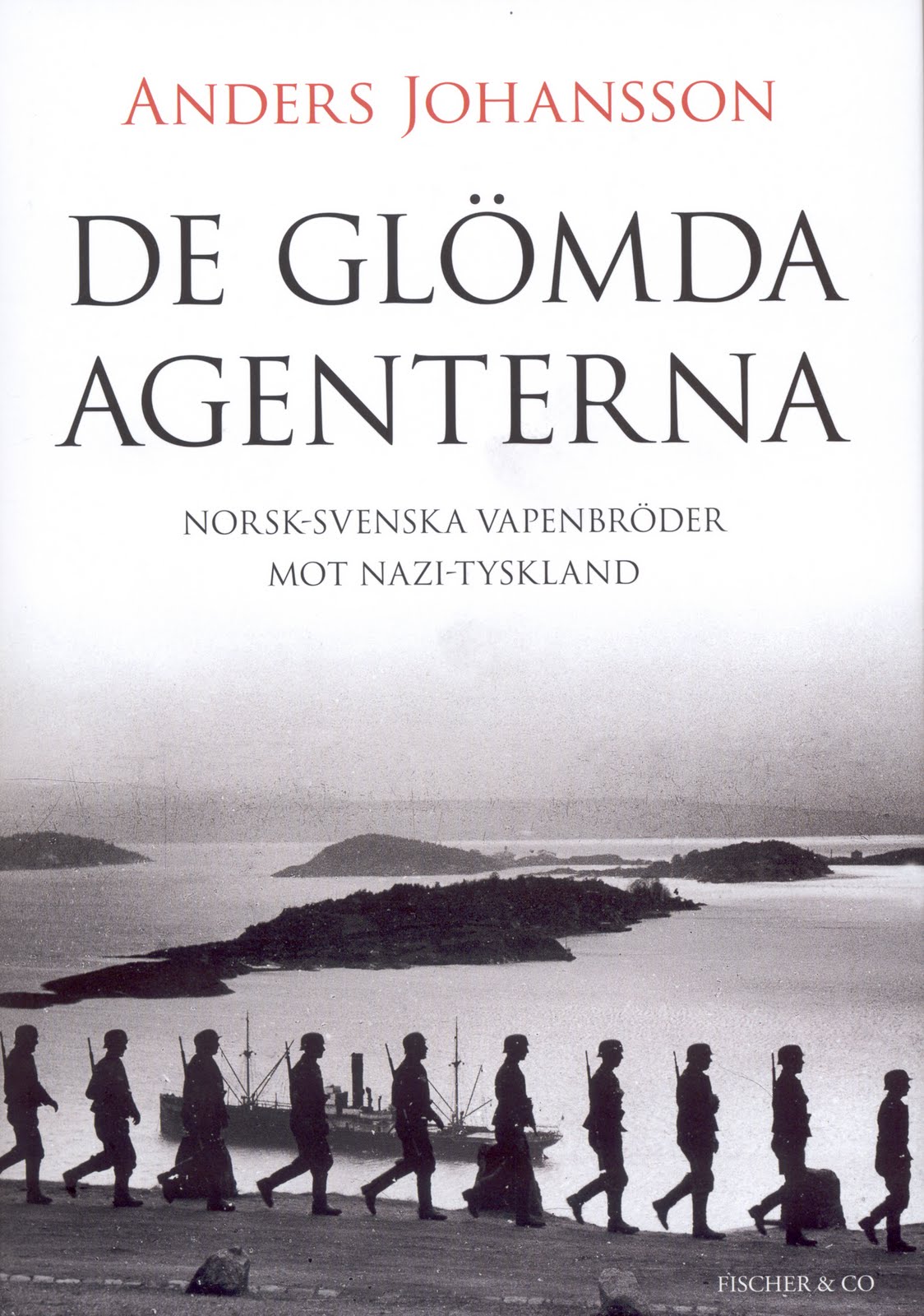 The cover of the brand new book "The Forgotten Agents" by Anders Johansson. So far only available in Swedish. Rather than showing agents on the cover the publisher chose to convey the occupation of Norway. Great cover IMHO.
"The Forgotten Agents" features not only Allan Mann but rather attempts to give an idea of all the not that few Swedes that served Norway as agents in one form or another. Still, Mann is a big part of the story, as is apparent from the back cover where a German-issued ID-card for Mann can be seen together with a photo of him in Norwegian uniform:
 On the back cover, one of Allan Mann´s counterfeit IDs and a postwar photo of Mann in a Norwegian captain´s uniform. You can click on the cover to see it larger.
If you have a special interest in Swedes at war during the 20th century or in the SOE in Scandinavia and read Swedish, I cordially recommend you to acquire De glömda agenterna. I also hope that in the future it might be translated into Norwegian and even English.
Wednesday, October 06, 2010
Where Eagles Dare
If you are a WWII movie buff I reckon you have seen the classic "Where Eagles Dare". But did you know there is an English-language Swedish website devoted to this movie? It has some truly amazing movie trivia. If you have not checked it out I reckon you will not regret doing so, here it is.
Monday, October 04, 2010
Only SS Battalion in Sweden
Seventy years ago, on October 4, 1940, a battalion of the Waffen-SS arrived in Luleå, Sweden. The below photos show the place where they arrived, Luleå harbour. I took the photos today, truly without thinking about the date - that it was exactly 70 years ago.
 The place where the first complete German unit to arrive in Sweden arrived exactly 70 years ago. Not much seems to have changed, the wood certainly looks like it could have been around for 70 years.
 The battalion was directly transferred to railway carriages that probably were standing on exactly these rails. The buildings in the background constitute the city centre of Luleå.
The battalion was part of the SS-Totenkopfstandarte (SS death´s head regiment) "Kirkenes" that was being set up around Kirkenes in Finnmark in Arctic Norway.
The battalion was transported from Germany to Luleå by the ship Isar, escorted by the Swedish Navy. The ship carried the complete second battalion (1,030 men) of "Kirkenes", which later became part of the SS-Division "Nord". Virtually all battalion weapons were brought over on the same transport, but on Swedish territory the soldiers did not carry their weapons.
From Luleå the battalion was transported by train to Narvik and from there to the province of Finnmark which bordered the then Finnish Petsamo area, beside the Soviet border.
I did not choose the date to take these photos - another person did, even more unaware of the uncanny timing. Weird...
BTW it was the first time I went to the place.
I will be writing more in English about this still rather unknown event in a coming book. In Swedish I have written about it in Slaget om Nordkalotten (1999, with James F. Gebhardt).
Subscribe to:
Posts (Atom)