About Me

- Lars Gyllenhaal
- Author, film researcher and member of the Swedish Military History Commission.
Wednesday, January 18, 2012
Swiss Waffen-SS Officer Biography
Among the French volunteers for the Waffen-SS there were a number of Swiss. Here a German 1943 newsreel about new French volunteers.
I today learnt that a fellow volunteer-researcher in Switzerland has released a new book, a biography about the second highest Swiss volunteer in the Waffen-SS, Heinrich Hersche from Appenzell.
In Swedes at War my co-author and I especially compare Swedes and Swiss in the Spanish Civil War and in the Waffen-SS. Our main source of information re. Swiss volunteers was the Swiss author Vincenz Oertle. He has written the most comprehensive book there is on the Swiss in the Waffen-SS: Sollte ich aus Russland nicht zurückkehren: Schweizer Freiwillige an deutscher Seite 1939-1945 (1997). That book is a real must-have source if you have a special interest in the Germanic volunteers (and read German).
Oertle's new book, released in December last year (2011), is entitled Ein Appenzeller in der Waffen-SS and focuses on the life of a battalion commander within the 33rd Waffen-Grenadier-Division "Charlemagne". Hersche was a former major in the Swiss Army cavalry. I have not read the book but judging from the brochure I received today the book is mainly about Hersche's years in the SS - he served right until the end - but also about his prewar personal and political life.
If you can read German here is a Swiss article about the book, and here one can order the book.
Herr Oertle has previously written books about Swiss citizens in the French Foreign Legion, since its inception, and the Swiss Guard of the Vatican. Although the guards may seem like a medieval army, they nowadays also have modern equipment and even a website of their own in English.
BTW, I wrote about the military links between Switzerland and Sweden in this post. I can add that the deal about JAS Gripen has not yet been concluded.

Swedish Volunteer Flag-bearer
 Unknown Swedish volunteer in Finnish Hangö on December 4, 1941. Click on the photo to see it in larger size. PHOTO: Laurin Zilliacus
This above photo has been published in some Swedish books, notably Från Salla till Hangöudd by Anders Grafström. But so far the identity of the flag-bearer is unknown, at least to me. Perhaps some blog reader knows more?
The occasion is the liberation of Finnish Hangö in 1941 and the flag is from the Jäger Company Grafström, so, obviously the soldier is from that company. Note the mug hanging from the bag, the Finnish knife and Sami leather boots.
Who knows the name of the man, and how did you know?
Here is the source of this photo, Gamle Hurtig, a today very little known wartime Finnish journal in Swedish about the ongoing war with a special focus on Swedish volunteers:

Tuesday, January 17, 2012
Swedish Dingo
 I made this 1:35 Dingo when I was about 16. I almost purchased a real one 1-2 years later.
The latest issue (1-2/2012) of the Swedish journal 4 Wheel Drive has a great story about a magnificent reproduction Dingo armoured car created by Swedish enthusiasts.
I have no photo of my own of the scale 1:1 Swedish Dingo but you can see one via this link to 4WD magazine.

The reason I am so fascinated by this repro project is 1. I was close to buying a Dingo wreck together with a friend, from a company in Northern Ireland in the 1980s. 2. It is simply an adorable little car, Daimler-made and all. 3. The Swedish enthusiasts built their repro for just 75 000 Swedish Crowns, which is something like 7500 Pounds.
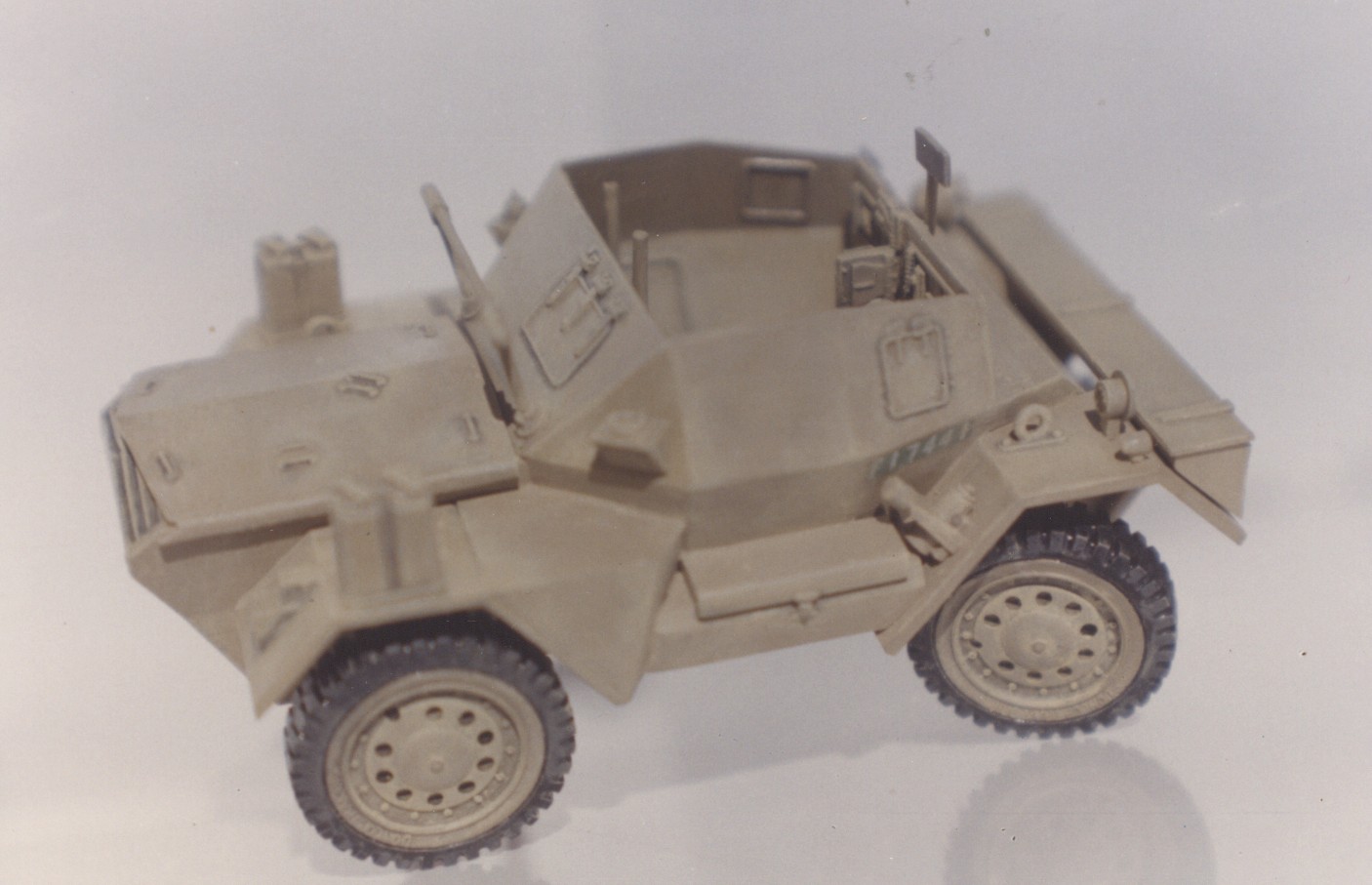 I was rather pleased with my model although I did not convert the exterior.
 However, I did add detail inside, such as a gearbox.
Incidentally, there are these Youtube-clips about a repro Dingo project in Britain. Hopefully, the current owner of the one and only Swedish repro Dingo will post some photos or a film clip on the web in the near future. If so, please do comment below.
Monday, January 09, 2012
Petsamo Front Movie
Russian WWII buffs have made this short film by mixing news reels with reenactors on real WWII sites in the Arctic.
I like the way the German Arctic news reel transforms into today's landscape, and how the film team have made use of the Titovka bunkers. The Soviets portrayed are NKVD border guards, who fought well.
The name of the film in English is "Seventh Day of the War". It is an amazing Russian amateur "Saving Private Ryan", filmed on the real WWII battlefields in the Russian Arctic.
Thursday, December 29, 2011
Petsamo Front Bunkers Today
Highlights from a summer of 2011 offroad/battlefield trip on the former Petsamo Front in northernmost Russia.
I have no connection with the company behind the above video and thus cannot endorse their trips, but it is evident that they can take foreign tourists - in this case Swedes - to some amazing places on the Kola Peninsula.
The main goal of the tour is the former Petsamo (after 1944 Pechenga) Front or Eismeerfront, the northernmost stretch of the WWII Eastern Front.
I recognize several locations in the film. Many roads are German built and I have myself been inside the bunker that has an inscription that proclaims "TOD DEM FEIND", i.e. "death to the enemy" and "2. GEB. DIV." = 2nd German Army Mountain Division. We also see some coastal artillery I have not visited, I reckon it is Soviet 1950s.
I am not able to make out the German unit insignia visible at, 3:50. Can you?
You should watch this video in large format because the landscapes are just awesome.
Remember, WWII battlefield trips are risky even if you take many precautions. Do not pick up anything that even remotely looks like ammunition. E.g. German antitank mines are still very lethal.
BTW I just found this other video about recent finds around Rajakoski in the southern part of the former Petsamo area, now Pechenga:
I have no connection with the company behind the above video and thus cannot endorse their trips, but it is evident that they can take foreign tourists - in this case Swedes - to some amazing places on the Kola Peninsula.
The main goal of the tour is the former Petsamo (after 1944 Pechenga) Front or Eismeerfront, the northernmost stretch of the WWII Eastern Front.
I recognize several locations in the film. Many roads are German built and I have myself been inside the bunker that has an inscription that proclaims "TOD DEM FEIND", i.e. "death to the enemy" and "2. GEB. DIV." = 2nd German Army Mountain Division. We also see some coastal artillery I have not visited, I reckon it is Soviet 1950s.
I am not able to make out the German unit insignia visible at, 3:50. Can you?
You should watch this video in large format because the landscapes are just awesome.
Remember, WWII battlefield trips are risky even if you take many precautions. Do not pick up anything that even remotely looks like ammunition. E.g. German antitank mines are still very lethal.
BTW I just found this other video about recent finds around Rajakoski in the southern part of the former Petsamo area, now Pechenga:
Friday, December 23, 2011
Swedish-based Marder III
The caption states it is "real restored" but actually this very convincing Marder III is the result of a conversion project.
An Englishman has done what I once imagined could be done, back in the 1980s. It is Mr. Alan Swatman who has converted a Swedish/Czech tank m/41 into a German Marder III tank destroyer.
I learnt this from the latest issue (December 2011) of that most excellent British military vehicle journal, Classic Military Vehicle.
On the one hand it is obviously a successful conversion, using also a genuine Pak 40 AT gun. On the other hand there are very, very few Swedish m/41s around. Well, perhaps the information on the web I have found is not quite correct in stating an m/41? I suspect that what Mr. Swatman converted was in fact a pbv 301, i.e. an armoured personnel carrier based on the m/41 tank. Perhaps someone reading this can confirm my suspicion?
An Englishman has done what I once imagined could be done, back in the 1980s. It is Mr. Alan Swatman who has converted a Swedish/Czech tank m/41 into a German Marder III tank destroyer.
I learnt this from the latest issue (December 2011) of that most excellent British military vehicle journal, Classic Military Vehicle.
On the one hand it is obviously a successful conversion, using also a genuine Pak 40 AT gun. On the other hand there are very, very few Swedish m/41s around. Well, perhaps the information on the web I have found is not quite correct in stating an m/41? I suspect that what Mr. Swatman converted was in fact a pbv 301, i.e. an armoured personnel carrier based on the m/41 tank. Perhaps someone reading this can confirm my suspicion?
Friday, December 09, 2011
Blood Road, Arctic WWII Documentary
The first WWII documentary film I worked on, by providing research, was released in 2000. It has now gone online with English subtitles, and can be seen via the above links.
The subtitles appear more clearly if you watch not the small version above but instead click on the above link to the site Cultureunplugged.
It all started with film director Gunilla G. Bresky who saw a photo of one starved man in Arctic Norway. She started to look for him, but she found a hundred thousand. They were Soviet prisoners of war, forced to build Hitler’s Arctic Railway, parts of which remains in service today. For those who survived, a new shock was waiting back home.
What I like most about the film is the indefatigable spirit of the ex-prisoners, the landscapes and that I believe Gunilla, against all odds, succeeded in identifying the man it all started with.
Subscribe to:
Posts (Atom)