About Me

My photo
Author, film researcher and member of the Swedish Military History Commission.

Friday, October 08, 2010

Tarzan-Discoverer´s Mystery Division

A reader of Swedes at War in the United States, Mr. N. Faller, has enquired about a mysterious unit mentioned in our book, the volunteer division "Theodore Roosevelt". Mr. Faller is right in doubting the existence of this unit.

However, the reply is not simply that it never existed. Mr. Faller has kindly allowed me to make the full reply to his question public, as it may interest other American readers and also British and Swedish readers.

The Swede behind the recruitment drive for the British-American division "Theodore Roosevelt", Ivar Thord Hallström, who in British service became Ivor Thord-Gray. Here he is in South Africa where he discovered the real-life Tarzan. PHOTO: The Research Archives, Umeå University Library

The volunteer division "Theodore Roosevelt" is only mentioned in one sentence in Swedes at War. Still, we should have added a footnote or endnote about it because it is a pretty unknown unit, to say the least.

The division is mentioned in our book in a CV for Ivar Thord Hallström who became Ivor Thord-Gray in conjunction with becoming a British officer in South Africa. In the United States Thord-Gray got the approval of then former president Roosevelt to start up the unit. He focused on recruiting Britons or ex-Brits in the US. By the time the project was stopped, in April 1917, 3,500 men har enlisted for the division. Roosevelt personally thanked Thord-Gray in a letter dated May 25, 1917, and said it was sad the project had to be aborted due to lack of support from President Woodrow Wilson.

As part of Thord-Gray´s work for the "Theodore Roosevelt" project he produced a manual entitled Tactics on Attack and Defence in Trench Warfare. You might possibly be able to find that book via some internet bookseller.

Speaking of World War One, it is not that difficult to prove how close we still are to that war. Close? Well, now in late 2010 there are still at least three WWI veterans alive. Or four if you like: Frank Buckles (US Army 1917-1919), Claude Choules (Royal Navy 1916-1956) and Florence Green (RAF 1918-1919). In addition theres is Mr. Jozef Kowalski of the Polish Army who began his service after the WWI armistice but before the Treaty of Versailles. Here is a nice master list about these veterans if you want to research them.

Why the hard feelings between Theodore Roosevelt and Woodrow Wilson? The most recent arcticle on this subject was the superb piece "War & Diplomacy" in Armchair General July 2010.

For more on Thord-Gray, not least his role in bringing about the Tarzan icon, see Joakim Langer´s book Mannen som hittade Tarzan ("The Man Who Found Tarzan").

BTW Swedes at War was recently used as a source in this Mexican history article, as Thord-Gray was there too, fighting as a soldier of fortune.

Thursday, October 07, 2010

One Tough King

It is not every day you get to see a cool and previously unpublished photograph of the King of Sweden. But in a new book written by a friend there is such a photo, with the king being instructed by Sweden´s most famous special operations veteran.

Taking into account that Allan Mann was a hand-to-hand combat expert our king (then crown prince) presumably learnt a thing or two about how to most effectively defend himself without weapons, and also with a knife and so on.

From the left, Carl XVI Gustaf, King of Sweden, unidentified person and Allan Mann, veteran of the Soviet-Finnish Winter War, the battle of Narvik and several years of SOE missions. PHOTO: Sten Bråkenhielm

I had the privelege of meeting Allan Mann, who served as a volunteer in Finland in 1940 on the Salla Front and then in Norway, lastly on the Narvik front. After there earning admission into the Légion d'honneur (French Legion of Honour), he joined the British Special Operations Executive (SOE) and served as a SOE agent and eventually also uniformed operator. He thus returned to Norway during WWII many times, the last time by parachute. A summary of his exploits can be found in Swedes at War.

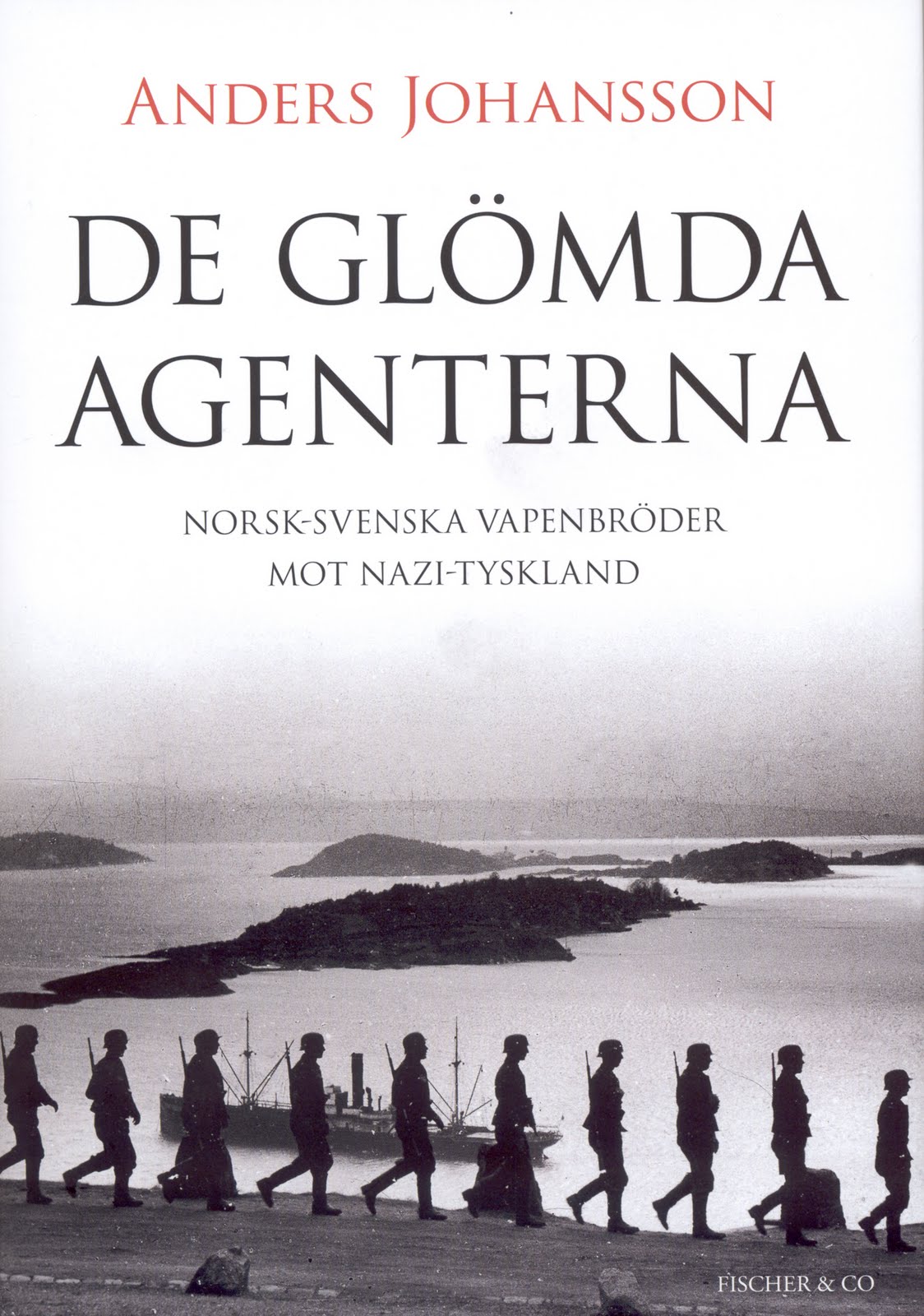
Since a few days ago there is a somewhat more complete chronicle of Allan Mann´s wartime experiences. The book´s title is De glömda agenterna, "The Forgotten Agents". The book´s author, Anders Johansson, earned well-deserved praise for his previous book, about the division of Norwegian "Police Troops" that was trained and organized in Sweden 1943-45. Here is the cover of Johansson´s new book:

The cover of the brand new book "The Forgotten Agents" by Anders Johansson. So far only available in Swedish. Rather than showing agents on the cover the publisher chose to convey the occupation of Norway. Great cover IMHO.

"The Forgotten Agents" features not only Allan Mann but rather attempts to give an idea of all the not that few Swedes that served Norway as agents in one form or another. Still, Mann is a big part of the story, as is apparent from the back cover where a German-issued ID-card for Mann can be seen together with a photo of him in Norwegian uniform:

On the back cover, one of Allan Mann´s counterfeit IDs and a postwar photo of Mann in a Norwegian captain´s uniform. You can click on the cover to see it larger.

If you have a special interest in Swedes at war during the 20th century or in the SOE in Scandinavia and read Swedish, I cordially recommend you to acquire De glömda agenterna. I also hope that in the future it might be translated into Norwegian and even English.

Wednesday, October 06, 2010

Where Eagles Dare

If you are a WWII movie buff I reckon you have seen the classic "Where Eagles Dare". But did you know there is an English-language Swedish website devoted to this movie? It has some truly amazing movie trivia. If you have not checked it out I reckon you will not regret doing so, here it is.

Monday, October 04, 2010

Only SS Battalion in Sweden

Seventy years ago, on October 4, 1940, a battalion of the Waffen-SS arrived in Luleå, Sweden. The below photos show the place where they arrived, Luleå harbour. I took the photos today, truly without thinking about the date - that it was exactly 70 years ago.

The place where the first complete German unit to arrive in Sweden arrived exactly 70 years ago. Not much seems to have changed, the wood certainly looks like it could have been around for 70 years.

The battalion was directly transferred to railway carriages that probably were standing on exactly these rails. The buildings in the background constitute the city centre of Luleå.

The battalion was part of the SS-Totenkopfstandarte (SS death´s head regiment) "Kirkenes" that was being set up around Kirkenes in Finnmark in Arctic Norway.

The battalion was transported from Germany to Luleå by the ship Isar, escorted by the Swedish Navy. The ship carried the complete second battalion (1,030 men) of "Kirkenes", which later became part of the SS-Division "Nord". Virtually all battalion weapons were brought over on the same transport, but on Swedish territory the soldiers did not carry their weapons.

From Luleå the battalion was transported by train to Narvik and from there to the province of Finnmark which bordered the then Finnish Petsamo area, beside the Soviet border.

I did not choose the date to take these photos - another person did, even more unaware of the uncanny timing. Weird...

BTW it was the first time I went to the place.

I will be writing more in English about this still rather unknown event in a coming book. In Swedish I have written about it in Slaget om Nordkalotten (1999, with James F. Gebhardt).

Friday, September 24, 2010

One More Parachute Container

I did not think it would be possible to find one more parachute container. But then, on this year´s final Narvik trip, I stumbled upon one. What amazed me most was the location, not far from the very centre of Björnfjell. And this was not the only Fallschirmjäger find the other week.

Here it is, the parachute container I found the other week. Some smaller parts of it are scattered about.

It started with recognizing a hut as the one used by the Propaganda Company during the battle of Narvik, according to the German period publication Narvik im Bild. The container is a stone´s throw from that house. So, there are today not one but two complete (well, almost) parachute containers still in situ on the Norwegian side of the border, plus one top-only and I believe one on the Swedish side - it is so flattened I am not totally sure about it. The latter is part of the Ju 52/3m wreckage I wrote about last week. Of course, we had to return to that site. It did not disappoint us - i.a. I found the below part of a set of binoculars.

It says Dienstglas, meaning service binoculars. These were generally issued to squad leaders.

On board the crashed aircraft there were eleven paratroopers. The crew consisted of four. Seven men, five paratroopers and two crew members, survived by parachuting.

Please note that I did not dig up the binoculars. I found them simply by looking closely at the ground around the aircraft wreckage. This is the most fascinating kind of find in my opinion, finds that are still in situ out in the open or in a crevice. If you should visit the site I hope they still will be there for you to see as well.

For comparison, the same kind on display in the Narvik War Museum.

Moving on from the border towards Narvik itself we stopped by some positions that have long confounded me. But I now know from having asked the director of the Narvik War Museum that these positions are not from WWII but from the war that never was in 1905, between Norway and Sweden. Let me explain why that "war" has a special significance for me. My father´s father was born in Oslo in 1906. His mother was Norwegian and his father was Swedish. BTW, my grandpa´s mother´s father was a Norwegian general, Major General Hans Jacob Raeder, commanding i.a. the fortress of Fredriksten.

These positions are of a different kind than the WWII ones (almost all WWII positions in the area are made by Germans).

A larger position from 1905, presumably for a cannon of some sort.

Revisiting the Troms Defence Museum in Setermoen I took some photos I did not have time to take the previous time:

A WWII US-made M 24 Chaffee light tank. A very nice light tank that served in the Norwegian Home Guard until the 1980s. Or was it even 1990s??

This is what the heating thing inside an Esbit food heater looks like. Must be very few around.

For comparison, a rusty Esbit heater still in situ in Finnish Lapland.

The parachute container presented to us by a kind family in the Björnfjell area back in 2004. The museum staff has since attached to it a part that was missing, in original light yellow paint.

Here is what the above container looked like when we noticed it in the yard of a Björnfjell family. Incidentally, a new book just arrived, that includes an almost identical photo, taken by my British friend Simon Orchard. I will soon review the book in question: German Paratroops in Scandinavia by Óscar Gonazález.

Speaking of parachutes, here is the most amazing para-related display in the museum IMHO. The complete uniform with all medals of local war veteran Alfred Henningsen. Mr. Henningsen during WWII served both in the Norwegian Army, the Soviet NKVD (thus the PPSh SMG on the wall) and finally was a commando for MI6/SIS, the British Secret Intelligence Service. He was probably the only highranking officer in postwar Norway to have served both in the NKVD and SIS. I will write more about him in a coming book

The final Narvik tour of the year of course ended with the "Adolf Cannon" in Harstad. Here we are about to theoretically fire the 406 mm gun.

Finally, some may wonder why most of my Narvik photos show traces of the Wehrmacht. What about the Norwegian, Polish, British, French etc soldiers that fought in and around Narvik in 1940? Well, from several years of hiking in the area I can just say that there are very few traces left on the ground from these men. One explanation is that not all German finds are from 1940, as the Germans stayed on until 1945. But still, I had expected more traces from the Allies.

For more on the actual Battle of Narvik, look for my Battle Studies article, "Dietl at Narvik, 1940", slated for the upcoming March 2011 issue of Armchair General magazine on sale and to subscribers in mid-January.

Monday, September 20, 2010

Last Destroyer´s Last Year?

Since a couple of years I have worked as a guide for the Swedish Tourist Association (STF) in the Abisko-Narvik area, taking groups to WWII sites. During this year´s tour we experienced both snow, history and the Norwegian fjords at their best. Perhaps it was the last year to see the warship Georg Thiele?

Abisko in Arctic Sweden is a rather natural (and beautiful) starting point for a WWII tour if you are coming from Sweden. Since last fall there is a museum in Abisko itself about the military history of the Swedish-Norwegian border area, the Border Defence Museum of Abisko, part of the larger Defence Museum of Boden.

Here are some of the battlefield finds displayed in the small but interesting Border Defence Museum. Most of these items were picked up in the 1960s by Swedish rangers:

Danish Madsen machine gun magazine and German flare gun with cartridge ("use before June 30, 1946") from the fighting around Björnfjell in 1940. Click on the photo for details.

Belgian (?) pistol with holster from the Narvik area. Who knows more about it? Could it be a private purchase by an officer? Above the pistol a German MP 40 can be seen.

Moving on towards the border itself a natural first stop is the railway station in Vassijaure, where a Swedish armoured train on its very first day in service got involved in a duel with a German airplane, resulting in the loss of one Swedish soldier, antitank-gunner Sven Sjöberg from Piteå. Since 2002 there is a monument to his memory on the station. On the outer walls of it, mainly facing north, there is some writing (graffiti) from WWII done by soldiers.

Our next stop was the remains of the Junkers Ju 52 just barely within Sweden, see previous post. While studying this wreckage we were actually walking on snow, and it was just the first of September...

Moving on into Norway, i.e. Björnfjell, we saw several ex-German buildings and studied the same Norwegian (?) soldier´s bowl and German Marschgetränk that I had found some weeks earlier during my private visit.

We then checked out four of the "caves" (manmade) in the area and were glad to see that the pieces of uniforms (some probably from foreign slave workers, prisoners of war) and even paper from 1943 was still in situ. It is my hope that these things will be left in place for many more visitors to see.

Mostly empty German parcels for explosives (Donarit) dated 1943. Click on the photo to see the writing.

The second tour day we spent partly on the deck of a ship that took us to the very end of the Rombak fjord, Rombaksbotn. After a quick walk there we sailed to the last German warship still above water, the destroyer Georg Thiele.

Georg Thiele on September 2, 2010. Slowly but steadily she is sliding down into the fjord.

The ship was named in honour of a German naval officer killed in World War I. It was on April 13, 1940 that Georg Thiele ran itself ashore after several hits by British warships.

For comparison, this is a photo I took of her in the fall of 2001.

From the director of the Narvik War Museum (an absolute must for all visitors) we got the estimate that Georg Thiele will probably be completely down below the waterline in 5-10 years. It could happen quite suddenly as the ship is more disintegrated below water.

The third and final day of the quick tour of the area we visited the Troms Defence Museum of Setermoen, which has an indoor section and a large collection of military vehicles located outdoors and in several sheds.

Setermoen´s moving history: US Army White scout car and British Humber scout car, both in driving condition.

Those who so desired could take a ride in an unusual WWII armoured vehicle, a Canadian C15.

Testing the C15. Great sound effects!

Inside the Defence Museum we got to listen to a lecture by none other than WWII warbird historian Kjetil Åkra. I have visited the museum annually since 2001 but never get tired of seeing it, not least because additions and changes are made. Here are just a few photos to give you an idea of the museum.

A Norwegian soldier in 1940 armed with a Danish Madsen machine gun, used extensively by both sides around Narvik. Also during WWI this weapon was used by many nations including Russia and Germany.

A Norwegian soldier of the Waffen-SS regiment "Norge" itself part of the "Nordland" division, as is apparent from the Norwegian arm shield and "Norge" cuff title.
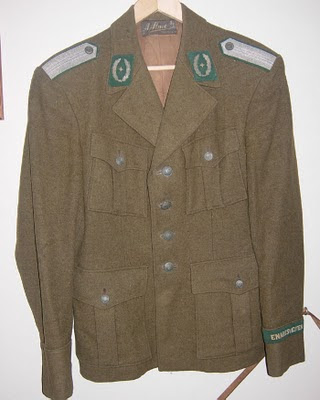
Finnish, Norwegian and German WWII history in one single garment. This tunic was worn by a Norwegian Quisling paramilitary work unit in northern Finland (Finnish Lapland) that supported the German troops there.


Enare is Norwegian (and Swedish) for the Finnish town of Inari in Finnish Lapland. Sveit is Norwegian for a district unit. I have never seen this cuff title anywhere else, has it been documented?

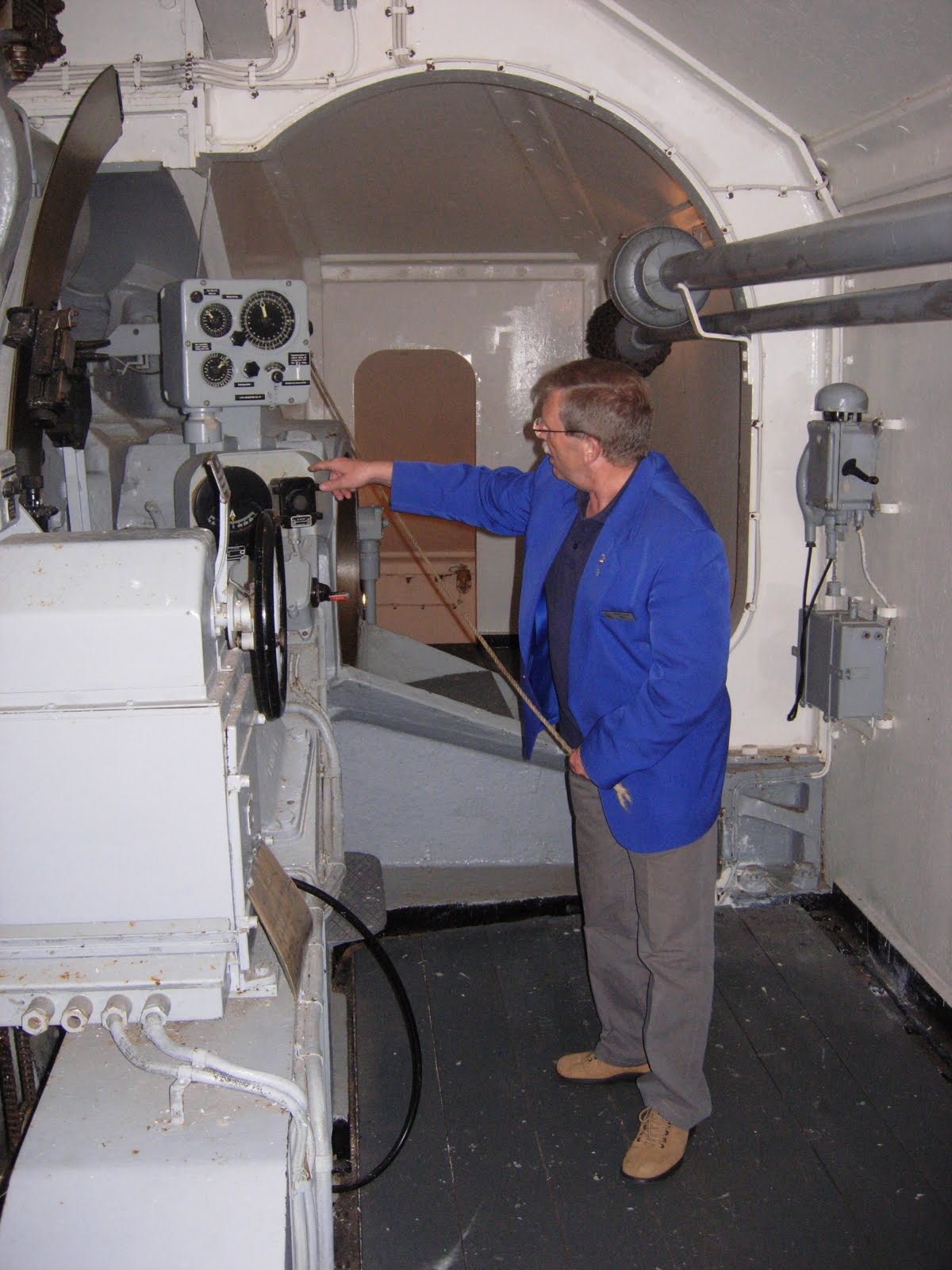
The final afternoon of the tour we spent in Harstad, examining a 406 mm "Adolf Gun", one of the largest naval guns placed ashore in Europe. The condition of this gun is remarkable in many ways. Theoretically it can still fire and in fact it did long after WWII, in the service of Norway.

Even more impressive in real life, I can tell you.


Same place as above but some 50-60 years ago. These are Norwegian soldiers well after WWII. There was still a lack of helmets, so German helmets were used.


Many of the German fire control instruments are mechanical computers.

Thus ended this year´s WWII history tour for the Swedish Tourist Association. As a guide I had a great time, mainly thanks to very amiable tour participants. Hope to meet you again someday!

Unidentified Submerged Objects in Norway

Fellow author and friend Roger Albrigtsen in Lakselv in Arctic Norway has sent me three photos I cannot really help him out with. Perhaps someone reading this blog can? I am therefore publishing these photos here, with permission from Roger.

The photos show two unidentified objects of which one, the carriage, is still submerged in a river by Lakselv:


Submerged carriage by Lakselv, presumably from the Wehrmacht. Underwater photo by local diver Odd-Bjørn Henriksen.


From another angle.

My guess is: part of a mobile German field kitchen. What do you think? Perhaps someone even knows the type?


This gasmask looks kind of Soviet 1930s to me. But I have been unable to identify it in my books about Soviet equipment. Does anyone recognize the model?

Please reply through the comments function of this blog.