About Me

My photo
Author, film researcher and member of the Swedish Military History Commission.
Showing posts with label Hungary. Show all posts

Thursday, August 13, 2020

Axis Armour You Never Knew Existed

Panzer IVs, Panthers and even Tigers served in the WWII Hungarian Army.

Quite many Axis tankers were Hungarians, which is why also several German Armoured Fighting Vehicles (AFVs) were in Hungarian service. A new book looks closer at these, and also the Hungarian vehicles with Swedish roots. 

An amazing number of rare photos and quite a lot of information has been assembled in the new book Hungarian Armoured Fighting Vehicles in the Second World War by Eduardo Manuel Gil Martinez. Being Swedish I was initially mainly interested in the Swedish aspects of his book, but it turned out that the German AFV presence in the Hungarian Army was greater than I thought, and also more interesting than I had imagined. If you are a modeller and you feel like you have run out of Panzer subjects - well, this book will provide you with some extra years of modelling challenges.

Most Swedish armor buffs will know that the Hungarian Toldis and Nimrods were to a large extent Landsverk vehicles, i.e. they were designs from the Landsverk factory in Landskrona in southernmost Sweden. But from this book I learnt something I had no idea of. Not only were the Toldis designed in Sweden, they also contained some components from Sweden, because the Hungarian industry was not able to supply all necessary parts.

Much to my surprise I also learnt from this book that there was even a Toldi converted to a tank destroyer, armed with a German PaK 40. Yes, the book has a photo of it. I can divulge that the result is very similar to a Marder II. Another good reason to release the Toldi also in scale 1/35 - or is there already such a kit and I have just missed it?

Many of the 111 pages of this book are of course devoted to AFVs that were mostly the result of Hungary´s own AFV design efforts. I am talking not least about the Turan tanks and Zrinyi "StuGs". Especially the latter should appeal to modellers. 

Generally speaking this book is a treasure chest for modellers and also provides some insights into the role that Hungary played for the Axis during WWII. The translation at times has some issues but that does not diminish the value of this book. Every tank buff, at least outside Hungary, ought to check out this one.

Friday, February 15, 2019

Countering Terrorism Today

Actions by counter-terrorist units in 16 different states are portrayed in this book.

If you are interested in how different countries act against terrorists, there is a new book out by Austrian investigative journalist and author Judith Grohmann. Her book Fighting the War on Terror: Global Counter-terrorist Units and their Actions provides insights into selected actions of counter-terrorism (CT) units in 16 countries.

The IS-terrorists may have lost most of their territory, but terrorism has always adapted and transformed itself. Thus the specialized CT units around the globe will hardly be disbanded anytime soon - and it is interesting to compare where these units stand today. As the book´s author is Austrian the book quite logically begins with an action of the Austrian Einsatzkommando Cobra. What the author does is to immediately make clear how many preparations are necessary to make sure a major VIP visit ends the way it should. There is, naturally, much more safety work behind these visits than you can imagine. Well, this book makes it possible to imagine a bit more.

Equipment and insignia are not so much the focus of this book (I will be reviewing such a book in the near future), but rather some of the major actions of CT units of the United Kingdom, Germany, France, Israel, Austria and eleven more states. There is also an interesting part about the European police tactical unit network called ATLAS, that has evolved since 2001, i.e. after the September 11 attacks. Too bad this exchange of proven CT practices and procedures between nations didn't start right after the catastrophe of the 1972 Olympic Games in Munich. The number of units within ATLAS is currently no less than 36. The major Swedish CT unit, NI, is not really featured in this book but yours truly can here add that NI is a part of ATLAS.

Interestingly, the UK focus of the book is the Specialist Firearms Command, SCO19. The main Israeli unit featured is Yamam. The Russian chapter, focused on SOBR, is of little interest and there is only one SOBR photo. The chapters about CT units in smaller states provide more valuable information.

The copy of Fighting the War on Terror that I have reviewed is an English one but the book has also appeared or will appear in German, Polish, French, Romanian and other languages.

Wednesday, July 12, 2017

Was Raoul Wallenberg´s Execution 70 Years Ago?

Sergeant Wallenberg of the Svea Life Guards Regiment, from Lars Brink´s book.

Only in October last year (2016) the Swedish Tax Agency declared Raoul Wallenberg officially dead. But when did he breathe his last breath? The Swedish Tax Agency recorded the date of his death as July 31, 1952. However, July 17, 1947 is the most presumed date for his execution by the MGB (which in 1954 became the KGB). In other words, 70 years ago.

The Swedish Tax Agency´s date of July 31, 1952 does not directly point out Wallenberg´s death day, it is just in line with the tax agency´s approach in cases where the circumstances of death are unclear. The agency has a general rule of five years after someone goes missing. Why then July 31 and not July 17? Well, again this is according to policy - which is to not mark a certain day but the last day of the month during which the person was known to be alive.

How was Raoul Wallenberg "liquidated", i.e. murdered? Poison or a bullet are the methods mentioned by different Soviet/Russian sources.

I am no Raoul Wallenberg expert but my co-author Lennart Westberg and I have followed developments around Raoul Wallenberg research and summarize these in the English translation of our book, Swedes at War 1914-1945. The latest book about Raoul Wallenberg recently landed on my desk and it is written by Lars Brink, an accomplished author and also veteran of the same voluntary defence organization that Raoul Wallenberg worked for, the Swedish Home Guard. Prior to his world famous work in Hungary, Wallenberg had been a very active Home Guard instructor - the above photo shows him in his Swedish Army uniform.

Brink´s new book includes a summary in English and is thus not only of interest for Swedish readers. The book´s title may sound academic, Raoul Wallenberg in Swedish Daily Press During the Cold War, but this is a book that should appeal not only to researchers at universities and institutions, but also to journalists and others. Brink´s book contains a credible and important analysis of how the press in Sweden, including Swedish communist papers, covered Raoul Wallenberg during the classic Cold War years. Previously, Lars Brink has written an amazing history of the Swedish Home Guard, including a very readable section about the young Wallenberg and his defence work. Brink´s books can be found in some Swedish book shops and also ordered from his own website.

Tuesday, June 10, 2014

The Kid That Ignited World War One

Sarajevo, where it all started.

In less than tree weeks it will be exactly 100 years since the assassination in Sarajevo that ignited World War One. Gregor Mayer has helped me better understand this event.

The whole thing started with a kid firing two bullets from a Belgian-made Fabrique Nationale model 1910 pistol. It may seem like the simplest of facts, but the age of the Sarajevo assassins of June 28 1914... the age! For some reason it just did not get to me before I had picked up the new book Conspiracy in Sarajevo by Gregor Mayer. The main assassin, Gavrilo Princip, was 19 when he shot the Austrian Archduke Franz Ferdinand and his wife Sophie, Duchess of Hohenberg. Take away Princip´s moustache and what remains is a kid, even more apparent when you see not just his face. Some of Princip´s helpers were even younger. Perhaps one shouldn´t focus too much on the age of the assassins - as behind the historic action of the young Bosnian Serbs stood older men, members of the secret military society best known as the Black Hand - officers of the Serbian Army. But I still think the age of the assassins says something, like that one has to attract young men (kids) for extreme deeds.

Was the First World War truly a result of the actions of some students? Formally there is little doubt about this but Gregor Mayer also writes that the Austro-Hungarian Empire viewed the assassination as a "welcome reason" for a long contemplated punitive drive against Serbia. In other words, had there been no Gavrilo Princip there would sooner or later nevertheless have been some other action that would have prompted Austria-Hungary to declare war against Serbia, thus setting off the chain reaction that became World War One.

But there did exist a Gavrilo Princip, and thus the story of his short life and motivations should long since be well known. However, while much has been written about the assassination, the actual killer has until now not been the subject of a modern biography such as Gregor Mayer´s. Doctor Martin Pappenheim studied the imprisoned Princip and his notes were published in 1926 - everyone who has read them, raise your hand... Of course, Doctor Pappenheim´s notes are often quoted in Conspiracy in Sarajevo.

What emerges from Gregor Mayer´s book is that Princip was greatly motivated by other assassins who went before him and also by the fact that he had not been allowed to become a soldier. Mayer provides the reader with a strong picture of Princip´s final years as well as the environment in which he grew up. It is also remarkable to read the words from Princip´s trial in October 1914 and about what it is like today in Princip´s home village of Gornij Obljaj.

Right now Sarajevo is preparing for the WWI anniversary, a large photo of Gavrilo Princip can be seen on the site of the assassination, on a banner somewhat strangely proclaiming "The street corner that started the 20th century".

So far, Conspiracy in Sarajevo is only available in German, as Verschwörung in Sarajevo: Triumph und Tod des Attentäters Gavrilo Princip. But aside from hardcover format it is also available as an e-book.

Sunday, July 15, 2012

New Swedish Military Vehicle Museum

A German-designed Swedish m/38 tank with a Czech-designed m/37 in the background. Tempo Vidal grille far right.

A few weeks ago I finally got to visit Arsenalen, the new national Swedish military vehicle museum. It is not as good as Bovington (the British tank museum), but is certainly worth a visit if you are in the Stockholm area.

The museum is focused on armour somehow connected to Sweden, from WWI to the present day, but also has some really interesting "soft skins", such as a German Tempo Vidal G 1200, which for some strange reason was purchased by the Swedish Army.

The influence of German design in early Swedish tanks is apparent, the reason is very simple: the main tank supplier was initially a German plant on Swedish soil, Landsverk. For instance, the above pictured Landsverk m/38 was virtually the same vehicle that in Hungary was known as the Toldi. Interestingly, the only two surviving Toldis are in Russia.

A very rare Landsverk AA-tank, based on the Anti that served Finland and Hungary (as Nimrod) in WWII.

A US-made M8 armoured car, one of four captured by the Swedish Army in Congo.

One of the most exotic vehicles in Arsenalen is the captured M8 Greyhound, once used by the Katanga Province Gendarmerie and then by Swedish UN troops in Congo in the early 1960s.

The museum also features some large dioramas with real vehicles, such as this one with a Hetzer:

I reckon this illustrates the end of the Third Reich quite well. But the Hetzer is rather clean...

In the smaller rooms there are many small dioramas and don't miss the upper floor scale models.

Friday, June 11, 2010

The largest German helmet?

This place has perhaps the largest German helmet in the world:


The diameter of the helmet is about one metre...

The flag of this place looks like this:


No idea which place I am talking about? Well, even most Swedes and Finns do not recognize its flag. The place is the Tornio Valley, it is the bilingual region situated where Sweden and Finland share a common land border. There are some rather unusual remains of both WWI and II in this area. To begin with the first one you see coming from Swedish Haparanda and entering the Finnish border town of Tornio, a beautiful wooden Russian chapel (below) for Russian border troops (cossacks) and other Russians serving in Tornio. Finland was a part of the Russian Empire 1809-1917.


Also not very far from the main border road is this monument commemorating the WWI Prussian (German) 27th Ranger Battalion. Wait a minute!? Were there any WWI battles in North Finland? Not really, but because Sweden and Denmark were not willing to train Finnish youths seeking to form a liberation force during WWI, Finland turned to Germany. The Germans obliged and thus a stream of volunteers bound for Germany started to flow through the Tornio Valley. This is their largest monument in Tornio:


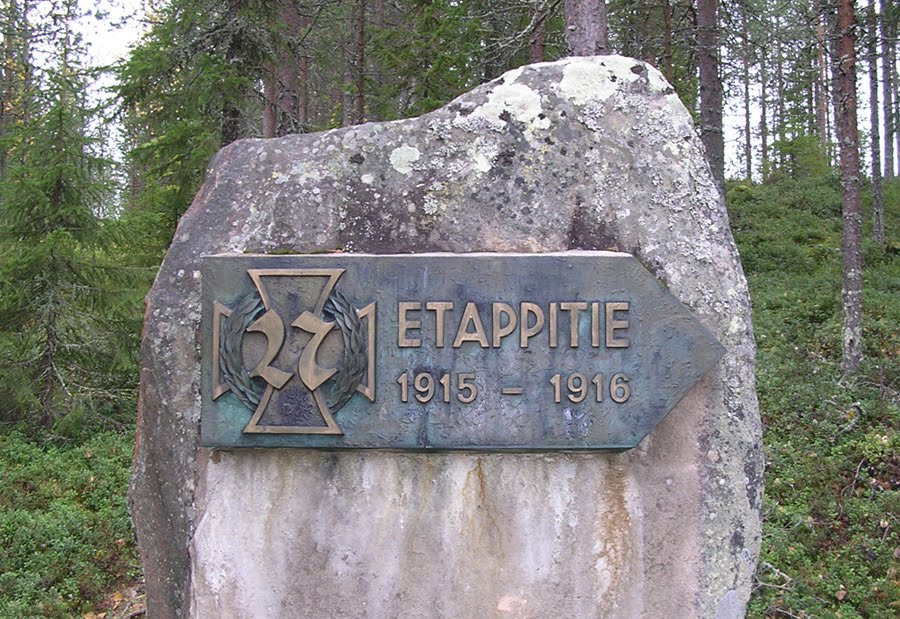
Notice the iron cross with "27", the battalion insignia. The same can be found on signs in and around Tornio denoting the illegal border-crossing paths of the volunteers, like this one north of Tornio in Jäkälänkangas, about 8 km west of Muurola:


In Finland this battalion hold a very special place in not only the history books but still today among the general public. Because the battalion members were instrumental in forming the Finnish army. Even until the 1950s veterans of the 27th dominated the top military positions in Finland. Half a dozen members of the battalion were Swedish citizens. More about the unit and especially the Swedish-speaking part of it you will find in Swedes at War.

All graves of volunteers bear the "27" insignia, which is unusual in Finland where unit insignia is usually not displayed on graves. This one also being in Tornio:


Although there was no fighting in the area during WWI there still is a large common grave for WWI soldiers, on the Swedish side, in the border town of Haparanda. The nationalities of the dead are reflected in that the monument has writing in both Hungarian, German and even Arabic. The Arabic alphabet was at the time used in Turkey and Turkish soldiers are among those buried here:


Why in Haparanda, Sweden then? Because this town was virtually the only place in Europe where there was the possibility to exhange POWs. Quite a few POWs got no further than Haparanda. Remember them too, when you visit Haparanda.

In the Torne Valley Museum, in Tornio itself, there are other reminders from both WWI and II, such as this Russian Maxim machine gun, used in both wars by all sides.


But why is a German paratrooper helmet also there? No German airborne troops are known to have operated in Finland. Does some reader of this blog know more? Here it is:


Driving along the Tornio river on the Swedish side the other week I made two discoveries. First this armoured turret which I reckon is either from WWII or the early Cold War. I had no idea we had such turrets right beside the Tornio river. Does someone know more about these?


Not very far from the turret was a flea market where this German-looking helmet was sold for 100 Swedish Crowns (about 14 US Dollars):


I do not really collect militaria any more, at least not as I did before. But in this case I couldn´t refrain. It turns out the helmet is in fact from Hungary, one of a lot sold/given to the Finnish Army. You can easily tell its Hungarian from the hanger in the back, to ease hanging the helmet from your belt.

A closeup of the hanger:


What about the German helmet at the very top of this page then? It is part of a monument commemorating the Finns (who in 1939-45 mainly wore German WWI and II helmets) who during the "Lapland War" fought against the German forces at Tornio in October 1944 (the Finns were under hard pressure from the Soviets to start killing Germans). It is situated right at the start of the road that leads to Tornio´s harbour. Is there a larger German helmet in the world I wonder? Well, I am sure there was, in the days of the Third Reich - but what about nowadays?

BTW I found out from the seller at the flea market that the Hungarian helmet too was from the Lapland War. It had been lying around on their property in Finland, on the ground surface, until the 1980s, when they finally picked it up.