About Me

My photo
Author, film researcher and member of the Swedish Military History Commission.
Showing posts with label Wehrmacht. Show all posts

Tuesday, July 27, 2021

Bletchley Park's Secret Source

Having read and watched several books/films/TV productions about Bletchley Park (BP) my interest was aroused when I learnt that there was a new book about the little-known network behind the information supplied to Station X (BP). The Swedish Navy is also part of the story.


Let it be said immediately that Bletchley Park´s Secret Source focuses on the very secret Y service that ran a global chain of wireless intercept stations. This new book by Peter Hore, former Head of Defence Studies for the Royal Navy, especially illuminates the Y service Wrens – the operators from the Women´s Royal Naval Service. Thus the subtitle of this book: Churchill´s Wrens and the Y service in World War II. My main reason for reading this book was my interest in the German-speaking Wrens who listened to German radio chatter, but for those of you who are interested in the monitoring of Japanese signals this book is also for you. 


While many Wrens of the Y service had zero military experience there were also some really experienced ladies, such as Violetta Thurstan. Not only had she won the Military Medal for her bravery as a nurse in the First World War, she had been decorated by Russia and Serbia as well, had served in the RAF and the Spanish Civil War and therefore spoke several languages and had a good grasp of many military matters – key Y service skills. 


Several Y service Wrens had been to Germany before the war and some had spent years there and even seen Hitler himself up close. Such a Wren was Elizabeth Agar, who didn´t know much about the Wrens but as soon as she met a smartly dressed one was intrigued and got a “[…] burning desire to join […] even though my only knowledge of the sea was that it made me seasick”.      


In the chaos of 1940 there sometimes was not even time for any training course, not even an issue of uniform! Those times also meant not only listening to the enemy but also observing Luftwaffe aircraft over Britain, sometimes close: “The girls became rather blasé, so they were surprised during a visit by a superintendent from London, when their visitor suddenly jumped into a ditch to take shelter.”


In the book´s chapter “Winning The Big Battles” the Swedish cruiser Gotland´s sighting of the German battleship Bismarck plays a vital role for the British naval attaché in Stockholm, Captain Henry Denham. The part that Denham´s report to London played in sinking the Bismarck is made clear by a personal signal from the First Sea Lord to Denham.   


The author writes that “At the height of the war, the Y stations sent more than 3,000 messages a day to Bletchley Park” and it seems natural to agree that this volume must have been a major contribution to the success of BP. The Y service Wrens in Colombo on Ceylon (now Sri Lanka) even helped prevent a second Pearl Harbor. Bletchley Park´s Secret Source highlights a small group of women, often in miserable working conditions, that indeed had a real effect on the war.

Friday, March 05, 2021

The Americans and Germans at Bastogne

Can anything more and also of interest be said about the Battle of the Bulge? This new book by Gary Sterne shows that it is still possible. This is a book of particular interest to wargamers and others who want to get into details of the fighting in December 1944.

The British author Gary Sterne is rather famous for his Normandy research, not least concerning the Maisy Battery (check it out!). To produce The Americans and Germans at Bastogne he located the early postwar interviews with several German commanders who took part. He then matched them with US Army reports and selected a large number of wartime and postwar maps. The result is a source that should be very useful for those intending to visit the areas in question, and for wargamers. Also, anyone wishing to research the most involved German generals should have this book. Waffen-SS Oberstgruppenführer (Generaloberst) Josef “Sepp” Dietrich is of course among the quoted generals but there are more pages with Generalleutnant Fritz Bayerlein and Generalmajor Heinz Kokott and others. 

Given that most featured German officers are generals the perspective is mostly on larger units, mainly the involved divisions. But from time to time you get to read about smaller units and even individual tanks. My impression of the Volksgrenadiers seems to be in need of revision as I understand from this book that their quality was very varied.

The clash in thick fog between US Army Staff Sergeant Michael Lesniak´s Sherman tank and a German Tiger is memorable. From the explosive account of the fighting around the village of Marvie I conclude that if I have the opportunity to again go there by car I would like to see what the place looks like today. Perhaps some buildings still show signs of the fighting? I have found scars from WWII before, many times.

If you are not into visiting battlefields I believe you will find that the most interesting part of The Americans and Germans at Bastogne is the chapter “German Commanders Assess the Reasons for Failure”. From it I note that “the failure to take St. Vith in time” is Generalfeldmarschall Gerd von Rundstedt´s number one reason. This was written down shortly after the war, without all the hindsight.

The book’s many maps should be of great interest, even though the image quality is not always the best. The photos are not that many but mostly good. This is a book that one gets for the text and maps, there are already plenty of photo books out there. If only this 291 page book would have had an index, and there are spelling mistakes (names). But hopefully there will be more editions, and then an index can be added.

Friday, February 05, 2021

Marching From Defeat


A lot of people have seen “As Far As My Feet Will Carry Me”, a 2001 WWII movie based on a book by Josef Martin Bauer. Both can be summed up as an exciting escape story: a German soldier, Clemens Forell, is sent to a very remote Soviet camp and walks to freedom against all odds. However, it has turned out that very little in that film/book can have come from the actual life of the real Forell, Cornelius Rost. Well, is the new book Marching From Defeat by Claus Neuber better than Bauer´s book?

Marching From Defeat is a book from 2020 in English but was published in German seven years ago, as Marsch aus dem Untergang. Simply put it is an autobiographical escape account by Claus Neuber, who was a German Army artillery lieutenant on the 1944 Eastern Front, serving in the 18th Panzergrenadier Division. Like thousands of other German soldiers he finds himself caught up in Operation Bagration, the huge Red Army offensive in the summer of 1944. He is then on the run behind Soviet lines for more than two months and during that time he is captured by the Soviets but manages to escape from his first camp.

Neuber recorded his experiences of escaping from Soviet captivity in a report soon afterwards, and later expanded his account. But it was not published in Germany until 2014. To tell you what I think of his book I will start with the credibility and then what it was like reading it.

Basically I wish Claus Neuber had met a more objective and professional German publisher/editor. Because his account has many signs of being authentic and therefore it should have been “left alone”, i.e. not been mixed with a lot of postwar thoughts. Of course the book could still have included postwar insights and comments. Actually, it could well have had some more postwar comments – from different historians of the Eastern Front. But the postwar insights and comments should have been in chapters separate from the wartime experiences. So, I object to how Neuber´s 1944 memories have been “developed”, because that process has not improved the book.

Still, especially once you get to the start of the long trek towards the new German lines, Marching From Defeat is often an amazing read. One gets the feeling that these are indeed the thoughts, experiences and conversations of German soldiers on the run. Surprisingly often they are helped by locals and some of the most moving scenes in the book are the encounters between the author´s group and villagers that often had no reason to help Germans - but still did so because they recognized the human beings behind the remains of German uniform.

I do not wish to spoil your reading experience but think the following quote from the author gives an idea of the challenges he encountered, without revealing too much: “Had I known about the ordeal that lay ahead of me, I would have given up all hope, but luckily I didn´t know and none of us knew because it was unimaginable.”

Neuber encountered countless setbacks of all kinds but also learnt repeatedly how a setback can turn out to be for the best. Sometimes it is almost beyond belief how he could carry on walking.

So, if you are into WWII escape & survival stories and/or have been intrigued by As Far As My Feet Will Carry Me, then Marching From Defeat should interest you. Hopefully some future book will examine Claus Neuber´s account in more detail, comparing it with wartime documents and also with similar fates.

Wednesday, December 09, 2020

The LRDG In Action 1940-1943


This book is different from most books about the Long Range Desert Group (LRDG) as it contains a great deal of rare or never before published photographs. It includes a lot of details of special interest to military vehicle buffs, special forces insignia collectors and scale modelers.


The New Zealander and LRDG buff Brendan O´Carroll has made this book in the series “Images of War” truly stand out. To start with, most books in this series are thinner. This one is 215 pages long and largely photographs but also some really good text. Sure, it does contain some photos I have seen before – but as Mr. O´Carroll is a true expert who knows how to write informative captions he has added new value to those photos. 


The many images in The Long Range Desert Group In Action 1940-1943 were taken both by official photographers and the LRDG men themselves, many come from private photo albums, drawers etc. The quality of the photos from personal cameras is not seldom poor (some have been enhanced), but this can both be forgiven, as they can still reveal a lot, and be explained – the films were often developed in Cairo photo shops with unclean water. The resulting images thus could show not only specks of dust but also hairs and parts of insects. Still, there are also plenty of photos in Brendan O´Carroll´s new book that are clear and sharp. Being Swedish I was particularly happy to find a new and crisp photo of a Bofors (made in Sweden) mounted on an LRDG Ford.


Uniforms and insignia of patrolmen are featured in some superb photographs I have never seen before. LRDG members could certainly look very strange and exotic! 


Several images ought to constitute strong inspiration for dioramas, and some of these also feature non-LRDG vehicles and I here have to make special mention of an Afrika Korps Panzerfunkwagen and a Marmon Herrington armoured car of the King´s Dragoon Guards. Simply stunning photos.


Those of you who have read the LRDG book I wrote with Karl-Gunnar Norén may recall the story of Nick Wilder, the LRDG captain who performed a miracle for Montgomery nor far from Tataouine, the town that later became Tatooine in the Star Wars films. Well, sadly we could not locate any good enough photos of Captain Wilder. But Brendan O´Carroll has succeeded in finding some photos of Wilder in preparation for the attack on the Barce airfield. It is just incredible to see these photos.    


You might think that the book ends with the LRDG operations in Tunisia – but this it does not! Instead, it follows the desert veterans to their next assignment as part of the Raiding Forces, Middle East, made up of around 200 LRDG patrolmen and 150 men of the Special Boat Squadron (SBS) and No. 30 Commando. In other words the book ends with some photos from Greek Islands. As soon as I saw them I started thinking about visiting these islands in a year or two. The vaccinations have started folks, so let us start planning to visit LRDG sites again – yet another reason to purchase The Long Range Desert Group In Action 1940-1943.

Saturday, November 21, 2020

SAS Jeep Operations in Germany and Norway


It´s not every day that you find a new book about the SAS in Norway and discover one more Nordic in the ranks of the SAS. Well, With the SAS Across the Rhine is mainly about final operations on German soil. Still, it is well worth getting and now for some details.


Unlike some SAS books this one by the late (he died in 2002) Colonel Ian Wellsted OBE, MA, is very personal, it has plenty of details about his love life. This may put off some readers, but should not – because Wellsted´s memoir highlights something probably quite common – how a turbulent emotional conflict at home can follow a soldier to the battlefield and affect his behaviour a lot.    


In January 1945 Ian Wellsted is trained in the French alps for operations in Norway together with a Danish SAS member I had never heard of before. No, I am not talking about Anders Lassen VC. Every Nordic reader into SAS history knows about Lassen. Wellsted writes about Paul Jensen, a former Spanish Civil War volunteer who after the German invasion of his homeland had become active in a Danish resistance organization until he had to flee to the UK, where he joined the SAS. No year for this is given but Wellsted writes about the man on several pages and Danish history buffs should thus be able to track him down. Would love to find out more about Paul Jensen, or perhaps that was not his actual name? Let me know, dear Danish readers.


To get into the right shape for Norway the SAS men are helped by French alpine rangers, chasseurs alpins, and the part about them was for me extra enjoyable as I have had the pleasure of observing them on an exercise. To be precise I was skiing with the 27thAlpine Ranger Battalion. I thus relate to Ian Wellsted´s warm feelings for his cool French hosts. 


After about a month in the alps the SAS skiers were told Norway was no longer a top priority (but Norway will come back on the agenda) and they were instead sent to Germany to there constitute an advance party with armoured jeeps. So, all you SAS jeep fans, here is a book you will definitely want to read. Wellsted´s jeep battle accounts are supported by 16 photos, not always top quality but none of which I have seen before, and some tactical maps. 


In Germany the author confronts not only German snipers but also a most tense situation with one of his own that obviously is suffering from extreme battle fatigue. 


Once Germany has fallen Norway returns on the SAS agenda. Of course, we now all know that this also broke the German will to fight on in Norway. But at the time things were not so evident, and Wellsted paints a vivid picture of what Norway was like just after the general German surrender. One only wishes this part had been a bit longer and that there had been more photos from it. But the one photo that there is, is of particular interest, with many nice jeep details.


With the SAS Across the Rhine (155 pages) ends with a very modern take on what the WWII SAS was all about and lessons to be learnt from them. This part has been written by one of New Zealand´s greatest SAS history buffs, Terence Gardiner, a retired air commodore, and is in itself worth your time. 

Thursday, November 12, 2020

Hitler´s V-weapons

The story of the battle against the German V-1 flying bomb and V-2 rocket is more fascinating than I thought. The official history of this battle, recently compiled by John Grehan, reminds of how the unmanned aerial vehicle made its debut long ago and includes Norwegian and Swedish aspects.    

The very secret war against the V-1 and V-2 actually began in Norway already in November 1939, most unexpectedly. This was several months before the country was invaded and became a battleground. What happened was that the British Embassy in Oslo then received two letters from an anonymous German scientist whose name turned out to be Hans Ferdinand Mayer. The embassy staff passed on his letters to the Secret Intelligence Service (SIS/MI6) HQ in London for further analysis. The letters turned out to be a leak from the heart of German high tech weapons research, or as the official history puts it: "the first serious evidence to fall into British hands that the Germans were developing rockets for military purposes". 

It is almost beyond belief how much the Germans poured into the V-1 and V-2 projects and this new book brings home both the scale of the German efforts and how the British analysts and leaders learnt of them and tried to prepare themselves for what was to come, and then acted. What the rocket threat more exactly consisted of became a lot clearer thanks to a V-2 that accidentally flew to Sweden on the 13th of June 1944. It was an incredible moment to stand by this rocket´s crater - it is still well preserved in a dark forest not too far from Kalmar in south Sweden. In fact, this crater is one of the highlights in my latest book.  

Having recently researched the V-2 that ended in Sweden I can say that I know of no previous book that mentions the following aspect of what happened once the Swedish authorities had become aware of the cause of the explosion. Basically all relevant previous books report that debris from the exploded V-2 was collected and brought to Swedish technical experts and then the debris was sent on to the Allies, to British experts in Farnborough. However, Hitler´s V-weapons also states that two British technical intelligence officers were allowed to enter Sweden soon after the explosion, and here immediately made some important discoveries. In other words the first Allied examination  of a V-2 took place not in Farnborough but in Sweden.

There is also an exciting "what if" scenario in Hitler´s V-weapons - the Special Operations Executive (SOE) selected a German technician for capture, a key person for the V-weapons. But the man turned out to be so closely guarded that the SOE deemed it impossible to get him alive. 

Well, this 328 page book with 16 photographs (some quite moving) should please both V-weapon and UAV buffs, as well as civil defense and London historians.

Tuesday, November 10, 2020

The Battle for Norway 1940-1942


If you are researching or wargaming Norway 1940 and/or Operation Claymore 1941, this book will be of great interest to you. Because in The Battle for Norway 1940-1942 you will find the original words of the commanding British officers. Written not with hindsight, but as they saw things at the time.

This 174 page book is mainly a collection of wartime despatches and is very ably introduced by the men who have compiled them, John Grehan and Martin Mace. They correctly point out the crucial factor for the Norwegian campaign of 1940, air superiority. As the Allies never achieved air superiority over Norway their attempts at contesting the German invasion forces were doomed. 

From a Swedish perspective it is of special interest to see how clearly the value of the Swedish port of Luleå is stated. "To interfere with ore supplies to Germany from Luleå" is the second priority of the British forces. After that came preserving "a part of Norway as a seat of Government for the Norwegian King and Government". I incorrectly supposed that Luleå came after that.  

On the other hand, the despatches and reports from Operation Claymore, the March 1941 raid on the Norwegian Lofoten Islands, are full of successful action. It was time for Hitler to taste some of his own medicine - the element of surprise. To attain this the Royal Navy first had to reach an exactness of timing, and so it did. The list of shipping and factories (fish oil plants) destroyed is impressive.

From a Norwegian perspective it is pleasant to read how highly the Norwegian detachment commanded by Captain Martin Linge was praised. In the relevant passage it becomes clear why Martin Linge became the founder of the most celebrated Norwegian WWII unit, the Linge Company of the Special Operations Executive.   

For researchers the index of persons is great. There are not that many illustrations (16) but the book still gets a high score as it constitutes a source of great historical value.

Friday, October 30, 2020

The Most Amazing Tank Destroyer Ever


Which tank destroyer can be called the most effective? We could probably debate that forever. However, I find one tank destroyer a bit more fascinating than the rest. Not least because after 76 years it is still in service. There is now a brilliant book in English about it.


Both the Third Reich and the Soviet Union produced some larger and deadlier tank destroyers than the Soviet SU-100. But in the Red Army the SU-100 was the most powerful medium tank destroyer. At medium ranges it could take out both Panthers and Tigers, even King Tigers. So, why has not that much been written about the SU-100 in English? Well one reason is that it entered service only in the fall of 1944. Another being that you basically have to be Russian and work in Russia many years to produce a book like this. Well, half of the pair behind SU-100 Self-Propelled Gun is Nikolai Polikarpov, chief editor of M-Hobby, a Russian modelling magazine which has been in publication since 1993. I read several of the first issues and still have them. Mr. Polikarpov´s research is one reason this new book is a dream come true for Soviet era AFV modellers. But it is also rich in details for military vehicle buffs. There is no detail of the SU-100 that is not featured, also in splendid colour photographs. The other author of the book, James Kinnear, has brought with him long experience of writing on military subjects, e.g. for IHS Jane´s defence yearbooks and Osprey Vanguard. In addition, the Swedish publisher, Canfora, has done a splendid job presenting the work of the authors. 


The combat debut of the SU-100 took place in Hungary in the first days of 1945. Here one of the few problems with the vehicle instantly became obvious, it lacked secondary armament, i.e. machine guns. This of course meant that to defend the vehicle against German infantry the crew would largely have to rely on personal small arms (SMGs) and hand grenades. The passage about the German documents about SU-100 employment in Hungary is sobering, evidently both combatants misidentified each others AFVs. 


The pages about SU-100s in post-1945 service are amazing if one is also a Cold War history buff. In Soviet service the type was formally taken out of service in 1968. But that was not the end, as it then entered “strategic reserve storage” and was at least returned to some active service during the 1980s. The Soviet forces in Afghanistan used SU-100s to knock out resistance fortifications. 


There are amazing sections about the SU-100 in Czechoslovak and Cuban service. In 1961 both SU-100s and T-34-85s were in combat against the American sponsored landings on Cuba. The photos from Cuba should also inspire any Cold War modeler, a great deal.


Then there is the story of the SD-100 (Czech-made SU-100) on display in the UKs fabulous Tank Museum at Bovington. I had no idea that it is one of several SD-100s knocked out by British paras in Egypt during the 1956 Suez Crisis. In general, the info and photos about preserved SU-100s and SD-100s is one of my favourite parts of the book.


The most remarkable thing, in my view, is the fact that several SU-100 again entered combat in 2014, when several companies of SU-100s were employed in the Yemeni Civil War. Accordingly, the last of the excellent colour profiles in the book shows a SU-100 in 2017, captured by Houthi rebels from government forces. During the Yemeni Civil War a number of SU-100s have of course been destroyed, but in 2020 at least one SU-100 remained in operation.  


The photographs in the book showing the SU-100 in operational WWII service are not that many, but on the other hand they are mostly of very high quality. I am especially fascinated by the image from Berlin April 1945 with two officers in British or Polish uniforms – the perfect subject for a small diorama. 


This book is so new it even contains photographs from the 75thanniversary Victory Parade in Moscow 2020, when no less than seven working SU-100s paraded across Red Square. SU-100 Self-Propelled Gun is the second in the series “Red Machines” from Canfora. The first was T-60 Small Tank & Variants


To sum things up, this is the way.

Monday, October 26, 2020

Surprisingly Good German Special Forces Memoir


The special forces of German WWII military intelligence, the Brandenburgers, are not as well known as the British SAS, but just as interesting. However, I have to confess that the title of this book made me think that it would not be as well-written and credible as it turned out to be. 

To me the title Blood and Soil somehow signalled propaganda. Still, I was very curious to read this book as the sources about the Brandenburgers are not that many, especially the good books are few. There are many misunderstandings about the Brandenburgers. Indeed, as Lawrence Paterson writes in his introduction: "What wartime records remain are often fragmentary or cloaked in cover names, leading to frequent misdirection and confusion. Many operations attributed to the Brandenburgers were either non-existent, or in fact carried out by other units of the Abwehr [German military intelligence service] or SS."

The name of the author of Blood and Soil, Sepp de Giampietro, sounds Italian and this is because he came from the German ethnic group in South Tyrol, Italy. One learns a great deal from this book how this group viewed both Fascist Italy and Nazi Germany. The punitive measures that Italy directed against the ethnic Germans proved to be very counterproductive.

Initially the author thinks he has joined the German mountain infantry/rangers, the Gebirgsjägers, and is satisfied with that. But after a while his unit is attached to German military intelligence and quite a few South Tyroleans thus became Brandenburgers. The first period of the author´s military training is described with some nostalgia, in spite of what followed. 

The key element of the special forces period of Brandenburger history (their status changed) was the wearing of foreign uniforms and use of captured vehicles, to enable complete surprise at bridges and other crucial objectives. The author very seriously discusses how he and others felt at the time about wearing different foreign uniforms. He also explains how the most important fighting unit was not the company but the commando, an unusually large and autonomous platoon.

The details are rich and fascinating about the German campaign in Greece 1941, the author was among the very first to reach the flagpole of the Acropolis. Then one gets to follow the author in the Soviet Union, up to the Caucasus mountains. The author writes well and not without humour. He is able to give a vivid idea of how things then appeared, how he viewed events at the time. But also shows in several passages how he came to change his views, not least regarding the policies of the Third Reich.  

There are 30 photographs in the book and most of them are of great interest although not all are sharp. I would have liked more pages about 1943-45 but that does not really affect my verdict - this memoir is of great interest to all with an interest in special forces and especially in the history of the Brandenburgers.

Wednesday, October 21, 2020

The Last 1945 Battle in Northwest Europe

The general public might think mostly of Nordics when hearing “foreign troops in German uniform”, while in fact the typical foreigner from Western Europe was from Spain and if one looks also eastwards the typical foreigner was from one of the Soviet republics. Thus Night of the Bayonets, is mainly about a very underreported group of soldiers. 

This new book by historian and journalist Eric Lee should be on your WWII reading list not only for focusing on Eastern European soldiers in German service. It is above all a surprising and well-written account of the last fighting to take place in 20thcentury Northwest Europe. Then there is a deeper reason for learning more about the homeland of the main characters, Georgia. By any measure a man from that part of the world was one of the most influential men of the 20thcentury, Joseph Stalin (born Dzhugashvili). Georgia has played and will play a large role in the fate of both Caucasia and Russia. 


It was in Oslo in the 1980s that I first heard about a strange and bloody battle in which Georgian troops in German uniform fought against much better armed German troops. This battle took place on Texel, a Dutch island, and ended only several days after the formal end of WWII in Europe. Ever since I have been keen to learn more about the fighting on Texel, what initiated it and what the underlying motives were. Sure, there have been some books and articles mentioning the battle for Texel. But until I read Night of the Bayonets I had only a rough idea of what happened. 


Eric Lee wisely begins his book by showing how the Georgian Legion in German WWII service was a revival – there had been such a legion during the First World War. Of course, that first legion had no National Socialist profile, and it gained a good reputation in Georgia, from which the second legion could benefit. Georgian history in this respect is similar to Finland´s – during WWII the phenomenon of Finnish volunteers in German uniform was to a great extent a consequence of the battalion of Finnish Jaegers in German service between 1915 and 1918.


Just like the Finnish Jaeger Battalion veterans, men who had served in the first Georgian Legion played an important role in the formation of a new national army. The Soviet authorities did their best to erase the memory of that army and most parts of Georgia´s independent period 1918 to 1921. But Eric Lee summarizes those years well and lets the reader glimpse into an amazing alternative to what happened in Lenin´s Russia. German troops arrived in the Georgian capital of Tbilisi just two weeks after Georgia had proclaimed independence in 1918. Knowing that is fundamental to understanding the relationship between Germany and Georgia. 


Likewise it is fundamental to Georgian history that there was a nationwide rebellion after the Soviet conquest. It took place in August 1924 and led to both thousands of deaths and a great career boost to a local Soviet secret police officer, Lavrenty Beria – later second only to Stalin and actually described as “our Himmler” by Stalin during the Yalta summit in 1945.  


During his invasion of the Soviet Union, Hitler´s forces never made it far beyond the Georgian frontier, although they somehow found the energy and time to climb Mount Elbrus, the highest peak in the Caucasus. 


While German WWII troops never were able to hold any sizeable Georgian town they did manage to take a number of Georgian prisoners, who were joined by Georgian deserters and Georgians in German and French exile. At first, while Germany was basically on the offensive, there could be no new Georgian Legion, due to Nazi optimism and racism. But long before the new legion was formed, German military intelligence set up a largely Georgian unit within the Brandenburg Regiment (Wehrmacht special forces). This unit was the Sonderverband Bergmann and by the spring of 1943 it was itself of regimental size. But, rather tellingly, all the officers in it were German. The Germans, especially Hitler, just didn´t really trust former Red Army soldiers. This somewhat changed, initially, with the advent of the Georgian Legion.


The low trust was quite rational, as very many Georgians (and other nationalities) had “volunteered” to serve in German uniform mainly to avoid starvation. Especially during the first year of the great invasion the conditions for Soviet prisoners of war were incredibly grim. The Germans realized that it would be much harder for their Georgian troops to desert on another front than the Eastern one. So, Georgians were sent to Northwest Europe, even to the Channel Islands (Guernsey etc). Still, even in France some managed to desert also in groups, and Eric Lee´s account of what happened in Hirson is remarkable – a Georgian group there managed to join the French resistance. There is also an amazing passage about a similar mutiny by Ukrainian troops in France.


Until April 1945 one of the most peaceful places to end up in as a Georgian was the Dutch island of Texel. Although it did have a large amount of bunkers, some 500, it was also a haven for children from the Dutch mainland. Why the Georgians rebelled there in April 1945 and not just waited calmly for the war to end has puzzled me ever since that day I learnt about the very bloody Texel mutiny. Well, to avoid spoilers I will here just say that Mr. Lee provides credible motives for this seemingly irrational course of action. 


The Germans, of course, counter-attacked, not least with an impressive amount of artillery rounds. Texel, the peaceful oasis, was shot to pieces while the war in Europe was largely winding down. The reader learns about these events both through accounts of Georgians, Germans, Dutchmen and Canadians. Mr. Lee has found some fantastic quotes. 


Night of the Bayonets also deals with the many misunderstandings and remains of Soviet era propaganda that still surround “the Russian War”, as the uprising on Texel is to this day called among the Dutch. More than 3,000 people died in the battle, mostly Germans. No Russians, but the name has stuck.


The photographs are not that many (20) but they are very interesting and some of the WWII photos of the Germans on Texel are even in colour.


So, Night of the Bayonets is a great book, a real must if you are into the last WWII fighting in Europe or Soviet/Georgian history.     

Tuesday, October 06, 2020

Essential Study of Foreign Volunteers in the Waffen-SS & Wehrmacht


There are lots of books about foreign volunteers in the Waffen-SS and not as many about the foreigners in the Wehrmacht. What makes A European Anabasis unusual is that it looks at both categories, and contains a lot of credible military analysis.


Last year a paperback version of A European Anabasis: Western European Volunteers in the German Army and SS, 1940-45 by Kenneth W. Estes was published by Helion & Company and it is this version of the book that I shall now review. Unlike many books about foreign volunteers in German formations I would say it treats Wehrmacht and Waffen-SS volunteers with equal attention and the author´s background as a marine, tanker (lieutenant colonel) and professor of history has made possible a convincing evaluation of how the different volunteer groups actually performed. The volunteers from Spain, the Netherlands, Belgium, France, Denmark and Norway (I have placed them in the order of contingent size) are the main focus, and this is a good choice by Estes, in my opinion. Sure, there were also groups from several other Western European states, like Switzerland and Sweden, but as these groups never reached anything even close to the number of Spaniards and Dutchmen etc their significance for the battles of WWII was, basically, microscopic. 


Well then, two-thirds of the West European volunteers in German formations came from Spain and the Netherlands. Kenneth W. Estes does, however, on occasion mention both Swiss and Swedish volunteers and in one case highlights a Swiss national, Dr. Franz Riedweg, as he was a key figure in the Waffen-SS recruitment program aimed at Germanic populations.  


The author in no way hides the fact that Volksdeutsche from Eastern and Southern Europe played the major role in alleviating the mostly unsuccessful recruiting in Western Europe, especially in Scandinavia. Here the author could have inserted a quote from my co-author Lennart Westberg about how dissatisfied Hitler was with the low Swedish turnout, barely 200 men.  


In the Netherlands the recruiting drive had a rather different level of support. Even the former Dutch Army Chief of Staff, General Hendrik Seyffardt, lent his prestige for a Dutch national “legion” under German SS command. However, it should be noted (as Estes does) that Anton Mussert, leader of the Dutch collaborationist NSB, was too optimistic about Dutch willingness to volunteer for German frontline formations.


Speaking of the frontline, the Wehrmacht´s Spanish Division experienced over three thousand (!) casualties in the fighting at Krasny Bor and the Izhora alone. 


Although Estes has concentrated on understanding the fate of contingents and units, he also presents fascinating details about individual volunteers - men that mostly went down with the Third Reich but in some cases also became rather successful, like the first commander of the Spanish Division, General Augustin Munoz Grandes. In fact, Munoz Grandes became the second-ranking man in the postwar Franco regime. 


Of the book´s 50 photos and paintings most are interesting and often depict Spaniards and Belgians (Walloons). In addition there are 15 useful maps. 


A European Anabasis remains an essential study to better understand the complicated German use of foreign volunteers from Western Europe, and their actual military/political value.

Wednesday, September 30, 2020

Hitler´s Hangmen: The Secret German Plot to Kill Churchill

German prisoners of war in the UK had ambitious plans for December 1944.

Years of research by retired Queen´s Counsel Brian Lett has led him to present spectacular conclusions about German plans for the UK connected to the German 1944 Ardennes campaign. This book is of special interest both to those into late German plans and fans of exploring WWII places. 

Recently I have reviewed two other books by Brian Lett that have expanded my knowledge of WWII special operations, see my blog posts "A Deniable Operation Under the Swedish Flag" and "SOE:s Mastermind". Here I will review Hitler´s Hangmen: The Secret German Plot to Kill Churchill, a 2019 book by Lett about British fascists, Axis POWs in the UK and how these, possibly even working together, might have affected world history during the German 1944 Ardennes offensive.

Having practiced law for almost half a century it is no wonder that Brian Lett begins his book with a thorough explanation of the Vehmic court, a German punishment court with medieval origins. This vigilante court system was revived among German POWs, also in Britain. Vehmic "justice" seems to have made many German POWs feel that the Third Reich was present also in very small and rural British locations. Lett has visited and photographed a number of these German POW places, and the book will surely inspire several readers to themselves visit them. Few camps are as unchanged as Camp 21 in Scottish Comrie ("British Colditz"), but I must say that even the rather small traces that remain of Camp 17 in Lodge Moor, Sheffield, hold a strange attraction (I confess to being a bit fascinated by WWII-related sites, my latest book is about visiting 200 WWII sites in Sweden).

Now, most readers will be aware of the British Union of Fascists (BUF) under Oswald Mosley - and the BUF certainly is part of this book - but Brian Lett shows that Mosley at the time was only one of several influential fascists in British society. Lett paints portraits also of British fascists like Arnold Leese and his Imperial Fascist League, and MP Jock Ramsay and his Right Club. The latter seems to have had special opportunities to cause serious damage. 

Considering the information that Brian Lett has provided about British fascists I would say that most (or even all?) authors outside Britain have underestimated the original British fascist groups and are largely ignorant of the Right Club.

Another reason to read Brian Lett´s latest book is that he writes eloquently about characters like the head of Churchill´s personal security, Detective Inspector Walter Thompson, and the officer of the German Army who became the head of the London Interrogation Centre (London Cage), Colonel Alexander Scotland.    

Well, what evidence does the author present to justify the sensational subtitle of this book, The Secret German Plot to Kill Churchill? Quite a lot hangs on the plans developed in the Devizes Camp in Wiltshire and I would like to know more about the interrogation team from the US XVIII Airborne Corps that discovered the Devizes plan. To begin with I will read the whole book one more time, not least for the sheer pleasure, but then I hope to some day get more details both about the interrogators and the interrogated.

Monday, August 03, 2020

Astonishing Normandy Discoveries

Two books that have changed my understanding of the great invasion. 

In recent years there have hardly been any finds in Normandy more astonishing than those of UK author Gary Sterne. It all began when he found a map in a pocket of a US Army veteran´s uniform - a map that led him to the forgotten German Maisy Battery battlefield. 

As the Maisy Battery could be forgotten and buried for so long one must wonder what else there is that we Normandy buffs have missed? Well, each year since the discovery in 2006 more and more of the Maisy trenches and bunkers are being restored. At the time of writing this (August 2020) the Maisy Battery is also again open for visitors. Recently I have been reading Gary Sterne´s two-volume work about the US Army ranger history that is so very much part of Maisy (on maps also known as Grandcamp-Maisy). Maisy for decades has been virtually unknown, in the shadow of the Pointe du Hoc battle. 

To summarize the two books by Gary Sterne is no easy task, given their almost incredible amount of facts, maps, photos and previously top secret documents. These books differ a lot from most WWII books in that the author, Mr. Sterne, has chosen to not just quote documents he has found but also to reproduce very many of them in the end product. He has really discovered a lot of ranger history previously unknown to the public, and it is therefore understandable that he was eager to include a lot of documents. Still, especially volume one suffers from simply too many documents. Well, if you are doing serious ranger research or are a relative of one of the most relevant men, the rangers of the 2nd and 5th US Army Ranger Infantry Battalions, you will probably benefit from this abundance of documents – because there is a high probability that the persons you are most interested in are mentioned on one or several of the 492 pages of volume one and/or 668 pages of volume two. 

The value of owning volume one is that you can see where each company was preparing for D-Day on any given day, plus that you get some good and sometimes amusing insights into the evolution of the relationship between the rangers and their British hosts, both commandos and civilians. The rangers were to a large extent the US equivalent of the commandos. A favourite paragraph of mine in volume one is: “The British don’t know how to make a good cup of coffee. You don´t know how to make a good cup of tea. It´s an even swap." This is a quote from the instruction Interaction with the British

The period document written by Maurice Prince of the 2nd Rangers is quoted a lot by Sterne, and rightly so, because it is a rather charming unit history. An example from 5 December 1943 about getting to know wartime Britain: “We learned what rationing really was, the darkness of a total black-out, the shortage of petrol, and the absence of motor vehicles.” The average WWII buff, however, may not be that interested in the many months of preparations for Normandy – which is the focus of volume one – and thus can go straight to volume two. Here one finds not only the most interesting invasion documents of the rangers and lots of Normandy photographs I have seen nowhere else, but also Gary Sterne´s groundbreaking conclusions. 

Learning more about Pointe du Hoc and Maisy it is probably impossible to not long for another trip to Normandy. I have previously reviewed this Normandy travel guide that should both be studied before trips and also be brought along. 

Being especially interested in Swedish-American Captain Ralph Goranson of the 2nd Rangers, as I have written about him in two of my books, I was pleased to find the most relevant after action report about him in D-Day Cover Up At Pointe Du Hoc. Goranson again appears in the chapter “Medals and Battle Honours”, where one gets all the information about every relevant Distinguished Service Cross and Silver Star. Relatives and researchers of 2nd and 5th rangers will indeed find a great deal of important documents in these books, the most interesting ones in volume two.

Wednesday, July 08, 2020

Panzers in Berlin 1945

392 pages of exactly what the cover says. The most amazing Panzer book ever.

If you like me have been collecting armour books since the 1980s it will take quite a lot to be surprised. But with Panzers in Berlin 1945 the surprises are MANY. The book is so rich that it is hard to summarize what is most baffling.

Not only does the book contain hundreds of black-and-white photos of Tigers, Panthers and more rare AFVs (some extremely rare), it even has some colour photos from Berlin 1945 I have not seen anywhere before, plus a large separate map showing where in Berlin most pictured AFV wrecks were situated. The total number of photos in the book is 360 and in addition it has 16 colour artworks of the highest quality. There is also a time travel aspect, as many pages include QR codes - one just points a smartphone camera at the code and then one sees the location as it is today in Google Street View.

The armour aside, the book provides a sense of the conditions in Berlin in April and May 1945 as well as during the first months after the war. Because in many photos you also get to see the everyday life of both soldiers and civilians from several states. So, a special interest in the last days of the war in Europe is also a motive to get this book.

The German Heer, Luftwaffe, Waffen-SS and Volkssturm units that employed AFVs and other vehicles in Berlin 1945 are the main focus of the text and many, many names of tankers and other soldiers appear. Very few people will previously have seen many of the included photographs. When occasionally previously published photos do appear they have better captions than before and generally speaking all images are perfectly reproduced and large. The text, like the photos, is full of news even for those with a special interest in Panzers.

Let me mention some of the rare vehicles pictured in this book: Panzerjäger B IV Ausf. B, Wilton-Fijenoord armoured car and the gepanzerter Munitionsschlepper. Soviet AFV buffs also get to see some Red Army vehicles in Berlin. The bloody reality of war is in no way censored, some images might well illustrate pacifist brochures. Quotes from veterans of the Battle for Berlin are of course included. Being from Sweden I must of course also mention that the units with Nordic volunteers are on several pages.

I can not imagine a better book if you want to study the last battles with WW2 Panzers, and how the battleground looks like today. Panzers in Berlin 1945 by Lee Archer, Robert Kraska and Mario Lippert is a gold mine for WW2 buffs planning to visit Berlin. The price of the book might seem high, but once you have the book and realize how much research is behind it, and see how well it turned out, the price is almost low. The book can be purchased in several places but my favourite is Canfora.

Wednesday, June 03, 2020

Hitler´s Spanish Division

This book covers more units than the "Blue Division" of Spanish volunteers.

One of the baffling things about foreigners in the Wehrmacht and Waffen-SS is how the really large categories are often ignored, like the Spaniards. This is not least true if we look at articles and books produced here in Scandinavia. Hitler´s Spanish Division provides a surprisingly rich visual overview of the different units with Spanish volunteers.

To give an idea of just how popular it initially was in Spain to volunteer for service in German units on the Eastern Front we can start by just looking at the number of Spanish volunteers in the Luftwaffe, 659 men. That in itself is many more than the number of Swedes in all types of German formations 1939-1945 - there were about 200 Swedes all in all. However, the vast majority of Spaniards of course served in German Army (Heer) units, more than 46,000. Well, if one adds up these with Spains Luftwaffe volunteers and the Spaniards in the Kriegsmarine, Waffen-SS and various Wehrmachtsgefolge (Wehrmacht auxiliaries) like Organisation Todt, then the total figure is around 48,000 Spanish men and women.

Hitler´s Spanish Division by Pablo Sagarra, Óscar González and Lucas Molina make clear just how large the Spanish contribution to Operation Barbarossa was. This they do in an unexpected way - not by focusing on the actions of the German 250th Infantry Division more commonly known as the Blue Division (blue = colour of Spain´s Falangist/Fascist Party) and other German units with Spaniards, but by looking at a select number of individual volunteers. The first chapter is about the three Spanish generals on the Eastern Front, the next about three of the sixteen Spanish colonels in German uniform. I bet you can guess what the third chapter is about. After the two chapters about NCOs and men follows a short but fascinating chapter about the Blue Legion, the successor of the Blue Division (the legion was more like a regiment). The remainder of the book briefly covers Spaniards in the Waffen-SS, Luftwaffe, Kriegsmarine etc.

The strength of the book lies in the many Eastern Front photos, studio portraits and Osprey-style colour illustrations by Ramiro Bueiro. A large number of original artifacts from volunteers are also shown in colour, mainly decorations and documents. The uniforms demonstrate that the look of the Spaniards could differ quite a lot from German regulations.

In other words, this is a book above all for readers who are into militaria and scale models. But readers more interested in studying volunteer movements, especially Falangist/Fascist volunteers, are at the same time provided with an overview of the Spanish presence on the Eastern Front, plus a rather good glimpse into how much Eastern Front veterans affected the postwar Spanish Armed Forces.

Thursday, May 21, 2020

A GI in the Ardennes

A terrific cover for a book full of amazing photos and essays, not just about GIs.

As a collector of WWII books since the 1980s it takes quite a lot to stun me. But I am truly stunned by A GI in the Ardennes by Denis Hambucken. This book is so filled with brilliant essays about GIs, the Battle of the Bulge and relevant artifacts that I must immediately congratulate the author and his publishers.

Having read several Battle of the Bulge books, seen lots of documentaries and driven around in the Ardennes in an original WWII Jeep one comes to think of new questions about what the fighting there was like and how various practical matters were resolved. In Belgian author Denis Hambucken´s new (2020) book, first published in French in 2017, so many of these questions are answered in 109 short but brilliant essays on subjects such as the draft, the GI uniform, dog tags, individual and squad weapons, a solder´s pay, field rations, "battle fatigue", V-mail and German trophies. I find myself especially impressed with the sections about the M1928 haversack, "Axis Sally", German mines and Christmas in the Ardennes.

What makes this book so outstanding is that combines excellent photographs of original artifacts (many types I have never seen before) with testimonies of veterans and Belgian civilians. You might think that the author is uncritical of the GIs, considering his deep passion for their artifacts. Well, there are actually several passages that are critical, moving and surprising.

Briefly put, I would say that Denis Hambucken has set a new standard for WWII books. The Ardennes aside, this is one of the best WWII books I have ever come across.

Monday, March 09, 2020

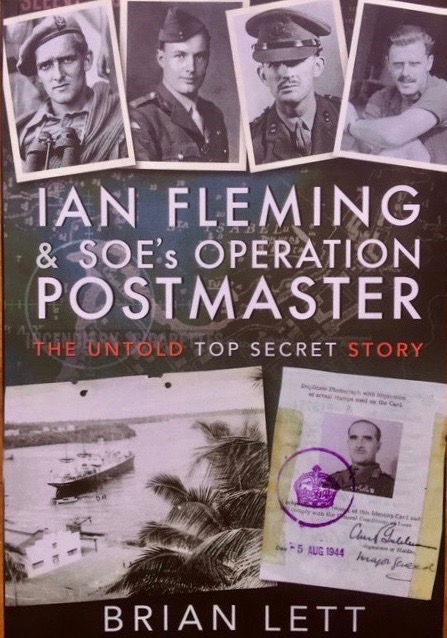
A Deniable Operation Under The Swedish Flag

SAS VC holder Anders Lassen (1st from the left) always catches my attention.

The story they presented was that they were a neutral Swedish crew on a neutral Swedish yacht. In fact, they were a group of SOE agents on an incredibly daring mission, commanded by an actual "M", with whom Ian Fleming worked. This is a book that especially Nordic SOE, SAS & Fleming/Bond buffs can appreciate.

While the Swedish flag was mere camouflage, there were actually Danes aboard, one of whom later would join the SAS and earn a VC, Anders Lassen. Thus it should already be apparent that Ian Fleming & SOE´s Operation Postmaster by Brian Lett is of special interest to Danish military history buffs. Norwegian WWII buffs also have several reasons to pick up this book, because Brigadier Colin Gubbins was "M" and he had a great deal to do with Norway from 1940.

Well, what kind of special operation is Ian Fleming & SOE´s Operation Postmaster about? In 1941 the British started receiving reports that German submarines were using rivers in French parts of Africa for refuelling. At the time, the Special Operations Executive (SOE) was a new outfit with many enemies, not just among the enemy. The SOE had to prove its worth. The cunning plan was to sail a "Swedish" SOE ship, with some great characters, to West Africa and locate German submarine bases. But having arrived in the area the main aim became to steal enemy ships from a neutral Spanish port on the volcanic island of Fernando Po. I will here not give away the wonderful story of what happened but just say that the British Government lied in order to conceal British responsibility for the operation, and basically recommend that you read this book yourself.

Being the author that I am, I do not think that the characterization of Sweden as "pro-German" in Lett´s book is fair. Regardless if one means the Swedish state or the majority of the Swedish people, the largest Swedish sympathies were about Finland, Norway and Denmark. Yes, there were Swedish Nazis and pro-German sympathies, but they never dominated. The thousands of Swedish citizens in Finnish, US and Norwegian service can be compared with the 200 in various German units. For more about Sweden during WWII please turn to e.g. John Gilmour or yours truly.

Nevertheless, Brian Lett´s book is an inspiring and exciting book that should please not just SOE and Fleming/Bond buffs. First published in 2012, the edition I got is from last year. Brian Lett has written other books about special ops and I just recently became aware of his SOE`s Mastermind - Sir Colin Gubbins, a book that I very much look forward to reading.

Thursday, January 30, 2020

Keystone of 22 SAS

Without him there would today probably be no 22nd Special Air Service Regiment.

Quite a few readers of this blog may have read several books about the WWII Special Air Service and also the SAS during recent years. But what about the first postwar decades of the SAS? Here is a book that both covers WWII experiences and some of the more interesting post-1945 SAS episodes until the 1970s. And, of course, there are some Nordic connections.

As some readers may have noticed, I have a special interest in SAS history. This should become more apparent here, as I am planning to blog more about the SAS. Keystone of 22 SAS is, simply put, a fine account both of the life, mostly in the SAS, and times of Lieutenant Colonel John Woodhouse MBE MC. He first experienced combat in a conventional British Army unit in North Africa and there, strangely enough, is the first Nordic connection in the book. For more than twenty years I have been hiking on Arctic WWII battlefields and the type of tin cans that I have most often encountered in German positions are cans that once contained Norwegian fish. Therefore I can recall images from my memory when the book´s author, Alan Hoe (himself an SAS veteran), writes about Woodhouse often eating captured (from the Germans) Norwegian sardines in North Africa.

Keystone of 22 SAS quite often contains Woodhouse´s own words and here are some sentences from his diary in 1944 to give you an idea of his wartime reflections:

"The German soldiers had an unshakable belief in their superiority over all other nations and armies. They had been led to believe that war was glorious and Hitler [...] was invincible. The Wehrmacht was very well led, better equipped and by 1943 more battle experienced than we were. [...] I was often fearful but it always mattered greatly to me that I should be well regarded and respected by the soldiers I commanded. This helped in overcoming fear."

It was in the ruins of the Third Reich that Woodhouse entered a door that eventually led to the SAS. By exaggerating his contacts with Soviet soldiers while he was a PoW, he managed to get a place in a Russian language course. On the successful completion of the course he was posted to Germany where he joined the Control Commission to act as interpreter between Soviet and British military groups. A short time later he was switched to army intelligence. He then exeperienced some memorable encounters both with Soviets, including an early defector, and Germans like Hanna Reitsch, "[...] the only German I met who had the courage still to proclaim loyalty to the Nazis".

In 1950 he reacted positively to an invitation to join the Malayan Scouts and thus fight in the deep jungles of Malaya. He volunteered not least because he was keen to serve under the legendary Mike Calvert, famous for having commanded a Chindit Brigade in Burma. Woodhouse sensed that Calvert was a great source of "original ideas and concepts". Woodhouse became both nervous and "a bit resentful" when Calvert made him Unit Intelligence Officer. But then he meets a very unlikely character in the jungle, "Yorkie" Bjorkman:

"With a good intelligence network the battle is half won. Yes. You can learn a lot from Yorkie. He´s a man with personality, guts and imagination. He´s got thirty Malay police there and he controls the jungle for miles around - controls the jungle."

Bjorkman was awarded both a Distinguished Conduct Medal, the oldest British award for gallantry, and a Military Medal, for bravery. The encounter in the jungle with a man obviously of Nordic extraction is only one of many surprises in Keystone of 22 SAS. The SAS in Cold War Denmark is also part of the book, but one wishes there had been more details in that part.

Woodhouse´s fascinating career did not end at all with his formal retirement in 1964. The year after he was asked by SAS founder David Stirling to lead a team of three men to Yemen and in cooperation with Royalist forces attack an Egyptian airfield. These experiences alone could be made into a good movie.

John Woodhouse passed away in 2008. Now it is time for you to read about his rich life in Keystone of 22 SAS.

Friday, January 24, 2020

The Memoirs of Karl Döenitz

The front cover of the latest edition of this classic Third Reich source.

For students of Germany´s WWII submarine warfare and the very last days of the Greater German Reich (the official name until 23 May 1945) there is one source that must be considered a real must read, The Memoirs of Karl Döenitz.

Many forget that the last head of state of the Großdeutsches Reich, i.e. Greater German Reich, was not Adolf Hitler but Grand Admiral Karl Döenitz (more commonly spelt Dönitz). In 1936 he had been made the supreme submariner, in German Führer der U-Boote. In 1943 he was made supreme commander of the whole German Navy, the Kriegsmarine. After Hitler´s suicide it was Dönitz who headed the remnants of the Third Reich until it ceased to exist on 23 May 1945. Thus it should be clear that there are several reasons why his memoirs have again appeared, in a new paperback version. What is my take then? Well, there is a whole lot here that is still of military relevance, in spite of all technological advances. This is because Dönitz was a very gifted officer and strategist. Had he earlier on been given more power it seems probable that he would at the very least have prolonged the war by some months (or even more) with his submarine "wolf packs". Thus it was fortunate for the Allies that he reached the naval top only in 1943.

The Dönitz memoirs are naturally filled with U-boats and naval strategy and, coming from Dönitz himself, this of course makes fascinating and also very important reading for all naval strategy and U-boat buffs. But, those major ingredients aside, what does Dönitz write about WWII in a more general sense? His mindset becomes pretty clear. Let me quote from page 52: "Whether any war is a war of aggression or not is a purely political question. The policy of any and every country will be to seek to prove that its adversary was the aggressor or that it had itself been menaced and had been compelled to act in self-defense."

Let me also quote a sentence that I find very telling from the following page: "At the outbreak of hostilities, then, I had no idea in my head other than to do my duty." In other words, the political side of these memoirs offers no surprises - it is yet another "my duty" memoir by a former member of the National Socialist German Workers' Party - which he joined on 1 February 1944.

The Dönitz memoirs can at times be a bit demanding reading, but the chapter about the invasion of Norway has an optimal length and explains the major technological significance of this campaign for the Kriegsmarine, the so called "torpedo crisis".

The impact of one British midget submarine, the X6, and its attack on 22 September 1943 in an Arctic fjord (Kåfjord) is pretty clear from these memoirs. The explosion under the German battleship Tirpitz´s stern, caused by a mine from the X6, meant not only big problems for the Kriegsmarine, but a "grave strategic handicap", according to Dönitz. In other words, no small praise for the commander of X6, Commander Donald Cameron VC. Actually, the X6 was not alone in managing to plant a mine, as the X7 also did so, but the point still is that Dönitz credited one midget sub to have caused a "grave strategic handicap".

American readers might want to go straight to the chapter "Operations in American Waters". Had Dönitz received the "timely warning" of the German declaration of war against the United States that he had requested from Hitler, the US would probably have suffered "a real blow".

Speaking about the Großdeutsches Reich, what was to have come after it according to national socialist visions? The answer is the Großgermanisches Reich, for short. The full name being the Großgermanisches Reich der Deutschen Nation meaning the Greater Germanic Reich of the German Nation. But what Dönitz inherited from Hitler was something very, very different.

As a Swede it is interesting to read about how Dönitz viewed the "Schellenberg plan" to surrender German-occupied Norway to Sweden.

The epilogue does not lack self-criticism but is also the one part of the book that should have been considerably longer.

Friday, January 10, 2020

Stunning Scale Models & Dioramas

Here focus on super detailed 1:32 aircraft, e.g. the B-25J Mitchell on the cover.

Few people find the time to spend hundreds of hours on a single scale model. The results can be simply stunning. They certainly are in the books from the Swedish publisher Canfora, and that is why I recently payed them a visit.

Finding little time to myself build scale models, I have come to the conclusion that what I mainly long for is being able to see really good models up close. I mean, REALLY close and in superb photos. Therefore I visited Toni Canfora in Stockholm to discuss his own models and his books - that contain both his finished models and those of many other "model artists" as I would like to call them. On top of the superb photos in all his books Toni Canfora has added really interesting historical facts and model information as well as good captions (IMHO really good books must have really good captions). The main focus of Canfora is scale models and dioramas, but they have other kinds of books too. But first let me show you two more scale model book covers:


What most of all appeals to me with the Canfora scale model books is that some contain dioramas based on actual photographs, like the StuG book above. To me, that sort of diorama is the most amazing to see, the experience can be both like experiencing art and history.

In addition to the now quite many books on scale modeling, Canfora also offer books focused on large & previously mostly unpublished photographs of actual AFVs and aircraft. Mostly taken during WWII. Let me just say how very much I have been surprised by the three AFV Photo Album books about Panther tanks and other AFVs in Czechoslovakia. This is the latest volume, vol 3.


I had never thought that so many previously unpublished amazing Panther photos would appear. Like the scale model books, the AFV books have captions full of information, pointing out lots of details in the photos that one would otherwise miss. Now, do check out all the amazing books from Canfora.