About Me

My photo
Author, film researcher and member of the Swedish Military History Commission.
Showing posts with label SOE. Show all posts

Wednesday, August 25, 2021

"She was not just difficult with the Gestapo"


Never before have I read such a rich, moving but also critical portrait of a WWII heroine. Lindell´s List delivers more than the title and subtitle promise.

A large part of the book deals with the escape and evasion organization for Allied airmen in France that the very British Mary Lindell founded and led. Looking only at this part there are several strong scenes that should inspire not least filmmakers. Let me immediately say that I am aware of the 1991 movie "One Against the Wind" based on Mary Lindell´s WWII experiences. But even though I have yet to see it I feel certain that modern filmmakers should take a close look at Peter Hore´s book Lindell´s List

Having gone through the First World War in France as a Red Cross nurse, Mary Lindell in 1940 decided to resist the German occupiers in France long before there was any large resistance movement. Her immediate and stubborn will to resist against the odds is, the reader soon understands, a consequence of her strong, controversial, character. Few books I have read have made me sense a person´s character as much as this one. It is clear that she could stand her ground as few others. Perhaps her brother summed her up best: "She was not just difficult with the Gestapo, she was difficult with everyone!"

Lindell´s focus was always on the war task at hand, often a supremely difficult or dangerous task that no one had given her, but that she still saw as something she herself had to solve. Not seldom her own children had to pay a hefty price for her decisions. To quote her son Maurice: "She wasn't´t a mother anymore; she was an officer doing a job which she considered was to be done." 

This tremendous devotion to duty led to Lindell´s death, or so it seemed. When her death certificate was about to be signed she came back from the dead, and more resistance work.  

One might think that in a book like this the Germans are mostly minor, evil types. But several Germans come across as friendly and some truly helpful. The half-English SS-Obersturmführer Percival Treite is very much part of Lindell´s List, and one of the book´s most puzzling figures. 

The women on Lindell´s secret Ravensbrück concentration camp list were taken to freedom and, eventually, health in Sweden by hastily painted Swedish Red Cross buses driven by Swedish Army soldiers. The Swedes part of this book, not least in the "Tuesday Club" (Tisdagsklubben) make it required reading for those with a special interest in Sweden during WWII. But Lindell´s List ought to be appreciated by anyone with an interest in occupied France and resistance work.

Thursday, July 08, 2021

Sepals Base Investigation


The most secret WWII Allied bases on Swedish territory are now being investigated by proper field research. Last week I had the privilege to take part in the investigation of an until now in modern Sweden basically unknown base under the Special Force HQ (insignia above with the standard British wings worn by many SFHQ operators).


The location of this Sepals base under SFHQ (and perhaps also the Norwegian XU) and most of the artifacts that we found can at this time not be shown, as the place and most artifacts are still under investigation by Swedish archaeologists. What I now can reveal is that a number of issues of the newspaper Stockholms-Tidningen found their way to this remote mountain location. Given the rarity of that paper above the Arctic Circle it is probable that these papers came to this place as part of the flow of weapons, ammunition, food etc between Allied embassies in Stockholm and the resistance groups in the Norwegian county of Nordland. It is known from Norwegian WWII literature that the place we searched was an important point in the secret supply chain to German-occupied Norway.  


Among the newspapers we found there were several articles that really bring home how the reader back then learnt of the major events as they unfolded. The headlines with Stalingrad and 10,000 destroyed Soviet tanks, see below, remind of the scale and connect the base to the larger picture. 


I could not help being rather amused by finding the below article entitled “Invasion In Western Europe Excluded”, that explains how the German fortifications there had become so numerous that successfully invading Western Europe was now impossible.


We were also reminded by the civilian history of the place by several finds. Again, most are waiting to be properly identified, but below is one artifact identified as the foundation for making traditional Sami shoes.


Finally, I wish to thank all those involved in this trip for making it happen, and for good company in a most beautiful area of the mountains shared by Sweden and Norway. For those of you not familiar with the Sepals bases, check out the books by Roger Albrigtsen and myself.   

Friday, March 26, 2021

Guarding Hitler

A 22-year-old Swiss student decided to kill Adolf Hitler and got very close to succeeding. The capture of two unusual Waffen-SS soldiers in Normandy resulted in another of the many close calls with death that the Nazi leader had. If you are keen to learn about the close protection around Hitler, his body guards and their vehicles, then this book by Dr. Mark Felton should be of great interest to you.  

Mark Felton has become a familiar name to many WWII buffs thanks to YouTube. By January 2021 his main YouTube channel reached one million subscribers. But with books like Guarding Hitler he has shown that he is much more than a talented YouTuber. In Guarding Hitler he tells the story of the SS forces directly responsible for the personal safety of Hitler and while doing so makes it clear how complicated the SS empire was. The number of similar (competing) branches within the SS is quite baffling and reflects a basic feature of the whole German state under National Socialism. The Sicherheitsdienst (SD), the intelligence agency of the SS and NSDAP (Nazi Party), has become well known, but Guarding Hitler instead acquaints the reader more with the two SS forces responsible for Hitler´s close personal security, the rather confusingly named Reichssicherheitsdienst (RSD) that was not part of the SD, and the Führerbegleitkommando (FBK). To not complicate life too much I here only use the last names that these groups had.


Guarding Hitler is not least about the many attempts to kill Hitler – I found the Swiss student´s to be the most fascinating one. Although this subject has been covered in previous books and documentaries, Felton manages to make also these sections of his book highly readable. He presents own archive finds about the British Special Operations Executive (SOE) assassination plan called Operation Foxley. The plan, focused on sending a sniper team to Obersalzberg, was created due to the capture of two very special Waffen-SS soldiers in Normandy in June 1944 – soldiers that made the SOE realize that the security at Hitler´s Obersalzberg complex was not perfect. The prisoners opened up a window of opportunity for the SOE. In my opinion Guarding Hitler has all the ingredients to form the basis for a really strong documentary about Operation Foxley, that of course could be followed by a WWII “what if” movie.     


Nordic readers may be surprised to learn from Guarding Hitler how RSD body guards protected also the Reichskommissars in Norway and Denmark. The RSD came to protect not only Hitler but many leaders of the Third Reich. 


Aviation buffs will no doubt be most interested in what Felton has written about Hitler´s private air force including the “parachute seat” that was added to the personal Condor aircraft of Hitler. To quote from the relevant chapter: “Air travel was dangerous, particularly during wartime, yet Hitler seemed to prefer the risks rather than using his train for most long-distance journeys.”


Hitler´s train is of course also present, the Führersonderzug and what I found particularly interesting in that part was what happened to it after the war, how it was used by different states and that Hitler´s saloon coach (dining carriage) was taken out of service only in 1990 (!) and is now on display in a Bavarian steam locomotive museum.


Well then, Guarding Hitler should be of interest to both the average WWII buff, WWII researchers and close protection specialists.

Monday, September 28, 2020

SOE´s Mastermind

A great read about one of the most influential special operations officers of all time.

His codename was actually “M” as Operations and Training Director of the Special Operations Executive (SOE). He was one of the leading British officers on the ground in Arctic Norway 1940. Long before that he had served in Arctic Russia.


Thus I kick myself for not sooner having read this terrific book about Sir Colin Gubbins. SOE´s Mastermind was first published in 2016 and reviews ought not to appear so long afterwards. But, better late than never. Lawyer and SOE expert Brian Lett starts his book perfectly with the escape from Germany in 1914 that was one of the most fundamental learning experiences of young Colin. Then follow years of extreme hardship as a gunner in the First World War and immediately afterwards, in 1919, on the Russian Archangel front. There he had to adapt not only to the Arctic but also to Soviet fighting methods.


On Ireland and in India Colin Gubbins, initially a very conventional warrior, had to learn even more about irregular fighting methods. The Irish Republican Volunteers became his best “teachers” in how to undermine a conventional army, the British Army. The Army realized that Gubbins had learnt a thing or two about irregular warfare and thus he came to write three handbooks for a planned British resistance movement, the first being The Art of Guerilla Warfare, then A Partisan Leader´s Handbook and finally How to Use High Explosives


But Lieutenant Colonel Gubbins was not to become an armchair general - due to various mishaps he had to assume the role of Temporary Brigadier not far from the Arctic Circle in Norway. In spite of very little relevant training and unfavourable geographical conditions he managed to put up a rather good fight against the Germans, until ordered to evacuate his brigade. In spite of being under attack he managed quite well, earning the Distinguished Service Order (DSO). Many of the men he had led in Norway were recruited into the newly formed Commandos. Gubbins himself was needed elsewhere, to form the British guerrilla army called “Auxiliary Units” or “Auxies” that were never employed but would no doubt have made life difficult for the Germans in an occupied United Kingdom.


Well, then follow the years as SOE´s mastermind, from 1943 also formal overall boss at SOE. Author Brian Lett refrained from writing another history of SOE, instead he mainly focused on what leading an organization for sabotage in several countries entailed. This being a Nordic-focused blog I will here only mention some Scandinavian aspects. It turns out that SOE from Stockholm launched a number of non-violent sabotage operations directly against the Germans in Norway. For example, capsules with utterly evil smelling fluid were smuggled into Norway and there were smeared on German greatcoats. The terrible smell made the garments impossible to wear and, like broken German windows, caused serious discomfort during the winter. 


In my blog post "A Deniable Operation Under the Swedish Flag" I wrote about Brian Lett´s wonderful book Ian Fleming & SOE´s Operation Postmaster. Well, in SOE´s Mastermind one learns of what became of the “Swedes”, among them not least the Danish volunteer Anders Lassen, who later was awarded a Victoria Cross.


Operation Gunnerside, the operation against the German atomic project in Norway, has been covered in many books. Still, the Gunnerside chapter in SOE´s Mastermind does not fail to keep me interested and it makes perfectly clear that Gunnerside became an immediate milestone. To quote Lett: “After Operation Gunnerside Colin found it much easier to obtain cooperation of the regular services for SOE´s operations.”


Finally, there is a very personal link between Colin Gubbins and the Swedish-British SOE operator Malcolm Munthe. His own son Michael served in the SOE together with Munthe. What happened next to Michael was a major blow to the Gubbins family but I shall here only say: do not miss this book and specially not if you are curious about what became of the SOE networks after 1945 - to quote the last chapter´s title “Did SOE Refuse to Die?”.

Tuesday, July 14, 2020

Special Operations South-East Asia 1942-1945

220 pages of amazing special operations in some truly exotic places.

When one hears "special operations during WWII" few will think of other continents than Europe and Africa. But special ops were of course also one method of fighting in Asia. David Miller´s book focuses on three special operations in Asia and especially one of them will surprise just about everyone - as the target was not Japanese but German. There is a Swedish connection, too.

German U-boat successes against Allied merchant ships in the Indian Ocean in 1942-43 became a real problem for the Allies. In fact, German naval forces were active in several parts of Asia, and more active than I had imagined. David Miller´s book has been a real eye-opener for me regarding this aspect of German operations. All three ops featured in his book Special Operations South-East Asia 1942-1945 are amazing to learn about, but the struggle against Japanese forces is what you expect and therefore the Special Operations Executive (SOE) raid against the Germans in Goa is the most spectacular.

At the time, i.e. early 1943, Goa was formally not part of India but Portugal, which explains the German presence. A charming aspect of the British Goa raid, Operation Longshanks/Creek, was that enthusiastic and somewhat unlikely volunteers from the Calcutta Light Horse played a key role. Now, some of you who read this blog post may now be saying "that rings a bell", because you have seen a film from 1980 starring Roger Moore and David Niven, called "The Sea Wolves". That film, based on the 1978 James Leasor novel Boarding Party, was an early signal to the world about the particularly secret SOE operation. But I think you will find this book to be more interesting than that film, not least because it busts a few myths present in the movie.

You might recall from my blog post "A Deniable Operation Under The Swedish Flag" that Swedish aspects manage to pop up even in some very faraway places. Well Special Operations South-East Asia 1942-1945 reminds also of how the US Department of State chartered the Swedish ocean liner Gripsholm as an exchange and repatriation ship. It carried many Japanese and Germans to ports where she could pick up US and Canadian citizens - and bring them home. She sailed with a Swedish captain and crew and made 12 round trips. Exchanges took place at neutral ports such as Goa in Portuguese India. In the article below is a photo showing the Gripsholm in Goa 1943, unloading Red Cross supplies for internees and prisoners of war.

The Gripsholm in The Shanghai Evening Post and Mercury on 24 December 1943.

Monday, March 09, 2020

A Deniable Operation Under The Swedish Flag

SAS VC holder Anders Lassen (1st from the left) always catches my attention.

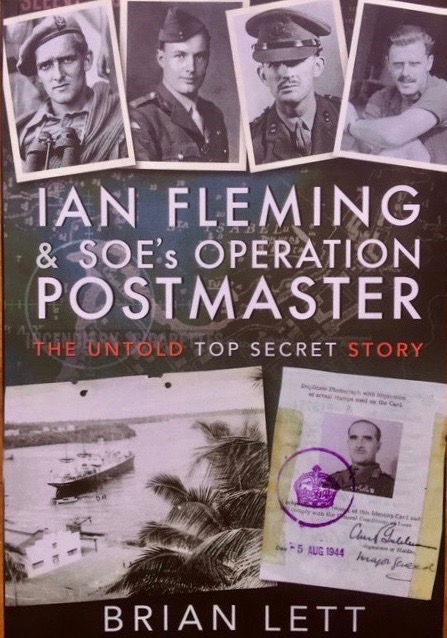
The story they presented was that they were a neutral Swedish crew on a neutral Swedish yacht. In fact, they were a group of SOE agents on an incredibly daring mission, commanded by an actual "M", with whom Ian Fleming worked. This is a book that especially Nordic SOE, SAS & Fleming/Bond buffs can appreciate.

While the Swedish flag was mere camouflage, there were actually Danes aboard, one of whom later would join the SAS and earn a VC, Anders Lassen. Thus it should already be apparent that Ian Fleming & SOE´s Operation Postmaster by Brian Lett is of special interest to Danish military history buffs. Norwegian WWII buffs also have several reasons to pick up this book, because Brigadier Colin Gubbins was "M" and he had a great deal to do with Norway from 1940.

Well, what kind of special operation is Ian Fleming & SOE´s Operation Postmaster about? In 1941 the British started receiving reports that German submarines were using rivers in French parts of Africa for refuelling. At the time, the Special Operations Executive (SOE) was a new outfit with many enemies, not just among the enemy. The SOE had to prove its worth. The cunning plan was to sail a "Swedish" SOE ship, with some great characters, to West Africa and locate German submarine bases. But having arrived in the area the main aim became to steal enemy ships from a neutral Spanish port on the volcanic island of Fernando Po. I will here not give away the wonderful story of what happened but just say that the British Government lied in order to conceal British responsibility for the operation, and basically recommend that you read this book yourself.

Being the author that I am, I do not think that the characterization of Sweden as "pro-German" in Lett´s book is fair. Regardless if one means the Swedish state or the majority of the Swedish people, the largest Swedish sympathies were about Finland, Norway and Denmark. Yes, there were Swedish Nazis and pro-German sympathies, but they never dominated. The thousands of Swedish citizens in Finnish, US and Norwegian service can be compared with the 200 in various German units. For more about Sweden during WWII please turn to e.g. John Gilmour or yours truly.

Nevertheless, Brian Lett´s book is an inspiring and exciting book that should please not just SOE and Fleming/Bond buffs. First published in 2012, the edition I got is from last year. Brian Lett has written other books about special ops and I just recently became aware of his SOE`s Mastermind - Sir Colin Gubbins, a book that I very much look forward to reading.

Monday, March 04, 2019

The Empire Strikes Norway

First to be filmed back in 1979 was Mark Hamill. PHOTO: Dutch National Archives

Forty years ago, the filming of "The Empire Strikes Back" began. The location is more spectacular than most people realize - it is connected to Hitler´s "Uranprojekt".

The first planet you get to know in "Star Wars" (later retitled "Star Wars: Episode IV – A New Hope") is Tatooine, one big, hot desert. Principal photography for that movie began in March 1976 in Tunisia. So, to contrast nicely, the filming of the sequel began near a remote Norwegian village, Finse, on March 5, 1979. The wilderness around Finse, mainly the Hardangerjøkulen (Hardanger Glacier), portrays Hoth, a planet consisting basically of an endless desert of ice and snow. Hoth is the home of the Rebel Alliance's secret Echo Base.

For fans who would like to visit Hoth/Finse, THE place to stay is Hotell Finse 1222, where the now mega-famous cast and crew lodged. Most of the Hoth locations are pretty close to the hotel. Now, to really experience the large Norwegian chunk of "The Empire Strikes Back" there is a special program taking place in Finse March 8-10. But ultra fans will of course be there earlier, to reenact the first scene with Mark Hamill, that was filmed on March 5 due to a bad snow storm that began the day before. The storm made filming that day on the glacier virtually impossible, so director Irvin Kershner instead filmed a scene in which Luke Skywalker was mostly just crawling in the snow. This scene was possible to film with the camera within the hotel. Thus, when Hamill/Skywalker escapes from the snow monster he is actually just some metres from his warm and cozy hotel.

The weather did not stop challenging the production and some props were very well covered with snow. According to a reliable Norwegian source, a few years ago it was still possible to find remains of "The Empire Strikes Back" on the glacier. Now I reckon there are very few, if any, left outside, but at least there are some nice photos in the hotel, as well as an original rebel "ski cap" left behind in 1979. What will always remain is the Hoth landscape, and the atmosphere.

What many Star Wars fans have not realized is that this part of Norway is of global significance not just because of "The Empire Strikes Back". Only some 100 kilometres southeast of Finse one finds Vemork, a hydroelectric power plant outside Rjukan. Vemork was the site of the first plant in the world to mass-produce heavy water - needed for the German nuclear weapons program, the "Uranprojekt". My latest book in Swedish, Elitförband i Norden, happens to partly be about the Special Operations Executive (SOE) sabotage operations that destroyed the heavy water production. So, if you are both a true Star Wars fan and WWII buff, you ought to combine your visit to Finse with seeing Vemork and visiting the museum there.

Wednesday, December 12, 2018

The Gestapo´s Most Improbable Hostage


This book, the indeed improbable wartime experiences of Squadron Leader Hugh Mallory Falconer, proved to be not only very informative but also more thought-provoking and entertaining than I had thought. Most books about the Second World War are limited in their outlook. A few, like this one, rise above the rest and simultaneously tell a strong story from WWII and another, larger one.

I had expected, and also got, a book about life as a special prisoner of the Third Reich and the half-baked idea of the top Nazi leadership to create a pool of prominent hostages, as a kind of insurance policy to make sure that they would be able to survive the defeat of the Third Reich. The essence of this idea was to collect regime opponents, not only foreign ones, that the Nazi leaders deemed were somehow valuable to the outside world. This plan was connected to the larger idea of the "Southern Redoubt" in Austria.

Squadron Leader Hugh Mallory Falconer, a French Foreign Legion veteran and agent of the Special Operations Executive (SOE), delivers a personal account of the Nazi hostage idea that also says a great deal about Nazism itself, mankind in general and how to cope with solitary confinement and mental torture. Mallory effectively teaches about mental strength, the SS guard mindset, secret communications and how to never give up. His survival strategy is a shining example of how to overcome the worst odds, but not inexplicable – he really helps the reader to understand the stages he went through during his long imprisonment.

The Gestapo´s Most Improbable Hostage is a disturbing, inspiring book that also contains some unexpected but very British humour.

Thursday, December 15, 2016

Parachute Containers For Christmas

WWII parachute containers still in situ. From new book "Norges tack till Sverige".

As a reader of this blog you might recall that I have quite often mentioned the parachute operations around Narvik. Amazingly, the not-that-hard-to-find parachute container that I blogged about back in 2010 is still (2016) in situ. Finding any kind of traces of WWII still out in the open is a memorable experience, but finding airborne-related materiel is special indeed.

A new book about Norway and Sweden during WWII shows how parachute containers still today can also be found in situ in Vassfaret, south Norway - see the above photos. I am also glad to see that Swedish Narvik veteran Jan Danielsen is mentioned in the book, entitled Norway´s Thanks To Sweden (In Swedish: Norges tack till Sverige). Generally speaking, the book is filled with WWII in Scandinavia facts, photos and other illustrations. And now comes the most unexpected part - the book is directly available as a free e-book on the new English/Swedish website www.norgestack.se

The kings of Norway and Sweden are on the cover with the "police troops" stone.

The authors, Mats Wallenius and Anders Johansson, have done a great deal to make Swedish covert and not-so-covert support for Norway during WWII more known to the general public. Their work can also be seen out in the open in Stockholm, as they were key persons behind this year´s move of the huge Norwegian "police troops" stone, taken from the Norwegian resistance stronghold Vassfaret (where many parachute containers were dropped). Now, thanks to the move, more residents and guests in Stockholm can see and touch a big piece of Scandinavian WWII history that hopefully will contribute to a broader understanding of Sweden´s support for Norway.

Yours truly by the Norwegian "police troops" memorial. PHOTO: Ella Gyllenhaal

So, during the coming holidays, do please visit www.norgestack.se

Wishing you a Merry Christmas.

Sunday, September 15, 2013

Better Than Bond

Clip mentioning why there are so many cool skiing scenes in Bond movies.

The SOE, No. 30 Commando and various other British James Bond-type units of World War II, where did they all come from? How did they get highly experienced people? A new book by Linda Parker provides more than a few clues.

The origin of the multitude of British special forces and commando units of WWII has been explained by the defeats that Britain experienced in 1939-40. The defeats made the British so desperate that they were willing to try anything new. Well, that explains how the units were allowed to start operating, but not how the units so quickly could be filled with men highly experienced in truly extreme navigation and survival.

Linda Parker has now written the book that provides the answer, and also is a very entertaining read. The title is Ice, Steel and Fire and it lets you follow several amazing British explorers from the most exciting expeditions imagineable to their very active participation in WWII special operations. Personally, Peter Fleming is my favourite, but not just because it turns out he is at least as exciting as his brother Ian of James Bond fame. Of course, Peter Fleming´s first WWII mission was special reconnaissance in Norway...

Sweden too, of course, is part of the book - in the form of two of the main characters. George Binney, the author of With Seaplane and Sledge in the Arctic (1925), during WWII became a blockade buster to procure Swedish ball bearings for Britain. From having been a record-breaking Greenland explorer and an assistant military attaché in Sweden, Andrew Croft did daring naval special operations work for SOE in the Med, i.a. with captured Italian MAS boats.

If you like Indian Jones-style explorers, British special forces and want to know why Bond movies have so many cool skiing scenes, then Ice, Steel and Fire is for you.