About Me

My photo
Author, film researcher and member of the Swedish Military History Commission.
Showing posts with label Poland. Show all posts

Tuesday, December 29, 2020

German Special Operations Book Of The Year

Prewar missions over the UK and Poland; German airfields behind Soviet lines and a "Tatzelwurm" mission against Stalin himself - there is so much amazing stuff in this book, and not just about the Luftwaffe´s most secret missions. Some spectacular photos are also in the book.

The two Russian authors Dmitry Degtev and Dmitry Zubov shed light on several German top secret missions with the help of both Russian archives and previous books only available in Russian. I reckon very few people in the West have seen most of the info and photos presented in this book. It starts with naming Luftwaffe officers involved in prewar reconnaissance missions over Poland, the Soviet Union and the UK. These missions were done mainly by using Deutsche Lufthansa aircraft and the first mission over the UK seems to have taken place in 1937. There are several exact officer and aircraft details in the text but here, like in other places in the book, one would have liked to have seen original documents and/or archival details - because the information is of such great interest. However, later on in the book some original wartime documents are shown, regarding other missions.

The invasion of Norway was of course preceded by secret Luftwaffe reconnaissance flights but nowhere before have I read about the exact aircraft used, and other details. There is also a Swedish connection as the reconnaissance aircraft mostly then used were Fw 200 Condors and part of the trip to and from Norway was a route over Sweden already frequented by civilian Fw 200s from Deutsche Lufthansa.

Most of the book is of course devoted to the Eastern Front and from these pages I believe almost every reader will learn new things about German spies, their equipment, the aircraft used and several secret German airfields behind the Soviet lines. The latter can be explained by very few radar stations, no Soviet night fighters as such and vast uninhabited areas. The many spy missions launched by the Germans over the Soviets, and much increased in numbers after the first German defeats, caused the Soviets to form two new formations: destroyer (anti-sabotage) battalions and a new type of security police, SMERSH, an abbreviation for "Death to spies". But, as the authors also note, quite often the Soviet security organs arrested people who had nothing to do with the Luftwaffe, Abwehr (German military intelligence) or SD (the SS intelligence service). These three German organs came to work together on the Eastern Front to such a degree that the title of the book might as well have contained the words "German special operations". 

Having an interest in the Arctic I was especially keen to read the sections about German insertions in the Arkhangelsk and Komi regions. Even though I have read some about these missions in Finnish books I found lots of new details in The Luftwaffe´s Secret WWII Missions. There are also some to me new details about German operations in Iraq and Iran, even illustrated with a Luftwaffe aerial photograph of an airfield near Teheran. But even more spectacular are the often illustrated pages of the special ops with the rare and futuristic Ar 232 "Tatzelwurm". It had a distinct advantage for special ops: "When taking off and landing on rough ground, eleven additional pairs of small wheels under the lower fuselage came into play, to which special rubber caterpillar tracks could be fitted if necessary."

The highlight of the book is in my opinion the description of Peter Tavrin´s failed but still most amazing Kremlin mission, that includes both German and Soviet photographs and Soviet documents that highlight the role of a "Tatzelwurm" in this desperate 007-type mission to assassinate Stalin. These pages could quite easily be transformed into a blockbuster or a TV series (isn't there already a Russian movie?).

The book ends with psychological portraits of Hitler and the Abwehr´s Wilhelm Canaris, which might seem a bit odd given the Luftwaffe title. But after having read these portraits I think I see the point of the authors. With men like Hitler and Canaris at the top, no secret mission could have altered the final outcome.

Thursday, April 23, 2020

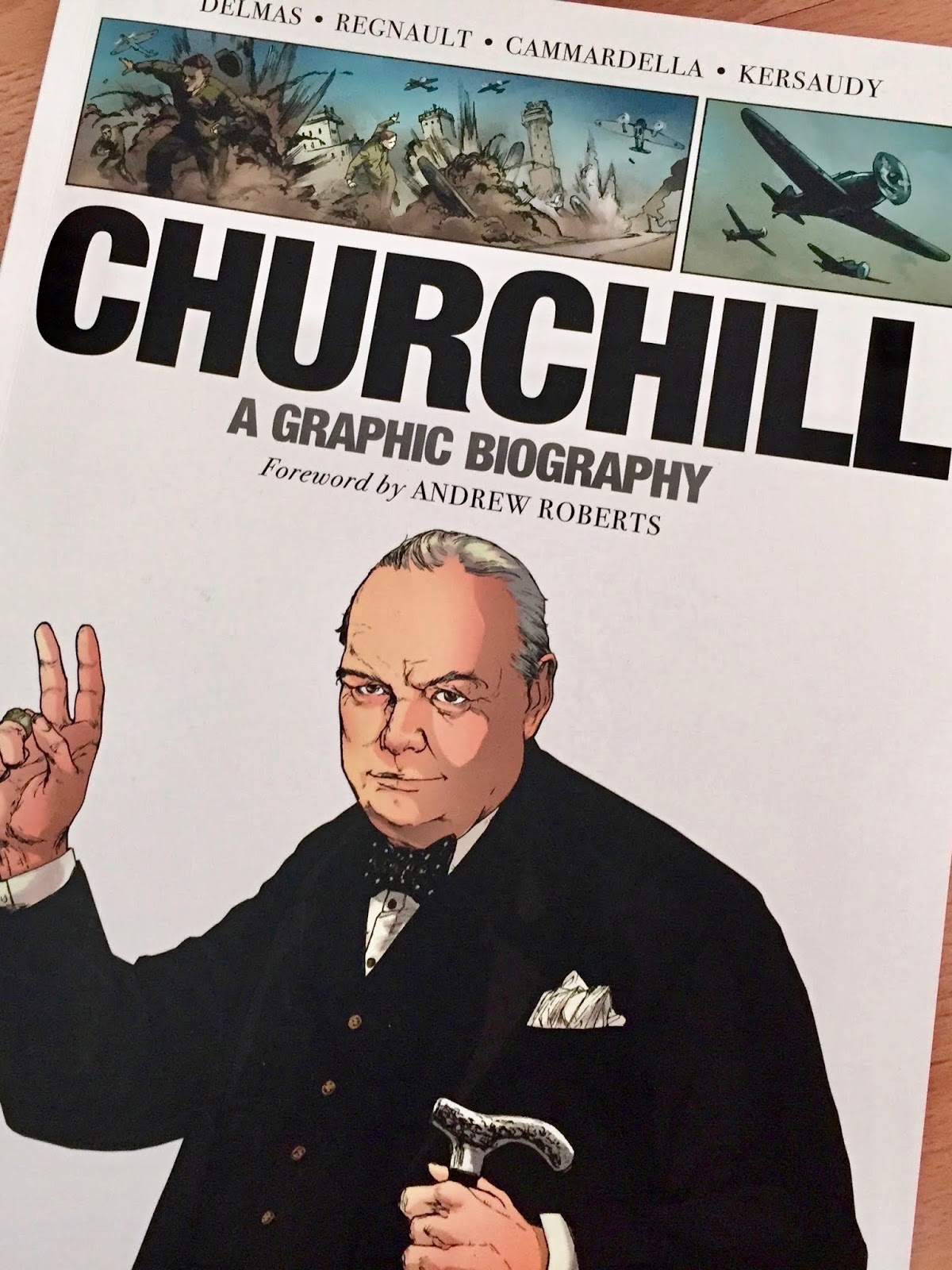
Churchill: A Graphic Biography

Yes, I am reviewing a comic book now! But, trust me - it is seriously good.

Now, Churchill is one fellow that is very hard to summarize. With such a rich and long life in various positions, almost an impossible task. But I´d say that Vincent Delmas has succeeded, both because of the comics and the superb introduction, which is more like an illustrated article.

Of course, lots of important stuff is not part of Churchill: A Graphic Biography, and as a Nordic reader I wanted more about Norway 1940. Still, most of the key moments in his life are here. Speaking about Norway - the heavy water sabotage operation is in the book.

My one real criticism is that the military hardware shown could have been more correct and detailed. But, generally speaking, this is one of the best, if not the best, fact-based comic books that I have read.

One subject that takes up a fairly large part in the final pages of the book is the failure to secure Poland´s independence. Rightly so!

Being a history nerd you have either seen or will probably see the brilliant historical drama web television series "The Crown" created and principally written by Peter Morgan for Netflix. Well, here comes a suggestion for you TV people out there. Check out Churchill: A Graphic Biography by Vincent Delmas etc. Because it is both brilliant and credible. I suspect that this has a lot to do with Francois Kersaudy, the project´s historical consultant. It should be possible to use Churchill: A Graphic Biography as the basis for a Netflix movie, or even a TV series.

Monday, December 30, 2019

My Father Joachim von Ribbentrop

The author´s Waffen-SS years are also in the book, but not in the title & subtitle.

This year (2019) was the final year in the life of Rudolf von Ribbentrop, son of the Third Reich´s foreign minister Joachim von Ribbentrop - the German half of the most common name for the Hitler-Stalin Pact (Molotov-Ribbentrop Pact) that in August 1939 stunned the world. Speaking about 2019, one of the final meetings of President Vladimir Putin this year was largely about this pact.

President Putin has lately talked a great deal about the Molotov-Ribbentrop Pact. There have been reactions to this, not least from the first victim of the pact, Poland. In other words, this first English language edition of Rudolf von Ribbentrop´s book about his father has been released with rather good timing. Most of its 476 pages are indeed about Joachim von Ribbentrop and several passages about him, as well as quotes from him and others, are of great interest. But aside from the direct quotes My Father Joachim von Ribbentrop is a mixed bag. The idea to let the book also be about the author´s own past is understandable. Rudolf von Ribbentrop not only witnessed the rise of the Third Reich from a rather unique position, he joined the SS Infantry Regiment "Deutschland" and took part in the invasion of France 1940. Afterwards he led a platoon of what later became "Nord", in Finland; was assigned to the Leibstandarte "Adolf Hitler"; participated as a tank commander in the Third Battle of Kharkov/Kharkiv and was shot by a sniper while rescuing wounded.

After recovering, the young von Ribbentrop became a Panzer company commander and led his company during the recapture of Kharkov/Kharkiv, after which he received the Knight’s Cross. He was transferred to the SS Division "Hitlerjugend" and was again wounded when a Spitfire attacked his car. Ribbentrop was awarded the German Cross in Gold during the defense of Normandy in 1944. He also took part in the Battle of the Bulge and met Hitler in his bunker in February 1945. All this he describes himself and his words are often fascinating to read. The problem is how these personal experiences are spread out over the book, and that there are passages that indicated to me that the author´s age introduced errors of memory into the text - he was 87 when he finished writing the original (German) manuscript.

Rudolf von Ribbentrop´s take on the origin and conduct of the Second World War is thought-provoking but at times simply not convincing. He did realize that he had served a murderous dictator but he nevertheless believed that Hitler had above all been tricked into attacking Poland - indirectly tricked by conspiring German generals. Where is Alfred Naujocks, Gleiwitz and other German-orchestrated incidents along the Polish-German border? Was I just too tired or did the author attempt to explain away the Lebensraum motive? The pages about his father´s enthusiasm for the pact with Stalin are more interesting, and also credible. My Father Joachim von Ribbentrop does contribute to the picture of Hitler´s foreign minister, but one should read it bearing in mind who wrote it, when he wrote it and only after having read other books about the Molotov–Ribbentrop Pact.

Thursday, November 14, 2019

Red Assault: Soviet Airborne Forces 1939-1941

A truly stunning book, 343 pages of Soviet airborne information and photographs.

For years I have been collecting books about airborne forces and therefore I can guarantee that this book is amazing. Very few readers outside what was once the Soviet Union will have previously seen more than two or three of the book´s photographs. And Red Assault has plenty of photos - that match the surprisingly rich text. And there is a Swedish connection.

Red Assault: Soviet Airborne Forces 1939-1941 by Vladimir Kotelnikov shows, with an amazingly detailed text and lots of different illustrations, that the Soviet airborne were pioneers in more ways than imagined. Because not only does it tell the story of the known airborne equipment and experiments, but also several ideas and tests that have never been documented in any previous book. The early Soviet airborne infatuation with armoured vehicles was not limited to the T-37A amphibious tank. Several other AFVs were tested by the airborne troops. Sketches and fine drawings reveal even more advanced ideas like a "helicopter tank" and then there was the quite adorable "avia-motorcycle" in two variants.

Airborne recoilless guns, an experimental camouflaged jump suit, various parachutes, special gliders, airborne dogs, airdrop sledges - this book has them all and often the quality of both the information and photographs is astounding.

Aircraft buffs will also be baffled, because early Soviet paratroopers were not only dropped from huge TB-3s, Red Assault contains many more types, some very futuristic designs. And now a Swedish connection: "There was a shortage of alloy steel in the country at the time and it had to be imported first and foremost from Sweden."

Not that surprisingly, Mikhail Tukhachevskiy is one of the officers portrayed in this book. But Vladimir Kotelnikov, for credible reasons, writes more about the "fanatic" and "genius" Pavel Grokhovskiy. This airborne pioneer deserves to become better known.

Is there nothing lacking in this book? The parts about the operations in Poland and Finland are short. What about the scope, the book ends in 1941. Well, if it were to cover also 1941-45 with the same degree of detail as 1930-1939 it would be thick as a brick. Better focus on that period in another book. But by the very nature of the events between 1941 and 1945 such a book can not contain as much about airborne development and equipment as Red Assault does. This is because the Soviet airborne forces in 1941-45 found themselves fighting most desperately, largely without aircraft and with no time or resources for airborne development. The Soviet visions of massive airborne operations were not possible to realize until the 1960s.

Sometimes book covers claim that a book is original and contains new insights, photos etc, but the book then actually offers very little that collectors have not seen before. Well, this is just not the case with Red Assault. It delivers. Both airborne and aircraft buffs will be pleasantly surprised by Vladimir Kotelnikov´s book, translated by Kevin Bridge and published by the UK publisher Helion & Company.

Thursday, October 10, 2019

Operation Totalize & Michael Wittmann

Great to better understand Operation Totalize and Michael Wittmann´s last battle.

Having previously blogged about two guides about all of Normandy it is time to look at a new book focusing on an area of particular interest to armour buffs, the area covered by Operation Totalize, during which German tank ace Michael Wittmann was killed.

The new book Operation Totalize by Tim Saunders is filled with both the information, photos and maps that you need to get a good idea of this offensive launched by Allied troops to break through the German defences south of Caen. If you are mostly interested in US forces this book is not for you, because Totalize is the story of Canadian, British and Polish troops fighting against Wehrmacht and Waffen-SS units.

Tim Saunders is of the opinion that it was most likely Sherman Trooper Joe Ekins who took out Michael Wittmann´s Tiger. Ekins belonged to the British 1st Northamptonshire Yeomanry. Saunders presents a plausible scenario but does not exclude another Sherman due to the nature of armoured warfare. Well, thanks to the relevant text, air photograph and map in Operation Totalize one has the tools necessary to visit the battleground in question and oneself judge what is more likely, Joe Ekins or a tank from the Canadian Sherbrooke Fusilier Regiment.

Speaking of tanks, during Totalize the Germans used also some radio-controlled tanks of the type Borgward B IV, operated by the Funklenk-Abteilung 301. This part of the book was a surprise for me, and Saunders has also found a Borgward photo I had not seen before.

If you are an AFV buff, wargamer or intend to do a battlefield tour of the Operation Totalize battlegrounds, you will find this book very helpful and you will want to bring it with you to Normandy.

Let me finally say that the author, Tim Saunders, has found many great photos I had never seen before and I also like how he uses maps and unit insignia.

Monday, July 08, 2019

Swedes Who Fought On D-Day

Personal items from Swedes who fought on D-Day are now on display.

Swedes who fought in Normandy 1944 are for the first time in focus in a museum. Hundreds of Swedes took part in the Allied Normandy operation, mostly at sea. But the Swedish Air Force Museum has of course chosen to focus on Swedes in D-Day aircraft.

It is one thing to read about the only air ace born in Sweden, William Yngve Anderson from Kramfors (see my recent book about him and other Swedes in US WWII service), but it is really something to watch his first air victories, recorded by his Mustang´s automatic camera. Now you can see this footage yourself at the Swedish Air Force Museum, and then see some of his own pilot gear, exhibited thanks to his daughter Gina.

William Yngve Anderson´s flight helmet and goggles, then and now.

The first thing you see when you this summer enter the Swedish Air Force Museum is actually their exhibition about D-Day, and perhaps first of all you will notice a Jeep from one of the Normandy-Swedes, Gösta Wollin from Ystad. Wollin was as a Swedish civilian in Norway while Hitler invaded. Because of that experience and some previous ones acquired in Germany itself, he joined the US 82nd Airborne Division, and jumped with them, actually without parachute training, over Sainte-Mère-Église. During many years his US Army Jeep, that he had legally purchased in 1945, was painted white and used as an offroad toy. Thanks to the Jeep enthusiast Mikael Stenberg the vehicle has been restored and this summer you can see it up close, together with an 82nd airborne paratrooper, at the Swedish Air Force Museum.

Beside Gösta Wollin´s Jeep stands a paratrooper looking like Wollin did on D-Day.

Erik G:son Lewenhaupt MC and Bar from Stockholm was one of the very first men to be dropped from a British aircraft on D-Day, as he was one of the pathfinders leading the British airborne assault. In spite of being a 38 year old Swedish citizen he had been allowed to join the British airborne and was on D-Day an airborne captain (and 40 years old). His exhibited items tell something about the battles that he survived. You will notice his weapons for close quarters combat; a German flag he captured and his Military Cross (he was awarded it twice, thus the MC and Bar). Also his Pegasus-marked jump helmet is on display, and the wrist watch he wore in Normandy. All thanks to his grandson Carl. Click on the photos to watch them in larger size (this goes for all photos on my blogs).

Lewenhaupt´s medals from Finland and Norway 1940, D-Day and other actions.

Hundreds of Swedes took part in D-Day in US, British, Canadian and Polish service. At least one of them was killed in action on D-Day itself, and several were killed some days later. For more about the Swedes in British, Polish, German etc service see Lennart Westberg´s and yours truly´s book Swedes at War (available on Amazon, Adlibris etc). Finally, a cordial THANK YOU to the Swedish Air Force Museum´s Torsten Nilsson and his colleagues, for making this exhibition. It ends on 25 August 2019.

Saturday, December 23, 2017

Rhodes WW2 History Holiday

On my first Rhodes trip I found this presumably Italian bunker while jogging.

Three years in a row we have been spending a week or two on Rhodes. The sun, people, beaches, landscape and food of Rhodes are well known. The island also has an amazing amount of remains of ancient Greece and various European knights. However, one thing is absent in the museums and guide books - the World War Two history of Rhodes.

Being an author with a special interest in 20th century wars I naturally could not miss noticing an old bunker while jogging on Rhodes, see the above photo. Then I had the luck to one day stroll into a cafe/hotel in the Old Town, Avalon. There I noticed a young man working on a very old field radio. I asked if it might be from the war, and it was. Thanks to that chance meeting in Avalon with the archeology student Panos Mprokos I have since been able to see many amazing traces from both the Italian and German occupation periods of Rhodes and it is time I show them here to let other Rhodes visitors know that the island has more World War Two history than you have imagined.

The Old Town then and now, the vehicle is a German assault gun, a StuG III.

About an hours drive from Old Town, an abandoned Italian/German barracks.

With Nietzsche´s words "Gelobt sei, was hart macht", i.e. Praised be what hardens.

These German occupants seem to have been from Danzig, today´s Gdansk.

Then we briefly stopped at Hotel Elaphos, a military hospital during the occupation.

The Italian town of Campochiaro became a German HQ and then Greek Eleousa.

Walking around in the former Italian town/military HQ of Campochiaro (now Eleousa) is a special experience, because for some reason the buildings used by the Italian and German occupiers have been abandoned for many decades, making the occupation seem not that distant.

Back in Rhodes City, an Allied WWII memorial for a Greek officer at El Alamein.

Another chance meeting in Rhodes City, a working BMW R 12 motorcycle.

How to see these places? There are plenty of tours to Rhodes Old Town but I believe there are no organized tours to the Italian/German remains outside it. So, you either do your own research and rent a car, or you find Panos Mprokos via the Avalon cafe/hotel, which is beside the upper part of the Avenue of the Knights in Old Town. Avalon is a really great place both to stay and for a snack or meal. The atmosphere is full of history. Try searching with the words avalon hotel rhodes. Below is a photo of Avalon´s main entrance. Just some words of advice if you choose to travel around the island by car/motorcycle: traffic is not like at home, be very careful and rent a safe car model.

Avalon, my favourite cafe/restaurant/hotel on Rhodes.

P.S. I have written about Rhodes during WWII in two issues of the Swedish journal Militär Historia, in issues 8 and 11 during 2017. Sadly, my articles are neither online nor are they in English, but I can recommend one book in English that has information about British raids against the Axis forces on Rhodes, SBS in World War II by Gavin Mortimer, it is also simply a must for all SBS history buffs.

Friday, June 06, 2014

The Last Living Normandy Swede

The Last Living Normandy Swede fought in a British uniform with Polish insignia, together with the Canadian Army. Here a clip from the Canadian D-Day film "Storming Juno".

I am glad I was sort of wrong. When I wrote my post "D-Day Swedes Forgotten in Sweden" I said I was "sorry to say that we believe that now every Swedish citizen who took part in D-Day has passed away".

Well, yesterday I came to think of that I didn´t have the obituary for Karl Habsburg, a Swedish-Polish volunteer in Normandy. He did not land in Normandy on June 6, but definately was in combat in Normandy and that is more important than the date he arrived. I believed I had heard or read somewhere that he had passed away. But then I checked the net and found out he is still very much alive and I thus could provide a tip for the Swedish daily DN, that today published this article about the Swedes in Normandy. He joined the Polish Army in Britain quite late, in early 1944 via the Polish embassy in Stockholm who put him on a plane of the secret US airline between Sweden and the UK. Although he got no lengthy training he managed to join the 1st Polish Armoured Division in time for the great invasion. His first combat experience was the battle for Caen, where the Poles fought together with the Canadians.

Quite fittingly I today remembered my veteran friends and trips to Normandy by for the first time ever watching "Storming Juno", the Canadian D-Day film (in Sweden called "D-dagen 6 juni 1944"). I must say I was favourably impressed by both the manuscript, cast and look of the movie. It differs from the previous D-Day films not just by totally focusing on the Canadians but also by not having a main hero charachter but rather telling the story of three small units, one airborne, one armoured and one infantry. The teamwork within these units but also between the units. Finally the focus shifts to the surviving (2010) veterans and this is done in a wonderful way.

I have previously blogged about "My Way", a strong war movie that ends with telling the basically true story of the many foreigners (in this case two Koreans!) in German uniform in Normandy. But what is still missing is a full movie about Normandy from a German perspective ("The Last Days of Rommel" is partially about Normandy but not enough IMHO). One could also wish for a French perspective (or is there such a movie?) and why not eventually a movie about Swedes in Normandy?

Thursday, April 05, 2012

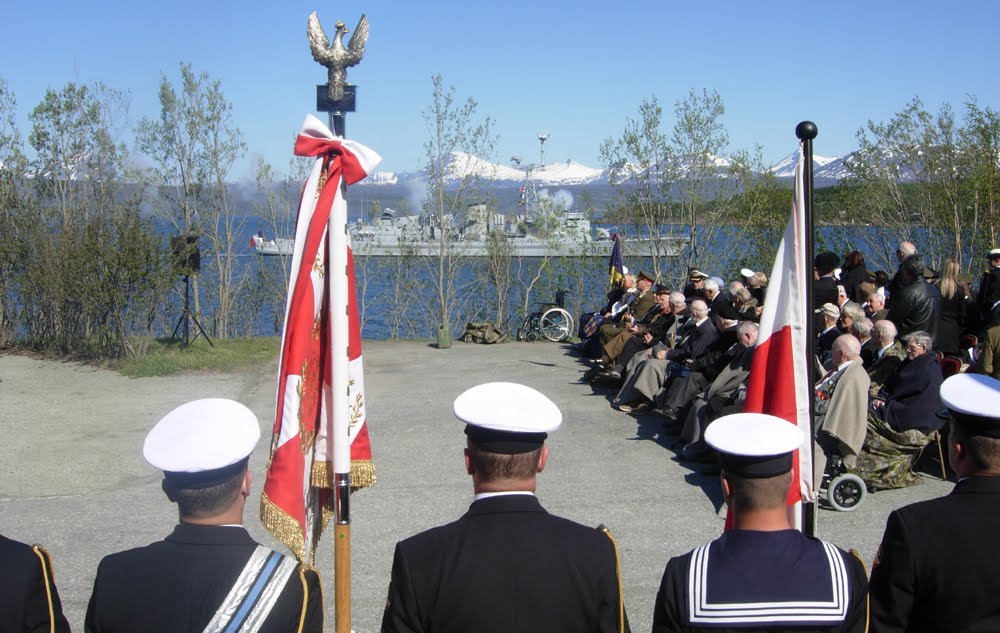
Polish Navy at Narvik in 2010


The best display I have seen I saw at Narvik in 2010 and here it is again!

Two years ago I blogged about the 70th anniversary events in Narvik. Just today Mikael, my friend and travelling companion to Narvik, found a nice video from that day.

The clip shows the most impressive gymnastic abilities of the Polish Navy. Note also their use of the unofficial theme song of our Narvik trips...

BTW I would love to hear more from you Polish visitors of this blog. I can see from the statistics that quite a few people are interested of or have read my book in Polish i.e. Europa Pólnocna 1939-1945 ("Northern Europe 1939-1945"). My questions to you are these:

1. Which Polish town are you writing from?
2. Have you been to Narvik yet?

If you have not been to Narvik yet you might want to click on the words "Poland" and "Narvik" below this post and you'll see all posts about Poland and Narvik that I have written on this blog.

Monday, August 22, 2011

Polish-German Battle on Aksla

On Aksla outside Narvik you can really see "the hand of history". Guess it is impossible to tell if this glove was worn by a German or a Pole? PHOTO: Oyvind Johnsen (and all below photos)

My friend and colleague Oyvind Johnsen in Narvik was kind enough to send me the below photos from a hike to Aksla on Saturday, August 20th. Johnsen is the author of Slaget om Narvik, Sydfronten, which I would translate as The Battle of Narvik: Southern Sector. It sure deserves to be translated not least for the many hike tips.

As can be seen from the below photos this site of a small Polish-German battle still has some German hand grenades (do not touch them) lying about and pieces of clothing like e.g. a life vest presumably from the "Gebirgsmarine" (perhaps it helped someone poorly dressed keep a bit warmer?).


Narvik WWII historian and author Oyvind Johnsen on Aksla.

There were 22 participants on the Saturday hike, among them one Polish visitor who perhaps was the first Pole up there since 1940. My friend Oyvind held a little lecture to the hikers at about 1000 metres. Wish I had been up there too.

Wednesday, June 15, 2011

RIP, My Best Russian Friend

Earlier today I learnt that my best friend in Russia, Roman Kravchenko-Berezhnoy, died the 20th of May. I honestly believe I somehow sensed this. For some weeks now I have felt uneasy for long periods, which I very seldom do.

The book project I have been a part of that I am most proud of was not about one of my own books, but Roman 's book: Victims, Victors: From Nazi Occupation to the Conquest of Germany as Seen by a Red Army Soldier. I was one of its editors.

The main part of the book is Roman's secret wartime diary that he wrote as a teenager in Nazi-occupied Ukraine. At the time his dream was "to survive until our guys got back, become a soldier myself, get a submachine gun, and head westward with them". But what really sets this book apart is that Roman is a very odd volunteer for the Red Army, as he has been raised in Poland, in a home very much part of a Russia that ceased to exist in 1917.

Although Roman after Hitler's 1941 attack against the Soviet Union dearly wants the Red Army to win, his family is not at all Soviet or Communist, it is a Russian family that has lived in a Russian community within a Ukrainian part of Poland until the advent of WWII.


Roman in 1942, while writing his occupation diaries.

Thus, getting to know Roman was getting to know not only a very warm, wise and remarkable gentleman, it was also a fantastic opportunity to get to know Russia before 1917 in the form of a living human being. It is still just as mind-boggling to me as ever, no - even more now, when I think about it.

My friend after having become a submachinegunner and then frontline military interpreter. Here he holds the rank of a sergeant in the Red Army.

Well, as you have already guessed, Roman could realize his dream and become a Red Army solider, in 1944. Thus a part of the book constitutes his candid memories of being a teenage soldier that in a matter of months becomes a seasoned veteran and also gets greater responsibilities when his language skills are discovered. He is then transferred to a reconnaissance detachment.

He fights in Latvia, Poland, and Germany up to the seizure of Berlin. In occupied Germany he serves as a military interpreter for some five years, including for an Inter-Allied group searching for remains of Allied aviators.

Because of the nature of the Stalinist system Roman was then "rewarded" for his long service abroad and contacts with westerners with banishment to a construction battalion in the Motherland.

Roman Kravchenko-Berezhnoy (1926-2011). Teenage writer and soldier and later NCO, scientist and linguist. But above all: a brave, honest man and gentleman.

I was very glad that Roman got to read several wonderful reviews about his book, that in the Russian language was virtually unknown until the advent of the English translation by Marina Guba in 2007, made possible by the small quality publisher Aberjona Press of Bedford, Pennsylvania. For example, Walter S. Dunn wrote in Journal of Military History about it: "A remarkable document, casting light on events little understood. . . . Required reading for students of World War II and modern Russian history."

Still, I must say I am also somewhat disappointed that this moving and "truly unique" (quote from David M. Glantz) book has not yet been translated into my own language, Swedish, although part of the book takes place in Sweden. Amazingly, the author again became a "frontline" interpreter in 1990 while on a hijacked plane that was landed in Sweden. The book also should have a sizeable audience in German-speaking countries and in Poland, where much of the book takes place. I also strongly believe that it could be made into a movie that actually could promote understanding for the Eastern European WWII experience.

To somewhat understand Russia and other states once part of the "Eastern bloc", studying WWII is simply essential. I also believe that especially the Red Army has long been a mystery to westerners for the lack of i.a. translated auto-biographies. Therefore I warmly recommend to those who have not read Victims, Victors to check it out. The book is available from many internet book stores.

Saturday, February 05, 2011

"The Battle for Arctic Europe"

A couple of years ago I was notified that a Polish publishing house wanted to translate Slaget om Nordkalotten which translates as "The Battle for Arctic Europe". I just learnt it will be out in the shops in Poland on Tuesday.

Here is the cover of the Polish translation:

The cover photos feature: OSS NORSO paratroopers bound for Norway; a OSS "Sepals" base in Sweden; the interior of a British Hurricane found on the Russian Kola Peninsula and Soviet soldiers together with a RAF pilot from New Zealand, also on Kola.

I wrote this book together with James F. Gebhardt in the 1990s. It was published the first time in 1999 by Historiska Media. It has sold something like 40,000 copies all editions included.

I learnt about the intention of the Polish company Bellona to publish our book. But this was something like two years ago. Poland was hit badly by the global financial crisis and virtually all publishing plans in Poland were affected, i.e. put on hold or terminated. There was a deal but nothing happened, and I started thinking there would be no Polish version.

Well, it was a pleasure to today learn that after all it will be available in Polish, starting on Tuesday, February 8, 2011.

The title Europa Pólnocna 1939-1945 means "Northern Europe 1939-1945". This may seem a bit strange but it is evidently published in a series called "Wars and Campaigns" and I reckon each book will cover one geographical area. The book is focused on WWII above the Arctic Circle, i.e. in Arctic Europe, but as the book at least gives a rough idea of the fighting also in southern Norway and Finland I suppose the Polish title is OK.

Here is the Polish publisher´s page about the book.

There is more about Poland and Poles in Swedes at War, not least about the amazing Swedish-born Polish Habsburg Princess who became a Polish partisan in early 1940. So I hope that book too will eventually appear in Polish.

Tuesday, January 11, 2011

Battle of Narvik Tour

One of my favourite finds during the 2010 hikes around Narvik, a Norwegian soldiers´s collapsible spade, a moment after it was spotted by a British friend. It should still be there, on the mountain of Kuberget.

The March 2011 issue of Armchair General magazine is on its way to subscribers and newsstands. It features an article by yours truly, entitled "Dietl, Hero of Narvik".

As a Web Extra complementing my article, there is this new Self Guided Tour of the Narvik area that I made. Since I wrote it, a new book has appeared that you should get before venturing out on a battlefield hike. The book is in Norwegian but has many photos and above all GPS maps of the southern Narvik battlefields. It is simply a must-have for exploring the southern area. The title is Slaget om Narvik: Sydfronten, the author is local WWII historian Oyvind Johnsen.

In addition, this Narvik Luger story of mine has also been published online by Armchair General.

Tuesday, November 30, 2010

Stahlhelms in Space

As I wrote some months ago, Darth Vader´s helmet was not as inspired by the classic German Stahlhelm (steel helmet) as one might think. But next year a movie will appear featuring totally WWII-style Stahlhelms in space. On planet earth the Stahlhelm is still serving in at least one country.

This post about the lasting influence of the most classic steel helmet is a sequel to "From Dürer To Darth". If you have not read that one you might want to do so before reading what follows.

Without any inspiration from yours truly my wife recently purchased something for our son that proves just how universal Darth Vader´s helmet has become:

Yes, Darth Vader´s reach now extends to the the socks of our children.

Now I must correct myself, in my previous Stahlhelm-post I wrote "During the final years of East Germany the basic Stahlhelm design was adopted by the US Armed Forces. The result was the PASGT". As an American reader kindly has pointed out to me, that sentence made it sound almost as if the US Armed Forces developed the PASGT-helmet from the Stahlhelm. I was expressing myself carelessly - sorry about that. I think the resemblance of the PASGT-helmet with Stahlhelms was unintentional. The resemblance did, however, lead to the PASGT-helmet being called the "Fritz-helmet".

A helmet similar to the "Fritz" was adopted by the Swedish Armed Forces in 1990, the m/90 helmet. Here is a photo of a guy training for United Nations service wearing a m/90 with a blue helmet cover.

The "Swedish Fritz", the m/90 helmet. I reckon this photo is from 1999.

Swedish firefighters had adopted an even more German-style helmet long before the m/90, but I am not sure when they started using these:

Old Swedish firefighter helmet, in the Piteå Museum. Does someone know when it was intoduced?

But the PASGT-helmet and m/90 can hardly compare with Finnish postwar helmets. For one thing, original German WWII-issued Stahlhelms continued to see service in the Finnish Armed Forces well after WWII and the "new" steel helmet introduced in 1955, the M55 (or m/55), was a copy of the the German WWII M40.

In the field the Finnish Armed Forces used the M55 well into the 1980s and I believe they retained it for ceremonial use a bit longer, does someone know exactly when they stopped using them?

I am not sure which year the armed forces of Afghanistan stopped using original German M16/18 helmets. But there is a photograph from US President Eisenhower's visit to Afghanistan in 1959 where they are still being worn.

There is at least one country that still to this day is using Stahlhelms, Chile:

Chilean military guards of honour still use a Chilean variant of the German M35 helmet. This photo was taken in 2009 in Santiago, Chile. PHOTO: Master Sgt. Adam M. Stump, USAF

From Peter Suciu´s really amazing helmet site I also understand that these Chilean helmets were introduced in the 1930s. The shape is closest to the German M35 helmet. The last (?) batch was produced in the 1980s.

A final question to you, dear reader, exactly which helmet model is featured in the coming movie "Iron Sky"? In the trailer for this dark science-fiction comedy you can see both Stahlhelms and MP 40s on the moon:


So, which is it? Are the storm troopers on the moon wearing repro/original M35s, M40s, M42s or perhaps Finnish M55s? The latter would be most suitable considering it is mainly a Finnish production. Interestingly, the cast of "Iron Sky" includes some internationally rather well-known actors such as Götz Otto, who played Otto Günsche in "The Downfall". The premiere of "Iron Sky" is now more or less exactly one year away (December 2011).

Will "Iron Sky" cement the Stahlhelm as a symbol of Nazism and evil? Possibly, but I find it quite interesting that not only in Finland and Chile the Stahlhelm is not automatically associated with Nazism, and not even with German soldiers. Where do you think the below hero monument stands?

The Warsaw insurgents monument. PHOTO: Cezary Piwowarski

Yes, in Warsaw. The soldiers are Polish guerrillas, resistance fighters. They often wore German helmets as can be seen in numerous wartime photographs.

Well, that was my concluding take on the influence and significance of the Stahlhelm, from sock icon to "Iron Sky".

P.S.
Thanks to a blog reader and helmet collector I am now aware of this almost-too-good-to-be-true Iraqi helmet actually inspired by Darth Vader´s helmet. No kidding!

Monday, November 08, 2010

Raiders of Modern Empires

World War Two and the Cold War are still present in the countryside of Poland and the Baltic states in such a strong way that is hard to grasp for us citizens from historically more fortunate nations.

Remains of a Soviet sailor in a former Soviet naval base. PHOTO: Jan Jörnmark

To comprehend what Poland, Estonia, Latvia and Lithuania went through during the 20th century, reading can only get you so far. Then you have to talk to those who were there and see the remains of the imperial projects in the region.

Jan Jörnmark has documented with his camera not only various remains of the German and Soviet empires but also all kinds of forgotten giant projects in Europe and the United States. Jörnmark´s website is simply a must if you are into travelling back 30, 70 or a 100 years ago.

But to get the full story of these mainly WWII and Cold War related sites you should get his latest book, produced together with Katarina Wikars. The book is so far only available in Swedish but can be bought just for the sake of the photographs. If you can read Swedish you are in for an ever stronger experience. The title is Atomtorg, porrharar & Hitlerslussar, which translates as "Atomic Squares, Porn-Hares and Hitler Sluices".

Imagine a very disturbing but also beautiful roadmovie - that´s what this book is like.

Tuesday, June 01, 2010

Narvik Veterans - a Tough Breed Indeed


Never before have I met so many impressive and fit 90-year-olds, as I did this weekend in Narvik during the 70th anniversary of the liberation of Narvik (May 28). Narvik was in its best mood and also greeted modern soldiers from five nations including Germany.

In the town of Narvik summer had just arrived. Just a bit up into the mountains it was still late winter.

A Twenty-one gun salute was fired from a French frigate in the morning in honour of the attending veterans and other guests. After this, Norwegian F-16s and British Tornado fighters made some spectacular fly pasts above the crowd. Bands played. ambassadors - including Germany´s - held eloquent speeches and wreaths were layed on monuments and graves.

Most veterans seemed to be from Poland and Norway but there were at least three French alpine ranger veterans attending. Several veterans wore military berets and two Polish veterans wore complete uniforms. Here is one of them (click on the images if you wish to see them in larger size):


No German veterans were sighted but they were remembered too and there were modern German officers attending. The German flag was prominent in the parade that went from the common war cemetery to the main town square.

Note the third flag from the front, in front of the French flag. A bit surprising, I must say.

Edelweiss insignia was present, but not on German uniforms. It so happens that the Polish mountain infantry have the same symbol on their collars and right arm.

Greeting the Poles is Norway´s Chief of Defence, General Harald Sunde. And yes, that is a German officer to the right of him.

The main hosts of the ceremonies were General Sunde and Narvik´s town mayor Karen Margrethe Kuvaas, standing side by side in the following photo:


For me, personally, the most amazing veteran attending was Jan Danielsen, the last living Swedish veteran of Narvik. Danielsen was a Swedish cavalry officer when he in late 1939 volunteered for Finland and served in the "Winter War". This could be done with the approval and finally also support of the Swedish government. After Germany on April 9 1940 invaded Norway the Swedish government did not even approve of the formation of a volunteer corps for Norway. Still, Jan Danielsen and some 300 other Swedish citizens crossed the border with Norway to volunteer. Perhaps half of them saw combat. Twelve of the latter at Narvik.

Jan Danielsen was effectively given command of a Norwegian platoon in the high altitude fighting. His closest friend, from the same Swedish cavalry regiment, was killed in action. Still, he led his men onwards. That he and his men did not advance all the way into Bjoernfjell was no fault of Danielsen´s but of the larger strategy.

The following photo shows Jan Danielsen, wearing one of his Norwegian medals and his Finnish Winter War medal, together with local 1940 reenactor Jon K. Johnsen:

Johnsen is wearing the very same type of uniform that Danielsen wore in 1940.

There were more reenactors in the main town square, displaying WWII uniforms together with WWII military vehicles such as this British Humber scout car:

The Bren gunner is the former director of the Troms Defence Museum, Finn Fossum. Behind the Humber a M29C Weasel tracked vehicle can be seen.

Here is another reenactor, showing what the British airborne looked like:

Behind him a magnificent Dodge ambulance can be seen.

The Troms Defence Museum in Setermoen also displayed some postwar vehicles, like this tank-busting Norwegian Willys Jeep:


I will be writing more about the events of the day and individual Narvik veterans in two coming articles. The above photos are not the best ones I took. Hopefully the articles will later be online and I will then post links to them.

Finally just a photo to show you the view from our dinner table on May 28:


Sitting by the Rombak fjord is my good friend and travelling companion Mikael Norman. After dinner we followed the route of the Allied invasion force up into the mountains. Of course, we found several traces of the events exactly 70 years ago, thanks largely to local WWII historian Öyvind Johnsen, who has just released a very good battlefield guide. More about those traces in the coming articles.