About Me

My photo
Author, film researcher and member of the Swedish Military History Commission.
Showing posts with label SAS. Show all posts

Saturday, November 21, 2020

SAS Jeep Operations in Germany and Norway


It´s not every day that you find a new book about the SAS in Norway and discover one more Nordic in the ranks of the SAS. Well, With the SAS Across the Rhine is mainly about final operations on German soil. Still, it is well worth getting and now for some details.


Unlike some SAS books this one by the late (he died in 2002) Colonel Ian Wellsted OBE, MA, is very personal, it has plenty of details about his love life. This may put off some readers, but should not – because Wellsted´s memoir highlights something probably quite common – how a turbulent emotional conflict at home can follow a soldier to the battlefield and affect his behaviour a lot.    


In January 1945 Ian Wellsted is trained in the French alps for operations in Norway together with a Danish SAS member I had never heard of before. No, I am not talking about Anders Lassen VC. Every Nordic reader into SAS history knows about Lassen. Wellsted writes about Paul Jensen, a former Spanish Civil War volunteer who after the German invasion of his homeland had become active in a Danish resistance organization until he had to flee to the UK, where he joined the SAS. No year for this is given but Wellsted writes about the man on several pages and Danish history buffs should thus be able to track him down. Would love to find out more about Paul Jensen, or perhaps that was not his actual name? Let me know, dear Danish readers.


To get into the right shape for Norway the SAS men are helped by French alpine rangers, chasseurs alpins, and the part about them was for me extra enjoyable as I have had the pleasure of observing them on an exercise. To be precise I was skiing with the 27thAlpine Ranger Battalion. I thus relate to Ian Wellsted´s warm feelings for his cool French hosts. 


After about a month in the alps the SAS skiers were told Norway was no longer a top priority (but Norway will come back on the agenda) and they were instead sent to Germany to there constitute an advance party with armoured jeeps. So, all you SAS jeep fans, here is a book you will definitely want to read. Wellsted´s jeep battle accounts are supported by 16 photos, not always top quality but none of which I have seen before, and some tactical maps. 


In Germany the author confronts not only German snipers but also a most tense situation with one of his own that obviously is suffering from extreme battle fatigue. 


Once Germany has fallen Norway returns on the SAS agenda. Of course, we now all know that this also broke the German will to fight on in Norway. But at the time things were not so evident, and Wellsted paints a vivid picture of what Norway was like just after the general German surrender. One only wishes this part had been a bit longer and that there had been more photos from it. But the one photo that there is, is of particular interest, with many nice jeep details.


With the SAS Across the Rhine (155 pages) ends with a very modern take on what the WWII SAS was all about and lessons to be learnt from them. This part has been written by one of New Zealand´s greatest SAS history buffs, Terence Gardiner, a retired air commodore, and is in itself worth your time. 

Tuesday, June 16, 2020

New LRDG Field Research Expedition

The issue includes two LRDG buff expeditions and some remarkable barn finds.

The times are strange and more trouble seems to be brewing. Still, there is some good news for fans of the early Long Range Desert Group (LRDG) and Special Air Service (SAS) - in the June 2020 issue of Classic Military Vehicle.

CMV has put together a very special LRDG 80th anniversary issue. It starts with a terrific and very visual summary by Toby Savage about the Egyptian LRDG field research trip featured in-depth in Karl-Gunnar Noréns and my book The Long Range Desert Group: History & Legacy, which is also shown in the article.

Very happy too see our book and the LRDG Preservation Society in CMV.

Toby brought along a kite on the trip and took aerial photographs with it and his article starts with a stunning example. The same CMV issue contains a complete surprise for me, an article by James Davis and Martin Spriggs about their Tunisia expedition in late 2019 to find LRDG patrol vehicles. While no complete vehicles were found, LRDG buffs will still find the article of interest and the finds they did make prove that there is more out there to be found. Good to learn about this and that the search in the area will continue.

I was chuffed to bits that CMV editor Andrew Stone was also able to do an interview with LRDG veteran Jack Mann, who was present at our book launch in London last year. Just before Stone was to meet the amazing Mann the pandemic changed everything. But IMHO the interview, mainly by telephone, turned out nicely and above all transmits some of Jack Mann´s remarkable attitude. No wonder he later served with the SAS.

Another morale-boosting section of this CMV issue is the "Military Vehicle Market" that includes some really inspiring barn finds. If you too have a soft spot for the Daimler Dingo - well, then you will just love the issue´s Dingo story. Now, don´t tell me that you also appreciate the odd Panzer? Well, the June issue also has a great Jagdpanzer 38 article that of course also has a Swedish connection. If you have trouble finding CMV for sale where you live, you might consider getting a (digital) CMV subscription.

Wednesday, April 29, 2020

When The SAS Stormed An Embassy

The SAS operation "Nimrod" took place here in 1980. My photo from 2019.

30 April 2020 it is 40 years since the start of one of the most famous anti-terrorist operations ever. In the end, Special Air Service (SAS) operators saved all but one of the remaining hostages. Do watch the movie about the event, but bear in mind that it says very little about one lesson from the event - a lesson that we ought to be more aware of.

As a kid in the early 1980s I was favourably impressed by the abseiling SAS soldiers that hit the global news. But their appearance at the Iranian embassy in London was also a bit terrifying. Dressed largely in black, with their faces inside black respirators and wielding black submachine guns (Heckler & Koch MP5s), they looked rather sinister (Darth Vader-ish). Naturally, as soon as "6 Days" was released I was keen to see how a detailed reenactment of the event would look like. Well, it is not just about the 17 minute SAS assault, but about the whole Iranian embassy siege of 30 April to 5 May 1980. The siege situation is presented from three perspectives and it is quite moving to follow the negotiator Max Vernon (Mark Strong). But, being fond of books about the SAS, I was more interested in the SAS perspective, i.e. Rusty Firmin (Jamie Bell). "6 Days" made me wonder about some of his decisions and therefore I wanted to know more from the actual Rusty Firmin. Here is the book by him that I then got:

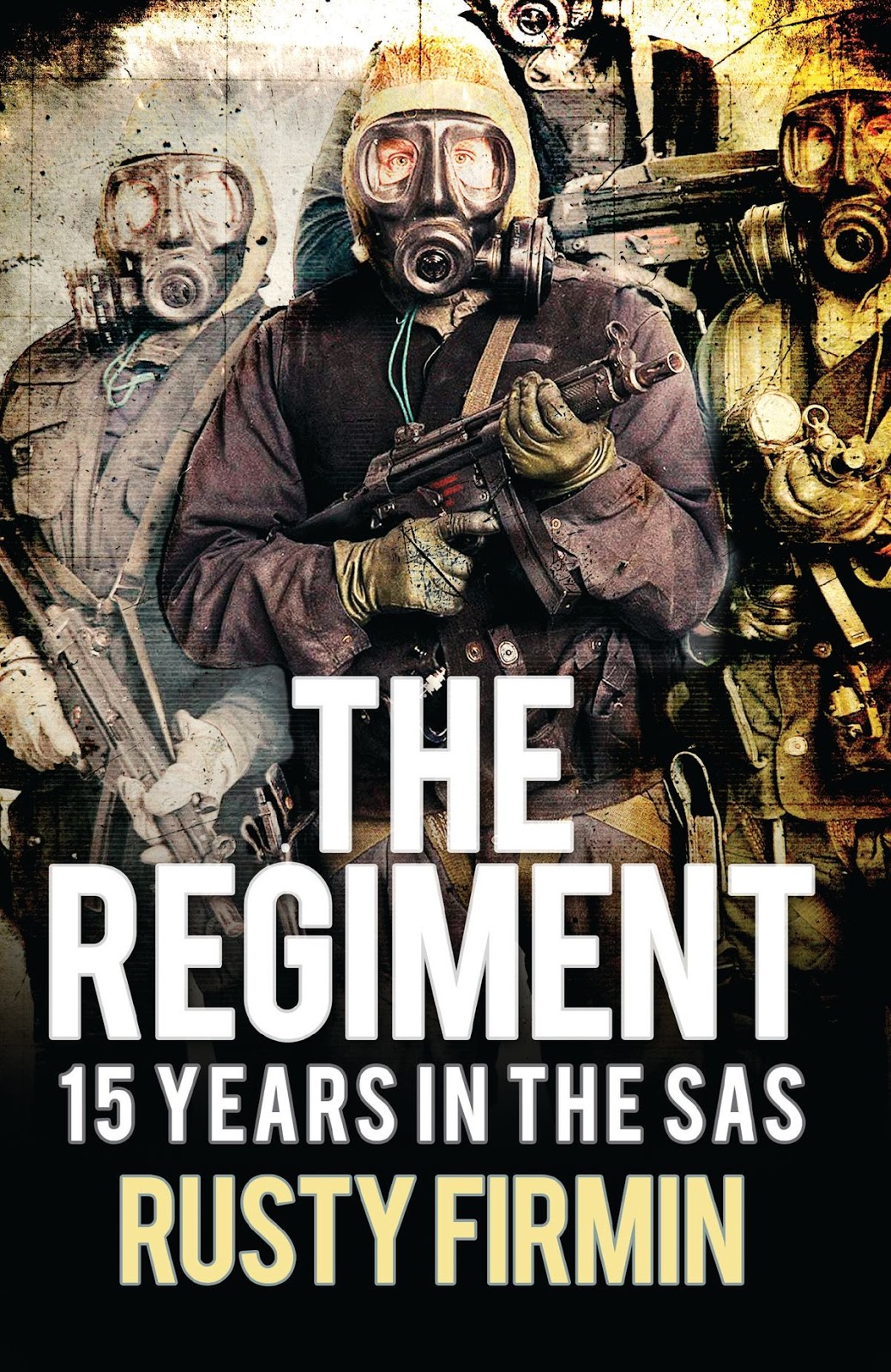
The book Rusty Firmin wrote about his career in the SAS. Some surprising insights.

Rusty Firmin´s The Regiment (2015) explains a key moment in the embassy that the movie "6 Days" portrays rather poorly, it seems to me. There is also the book focusing on the siege that Firmin wrote together with Will Pearson, entitled Go! Go! Go! (2011), and then there is e.g. Who Dares Wins (2009) by Gregory Fremont-Barnes. But hey, no book will probably affect the general public´s knowledge about the event as much as the movie "6 Days", which is why I decided to write this blog post. In spite of everything that I appreciate in "6 Days", there is one big thing the film makers could have done better. Who was behind the whole thing? Of course, the movie informs a bit about the terrorist group that took over the embassy, the Democratic Revolutionary Front for the Liberation of Arabistan. However, there was a state behind the group: Iraq. The Iraqi state under Saddam Hussein not only prepared, financed and supplied the terrorists (e.g. with Soviet RGD-5 hand grenades and Czechoslovak Skorpions). One of their Iraqi intelligence handlers had even taken them to London. In "6 Days" this is summarized too much, the relevant scene is so short that some may miss it.

So, what on the surface looked like the act of a terrorist group of Arabian separatists from Iran was more like an Iraqi strike against Iran. Byt why is this small proxy war in London forty years ago relevant for us in 2020? Well, there were several terrorist actions during the 1980s, in different countries, that still today are sometimes not portrayed as what they mostly were, war by proxy. That is a form of warfare that has made a comeback in recent years, and therefore we need to be able to identify and understand it. Iraq under Saddam was not the main culprit, usually it was one or more security/intelligence agencies from the Soviet bloc. But these quite often used terrorists, not least Arab terrorists. This modus operandi even affected my native Sweden, and it took many years for Swedes to start realizing this.

Seeing the Iranian embassy in London today is just like seeing it on 30 April 1980. It was seriously damaged at the end of the siege but has been nicely restored. It is easy to see the embassy yourself as it is in the heart of London. There are some other places connected to SAS history not far from the embassy and I will be writing about these in a London guide that I intend to release here in a month or so.

Monday, March 09, 2020

A Deniable Operation Under The Swedish Flag

SAS VC holder Anders Lassen (1st from the left) always catches my attention.

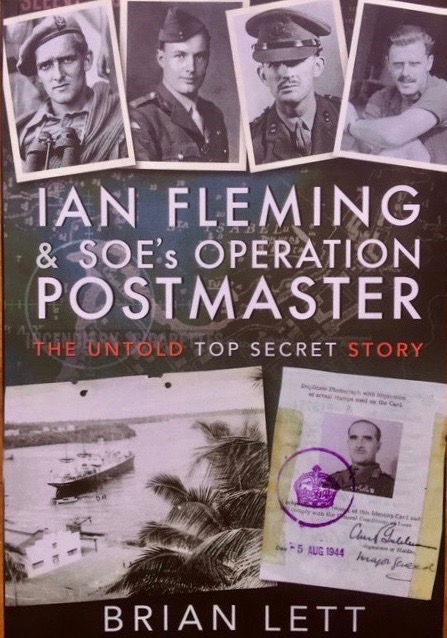
The story they presented was that they were a neutral Swedish crew on a neutral Swedish yacht. In fact, they were a group of SOE agents on an incredibly daring mission, commanded by an actual "M", with whom Ian Fleming worked. This is a book that especially Nordic SOE, SAS & Fleming/Bond buffs can appreciate.

While the Swedish flag was mere camouflage, there were actually Danes aboard, one of whom later would join the SAS and earn a VC, Anders Lassen. Thus it should already be apparent that Ian Fleming & SOE´s Operation Postmaster by Brian Lett is of special interest to Danish military history buffs. Norwegian WWII buffs also have several reasons to pick up this book, because Brigadier Colin Gubbins was "M" and he had a great deal to do with Norway from 1940.

Well, what kind of special operation is Ian Fleming & SOE´s Operation Postmaster about? In 1941 the British started receiving reports that German submarines were using rivers in French parts of Africa for refuelling. At the time, the Special Operations Executive (SOE) was a new outfit with many enemies, not just among the enemy. The SOE had to prove its worth. The cunning plan was to sail a "Swedish" SOE ship, with some great characters, to West Africa and locate German submarine bases. But having arrived in the area the main aim became to steal enemy ships from a neutral Spanish port on the volcanic island of Fernando Po. I will here not give away the wonderful story of what happened but just say that the British Government lied in order to conceal British responsibility for the operation, and basically recommend that you read this book yourself.

Being the author that I am, I do not think that the characterization of Sweden as "pro-German" in Lett´s book is fair. Regardless if one means the Swedish state or the majority of the Swedish people, the largest Swedish sympathies were about Finland, Norway and Denmark. Yes, there were Swedish Nazis and pro-German sympathies, but they never dominated. The thousands of Swedish citizens in Finnish, US and Norwegian service can be compared with the 200 in various German units. For more about Sweden during WWII please turn to e.g. John Gilmour or yours truly.

Nevertheless, Brian Lett´s book is an inspiring and exciting book that should please not just SOE and Fleming/Bond buffs. First published in 2012, the edition I got is from last year. Brian Lett has written other books about special ops and I just recently became aware of his SOE`s Mastermind - Sir Colin Gubbins, a book that I very much look forward to reading.

Thursday, January 30, 2020

Keystone of 22 SAS

Without him there would today probably be no 22nd Special Air Service Regiment.

Quite a few readers of this blog may have read several books about the WWII Special Air Service and also the SAS during recent years. But what about the first postwar decades of the SAS? Here is a book that both covers WWII experiences and some of the more interesting post-1945 SAS episodes until the 1970s. And, of course, there are some Nordic connections.

As some readers may have noticed, I have a special interest in SAS history. This should become more apparent here, as I am planning to blog more about the SAS. Keystone of 22 SAS is, simply put, a fine account both of the life, mostly in the SAS, and times of Lieutenant Colonel John Woodhouse MBE MC. He first experienced combat in a conventional British Army unit in North Africa and there, strangely enough, is the first Nordic connection in the book. For more than twenty years I have been hiking on Arctic WWII battlefields and the type of tin cans that I have most often encountered in German positions are cans that once contained Norwegian fish. Therefore I can recall images from my memory when the book´s author, Alan Hoe (himself an SAS veteran), writes about Woodhouse often eating captured (from the Germans) Norwegian sardines in North Africa.

Keystone of 22 SAS quite often contains Woodhouse´s own words and here are some sentences from his diary in 1944 to give you an idea of his wartime reflections:

"The German soldiers had an unshakable belief in their superiority over all other nations and armies. They had been led to believe that war was glorious and Hitler [...] was invincible. The Wehrmacht was very well led, better equipped and by 1943 more battle experienced than we were. [...] I was often fearful but it always mattered greatly to me that I should be well regarded and respected by the soldiers I commanded. This helped in overcoming fear."

It was in the ruins of the Third Reich that Woodhouse entered a door that eventually led to the SAS. By exaggerating his contacts with Soviet soldiers while he was a PoW, he managed to get a place in a Russian language course. On the successful completion of the course he was posted to Germany where he joined the Control Commission to act as interpreter between Soviet and British military groups. A short time later he was switched to army intelligence. He then exeperienced some memorable encounters both with Soviets, including an early defector, and Germans like Hanna Reitsch, "[...] the only German I met who had the courage still to proclaim loyalty to the Nazis".

In 1950 he reacted positively to an invitation to join the Malayan Scouts and thus fight in the deep jungles of Malaya. He volunteered not least because he was keen to serve under the legendary Mike Calvert, famous for having commanded a Chindit Brigade in Burma. Woodhouse sensed that Calvert was a great source of "original ideas and concepts". Woodhouse became both nervous and "a bit resentful" when Calvert made him Unit Intelligence Officer. But then he meets a very unlikely character in the jungle, "Yorkie" Bjorkman:

"With a good intelligence network the battle is half won. Yes. You can learn a lot from Yorkie. He´s a man with personality, guts and imagination. He´s got thirty Malay police there and he controls the jungle for miles around - controls the jungle."

Bjorkman was awarded both a Distinguished Conduct Medal, the oldest British award for gallantry, and a Military Medal, for bravery. The encounter in the jungle with a man obviously of Nordic extraction is only one of many surprises in Keystone of 22 SAS. The SAS in Cold War Denmark is also part of the book, but one wishes there had been more details in that part.

Woodhouse´s fascinating career did not end at all with his formal retirement in 1964. The year after he was asked by SAS founder David Stirling to lead a team of three men to Yemen and in cooperation with Royalist forces attack an Egyptian airfield. These experiences alone could be made into a good movie.

John Woodhouse passed away in 2008. Now it is time for you to read about his rich life in Keystone of 22 SAS.

Saturday, August 31, 2019

LRDG & SAS Traces On Rhodes

Mussolini´s castle in Rhodes is not the only reminder of WWII on the island.

Could there really be traces of the Long Range Desert Group (LRDG) and Special Air Service (SAS) on the island of Rhodes, not far from the old town? Yes there are such traces but you will not learn about them from most Rhodes guides.

The Palace of the Grand Master of the Knights of Rhodes is not just a Gothic castle inside the old town on Rhodes. During the Italian period on Rhodes (1912-1943) the castle was extensively restored and became a holiday residence first for the Italian king and later for Fascist dictator Benito Mussolini, whose name can actually still be seen on a wall by the castle entrance. That wall and the The Rhodes Jewish Museum would to many visitors seem to be the only traces of WWII on the island, but there is actually much, much more to see, especially if you venture outside the old town.

In this old blog post I presented my first tips where to look for traces of the Italian and German occupation periods. Some days ago I returned from our latest Rhodes holiday, during which I found rather intact WWII trenches and the ruins of an Italian WWII workshop, and visited two sites connected to the LRDG and SAS.

This is where a trooper of the LRDG rests, south of the old town on Rhodes.

Hector Mallett came from the NZ cavalry, but was killed while serving in the LRDG.

Why on earth is there a Long Range Desert Group trooper in the Commonwealth war cemetery on Rhodes? Surely there are no deserts on Rhodes? Well, let me first explain that after the North African campaign ended in May 1943 the LRDG became more like the SAS/SBS and was used mainly for raids/sabotage on various Mediterranean islands and in Italy and Yugoslavia. New Zealand LRDG Trooper Hector Mallett died from wounds he sustained during an assault against the Germans on the small island of Levita (now Levitha), more than 100 kilometers from Rhodes. The cemetery is not only for those who lost their lives on Rhodes but also on many other islands in the region, some quite isolated. The Rhodes cemetery is located in the southern outskirts of the city of Rhodes, by the old coastal road to Lindos, opposite the Italian, Jewish and Turkish cemeteries.

After a long jog from our hotel, the joy of finding the Sacred Band/Squadron.

What about traces of the SAS then? Well, first find Mandraki Port. Just north of it stands a war memorial not far from the water, topped with a winged bronze figure representing Victory. It is located in Pl. Antinavarchou Perikli Ioannidi. One of the units specifically named on the memorial and also represented by its insignia is the Sacred Band (or Sacred Squadron). This Greek special forces unit was attached to the SAS from March 1942 and below is a close up of their insignia including the motto "Return Victorious or Dead" (in Greek), said to be the words with which Greek wives once saw their men off to battle.

The Sacred Band insignia in bronze was worn on the right breast of the uniform.

By conducting literally hundreds of island raids together with the SBS, the Sacred Band pinned down thousands of German troops on many islands, thus preventing them from reinforcing the German troops in Italy or France. There are two images of the Sacred Band in action on the war memorial, the better preserved one can be seen below.

Sacred Band soldier scaling some cliffs, depicted on the Rhodes war memorial.

In the modern Greek Army, the Sacred Band's traditions are carried on by the 1st Raider/Paratrooper Brigade, that sports both the band´s sword and the motto of the SAS "Who Dares Wins" in Greek: O Tolmon Nika. If you are a bit of a patch collector you might want to know that the below one was purchased in an army store a short walk from the memorial.

Greek 1st Raider/Paratrooper Brigade patch bought just north of the old town.

What about the WWII trenches and ruins of an Italian workshop that I also found? Well, I need some more input before blogging about them - but don't worry, I will eventually get that and then blog some more about Rhodes.