About Me

My photo
Author, film researcher and member of the Swedish Military History Commission.
Showing posts with label Spain. Show all posts

Saturday, November 21, 2020

SAS Jeep Operations in Germany and Norway


It´s not every day that you find a new book about the SAS in Norway and discover one more Nordic in the ranks of the SAS. Well, With the SAS Across the Rhine is mainly about final operations on German soil. Still, it is well worth getting and now for some details.


Unlike some SAS books this one by the late (he died in 2002) Colonel Ian Wellsted OBE, MA, is very personal, it has plenty of details about his love life. This may put off some readers, but should not – because Wellsted´s memoir highlights something probably quite common – how a turbulent emotional conflict at home can follow a soldier to the battlefield and affect his behaviour a lot.    


In January 1945 Ian Wellsted is trained in the French alps for operations in Norway together with a Danish SAS member I had never heard of before. No, I am not talking about Anders Lassen VC. Every Nordic reader into SAS history knows about Lassen. Wellsted writes about Paul Jensen, a former Spanish Civil War volunteer who after the German invasion of his homeland had become active in a Danish resistance organization until he had to flee to the UK, where he joined the SAS. No year for this is given but Wellsted writes about the man on several pages and Danish history buffs should thus be able to track him down. Would love to find out more about Paul Jensen, or perhaps that was not his actual name? Let me know, dear Danish readers.


To get into the right shape for Norway the SAS men are helped by French alpine rangers, chasseurs alpins, and the part about them was for me extra enjoyable as I have had the pleasure of observing them on an exercise. To be precise I was skiing with the 27thAlpine Ranger Battalion. I thus relate to Ian Wellsted´s warm feelings for his cool French hosts. 


After about a month in the alps the SAS skiers were told Norway was no longer a top priority (but Norway will come back on the agenda) and they were instead sent to Germany to there constitute an advance party with armoured jeeps. So, all you SAS jeep fans, here is a book you will definitely want to read. Wellsted´s jeep battle accounts are supported by 16 photos, not always top quality but none of which I have seen before, and some tactical maps. 


In Germany the author confronts not only German snipers but also a most tense situation with one of his own that obviously is suffering from extreme battle fatigue. 


Once Germany has fallen Norway returns on the SAS agenda. Of course, we now all know that this also broke the German will to fight on in Norway. But at the time things were not so evident, and Wellsted paints a vivid picture of what Norway was like just after the general German surrender. One only wishes this part had been a bit longer and that there had been more photos from it. But the one photo that there is, is of particular interest, with many nice jeep details.


With the SAS Across the Rhine (155 pages) ends with a very modern take on what the WWII SAS was all about and lessons to be learnt from them. This part has been written by one of New Zealand´s greatest SAS history buffs, Terence Gardiner, a retired air commodore, and is in itself worth your time. 

Tuesday, October 06, 2020

Essential Study of Foreign Volunteers in the Waffen-SS & Wehrmacht


There are lots of books about foreign volunteers in the Waffen-SS and not as many about the foreigners in the Wehrmacht. What makes A European Anabasis unusual is that it looks at both categories, and contains a lot of credible military analysis.


Last year a paperback version of A European Anabasis: Western European Volunteers in the German Army and SS, 1940-45 by Kenneth W. Estes was published by Helion & Company and it is this version of the book that I shall now review. Unlike many books about foreign volunteers in German formations I would say it treats Wehrmacht and Waffen-SS volunteers with equal attention and the author´s background as a marine, tanker (lieutenant colonel) and professor of history has made possible a convincing evaluation of how the different volunteer groups actually performed. The volunteers from Spain, the Netherlands, Belgium, France, Denmark and Norway (I have placed them in the order of contingent size) are the main focus, and this is a good choice by Estes, in my opinion. Sure, there were also groups from several other Western European states, like Switzerland and Sweden, but as these groups never reached anything even close to the number of Spaniards and Dutchmen etc their significance for the battles of WWII was, basically, microscopic. 


Well then, two-thirds of the West European volunteers in German formations came from Spain and the Netherlands. Kenneth W. Estes does, however, on occasion mention both Swiss and Swedish volunteers and in one case highlights a Swiss national, Dr. Franz Riedweg, as he was a key figure in the Waffen-SS recruitment program aimed at Germanic populations.  


The author in no way hides the fact that Volksdeutsche from Eastern and Southern Europe played the major role in alleviating the mostly unsuccessful recruiting in Western Europe, especially in Scandinavia. Here the author could have inserted a quote from my co-author Lennart Westberg about how dissatisfied Hitler was with the low Swedish turnout, barely 200 men.  


In the Netherlands the recruiting drive had a rather different level of support. Even the former Dutch Army Chief of Staff, General Hendrik Seyffardt, lent his prestige for a Dutch national “legion” under German SS command. However, it should be noted (as Estes does) that Anton Mussert, leader of the Dutch collaborationist NSB, was too optimistic about Dutch willingness to volunteer for German frontline formations.


Speaking of the frontline, the Wehrmacht´s Spanish Division experienced over three thousand (!) casualties in the fighting at Krasny Bor and the Izhora alone. 


Although Estes has concentrated on understanding the fate of contingents and units, he also presents fascinating details about individual volunteers - men that mostly went down with the Third Reich but in some cases also became rather successful, like the first commander of the Spanish Division, General Augustin Munoz Grandes. In fact, Munoz Grandes became the second-ranking man in the postwar Franco regime. 


Of the book´s 50 photos and paintings most are interesting and often depict Spaniards and Belgians (Walloons). In addition there are 15 useful maps. 


A European Anabasis remains an essential study to better understand the complicated German use of foreign volunteers from Western Europe, and their actual military/political value.

Wednesday, June 03, 2020

Hitler´s Spanish Division

This book covers more units than the "Blue Division" of Spanish volunteers.

One of the baffling things about foreigners in the Wehrmacht and Waffen-SS is how the really large categories are often ignored, like the Spaniards. This is not least true if we look at articles and books produced here in Scandinavia. Hitler´s Spanish Division provides a surprisingly rich visual overview of the different units with Spanish volunteers.

To give an idea of just how popular it initially was in Spain to volunteer for service in German units on the Eastern Front we can start by just looking at the number of Spanish volunteers in the Luftwaffe, 659 men. That in itself is many more than the number of Swedes in all types of German formations 1939-1945 - there were about 200 Swedes all in all. However, the vast majority of Spaniards of course served in German Army (Heer) units, more than 46,000. Well, if one adds up these with Spains Luftwaffe volunteers and the Spaniards in the Kriegsmarine, Waffen-SS and various Wehrmachtsgefolge (Wehrmacht auxiliaries) like Organisation Todt, then the total figure is around 48,000 Spanish men and women.

Hitler´s Spanish Division by Pablo Sagarra, Óscar González and Lucas Molina make clear just how large the Spanish contribution to Operation Barbarossa was. This they do in an unexpected way - not by focusing on the actions of the German 250th Infantry Division more commonly known as the Blue Division (blue = colour of Spain´s Falangist/Fascist Party) and other German units with Spaniards, but by looking at a select number of individual volunteers. The first chapter is about the three Spanish generals on the Eastern Front, the next about three of the sixteen Spanish colonels in German uniform. I bet you can guess what the third chapter is about. After the two chapters about NCOs and men follows a short but fascinating chapter about the Blue Legion, the successor of the Blue Division (the legion was more like a regiment). The remainder of the book briefly covers Spaniards in the Waffen-SS, Luftwaffe, Kriegsmarine etc.

The strength of the book lies in the many Eastern Front photos, studio portraits and Osprey-style colour illustrations by Ramiro Bueiro. A large number of original artifacts from volunteers are also shown in colour, mainly decorations and documents. The uniforms demonstrate that the look of the Spaniards could differ quite a lot from German regulations.

In other words, this is a book above all for readers who are into militaria and scale models. But readers more interested in studying volunteer movements, especially Falangist/Fascist volunteers, are at the same time provided with an overview of the Spanish presence on the Eastern Front, plus a rather good glimpse into how much Eastern Front veterans affected the postwar Spanish Armed Forces.

Monday, March 09, 2020

A Deniable Operation Under The Swedish Flag

SAS VC holder Anders Lassen (1st from the left) always catches my attention.

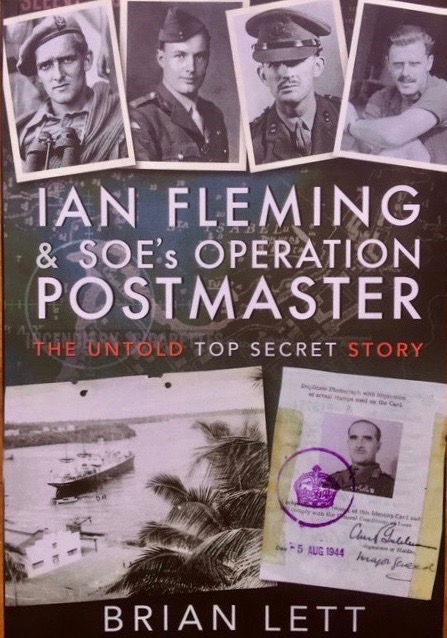
The story they presented was that they were a neutral Swedish crew on a neutral Swedish yacht. In fact, they were a group of SOE agents on an incredibly daring mission, commanded by an actual "M", with whom Ian Fleming worked. This is a book that especially Nordic SOE, SAS & Fleming/Bond buffs can appreciate.

While the Swedish flag was mere camouflage, there were actually Danes aboard, one of whom later would join the SAS and earn a VC, Anders Lassen. Thus it should already be apparent that Ian Fleming & SOE´s Operation Postmaster by Brian Lett is of special interest to Danish military history buffs. Norwegian WWII buffs also have several reasons to pick up this book, because Brigadier Colin Gubbins was "M" and he had a great deal to do with Norway from 1940.

Well, what kind of special operation is Ian Fleming & SOE´s Operation Postmaster about? In 1941 the British started receiving reports that German submarines were using rivers in French parts of Africa for refuelling. At the time, the Special Operations Executive (SOE) was a new outfit with many enemies, not just among the enemy. The SOE had to prove its worth. The cunning plan was to sail a "Swedish" SOE ship, with some great characters, to West Africa and locate German submarine bases. But having arrived in the area the main aim became to steal enemy ships from a neutral Spanish port on the volcanic island of Fernando Po. I will here not give away the wonderful story of what happened but just say that the British Government lied in order to conceal British responsibility for the operation, and basically recommend that you read this book yourself.

Being the author that I am, I do not think that the characterization of Sweden as "pro-German" in Lett´s book is fair. Regardless if one means the Swedish state or the majority of the Swedish people, the largest Swedish sympathies were about Finland, Norway and Denmark. Yes, there were Swedish Nazis and pro-German sympathies, but they never dominated. The thousands of Swedish citizens in Finnish, US and Norwegian service can be compared with the 200 in various German units. For more about Sweden during WWII please turn to e.g. John Gilmour or yours truly.

Nevertheless, Brian Lett´s book is an inspiring and exciting book that should please not just SOE and Fleming/Bond buffs. First published in 2012, the edition I got is from last year. Brian Lett has written other books about special ops and I just recently became aware of his SOE`s Mastermind - Sir Colin Gubbins, a book that I very much look forward to reading.

Monday, March 27, 2017

New Spanish Civil War Volunteer Biography

An International Brigade veteran from Germany is portrayed in this new book.

Having met and interviewed several Swedish veterans of the Spanish Civil War (see Swedes at War 1914-45) I have most books written by or about them. There is a strange gap among them that I have been thinking about lately, thanks to a new book.

Walter Struck was one of the many thousands of Germans who fought in Spain 1936-39. Most were in the German pro-Franco Condor Legion, but there were also rather large groups of Germans within the opposing International Brigades of the Comintern (Communist International). Struck was one of the Germans in the Brigades that joined up via Norway. His eventful life in Spain and afterwards in Sweden has now been documented by his son Rune Struck in the book Pappa ville aldrig prata om Ebro, which translates as "Dad never wanted to talk about Ebro". This is a book that attempts to, and succeeds, in painting a vivid portrait of a German Spanish Civil War volunteer. One gets to know the man behind the strong convictions and it is no simple hero portrait.

Rune Struck knows how to write and has had access both to good notes from his father and has searched for traces of him in today´s Spain. Like yours truly he found out that the memory of the war is still very much alive in Spain, in surprising ways and in spite of the fact that most war participants are now dead. I also recognize the author´s joy in actually finding places described so many decades ago, almost as they were. Those moments will never go away.

The book does not end with Ebro and the fall of the Spanish Republic but follows Walter Struck to his refugee life in Sweden, from which he took part in the information war (to use a more modern term) against the Third Reich. After 1945 he for a time considers returning to Germany, but opts for joining Swedish society together with his Norwegian wife and children.

Rune Struck´s quest for his father´s and also mother´s wartime past is a moving one. I suspect that I will many times look back at this book´s questions about Germany and the Germans. Reading the book I also came to think of the very small number of Swedish biographies about Spanish Civil War veterans. If one excludes a handful of autobiographies, I can only come up with two previous biographies in Swedish: Frisco-Per (1985) by Arvid Rundberg and Helmut Kirschey (1998) by Richard Jändel. Considering that over 550 Swedes took part in the Spanish Civil War, plus the Spain veterans from other countries (like Walter Struck and Helmut Kirschey), the number of biographies in Swedish is surprisingly low.

Monday, October 10, 2016

Spanish Civil War & Narvik

One of the about 200 Norwegians who fought in Spain 1936-39.

The Swedish cover photo of the unknown Norwegian member of the International Brigades in Spain is one of several links between Sweden and the about 200 Norwegians in the Spanish Civil War. But this book also is a good reminder about Narvik.

The title of the book Tusen dager. Norge og den spanske borgerkrigen (“A thousand days. Norway and the Spanish Civil War”) is explained by the fact that the war lasted 989 days. I like the poetic title, and I am very impressed by all the history and photographs that the authors have dug up. The book´s authors Jo Stein Moen and Rolf Saether tell the story of how the Spanish Civil War affected Norway, and recount the experiences of the about 200 Norwegian volunteers - of which most were on the side of the republic. As is the case with the about 550 Swedish volunteers in Spain, only a small number fought on Franco´s side. In Norway´s case it was seven men. Although few, they too are covered in the book, not least the later SS-volunteer Per Imerslund.

The authors estimate that about 50 Norwegians died for the republic, slightly more than previously thought. In other words, every fourth Norwegian died. On this very day, the tenth of October, in the year 2000, the last surviving Norwegian veteran passed away.

Gladly, not just the International Brigades are covered, but also the joint Swedish-Norwegian hospital on the republican side. Not that many years ago I was talking to its last surviving member.

The book also describes what happened afterwards and I especially appreciate the part about the Spanish Civil War veterans who fought at Narvik 1940. In the war cemetery there rest 118 members of the French Foreign Legion - 16 of them are Spanish.

There is a website about the book, with a section in English - here is the link to that section.

I hereby would like to tell the authors how sorry I am it took so very long until I could review your fine book.

Friday, December 28, 2012

What Mattered In 2012

The book of the year, if you ask me.

Looking back at 2012 I would say it again was a year of the rise of Asia and in particular China. As for my own work during this year, North Africa was a major focus.

Judging from recent reports, the world in 2013 will be no less shaped by what takes place in Asia, starting January 1.

The Syrian Civil War may evolve into something much worse. Another serious hotspot is of course Iran, and, as always, there is Israel and North Korea. The latter country is the subject of this year´s strongest book IMHO, Escape From Camp 14 by Blaine Harden. But for some reason I reckon that the East China Sea holds the greatest dangers during 2013.

In case we are fortunate enough that no new major wars break out in 2013 the world may still suffer greatly, perhaps as much as from war, by further inactivity in the field of energy, i.e. by not seriously going for alternative energy sources. Here the US, China and the EU probably hold the largest keys.

Moving away from things of global importance to my own work, in 2012 I was writing mostly on a book about a special forces unit in North Africa, Ghost Patrol. It was released a month ago. I also wrote several articles about more or less recent military history, one which was extra special, as it to a great extent was the result of exciting discoveries in the mountains by some very energetic readers of mine.

Speaking about readers, I only now found this study in English about Swedish volunteers in the International Brigades during the Spanish Civil War, partly based on Swedes at War. Well, in 2013 I will return to the subject of Swedish volunteers, first those in Finland and Norway in 1940, and then, in another book, all over Europe and Asia.

Goodbye 2012 and wishing all my readers a Happy New Year!

UPDATE DEC 30:
When I wrote the above I was not aware of this article re. the worsening security climate China-Japan.

P.S.
But, you may ask, what about a Swedish connection to Escape From Camp 14? Well, although the book makes no reference to Sweden or any other Nordic country, Sweden played a largely unknown role during the first combat phase of the still unfinished Korean War. There was both a Swedish field hospital where everyone wore US uniforms and in addition a handful of Swedish volunteers and many more Swedish Americans in US combat units. More about them in a coming book by me and Lennart Westberg. Although Escape From Camp 14 is not about a soldier but about a man born in a North Korean concentration camp, it does provide valuable insights also into Korean history. In addition, yours truly during four years lived right beside the North Korean embassy in Switzerland. This gave me several opportunities to learn about North Korea. I got to talk with several persons living inside the embassy, especially one Kim. It was, however, not the Kim now ruling North Korea, as he arrived in Switzerland only after I had left the country. Still, I have some idea about the wonderful environment where he spent some of his formative years. I tend to think those years must have done him and the world some kind of good.