About Me

My photo
Author, film researcher and member of the Swedish Military History Commission.
Showing posts with label Kriegsmarine. Show all posts

Tuesday, July 27, 2021

Bletchley Park's Secret Source

Having read and watched several books/films/TV productions about Bletchley Park (BP) my interest was aroused when I learnt that there was a new book about the little-known network behind the information supplied to Station X (BP). The Swedish Navy is also part of the story.


Let it be said immediately that Bletchley Park´s Secret Source focuses on the very secret Y service that ran a global chain of wireless intercept stations. This new book by Peter Hore, former Head of Defence Studies for the Royal Navy, especially illuminates the Y service Wrens – the operators from the Women´s Royal Naval Service. Thus the subtitle of this book: Churchill´s Wrens and the Y service in World War II. My main reason for reading this book was my interest in the German-speaking Wrens who listened to German radio chatter, but for those of you who are interested in the monitoring of Japanese signals this book is also for you. 


While many Wrens of the Y service had zero military experience there were also some really experienced ladies, such as Violetta Thurstan. Not only had she won the Military Medal for her bravery as a nurse in the First World War, she had been decorated by Russia and Serbia as well, had served in the RAF and the Spanish Civil War and therefore spoke several languages and had a good grasp of many military matters – key Y service skills. 


Several Y service Wrens had been to Germany before the war and some had spent years there and even seen Hitler himself up close. Such a Wren was Elizabeth Agar, who didn´t know much about the Wrens but as soon as she met a smartly dressed one was intrigued and got a “[…] burning desire to join […] even though my only knowledge of the sea was that it made me seasick”.      


In the chaos of 1940 there sometimes was not even time for any training course, not even an issue of uniform! Those times also meant not only listening to the enemy but also observing Luftwaffe aircraft over Britain, sometimes close: “The girls became rather blasé, so they were surprised during a visit by a superintendent from London, when their visitor suddenly jumped into a ditch to take shelter.”


In the book´s chapter “Winning The Big Battles” the Swedish cruiser Gotland´s sighting of the German battleship Bismarck plays a vital role for the British naval attaché in Stockholm, Captain Henry Denham. The part that Denham´s report to London played in sinking the Bismarck is made clear by a personal signal from the First Sea Lord to Denham.   


The author writes that “At the height of the war, the Y stations sent more than 3,000 messages a day to Bletchley Park” and it seems natural to agree that this volume must have been a major contribution to the success of BP. The Y service Wrens in Colombo on Ceylon (now Sri Lanka) even helped prevent a second Pearl Harbor. Bletchley Park´s Secret Source highlights a small group of women, often in miserable working conditions, that indeed had a real effect on the war.

Monday, March 01, 2021

Total Undersea War

Were the German U-boats in the Atlantic defeated in May 1943? Not only is that an illusion but submarine historian Aaron S. Hamilton proves that some of the last German sub operations, shortly before the big German surrender and right beside the North American coastline, are among the most amazing. 

The book title, Total Undersea War, at first seemed a bit vague. But once you get into the book it becomes logical, as Mr. Hamilton is able to show how largely surface-bound submarine warfare was transformed by the introduction of an air mast, or “snorkel”, opening up a new era under the surface of the sea. Thus this book is both about submarine design, late U-boat operations and postwar submarine design. 


Submarine buffs, and especially those that are residents of North America, will be richly rewarded by Hamilton´s research. If you are not already a buff you might have problems believing the Germans cruised so close to your shores even when the war was about to end. There is no doubt, however, that Hamilton´s book is based on hard facts. 


More U-boats departed for the East Coast in the spring of 1945 than at any point since 1942. Let that sink in. The US Navy took this German underwater offensive very seriously, and more than most people now realize. This was not least because of the possibility that a U-boat might launch a V-weapon against a US city or base. Why this V-rocket scare must have been especially troublesome can be understood by taking into consideration how Allied intelligence, in spite of all its resources, had failed to predict the massive German offensive in the Ardennes in late 1944. Hitler there proved that he could still deliver large and unpleasant surprises.


In fact, in January 1945, the German Minister of Armaments Albert Speer made a radio broadcast in which he said V-rockets would fall on New York “by February 1”. We all know that this didn´t happen, but it is amazing enough to learn how despite a tight US naval barrier, German U-boats still managed to slip through, reach the East Coast and remain undetected to the end. To quote Hamilton: “[…] a submarine that didn´t surface and didn´t transmit by radio was almost impossible to track, find and destroy.”


This brings us to the final chapter of the book, about the mystery of U-869. Here the author has gone to very great lengths to provide a credible solution, and any future expeditions to the wreck ought to use Total Undersea War as the starting point.


This 416-page book contains plenty of fine photographs that I have never seen before, plus several interesting appendices.

Wednesday, December 23, 2020

Das Book


OK, you have seen "Das Boot" and want to know more about the U-boat arm, its submarine types, bunkers, missions, special insignia, awards, aces and downfall. You are also keen to see original artifacts up close. Well, in that case this new book is what you are looking for.   

U-Boats At War In 100 Objects 1939-1945 is written by Gordon Williamson and the name will probably ring a bell with many reading these words, as he has written more than 40 books - many about German WWII armed forces. Because of his long experience and not least several visits in Germany he has been able to produce a simply stunning book with 100 short but still rich chapters. Each chapter is illustrated with at least one high quality photograph, often more than one and quite often in colour.

Here are just a few of the chapter titles/subjects: The Snorkel; Enigma; Air Support; The U-Boat War Badge; Award Documents; Clocks; Toilet Facilities; The Atlantic Bunkers; The Visor Cap; Propaganda; Hygiene; U-Bootsfrontspange.

For Nordic readers there are two parts of particular interest: The Norwegian Bases and the Type XXI Elektroboot. The latter is the very advanced submarine type featured on the cover of one of my Swedish language books, as one of these submarines was salvaged by the Swedish Navy and affected Swedish submarine design a great deal. Well, that is not unique, German submarines in one way or another affected all postwar navies.

It is no wonder that the recently taken photos are in high quality colour, but it is quite amazing how Gordon Williamson has been able to find several wartime colour photos that I have not seen before. 

Directors of future "Das Boot" films/episodes would do well to purchase a copy of this book, that I will call "Das Book". They should read it carefully and have it handy during filming.

Tuesday, November 10, 2020

The Battle for Norway 1940-1942


If you are researching or wargaming Norway 1940 and/or Operation Claymore 1941, this book will be of great interest to you. Because in The Battle for Norway 1940-1942 you will find the original words of the commanding British officers. Written not with hindsight, but as they saw things at the time.

This 174 page book is mainly a collection of wartime despatches and is very ably introduced by the men who have compiled them, John Grehan and Martin Mace. They correctly point out the crucial factor for the Norwegian campaign of 1940, air superiority. As the Allies never achieved air superiority over Norway their attempts at contesting the German invasion forces were doomed. 

From a Swedish perspective it is of special interest to see how clearly the value of the Swedish port of Luleå is stated. "To interfere with ore supplies to Germany from Luleå" is the second priority of the British forces. After that came preserving "a part of Norway as a seat of Government for the Norwegian King and Government". I incorrectly supposed that Luleå came after that.  

On the other hand, the despatches and reports from Operation Claymore, the March 1941 raid on the Norwegian Lofoten Islands, are full of successful action. It was time for Hitler to taste some of his own medicine - the element of surprise. To attain this the Royal Navy first had to reach an exactness of timing, and so it did. The list of shipping and factories (fish oil plants) destroyed is impressive.

From a Norwegian perspective it is pleasant to read how highly the Norwegian detachment commanded by Captain Martin Linge was praised. In the relevant passage it becomes clear why Martin Linge became the founder of the most celebrated Norwegian WWII unit, the Linge Company of the Special Operations Executive.   

For researchers the index of persons is great. There are not that many illustrations (16) but the book still gets a high score as it constitutes a source of great historical value.

Wednesday, July 29, 2020

The U-Boat Commanders

323 pages of U-boat history with a bio for every Knight´s Cross holder.

When researching WWII U-boat history you get to a point where you need a good reference book. Well, this is it. This is not a book about every single U-boat and every U-boat commander. But just about all major U-boat actions and key commanders are present in The U-Boat Commanders: Knight´s Cross Holders 1939-1945 by Jeremy Dixon.

This is not the kind of book that puts the U-boat actions into context - there are other books that do that. This is more of a very specialized compilation of biographies and it is organized in such a manner that the first section is very short - it contains only two men: Albrecht Brandi and Wolfgang Luth - because only these two were awarded the Knight´s Cross with Oakleaves, Swords and Diamonds. Then there is a section about the three who received the above but minus the diamonds; then the 23 recipients of the Knight´s Cross with Oakleaves and finally the 93 who "only" received the cross.

Each biography starts with the number of ships the recipient sunk and how many tons and then the life and career of each recipient is summarized on two to four pages. Postwar life - if the recipient survived the war - is mentioned, but there are not that many details. Every biography ends with a list of other wartime awards that the person received.

There is at least one photograph of every recipient, sometimes there are two and at times also the victims of these men are present in so far that some of the ships they sunk are pictured and the captions provide some data about their histories.

Are you trying to research some major action with U-boats involved? Then the 323 pages of The U-Boat Commanders: Knight´s Cross Holders 1939-1945 will most probably provide several of the facts that you are looking for. The book also provides good information on several decorations, Kriegsmarine terminology and ends with a bibliography.

Tuesday, July 14, 2020

Special Operations South-East Asia 1942-1945

220 pages of amazing special operations in some truly exotic places.

When one hears "special operations during WWII" few will think of other continents than Europe and Africa. But special ops were of course also one method of fighting in Asia. David Miller´s book focuses on three special operations in Asia and especially one of them will surprise just about everyone - as the target was not Japanese but German. There is a Swedish connection, too.

German U-boat successes against Allied merchant ships in the Indian Ocean in 1942-43 became a real problem for the Allies. In fact, German naval forces were active in several parts of Asia, and more active than I had imagined. David Miller´s book has been a real eye-opener for me regarding this aspect of German operations. All three ops featured in his book Special Operations South-East Asia 1942-1945 are amazing to learn about, but the struggle against Japanese forces is what you expect and therefore the Special Operations Executive (SOE) raid against the Germans in Goa is the most spectacular.

At the time, i.e. early 1943, Goa was formally not part of India but Portugal, which explains the German presence. A charming aspect of the British Goa raid, Operation Longshanks/Creek, was that enthusiastic and somewhat unlikely volunteers from the Calcutta Light Horse played a key role. Now, some of you who read this blog post may now be saying "that rings a bell", because you have seen a film from 1980 starring Roger Moore and David Niven, called "The Sea Wolves". That film, based on the 1978 James Leasor novel Boarding Party, was an early signal to the world about the particularly secret SOE operation. But I think you will find this book to be more interesting than that film, not least because it busts a few myths present in the movie.

You might recall from my blog post "A Deniable Operation Under The Swedish Flag" that Swedish aspects manage to pop up even in some very faraway places. Well Special Operations South-East Asia 1942-1945 reminds also of how the US Department of State chartered the Swedish ocean liner Gripsholm as an exchange and repatriation ship. It carried many Japanese and Germans to ports where she could pick up US and Canadian citizens - and bring them home. She sailed with a Swedish captain and crew and made 12 round trips. Exchanges took place at neutral ports such as Goa in Portuguese India. In the article below is a photo showing the Gripsholm in Goa 1943, unloading Red Cross supplies for internees and prisoners of war.

The Gripsholm in The Shanghai Evening Post and Mercury on 24 December 1943.

Wednesday, June 03, 2020

Hitler´s Spanish Division

This book covers more units than the "Blue Division" of Spanish volunteers.

One of the baffling things about foreigners in the Wehrmacht and Waffen-SS is how the really large categories are often ignored, like the Spaniards. This is not least true if we look at articles and books produced here in Scandinavia. Hitler´s Spanish Division provides a surprisingly rich visual overview of the different units with Spanish volunteers.

To give an idea of just how popular it initially was in Spain to volunteer for service in German units on the Eastern Front we can start by just looking at the number of Spanish volunteers in the Luftwaffe, 659 men. That in itself is many more than the number of Swedes in all types of German formations 1939-1945 - there were about 200 Swedes all in all. However, the vast majority of Spaniards of course served in German Army (Heer) units, more than 46,000. Well, if one adds up these with Spains Luftwaffe volunteers and the Spaniards in the Kriegsmarine, Waffen-SS and various Wehrmachtsgefolge (Wehrmacht auxiliaries) like Organisation Todt, then the total figure is around 48,000 Spanish men and women.

Hitler´s Spanish Division by Pablo Sagarra, Óscar González and Lucas Molina make clear just how large the Spanish contribution to Operation Barbarossa was. This they do in an unexpected way - not by focusing on the actions of the German 250th Infantry Division more commonly known as the Blue Division (blue = colour of Spain´s Falangist/Fascist Party) and other German units with Spaniards, but by looking at a select number of individual volunteers. The first chapter is about the three Spanish generals on the Eastern Front, the next about three of the sixteen Spanish colonels in German uniform. I bet you can guess what the third chapter is about. After the two chapters about NCOs and men follows a short but fascinating chapter about the Blue Legion, the successor of the Blue Division (the legion was more like a regiment). The remainder of the book briefly covers Spaniards in the Waffen-SS, Luftwaffe, Kriegsmarine etc.

The strength of the book lies in the many Eastern Front photos, studio portraits and Osprey-style colour illustrations by Ramiro Bueiro. A large number of original artifacts from volunteers are also shown in colour, mainly decorations and documents. The uniforms demonstrate that the look of the Spaniards could differ quite a lot from German regulations.

In other words, this is a book above all for readers who are into militaria and scale models. But readers more interested in studying volunteer movements, especially Falangist/Fascist volunteers, are at the same time provided with an overview of the Spanish presence on the Eastern Front, plus a rather good glimpse into how much Eastern Front veterans affected the postwar Spanish Armed Forces.

Monday, March 09, 2020

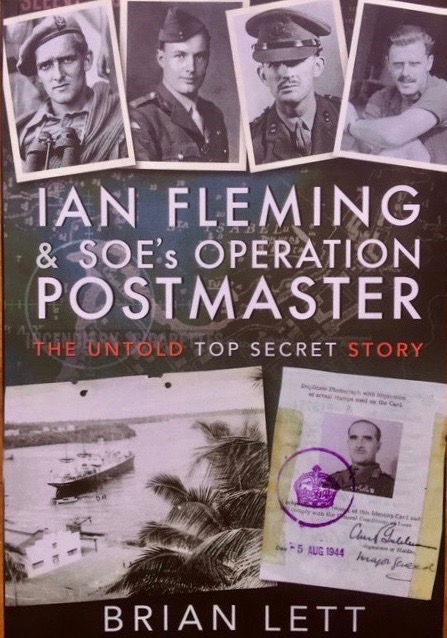
A Deniable Operation Under The Swedish Flag

SAS VC holder Anders Lassen (1st from the left) always catches my attention.

The story they presented was that they were a neutral Swedish crew on a neutral Swedish yacht. In fact, they were a group of SOE agents on an incredibly daring mission, commanded by an actual "M", with whom Ian Fleming worked. This is a book that especially Nordic SOE, SAS & Fleming/Bond buffs can appreciate.

While the Swedish flag was mere camouflage, there were actually Danes aboard, one of whom later would join the SAS and earn a VC, Anders Lassen. Thus it should already be apparent that Ian Fleming & SOE´s Operation Postmaster by Brian Lett is of special interest to Danish military history buffs. Norwegian WWII buffs also have several reasons to pick up this book, because Brigadier Colin Gubbins was "M" and he had a great deal to do with Norway from 1940.

Well, what kind of special operation is Ian Fleming & SOE´s Operation Postmaster about? In 1941 the British started receiving reports that German submarines were using rivers in French parts of Africa for refuelling. At the time, the Special Operations Executive (SOE) was a new outfit with many enemies, not just among the enemy. The SOE had to prove its worth. The cunning plan was to sail a "Swedish" SOE ship, with some great characters, to West Africa and locate German submarine bases. But having arrived in the area the main aim became to steal enemy ships from a neutral Spanish port on the volcanic island of Fernando Po. I will here not give away the wonderful story of what happened but just say that the British Government lied in order to conceal British responsibility for the operation, and basically recommend that you read this book yourself.

Being the author that I am, I do not think that the characterization of Sweden as "pro-German" in Lett´s book is fair. Regardless if one means the Swedish state or the majority of the Swedish people, the largest Swedish sympathies were about Finland, Norway and Denmark. Yes, there were Swedish Nazis and pro-German sympathies, but they never dominated. The thousands of Swedish citizens in Finnish, US and Norwegian service can be compared with the 200 in various German units. For more about Sweden during WWII please turn to e.g. John Gilmour or yours truly.

Nevertheless, Brian Lett´s book is an inspiring and exciting book that should please not just SOE and Fleming/Bond buffs. First published in 2012, the edition I got is from last year. Brian Lett has written other books about special ops and I just recently became aware of his SOE`s Mastermind - Sir Colin Gubbins, a book that I very much look forward to reading.

Friday, January 24, 2020

The Memoirs of Karl Döenitz

The front cover of the latest edition of this classic Third Reich source.

For students of Germany´s WWII submarine warfare and the very last days of the Greater German Reich (the official name until 23 May 1945) there is one source that must be considered a real must read, The Memoirs of Karl Döenitz.

Many forget that the last head of state of the Großdeutsches Reich, i.e. Greater German Reich, was not Adolf Hitler but Grand Admiral Karl Döenitz (more commonly spelt Dönitz). In 1936 he had been made the supreme submariner, in German Führer der U-Boote. In 1943 he was made supreme commander of the whole German Navy, the Kriegsmarine. After Hitler´s suicide it was Dönitz who headed the remnants of the Third Reich until it ceased to exist on 23 May 1945. Thus it should be clear that there are several reasons why his memoirs have again appeared, in a new paperback version. What is my take then? Well, there is a whole lot here that is still of military relevance, in spite of all technological advances. This is because Dönitz was a very gifted officer and strategist. Had he earlier on been given more power it seems probable that he would at the very least have prolonged the war by some months (or even more) with his submarine "wolf packs". Thus it was fortunate for the Allies that he reached the naval top only in 1943.

The Dönitz memoirs are naturally filled with U-boats and naval strategy and, coming from Dönitz himself, this of course makes fascinating and also very important reading for all naval strategy and U-boat buffs. But, those major ingredients aside, what does Dönitz write about WWII in a more general sense? His mindset becomes pretty clear. Let me quote from page 52: "Whether any war is a war of aggression or not is a purely political question. The policy of any and every country will be to seek to prove that its adversary was the aggressor or that it had itself been menaced and had been compelled to act in self-defense."

Let me also quote a sentence that I find very telling from the following page: "At the outbreak of hostilities, then, I had no idea in my head other than to do my duty." In other words, the political side of these memoirs offers no surprises - it is yet another "my duty" memoir by a former member of the National Socialist German Workers' Party - which he joined on 1 February 1944.

The Dönitz memoirs can at times be a bit demanding reading, but the chapter about the invasion of Norway has an optimal length and explains the major technological significance of this campaign for the Kriegsmarine, the so called "torpedo crisis".

The impact of one British midget submarine, the X6, and its attack on 22 September 1943 in an Arctic fjord (Kåfjord) is pretty clear from these memoirs. The explosion under the German battleship Tirpitz´s stern, caused by a mine from the X6, meant not only big problems for the Kriegsmarine, but a "grave strategic handicap", according to Dönitz. In other words, no small praise for the commander of X6, Commander Donald Cameron VC. Actually, the X6 was not alone in managing to plant a mine, as the X7 also did so, but the point still is that Dönitz credited one midget sub to have caused a "grave strategic handicap".

American readers might want to go straight to the chapter "Operations in American Waters". Had Dönitz received the "timely warning" of the German declaration of war against the United States that he had requested from Hitler, the US would probably have suffered "a real blow".

Speaking about the Großdeutsches Reich, what was to have come after it according to national socialist visions? The answer is the Großgermanisches Reich, for short. The full name being the Großgermanisches Reich der Deutschen Nation meaning the Greater Germanic Reich of the German Nation. But what Dönitz inherited from Hitler was something very, very different.

As a Swede it is interesting to read about how Dönitz viewed the "Schellenberg plan" to surrender German-occupied Norway to Sweden.

The epilogue does not lack self-criticism but is also the one part of the book that should have been considerably longer.

Saturday, September 09, 2017

WWII Narvik 2017 Update


It is a bit more than a year since I visited the then new Narvik War Museum. My blog report about that visit was a bit critical. Have things changed since? Yes, and there are both some improvements to report, and a brand new exhibit in the form of the above pictured untouched German Ford V8 towing FLAK.

Artifacts from WWII, especially vehicles, that have "simply" been preserved have a special atmosphere around them. The Hotchkiss tank in the Narvik War Museum is, sadly, not among those vehicles. The tank ought at least to be put into context with the help of some large photographs showing the type in use around Narvik.


However, since my visit last year the museum has added some vehicles from the previous museum and also one that has not been exhibited before, a Ford V8 that really takes you back in time (it is the one in the top photo). The story behind it in brief: it was a Norwegian passenger car (sedan) and then taken over by the Germans and modified so it became a hybrid truck. Two more photos of it.


Another positive change is that the 1:1 diorama is back from the old museum. It is an original German mountain position that has been reconstructed inside the museum. A bonus is that there is now no glass between the visitor and this display. Three photos of it now.


Where is the mountain diorama located? Look for the experimental German rocket launcher. BTW there are only two of these launchers still around... The diorama is right beside it.


The "human torpedo", Morris armoured car and Kettenkrad tracked motorcycle from the old museum are also now back on display.


Gladly, VC Captain Bernard Warburton-Lee´s name has also been rectified.

Now, if one may make a wish or two - how about using the long, winding and mostly empty corridor to the bottom floor - putting up some of the photographs and paintings from the previous museum there? And surely there is room for at least a small display about the paratrooper dimension of the battle of Narvik, a milestone in history, not just WWII history. How about a paratrooper and a parachute container with contents?

Visitors could also get tips for WWII sights around town, e.g. be directed to the 1940 landing sites, slave labour camps and the war cemeteries with their many strong reminders of the ultimate price, with fallen even from New Zealand ("N.Z."). BTW who knows more about Major Bowen´s death, and how Lieutenant Morrison from New Zealand was killed, why so late as May 4, 1945?


Finally, the naval history sight outside Narvik that you have to be rather fit to walk to (skip it in wet conditions, just too dangerous a walk then). In other words, the wreck of the German destroyer Georg Thiele - how is it faring? Well, here are two photos of it I have taken, the first in 2001 and the one below this week.


Saturday, September 24, 2016

Major New Book About WWII Norway


Norway has been blessed with a number of really good WWII history books in recent years. The latest one that I find to be a real milestone is a WWII history of the Trondheim region. It has so many new and interesting photos that even if you don´t read Norwegian you should get it, provided you have a keen interest in Scandinavia during WWII.

The title in translation is The Bunker: Trondheim Under The Swastika and the authors are Karl H. Brox, Hermann Hansen and Knut Sivertsen. I agree with the authors that from the viewpoint of the German military, Trondheim, not Oslo, was the most important city in occupied Norway. But the book is both about the fighting in the area in 1940 and what happened afterwards. What strikes me as the book´s main strength, aside from the fantastic photos, is that it is the result of not years but decades of research. The collaboration of many Norwegians, the grandiose plans to remake Trondheim into a major German/Germanic city, info about little known German units - its all in this impressive book.

Wednesday, May 25, 2016

German Submarine U-864 Norwegian News


Excellent video update in English.

There is some good news about the wreck of the German submarine U-864, recently the subject of a book also translated into Swedish (Jakten på ubåt 864). Check out the above video update in English from the Norwegian Coastal Administration.

Tuesday, October 30, 2012

Narvik Military History Bookstore Update

Now in central Narvik, lots of military history books. Both new and old.

Some really rare old books, in several languages, are now for sale in Narvik.

It is with great pleasure that I now can announce that my friend Trond Kristansen in Narvik has moved his military history bookshop to central Narvik, to Kongens gate number 22.

Of course, the bookstore has extra many books about WWII in Narvik and the north in general. Congratulations and best wishes from Arctic Sweden! All you have to do now, Trond, is make a short English summary on the shop´s website.

Tuesday, August 21, 2012

See Thiele Before Its Too Late

Just some good Narvik then-and-now photos that I hadn't seen before. Remember, the destroyer Georg Thiele could slip down into the fjord any year now, and probably suddenly. So, if you have not visited it yet...

Hat tip to Mats for the tip!

Saturday, July 21, 2012

Gebirgsjägers, Monty and Gebirgsmarine

Amazing what you can find on the surface in Arctic Norway, a Gebirgsjäger´s personal ice pick. Karl-Gunnar found it "just like that" walking in a Wehrmacht dumping area.

This year´s WWII in the Arctic summer expedition largely followed the route of last year´s trip, but we went higher up in the mountains, and consequently got to see more.

Like last year we this year had the privelege of having a desert war expert among us, Karl-Gunnar Norén. This may sound odd but Karl-Gunnar has an interest in the Arctic too, having been to Arctic Russia´s battlefields with me. And as for me, aside from a strong interest in the Arctic I have always had an interest in the special forces of the desert war, especially the Long Range Desert Group (LRDG). Thus it was only a matter of time before we teamed up to write a book about the "Ghost patrol".

This year´s trip started off with Karl-Gunnar immediately walking into a Gebirgsjäger ice pick, just lying about on the surface. Nobody in our Arctic fellowship, now 8 men strong, had so far discovered such an artifact...

The Opel Olympia staff car in dunkelgelb is still there in 2012, but aside from the main body very little remains.

We revisited the Wehrmacht staff car in the stream, and by standing in the not exactly lukewarm stream I was able to take the new photo above.

The ice pick was a nice discovery, but then I made a pretty weird one myself by finding a British WWII "flimsy" petrol can. A type Karl-Gunnar had seen a lot of in Egypt in April while searching for traces of the LRDG. How come a flimsy ended up there? Either the Germans took it there with some captured British vehicle from Dunkirk, or the British or Norwegians did in 1945 or soon after.

German pressure cooker in Norwegian stream.

Moving on into another valley not that far from Sweden´s northernmost point we found i.a. a Wehrmacht pressure cooker in a stream. The cooker is of the same type as the one in the Björnfjell area. Not far from it is a water tower built for the Germans by some local firm and reportedly built with some conscious flaws. But it is still standing.

One of the best then-and-now experiences was finding this German shelter, just as the ones pictured by a British war artist.

Just barely still standing was a shelter of the same type depicted by a British war artist. Great of Simon Orchard to find the painting and good that we together could locate one of the houses, possibly the last one standing and very hard to spot from just ten metres away.

One of the most intact German mountain positions around, with Karl-Gunnar in the door. Note the amount of snow although it is July 8.

Then we went up to some of the top positions and saw there was more snow up in the mountains than can be expected in July. It was rather nice to nevertheless discover some positions we had never seen before. We had been in that valley before but had somehow missed a number of positions. Well, perhaps not that strange considering they were meant to be hard to find.

The remoteness of the area also means that most, if not all, WWII artifacts that we had seen on previous trips were still there in the open, or inside shelters. On this trip we came across two primus stoves marked RAD = Reichsarbeitsdienst. I know for sure the RAD built a hangar in Tromsö, so perhaps they also worked up here? In some cases, as with remains of uniform garments out in the open, we moved artifacts to inside the shelters, so that they may be preserved longer.

The remains of an early model gas mask, from 1930, after 67 years in the open. However, for most of the time it is covered by snow.

Metal case for 98k rifle cleaning kit, after 67 years on a rock.

Name plate on ski identifying the owner as Obg = Obergefreiter Vasold. What happened to him?

Inside the remains of an anorak among the rocks there was this label, Johann clearly belonged to GJR 137 but his last name is hard to tell. I can´t see what it says, can you?

This seems to be a very elaborate Wehrmacht toilet, or could it be something else?

Moving down from the mountains we again met our friend in the Tamok valley with several WWII artifacts. According to the previous owner of this sledge it once transported the wounded commando hero Jan Baalsrud, who i.a. was awarded an MBE.

Sweden´smajor expert on the British Army in North Africa, Karl-Gunnar Norén, standing on the spot where Montgomery stood by the Rundhaug hotel, well above the polar circle.

As tradition has it we then visited the Troms Defence Museum in Setermoen and got to see a new vehicle very much connected to Sweden during WWII, a Volvo issued to the Norwegian "police troops" that were trained in Sweden 1943-45.

This year we finally took the time to climb the Reinnesfjellet mountain, where U-boat crews have left their mark, here stones commemorating the U-657. It is amazing that the stones are still there, but there are also some other "tags" up there of more recent vintage.

Exhibits in the Abisko museum. This German helmet was found in the 1970s in an Abisko mouintain pass, well inside Sweden. It is a mystery how it got there. Just to the left of it is a rather special iron cross.

The last museum we visited was on the road back to Luleå, the Abisko Border Defence Museum. It is located in Swedish Abisko but has several WWII artifacts as the battle for Narvik on several occasions "spilled over" into Sweden.

Personally, the three top highlights of the trip was being in Lyngen again, our fabulous stay at the former headquarters of the 20th Mountain Army (Gebirgs-AOK), Rundhaug gjestegård in Rundhaug (very intact and with some remains from 20 Gebirgs-AOK) and finally standing by the stones from the crew of U-657.

Speaking of U-boats, I wonder if not the "Baltic Sea UFO" (USO would be more correct, S = Unidentified Submerged Object) currently being investigated by a Swedish "X-team" turns out to be some kind of German anti-submarine installation? Or might it be something from the 1950s Cold War?

P.S.
If you plan to visit both the Narvik area and WWII sights above it, like the Troms Defence Museum, the Tromsö War Museum or the Tirpitz Museum by Alta
I can think of no better - yet still affordable - place to stay than Rundhaug gjestegard, i.e. the former HQ of 20 Gebirgs-AOK and also the place where Kaiser Wilhelm and General Montgomery stayed when they came to the area.

UPDATE 23 July: The last name of the GJR 137 Gebirgsjäger was most probably Entsellner, writes a friend in Germany. Thanks for the help.

Monday, August 22, 2011

Polish-German Battle on Aksla

On Aksla outside Narvik you can really see "the hand of history". Guess it is impossible to tell if this glove was worn by a German or a Pole? PHOTO: Oyvind Johnsen (and all below photos)

My friend and colleague Oyvind Johnsen in Narvik was kind enough to send me the below photos from a hike to Aksla on Saturday, August 20th. Johnsen is the author of Slaget om Narvik, Sydfronten, which I would translate as The Battle of Narvik: Southern Sector. It sure deserves to be translated not least for the many hike tips.

As can be seen from the below photos this site of a small Polish-German battle still has some German hand grenades (do not touch them) lying about and pieces of clothing like e.g. a life vest presumably from the "Gebirgsmarine" (perhaps it helped someone poorly dressed keep a bit warmer?).


Narvik WWII historian and author Oyvind Johnsen on Aksla.

There were 22 participants on the Saturday hike, among them one Polish visitor who perhaps was the first Pole up there since 1940. My friend Oyvind held a little lecture to the hikers at about 1000 metres. Wish I had been up there too.