About Me

My photo
Author, film researcher and member of the Swedish Military History Commission.
Showing posts with label USA. Show all posts

Wednesday, August 25, 2021

"She was not just difficult with the Gestapo"


Never before have I read such a rich, moving but also critical portrait of a WWII heroine. Lindell´s List delivers more than the title and subtitle promise.

A large part of the book deals with the escape and evasion organization for Allied airmen in France that the very British Mary Lindell founded and led. Looking only at this part there are several strong scenes that should inspire not least filmmakers. Let me immediately say that I am aware of the 1991 movie "One Against the Wind" based on Mary Lindell´s WWII experiences. But even though I have yet to see it I feel certain that modern filmmakers should take a close look at Peter Hore´s book Lindell´s List

Having gone through the First World War in France as a Red Cross nurse, Mary Lindell in 1940 decided to resist the German occupiers in France long before there was any large resistance movement. Her immediate and stubborn will to resist against the odds is, the reader soon understands, a consequence of her strong, controversial, character. Few books I have read have made me sense a person´s character as much as this one. It is clear that she could stand her ground as few others. Perhaps her brother summed her up best: "She was not just difficult with the Gestapo, she was difficult with everyone!"

Lindell´s focus was always on the war task at hand, often a supremely difficult or dangerous task that no one had given her, but that she still saw as something she herself had to solve. Not seldom her own children had to pay a hefty price for her decisions. To quote her son Maurice: "She wasn't´t a mother anymore; she was an officer doing a job which she considered was to be done." 

This tremendous devotion to duty led to Lindell´s death, or so it seemed. When her death certificate was about to be signed she came back from the dead, and more resistance work.  

One might think that in a book like this the Germans are mostly minor, evil types. But several Germans come across as friendly and some truly helpful. The half-English SS-Obersturmführer Percival Treite is very much part of Lindell´s List, and one of the book´s most puzzling figures. 

The women on Lindell´s secret Ravensbrück concentration camp list were taken to freedom and, eventually, health in Sweden by hastily painted Swedish Red Cross buses driven by Swedish Army soldiers. The Swedes part of this book, not least in the "Tuesday Club" (Tisdagsklubben) make it required reading for those with a special interest in Sweden during WWII. But Lindell´s List ought to be appreciated by anyone with an interest in occupied France and resistance work.

Thursday, July 08, 2021

Sepals Base Investigation


The most secret WWII Allied bases on Swedish territory are now being investigated by proper field research. Last week I had the privilege to take part in the investigation of an until now in modern Sweden basically unknown base under the Special Force HQ (insignia above with the standard British wings worn by many SFHQ operators).


The location of this Sepals base under SFHQ (and perhaps also the Norwegian XU) and most of the artifacts that we found can at this time not be shown, as the place and most artifacts are still under investigation by Swedish archaeologists. What I now can reveal is that a number of issues of the newspaper Stockholms-Tidningen found their way to this remote mountain location. Given the rarity of that paper above the Arctic Circle it is probable that these papers came to this place as part of the flow of weapons, ammunition, food etc between Allied embassies in Stockholm and the resistance groups in the Norwegian county of Nordland. It is known from Norwegian WWII literature that the place we searched was an important point in the secret supply chain to German-occupied Norway.  


Among the newspapers we found there were several articles that really bring home how the reader back then learnt of the major events as they unfolded. The headlines with Stalingrad and 10,000 destroyed Soviet tanks, see below, remind of the scale and connect the base to the larger picture. 


I could not help being rather amused by finding the below article entitled “Invasion In Western Europe Excluded”, that explains how the German fortifications there had become so numerous that successfully invading Western Europe was now impossible.


We were also reminded by the civilian history of the place by several finds. Again, most are waiting to be properly identified, but below is one artifact identified as the foundation for making traditional Sami shoes.


Finally, I wish to thank all those involved in this trip for making it happen, and for good company in a most beautiful area of the mountains shared by Sweden and Norway. For those of you not familiar with the Sepals bases, check out the books by Roger Albrigtsen and myself.   

Friday, March 05, 2021

The Americans and Germans at Bastogne

Can anything more and also of interest be said about the Battle of the Bulge? This new book by Gary Sterne shows that it is still possible. This is a book of particular interest to wargamers and others who want to get into details of the fighting in December 1944.

The British author Gary Sterne is rather famous for his Normandy research, not least concerning the Maisy Battery (check it out!). To produce The Americans and Germans at Bastogne he located the early postwar interviews with several German commanders who took part. He then matched them with US Army reports and selected a large number of wartime and postwar maps. The result is a source that should be very useful for those intending to visit the areas in question, and for wargamers. Also, anyone wishing to research the most involved German generals should have this book. Waffen-SS Oberstgruppenführer (Generaloberst) Josef “Sepp” Dietrich is of course among the quoted generals but there are more pages with Generalleutnant Fritz Bayerlein and Generalmajor Heinz Kokott and others. 

Given that most featured German officers are generals the perspective is mostly on larger units, mainly the involved divisions. But from time to time you get to read about smaller units and even individual tanks. My impression of the Volksgrenadiers seems to be in need of revision as I understand from this book that their quality was very varied.

The clash in thick fog between US Army Staff Sergeant Michael Lesniak´s Sherman tank and a German Tiger is memorable. From the explosive account of the fighting around the village of Marvie I conclude that if I have the opportunity to again go there by car I would like to see what the place looks like today. Perhaps some buildings still show signs of the fighting? I have found scars from WWII before, many times.

If you are not into visiting battlefields I believe you will find that the most interesting part of The Americans and Germans at Bastogne is the chapter “German Commanders Assess the Reasons for Failure”. From it I note that “the failure to take St. Vith in time” is Generalfeldmarschall Gerd von Rundstedt´s number one reason. This was written down shortly after the war, without all the hindsight.

The book’s many maps should be of great interest, even though the image quality is not always the best. The photos are not that many but mostly good. This is a book that one gets for the text and maps, there are already plenty of photo books out there. If only this 291 page book would have had an index, and there are spelling mistakes (names). But hopefully there will be more editions, and then an index can be added.

Monday, March 01, 2021

Total Undersea War

Were the German U-boats in the Atlantic defeated in May 1943? Not only is that an illusion but submarine historian Aaron S. Hamilton proves that some of the last German sub operations, shortly before the big German surrender and right beside the North American coastline, are among the most amazing. 

The book title, Total Undersea War, at first seemed a bit vague. But once you get into the book it becomes logical, as Mr. Hamilton is able to show how largely surface-bound submarine warfare was transformed by the introduction of an air mast, or “snorkel”, opening up a new era under the surface of the sea. Thus this book is both about submarine design, late U-boat operations and postwar submarine design. 


Submarine buffs, and especially those that are residents of North America, will be richly rewarded by Hamilton´s research. If you are not already a buff you might have problems believing the Germans cruised so close to your shores even when the war was about to end. There is no doubt, however, that Hamilton´s book is based on hard facts. 


More U-boats departed for the East Coast in the spring of 1945 than at any point since 1942. Let that sink in. The US Navy took this German underwater offensive very seriously, and more than most people now realize. This was not least because of the possibility that a U-boat might launch a V-weapon against a US city or base. Why this V-rocket scare must have been especially troublesome can be understood by taking into consideration how Allied intelligence, in spite of all its resources, had failed to predict the massive German offensive in the Ardennes in late 1944. Hitler there proved that he could still deliver large and unpleasant surprises.


In fact, in January 1945, the German Minister of Armaments Albert Speer made a radio broadcast in which he said V-rockets would fall on New York “by February 1”. We all know that this didn´t happen, but it is amazing enough to learn how despite a tight US naval barrier, German U-boats still managed to slip through, reach the East Coast and remain undetected to the end. To quote Hamilton: “[…] a submarine that didn´t surface and didn´t transmit by radio was almost impossible to track, find and destroy.”


This brings us to the final chapter of the book, about the mystery of U-869. Here the author has gone to very great lengths to provide a credible solution, and any future expeditions to the wreck ought to use Total Undersea War as the starting point.


This 416-page book contains plenty of fine photographs that I have never seen before, plus several interesting appendices.

Saturday, December 19, 2020

Finest Aviation Book I Have Seen


I have previously been impressed by Mikael Forslund´s work, but his latest book, about the American, British, German, Italian and SAAB bombers in the Swedish Air Force 1924-58, is so stunning it is doubtless the finest aviation book I have yet come across. But there is one annoying thing about it.

This superbly illustrated 296 page aircraft book in A4 format has a title that I find a bit misleading: Swedish Bomber Colours 1924-1958. Given the narrow focus of the title and the rather high price of the book I reckon more than a few aviation buffs will wonder if this book is really worth the money. Well, the camouflage and markings of the aircraft in question are certainly covered in the best possible way both by spectacular photographs, several in colour, and many exclusive colour profiles. But the thing is that this book provides so much background and detailed history about the aircraft types and their use that it is more of a bomber aircraft encyclopedia than just a book about paint and markings. In other words the book delivers more than the title promises. Of course, that is better than the other way around, but it may also make some people refrain from getting this book. Now, hopefully some of you who have doubts are reading these words.  

Here are the aircraft types featured in this book, first I list the Swedish Air Force designation and then the international name:

B 1 - FIAT BR
B 2 - FIAT BR 1
B 3 - Junkers Ju 86
B 4 - Hawker Hart
B 5 - Norhrop 8A-1
B 6 - Republic 2-PA Guardsman
B 7 - Fokker G.1 (not delivered but still featured on one page)
B 16A - Caproni Ca 313
B 17 - SAAB 17
B 18 - SAAB 18

Let me add that all variants are featured. Then there are the wonderful sections about Swedish bombers in foreign service, mainly Danish SAAB B 17 bombers in 1945 and the SAAB B 17s in Ethiopia. The Ethiopian photos and interview are incredible and I was very surprised to learn that two former Ethiopian B 17As in 2020 were being restored in Lithuania, of all places.

If you are into building scale models of Swedish bomber aircraft and want to find good photos and colour profiles this book will be like Eldorado for you. But again, this book is much more than a book for scale model enthusiasts, it will delight any Swedish Air Force buff and it also constitutes a great source for researchers and writers. Well done, Mr. Forslund, very well done!

Friday, December 11, 2020

P-51 Mustang

The P-51 Mustang was first flown operationally not by the USAAF but by the Royal Air Force (RAF). This is reflected in this new book that should please both warbird buffs in general and especially modellers - here you will find sharp reviews of P-51 kits in all scales.

This book combines facts about the various Mustangs produced for the RAF and USAAF; text about how they performed (not least against the German Me 262); splendid b/w and color photos from WWII and the Korean War; superb color profiles; some photos of the plane in smaller air forces (including Sweden´s) plus a beautiful section about the plane in model form. 

The chosen photographs are excellent and I have to mention one in particular, of Major James H. Howard - seeing the photo of him and his plane marked for six victories over German aircraft and six victories over Japanese immediately inspired me to build his particular plane. He was awarded the Congressional Medal of Honor for a single-handed battle against over 30 enemy fighters.

Before opening this book I was just vaguely aware of the last Mustang, the Twin Mustang, basically two Mustang fuselages joined together. Weird design - I didn't think it had seen any service. But I was wrong, during the Korean War Twin Mustangs were among the first US aircraft to fight over Korea and they soon, as well as normal Mustangs, showed that they were not obsolete. In my mind the Korean War was a jet fighter war, so the book´s section about Mustangs over Korea held several surprises for me.

Of the book´s 96 large size pages, 37 are devoted to the Mustang in model form, starting with the Academy Mustangs in 1/72 scale and then covering the different 1/48 and 1/32 scale models by various manufacturers. I was surprised at the large number of different kits and appreciate very much how the authors describe the pros and cons of them. It is also in the model section that one finds two photos of Clarence "Bud" Anderson´s "Old Crow". Considering both his Swedish roots and ace status I plan to build  his plane in the near future and while doing so will no doubt have good use of this fine aircraft study produced by Robert Jackson and Lynn Ritger. "Bud" is still alive (!) and I hope he will soon be reading these words.

Friday, October 30, 2020

The Most Amazing Tank Destroyer Ever


Which tank destroyer can be called the most effective? We could probably debate that forever. However, I find one tank destroyer a bit more fascinating than the rest. Not least because after 76 years it is still in service. There is now a brilliant book in English about it.


Both the Third Reich and the Soviet Union produced some larger and deadlier tank destroyers than the Soviet SU-100. But in the Red Army the SU-100 was the most powerful medium tank destroyer. At medium ranges it could take out both Panthers and Tigers, even King Tigers. So, why has not that much been written about the SU-100 in English? Well one reason is that it entered service only in the fall of 1944. Another being that you basically have to be Russian and work in Russia many years to produce a book like this. Well, half of the pair behind SU-100 Self-Propelled Gun is Nikolai Polikarpov, chief editor of M-Hobby, a Russian modelling magazine which has been in publication since 1993. I read several of the first issues and still have them. Mr. Polikarpov´s research is one reason this new book is a dream come true for Soviet era AFV modellers. But it is also rich in details for military vehicle buffs. There is no detail of the SU-100 that is not featured, also in splendid colour photographs. The other author of the book, James Kinnear, has brought with him long experience of writing on military subjects, e.g. for IHS Jane´s defence yearbooks and Osprey Vanguard. In addition, the Swedish publisher, Canfora, has done a splendid job presenting the work of the authors. 


The combat debut of the SU-100 took place in Hungary in the first days of 1945. Here one of the few problems with the vehicle instantly became obvious, it lacked secondary armament, i.e. machine guns. This of course meant that to defend the vehicle against German infantry the crew would largely have to rely on personal small arms (SMGs) and hand grenades. The passage about the German documents about SU-100 employment in Hungary is sobering, evidently both combatants misidentified each others AFVs. 


The pages about SU-100s in post-1945 service are amazing if one is also a Cold War history buff. In Soviet service the type was formally taken out of service in 1968. But that was not the end, as it then entered “strategic reserve storage” and was at least returned to some active service during the 1980s. The Soviet forces in Afghanistan used SU-100s to knock out resistance fortifications. 


There are amazing sections about the SU-100 in Czechoslovak and Cuban service. In 1961 both SU-100s and T-34-85s were in combat against the American sponsored landings on Cuba. The photos from Cuba should also inspire any Cold War modeler, a great deal.


Then there is the story of the SD-100 (Czech-made SU-100) on display in the UKs fabulous Tank Museum at Bovington. I had no idea that it is one of several SD-100s knocked out by British paras in Egypt during the 1956 Suez Crisis. In general, the info and photos about preserved SU-100s and SD-100s is one of my favourite parts of the book.


The most remarkable thing, in my view, is the fact that several SU-100 again entered combat in 2014, when several companies of SU-100s were employed in the Yemeni Civil War. Accordingly, the last of the excellent colour profiles in the book shows a SU-100 in 2017, captured by Houthi rebels from government forces. During the Yemeni Civil War a number of SU-100s have of course been destroyed, but in 2020 at least one SU-100 remained in operation.  


The photographs in the book showing the SU-100 in operational WWII service are not that many, but on the other hand they are mostly of very high quality. I am especially fascinated by the image from Berlin April 1945 with two officers in British or Polish uniforms – the perfect subject for a small diorama. 


This book is so new it even contains photographs from the 75thanniversary Victory Parade in Moscow 2020, when no less than seven working SU-100s paraded across Red Square. SU-100 Self-Propelled Gun is the second in the series “Red Machines” from Canfora. The first was T-60 Small Tank & Variants


To sum things up, this is the way.

Monday, August 03, 2020

Astonishing Normandy Discoveries

Two books that have changed my understanding of the great invasion. 

In recent years there have hardly been any finds in Normandy more astonishing than those of UK author Gary Sterne. It all began when he found a map in a pocket of a US Army veteran´s uniform - a map that led him to the forgotten German Maisy Battery battlefield. 

As the Maisy Battery could be forgotten and buried for so long one must wonder what else there is that we Normandy buffs have missed? Well, each year since the discovery in 2006 more and more of the Maisy trenches and bunkers are being restored. At the time of writing this (August 2020) the Maisy Battery is also again open for visitors. Recently I have been reading Gary Sterne´s two-volume work about the US Army ranger history that is so very much part of Maisy (on maps also known as Grandcamp-Maisy). Maisy for decades has been virtually unknown, in the shadow of the Pointe du Hoc battle. 

To summarize the two books by Gary Sterne is no easy task, given their almost incredible amount of facts, maps, photos and previously top secret documents. These books differ a lot from most WWII books in that the author, Mr. Sterne, has chosen to not just quote documents he has found but also to reproduce very many of them in the end product. He has really discovered a lot of ranger history previously unknown to the public, and it is therefore understandable that he was eager to include a lot of documents. Still, especially volume one suffers from simply too many documents. Well, if you are doing serious ranger research or are a relative of one of the most relevant men, the rangers of the 2nd and 5th US Army Ranger Infantry Battalions, you will probably benefit from this abundance of documents – because there is a high probability that the persons you are most interested in are mentioned on one or several of the 492 pages of volume one and/or 668 pages of volume two. 

The value of owning volume one is that you can see where each company was preparing for D-Day on any given day, plus that you get some good and sometimes amusing insights into the evolution of the relationship between the rangers and their British hosts, both commandos and civilians. The rangers were to a large extent the US equivalent of the commandos. A favourite paragraph of mine in volume one is: “The British don’t know how to make a good cup of coffee. You don´t know how to make a good cup of tea. It´s an even swap." This is a quote from the instruction Interaction with the British

The period document written by Maurice Prince of the 2nd Rangers is quoted a lot by Sterne, and rightly so, because it is a rather charming unit history. An example from 5 December 1943 about getting to know wartime Britain: “We learned what rationing really was, the darkness of a total black-out, the shortage of petrol, and the absence of motor vehicles.” The average WWII buff, however, may not be that interested in the many months of preparations for Normandy – which is the focus of volume one – and thus can go straight to volume two. Here one finds not only the most interesting invasion documents of the rangers and lots of Normandy photographs I have seen nowhere else, but also Gary Sterne´s groundbreaking conclusions. 

Learning more about Pointe du Hoc and Maisy it is probably impossible to not long for another trip to Normandy. I have previously reviewed this Normandy travel guide that should both be studied before trips and also be brought along. 

Being especially interested in Swedish-American Captain Ralph Goranson of the 2nd Rangers, as I have written about him in two of my books, I was pleased to find the most relevant after action report about him in D-Day Cover Up At Pointe Du Hoc. Goranson again appears in the chapter “Medals and Battle Honours”, where one gets all the information about every relevant Distinguished Service Cross and Silver Star. Relatives and researchers of 2nd and 5th rangers will indeed find a great deal of important documents in these books, the most interesting ones in volume two.

Tuesday, July 21, 2020

Bren Gun Carrier

Contains 64 pages crammed with first class information and photographs.

Let me immediately confess that I have been wrong about the Bren Gun and Universal Carriers. For some reason I until recently thought it was a simple, dull type of vehicle. I have been VERY wrong.

Last year I reviewed a previous Land Craft series book about a more universally (forgive the pun) appreciated vehicle, the Jeep in SAS & LRDG service. Now it is time for Robert Jackson´s book about something of an armoured equivalent of the Jeep. Bren Gun and Universal Carriers did not only serve in every theatre of WWII, they were also produced in several countries. I had been aware of the Canadian Universal Carriers but have now, thanks to Jackson´s new book, learnt also of the US, Canadian and New Zealand Universals.

Carriers not only had machine guns, there were some with artillery and anti-tank weapons mounted on top - both in Allied and German service. Yes, the Germans used captured Universal Carriers, and that is how I came to develop an interest in them. The thing is that I last year discovered that German trains transported i.a. a Carrier from a Swedish railway station (Haparanda) to an unknown destination in Norway or Germany. The vehicle in question may have been captured at Dunkirk and then sent to serve with a German unit somewhere in Lapland. There definitely exist photos of Universal Carriers in German Arctic service, in Kari Kuusela´s book Panzers in Finland. Why at least one Carrier (there is only one in the photos) was transported by the Germans via Sweden is not known. While Robert Jackson´s new book has not solved this mystery it does have some photos and colour drawings of Universal Carriers in German service.

Especially scale modellers and MV buffs will appreciate Bren Gun Carrier - Britain´s Universal War Machine, because it contains the best photos I have ever seen of many different scale models of the type. Several of the scale models also carry all kinds of equipment and some are part of magnificent dioramas.

The combat performance of the Universal Carrier is not the main focus of this book - but it does provide examples of the type´s strengths and weaknesses. There are some surprising examples of actions with Carriers. While the section about Carriers in conflicts after 1945 is not long, it is certainly interesting. BTW I hope to rather soon visit a Carrier abandoned in an Arctic forest.

Friday, July 03, 2020

The Americans From The Ardennes To VE Day

Highlighting US and German troops in the Ardennes and Operation Varsity.

Last year I reviewed another book by Brooke S. Blades, The Americans On D-Day & In Normandy and I found it to be better than I had expected. What about this new book by Mr. Blades then?

Well, the amount of photographs in The Americans From The Ardennes To VE Day is again unusually high, and the photos are generally large and nicely reproduced. This time the book consists of 256 pages and the focus is mainly on the Ardennes i.e. the Battle of the Bulge and to a lesser degree it is about the Allied advance to the Rhine, the airborne operation called Varsity and the final days of the war in Europe. There are several stunning images I have never seen before and the captions are often more informative than normally is the case. Several photos should be able to inspire modellers and reenactors. Some are also quite puzzling, like a British 6th Airborne paratrooper during Operation Varsity, who is wearing several American uniform items. Could he in fact be an American para? Hardly, because his helmet and Sten Mk V ("commando" type) are both British. Thus I reckon the man is either a British or Canadian para.

The text provides views from all ranks and my favorite is a quote from Alfred Jodl that shows just how deluded he was about how British and American soldiers thought. The evaluation of Operation Varsity, a huge airborne operation in which Swedish volunteer Erik G:son Lewenhaupt took part, is sobering. Was Varsity really that necessary? By the way, British airborne volunteer Lewenhaupt is not mentioned in this book but he is in three of mine. James Gavin´s insights about the attitude among regular US infantrymen at the end of the war are also a highlight in the text.

In case you are new to collecting books about the Battle of the Bulge, that constitutes half of this book, you will probably be very pleased with The Americans From The Ardennes To VE Day. If you, like me, already have many Ardennes books, you will recognize several photos from previous books and articles. But, because of the strong images I had not seen before I "forgive" the author for having included those classic photos.

Thursday, May 21, 2020

A GI in the Ardennes

A terrific cover for a book full of amazing photos and essays, not just about GIs.

As a collector of WWII books since the 1980s it takes quite a lot to stun me. But I am truly stunned by A GI in the Ardennes by Denis Hambucken. This book is so filled with brilliant essays about GIs, the Battle of the Bulge and relevant artifacts that I must immediately congratulate the author and his publishers.

Having read several Battle of the Bulge books, seen lots of documentaries and driven around in the Ardennes in an original WWII Jeep one comes to think of new questions about what the fighting there was like and how various practical matters were resolved. In Belgian author Denis Hambucken´s new (2020) book, first published in French in 2017, so many of these questions are answered in 109 short but brilliant essays on subjects such as the draft, the GI uniform, dog tags, individual and squad weapons, a solder´s pay, field rations, "battle fatigue", V-mail and German trophies. I find myself especially impressed with the sections about the M1928 haversack, "Axis Sally", German mines and Christmas in the Ardennes.

What makes this book so outstanding is that combines excellent photographs of original artifacts (many types I have never seen before) with testimonies of veterans and Belgian civilians. You might think that the author is uncritical of the GIs, considering his deep passion for their artifacts. Well, there are actually several passages that are critical, moving and surprising.

Briefly put, I would say that Denis Hambucken has set a new standard for WWII books. The Ardennes aside, this is one of the best WWII books I have ever come across.

Thursday, April 23, 2020

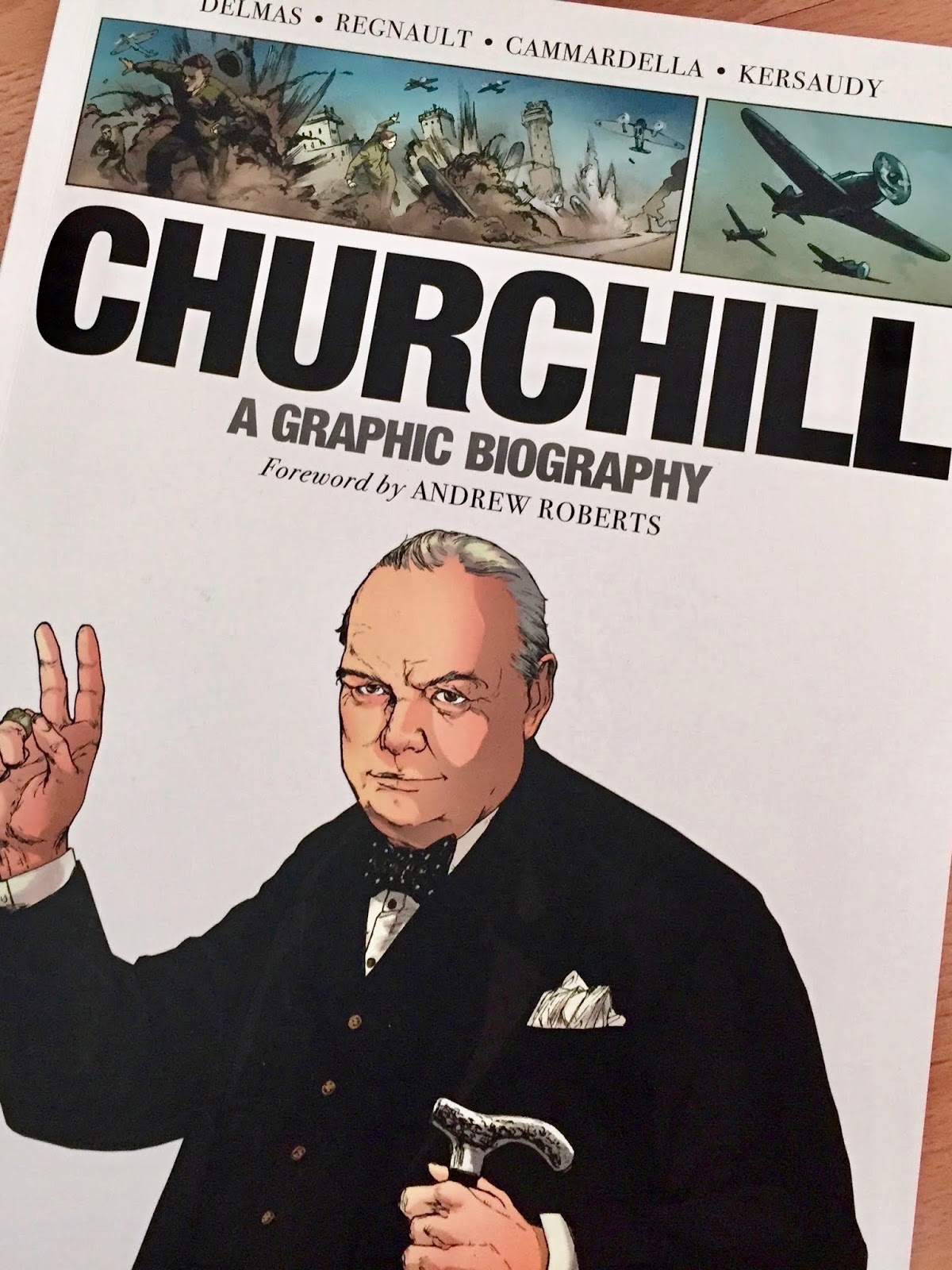
Churchill: A Graphic Biography

Yes, I am reviewing a comic book now! But, trust me - it is seriously good.

Now, Churchill is one fellow that is very hard to summarize. With such a rich and long life in various positions, almost an impossible task. But I´d say that Vincent Delmas has succeeded, both because of the comics and the superb introduction, which is more like an illustrated article.

Of course, lots of important stuff is not part of Churchill: A Graphic Biography, and as a Nordic reader I wanted more about Norway 1940. Still, most of the key moments in his life are here. Speaking about Norway - the heavy water sabotage operation is in the book.

My one real criticism is that the military hardware shown could have been more correct and detailed. But, generally speaking, this is one of the best, if not the best, fact-based comic books that I have read.

One subject that takes up a fairly large part in the final pages of the book is the failure to secure Poland´s independence. Rightly so!

Being a history nerd you have either seen or will probably see the brilliant historical drama web television series "The Crown" created and principally written by Peter Morgan for Netflix. Well, here comes a suggestion for you TV people out there. Check out Churchill: A Graphic Biography by Vincent Delmas etc. Because it is both brilliant and credible. I suspect that this has a lot to do with Francois Kersaudy, the project´s historical consultant. It should be possible to use Churchill: A Graphic Biography as the basis for a Netflix movie, or even a TV series.

Friday, January 10, 2020

Stunning Scale Models & Dioramas

Here focus on super detailed 1:32 aircraft, e.g. the B-25J Mitchell on the cover.

Few people find the time to spend hundreds of hours on a single scale model. The results can be simply stunning. They certainly are in the books from the Swedish publisher Canfora, and that is why I recently payed them a visit.

Finding little time to myself build scale models, I have come to the conclusion that what I mainly long for is being able to see really good models up close. I mean, REALLY close and in superb photos. Therefore I visited Toni Canfora in Stockholm to discuss his own models and his books - that contain both his finished models and those of many other "model artists" as I would like to call them. On top of the superb photos in all his books Toni Canfora has added really interesting historical facts and model information as well as good captions (IMHO really good books must have really good captions). The main focus of Canfora is scale models and dioramas, but they have other kinds of books too. But first let me show you two more scale model book covers:


What most of all appeals to me with the Canfora scale model books is that some contain dioramas based on actual photographs, like the StuG book above. To me, that sort of diorama is the most amazing to see, the experience can be both like experiencing art and history.

In addition to the now quite many books on scale modeling, Canfora also offer books focused on large & previously mostly unpublished photographs of actual AFVs and aircraft. Mostly taken during WWII. Let me just say how very much I have been surprised by the three AFV Photo Album books about Panther tanks and other AFVs in Czechoslovakia. This is the latest volume, vol 3.


I had never thought that so many previously unpublished amazing Panther photos would appear. Like the scale model books, the AFV books have captions full of information, pointing out lots of details in the photos that one would otherwise miss. Now, do check out all the amazing books from Canfora.

Thursday, November 28, 2019

Hitler´s Paratroopers In Normandy

If you wish to know how the German paras fought in Normandy, this book is for you.

Retired US Army Colonel Gilberto Villahermosa has produced 303 pages of top-notch German paratrooper history. He has chosen to focus on the German II Parachute Corps and its commander Eugen Meindl in Normandy.

Some German paratroopers were actually wargaming an airborne landing by the Allies just hours before the Allied airborne operation was launched. It so happened that German paras then found themselves fighting great numbers of their equivalents in the US Army. it is interesting to read how they viewed each other and compared equipment. The aspect the Germans were really impressed with seems to have been the (amount of) American medical equipment, not least the individual soldier´s medical items. The US rations also caused some German envy.

What about the US view of Fallschirmjäger equipment? An example comes from Major Salve Matheson, partly Norwegian and Swedish and at the time a staff officer in the US 506th PIR. Matheson is quoted by the author regarding the capture of a German 75 mm recoilless rifle for paratroopers: "This was the first and only weapon of this kind encountered by the regiment though its value was not realised".

The fighting between the German and US paras became bitter indeed around Vierville, where an entire Fallschirmjäger battalion fought an understrength battalion of US paras. It became known as the Battle of Hell´s Corner. The pages about this battle are among the most interesting in the book.

The combat experience and quality of the German paras in Normandy varied greatly - far from all had any jump training at this stage of the war, and Hitler´s Paratroopers In Normandy helps make that clear.

This book contains a document from General Meindl marked "Destroy After Reading" that sums up the first lessons learnt the hard way by the Fallschirmjägers in Normandy. In general, this book´s conclusions are of great value.

Hitler´s Paratroopers In Normandy has all that one expects from a good unit history including maps, photographs and useful appendixes. It contains 44 photos - not a huge number, but some of them are amazing.

Saturday, October 12, 2019

Secret War - Not Just About SOE

An attractive cover for a special operations reference book not just about the SOE.

When you have read about Special Operations Executive (SOE) operations in certain countries you might want to better understand the SOE in general - why it was created in 1940, how it began its existence and what became of it. Secret War by Nigel West answers such questions and has some parts of particular interest to Nordic readers.

Secret War: The Story Of SOE includes the original Cabinet memorandum, drafted by Neville Chamberlain in July 1940, which created SOE. West´s book has many details about the origins of SOE and the serious rivalry it from the start experienced with the Secret Intelligence Service (SIS, also known as MI6). Nigel West even writes that an "undeclared war" existed between the SOE and SIS. West also makes it clear that he has studied not just the successful SOE operations, and that he wants to shed light on how the SOE tipped the resistance balance in favor of Communist groups in several countries, not only in Yugoslavia.

West does not devote many paragraphs to describe Operation Gunnerside, the successful SOE action in the Norwegian mountains to stop the German development of nuclear weapons, through the destruction of heavy water production and stocks. But that operation is well documented in several other books and West instead clarifies how Gunnerside was to the benefit of the status of SOE in general.

Early SOE activities in Sweden and Norway are covered rather extensively. One wishes West had written as much about the last activities, that interest me more. Still, one learns some important facts about the SOE in all of Scandinavia and regarding the Danes I learnt of something I had no idea of - how the US Office of Strategic Services (OSS) had plans for a Danish Operational Group (OG). In fact, several pages of this book are very informative about the OSS.

If you are mainly interested in SOE and OSS activities in France, this book will be even more useful to you.

The edition of Secret War: The Story Of SOE that I have just reviewed is the one that was printed this year (2019). The first edition was published in 1992. I believe it remains a good investment.

Thursday, September 19, 2019

Hitler´s Largest Arctic Project Then & Now

Org. Todt chief Albert Speer (right) with General Eduard Dietl in the Arctic 1943. Attribution: Bundesarchiv, Bild 183-J16636 / CC-BY-SA 3.0

Thanks to a Norwegian friend I was recently invited to a WWII research meeting right beside Hitler´s largest Arctic project, his railway line that was meant to end in Kirkenes by the Finnish (now Russian) border. This blog post is mainly to provide a visual idea of the amazing days we spent up there.

The Organisation Todt (OT) was a German paramilitary engineering organization named after Fritz Todt, an engineer and senior Nazi leader. The OT was one of the Wehrmachtgefolge, German Armed Forces auxiliaries. The organization was responsible for implementing the vision of connecting by rail south Norway with Kirkenes, the northeasternmost town not far from Soviet Murmansk. This meant working in one of the most challenging landscapes on earth due to a staggering amount of mountains and fjords. The Arctic climate and often total lack of roads for supporting motor vehicles did not make things easier. As usual, the OT would rely on forced labour, mostly Soviet and Yugoslav prisoners of war. The section responsible for this most extreme railway project was called OT-Einsatzgruppe "Wiking". The project was pursued right to the very end of the Third Reich, at the cost of thousands of lives.

Our trip last week began with a visit at Klungset, beside the town of Fauske, about 70 kilometres inside the Arctic Circle. Klungset is probably the most intact OT base that there is in 2019, and one of few WWII German military hospitals still around. Last time I visited it, 18 years ago, it was in a deplorable state. Now several parts of it have been restored. In 2015 it became protected by the Directorate for Cultural Heritage in Norway.

The German hospital in Klungset shortly after the German capitulation.

The same place the other day, now in private Norwegian hands.

In connection with the huge Arctic railway project to Kirkenes, this hospital complex was built in 1942-43, mainly for the benefit of German OT staff. Construction was carried out by forced labour, local companies, a southern Norwegian construction company and others. When the base was completed in 1943, it consisted of 12 buildings with a total capacity of 200 beds. Today, four of these buildings are preserved. Although the bulk of the labour force consisted of prisoners of war, this group received limited treatment at the base. This changed radically after the German capitulation, when, in June 1945, the US Army flew Swedish Red Cross personnel, diet foods and medical equipment to treat the most ill Soviet former prisoners of war. Thus American C-47 aircraft flew a Swedish hospital staff from Luleå to Bodö, not far from Klungset. The above 1945 photo from Klungset shows the main building with Swedish medical staff and also some Germans under Norwegian command.

This Phänomen was an ambulance at the base and after 1945 used by a farmer.

Hopefully Klungset will sometime in the future also become a true museum. We saw why that would be a good idea - not only has the main building been restored, another building has been left virtually untouched since 1945 and contains many both unusual and moving artifacts and photographs. Just walking around on the base, especially in the cellars, is a remarkable experience in itself. The two gentlemen who own the premises also have some relevant WWII military vehicles, some virtually untouched since the war, some restored.

US Army Dodge ambulance with a German BMW R75 motorcycle in Klungset.

Thank you so much, Trond Ole Slettvoll, for showing us around on Klungset. Our next big thank you goes to Trond Inge Mathisen of Hamaröy, whose WWII researcher event took place by a mountain lake 90 kilometres north of Klungset, beside the last large German tunnel that was made before the German capitulation. It was never completed and is dangerous to enter, but can be entered with a guide and special equipment - see the last photograph below.

All around our research meeting there were traces of German slave labour camps.

The foundations for a German Arctic railway bridge between two mountains.

The quality of the work is just amazing but also largely covered by vegetation.

German bridge foundations are everywhere but the bridges long gone (sold).

Some of the construction equipment used by the slave workers is still in situ.

The WWII weekend brought together more than 50 Norwegians and 3 Swedes.

Part of the weekend was the unveiling of a new memorial by the last large tunnel.

One of the WWII Soviet (Norwegian) reenactors unveiled the memorial.

The text to the memory of the prisoners of war is in Russian and Norwegian.

Entering the last tunnel should only be done with safety equipment and a guide.

What is inside the last large German Arctic railway tunnel? First, please understand that abandoned WWII tunnels should not be entered, or at least not without safety equipment and a guide, as they are more or less unsafe for various reasons. Well, what about my experiences from the above tunnel? I am saving them and the relevant photos for a manuscript I hope to finish next year which will contain largely unknown and unpublished material. You can support this by reading my books, two are available in English (check Amazon etc). The next one (in October) in Swedish you can see below. It contains chapters i.a. about some very large gifts from Soviet former prisoners of war in Sweden and a previously unknown Allied base on Swedish soil - the Norwegian SOE operators on the cover came from one of these bases. If you are wondering about the submarine on the cover it is U 3503, one of the extremely advanced German submarines of the type XXI class, en route to Norway but scuttled on 8 May 1945 west of Göteborg, Sweden.

Thursday, September 12, 2019

The Normandy Battlefield Encyclopedia

Superb for those of you who have been to Normandy but want to discover more.

Recently I reviewed Visiting the Normandy Invasion Beaches and Battlefields, a terrific book for first-time visitors to Normandy and those planning to lead school groups and similar groups. Now I will review a Normandy guide so comprehensive that it could also be considered a battlefield encyclopedia.

This book, Major & Mrs Holt´s Definitive Battlefield Guide to the D-Day Normandy Landing Beaches (75th Anniversary edition) by Tonie and Valmai Holt, is an impressive mix of good maps, photos and information, the result of decades of Normandy experience and countless meetings with veterans. Aside from many colour maps inside the book you also get a separate map which in itself will probably be very helpful, not least while you are in the area. Simply put, I have never seen a better battlefield tour map before.

Major & Mrs Holt´s new guide can be used not only to plan a trip to battlegrounds or museums of special interest, it is a tool for historians, serving officers, history buffs and wargamers. Even if you have been to Normandy a couple of times I bet you will find several new and highly interesting places thanks to this guide. I did. Also, you will probably find the purely historical information in the book very readable, motivating, and sometimes also very moving.

Nordic readers will be pleased to know that Major & Mrs Holt have not missed the Norwegian and Danish memorials in Normandy and thanks to the maps and photos you will be able to locate them. So far there is no memorial to the Swedes who were also a part of the Normandy landings (mostly at sea but also on the ground and in the air), but there is at least a Bofors anti-aircraft gun in the Bayeux Museum (there is a photo of it in the guide), one of hundreds of Bofors guns used in Normandy.

Major & Mrs Holt´s guide also cover where to stay and eat and special tips for those wishing to tour Normandy by bicycle. The book is 350 pages long but still quite handy (not that large), and filled with good illustrations, mainly in colour.

Tuesday, August 13, 2019

Building SAS & LRDG Jeeps

64 large format pages of Jeep history by car designer and restorer Lance Cole.

Many books have been made about the first, now iconic, Second World War Jeeps. So why one more? Well, this is a Jeep book with a difference, being specially focused on modelmakers and military vehicle restorers - and not least those with a special interest for SAS and LRDG Jeeps.

Being a co-author of The Long Range Desert Group: History & Legacy my interest in LRDG & SAS Jeeps is pretty strong. I was therefore pleasantly surprised to see a SAS European Theatre of Operations Jeep as the main illustration on the cover of the new Pen & Sword Land Craft series book The Jeep by car designer, author, journalist, restorer etc Lance Cole. The scale model focus of the series (like in the Tank Craft series) is apparent from the SAS Jeep on the cover, as it is a model. But photographs of actual vehicles and color line drawings are also very much part of the book. I would say that even if you are not at all into models and rather describe yourself as a restorer and/or reenactor, you will find this book to be both helpful and simply a pleasant read and good source.

Basically, this book contains the essential development and design history, describes the lovely details of wartime Jeeps, many variants and, of course, the services they provided on various WWII battlefields. Lance Cole delivers both excellent text and many photographs of actual Jeeps and model Jeeps. Modern military vehicle designers would do well by studying the small, very clever touches of the original Jeeps.

The scale models of SAS Jeeps are well covered, both the Jeeps used in North Africa and in the ETO. The book has only one wartime SAS Jeep photo - the most classic one there is. But the many excellent colour photos of SAS Jeep models made me forgive that. The LRDG part is just one page of line drawings, but on the other hand the four page SAS in North Africa showcase features two wonderful LRDG figures that have replaced the original Tamiya SAS figures. The book informs exactly where these figures are from, and describes and shows just about every 1:24, 1:35, 1:72 and 1:76 scale Jeep kit ever made by various manufacturers around the world. The mostly stunning photos show lots of details, scale model modifications (improvements) and in some cases the models have figures and diorama bases.

Not every aspect of this vast subject is covered in the 64 pages and one hopes that Lance Cole might one day produce a second volume with e.g. Red Army Jeeps, captured Jeeps, unpublished wartime photos of SAS & LRDG Jeeps etc. But, let me be clear, this first Land Craft series book is both a very useful and beautiful guide for Jeep lovers and especially those into scale models of this superb little green machine.

Tuesday, July 09, 2019

Excellent M29 Weasel Book

The cover is great but does not inform about the superb colour photos inside.

Large-scale Allied raids against the Germans in Norway were the main motive for the development of the small tracked vehicle that became known as the M29 Weasel. This new book about the M29 by David Doyle tells the Weasel story better than everything I have previously read on the subject. Add to that many great photos.

The large-scale raids were basically dropped, but the development of the Weasel continued and it came to be deployed in many European and Asian countries during WWII. The service did not end there, it became an important snow vehicle in postwar Scandinavia and also served in the Korean War. The new M29 book by David Doyle tells the story of the development and service of the Weasel family of vehicles mainly by means of photographs with excellent captions. The photos are mostly of very high quality and I have seen few of them before. Doyle also informs about many prototypes, some really funny-looking that I was totally unaware of.

The cover says nothing about the many nice colour photos inside. These are mostly modern images, showing preserved Weasels with all the details you can wish for. These, like the wartime photos, should be very much appreciated by both military vehicle owners and scale modellers. Even if you are neither a MV owner or modeller but "only" interested in the history I think you will like this book a lot.

Monday, July 08, 2019

Swedes Who Fought On D-Day

Personal items from Swedes who fought on D-Day are now on display.

Swedes who fought in Normandy 1944 are for the first time in focus in a museum. Hundreds of Swedes took part in the Allied Normandy operation, mostly at sea. But the Swedish Air Force Museum has of course chosen to focus on Swedes in D-Day aircraft.

It is one thing to read about the only air ace born in Sweden, William Yngve Anderson from Kramfors (see my recent book about him and other Swedes in US WWII service), but it is really something to watch his first air victories, recorded by his Mustang´s automatic camera. Now you can see this footage yourself at the Swedish Air Force Museum, and then see some of his own pilot gear, exhibited thanks to his daughter Gina.

William Yngve Anderson´s flight helmet and goggles, then and now.

The first thing you see when you this summer enter the Swedish Air Force Museum is actually their exhibition about D-Day, and perhaps first of all you will notice a Jeep from one of the Normandy-Swedes, Gösta Wollin from Ystad. Wollin was as a Swedish civilian in Norway while Hitler invaded. Because of that experience and some previous ones acquired in Germany itself, he joined the US 82nd Airborne Division, and jumped with them, actually without parachute training, over Sainte-Mère-Église. During many years his US Army Jeep, that he had legally purchased in 1945, was painted white and used as an offroad toy. Thanks to the Jeep enthusiast Mikael Stenberg the vehicle has been restored and this summer you can see it up close, together with an 82nd airborne paratrooper, at the Swedish Air Force Museum.

Beside Gösta Wollin´s Jeep stands a paratrooper looking like Wollin did on D-Day.

Erik G:son Lewenhaupt MC and Bar from Stockholm was one of the very first men to be dropped from a British aircraft on D-Day, as he was one of the pathfinders leading the British airborne assault. In spite of being a 38 year old Swedish citizen he had been allowed to join the British airborne and was on D-Day an airborne captain (and 40 years old). His exhibited items tell something about the battles that he survived. You will notice his weapons for close quarters combat; a German flag he captured and his Military Cross (he was awarded it twice, thus the MC and Bar). Also his Pegasus-marked jump helmet is on display, and the wrist watch he wore in Normandy. All thanks to his grandson Carl. Click on the photos to watch them in larger size (this goes for all photos on my blogs).

Lewenhaupt´s medals from Finland and Norway 1940, D-Day and other actions.

Hundreds of Swedes took part in D-Day in US, British, Canadian and Polish service. At least one of them was killed in action on D-Day itself, and several were killed some days later. For more about the Swedes in British, Polish, German etc service see Lennart Westberg´s and yours truly´s book Swedes at War (available on Amazon, Adlibris etc). Finally, a cordial THANK YOU to the Swedish Air Force Museum´s Torsten Nilsson and his colleagues, for making this exhibition. It ends on 25 August 2019.