About Me

My photo
Author, film researcher and member of the Swedish Military History Commission.
Showing posts with label Denmark. Show all posts

Friday, March 26, 2021

Guarding Hitler

A 22-year-old Swiss student decided to kill Adolf Hitler and got very close to succeeding. The capture of two unusual Waffen-SS soldiers in Normandy resulted in another of the many close calls with death that the Nazi leader had. If you are keen to learn about the close protection around Hitler, his body guards and their vehicles, then this book by Dr. Mark Felton should be of great interest to you.  

Mark Felton has become a familiar name to many WWII buffs thanks to YouTube. By January 2021 his main YouTube channel reached one million subscribers. But with books like Guarding Hitler he has shown that he is much more than a talented YouTuber. In Guarding Hitler he tells the story of the SS forces directly responsible for the personal safety of Hitler and while doing so makes it clear how complicated the SS empire was. The number of similar (competing) branches within the SS is quite baffling and reflects a basic feature of the whole German state under National Socialism. The Sicherheitsdienst (SD), the intelligence agency of the SS and NSDAP (Nazi Party), has become well known, but Guarding Hitler instead acquaints the reader more with the two SS forces responsible for Hitler´s close personal security, the rather confusingly named Reichssicherheitsdienst (RSD) that was not part of the SD, and the Führerbegleitkommando (FBK). To not complicate life too much I here only use the last names that these groups had.


Guarding Hitler is not least about the many attempts to kill Hitler – I found the Swiss student´s to be the most fascinating one. Although this subject has been covered in previous books and documentaries, Felton manages to make also these sections of his book highly readable. He presents own archive finds about the British Special Operations Executive (SOE) assassination plan called Operation Foxley. The plan, focused on sending a sniper team to Obersalzberg, was created due to the capture of two very special Waffen-SS soldiers in Normandy in June 1944 – soldiers that made the SOE realize that the security at Hitler´s Obersalzberg complex was not perfect. The prisoners opened up a window of opportunity for the SOE. In my opinion Guarding Hitler has all the ingredients to form the basis for a really strong documentary about Operation Foxley, that of course could be followed by a WWII “what if” movie.     


Nordic readers may be surprised to learn from Guarding Hitler how RSD body guards protected also the Reichskommissars in Norway and Denmark. The RSD came to protect not only Hitler but many leaders of the Third Reich. 


Aviation buffs will no doubt be most interested in what Felton has written about Hitler´s private air force including the “parachute seat” that was added to the personal Condor aircraft of Hitler. To quote from the relevant chapter: “Air travel was dangerous, particularly during wartime, yet Hitler seemed to prefer the risks rather than using his train for most long-distance journeys.”


Hitler´s train is of course also present, the Führersonderzug and what I found particularly interesting in that part was what happened to it after the war, how it was used by different states and that Hitler´s saloon coach (dining carriage) was taken out of service only in 1990 (!) and is now on display in a Bavarian steam locomotive museum.


Well then, Guarding Hitler should be of interest to both the average WWII buff, WWII researchers and close protection specialists.

Saturday, November 21, 2020

SAS Jeep Operations in Germany and Norway


It´s not every day that you find a new book about the SAS in Norway and discover one more Nordic in the ranks of the SAS. Well, With the SAS Across the Rhine is mainly about final operations on German soil. Still, it is well worth getting and now for some details.


Unlike some SAS books this one by the late (he died in 2002) Colonel Ian Wellsted OBE, MA, is very personal, it has plenty of details about his love life. This may put off some readers, but should not – because Wellsted´s memoir highlights something probably quite common – how a turbulent emotional conflict at home can follow a soldier to the battlefield and affect his behaviour a lot.    


In January 1945 Ian Wellsted is trained in the French alps for operations in Norway together with a Danish SAS member I had never heard of before. No, I am not talking about Anders Lassen VC. Every Nordic reader into SAS history knows about Lassen. Wellsted writes about Paul Jensen, a former Spanish Civil War volunteer who after the German invasion of his homeland had become active in a Danish resistance organization until he had to flee to the UK, where he joined the SAS. No year for this is given but Wellsted writes about the man on several pages and Danish history buffs should thus be able to track him down. Would love to find out more about Paul Jensen, or perhaps that was not his actual name? Let me know, dear Danish readers.


To get into the right shape for Norway the SAS men are helped by French alpine rangers, chasseurs alpins, and the part about them was for me extra enjoyable as I have had the pleasure of observing them on an exercise. To be precise I was skiing with the 27thAlpine Ranger Battalion. I thus relate to Ian Wellsted´s warm feelings for his cool French hosts. 


After about a month in the alps the SAS skiers were told Norway was no longer a top priority (but Norway will come back on the agenda) and they were instead sent to Germany to there constitute an advance party with armoured jeeps. So, all you SAS jeep fans, here is a book you will definitely want to read. Wellsted´s jeep battle accounts are supported by 16 photos, not always top quality but none of which I have seen before, and some tactical maps. 


In Germany the author confronts not only German snipers but also a most tense situation with one of his own that obviously is suffering from extreme battle fatigue. 


Once Germany has fallen Norway returns on the SAS agenda. Of course, we now all know that this also broke the German will to fight on in Norway. But at the time things were not so evident, and Wellsted paints a vivid picture of what Norway was like just after the general German surrender. One only wishes this part had been a bit longer and that there had been more photos from it. But the one photo that there is, is of particular interest, with many nice jeep details.


With the SAS Across the Rhine (155 pages) ends with a very modern take on what the WWII SAS was all about and lessons to be learnt from them. This part has been written by one of New Zealand´s greatest SAS history buffs, Terence Gardiner, a retired air commodore, and is in itself worth your time. 

Tuesday, October 06, 2020

Essential Study of Foreign Volunteers in the Waffen-SS & Wehrmacht


There are lots of books about foreign volunteers in the Waffen-SS and not as many about the foreigners in the Wehrmacht. What makes A European Anabasis unusual is that it looks at both categories, and contains a lot of credible military analysis.


Last year a paperback version of A European Anabasis: Western European Volunteers in the German Army and SS, 1940-45 by Kenneth W. Estes was published by Helion & Company and it is this version of the book that I shall now review. Unlike many books about foreign volunteers in German formations I would say it treats Wehrmacht and Waffen-SS volunteers with equal attention and the author´s background as a marine, tanker (lieutenant colonel) and professor of history has made possible a convincing evaluation of how the different volunteer groups actually performed. The volunteers from Spain, the Netherlands, Belgium, France, Denmark and Norway (I have placed them in the order of contingent size) are the main focus, and this is a good choice by Estes, in my opinion. Sure, there were also groups from several other Western European states, like Switzerland and Sweden, but as these groups never reached anything even close to the number of Spaniards and Dutchmen etc their significance for the battles of WWII was, basically, microscopic. 


Well then, two-thirds of the West European volunteers in German formations came from Spain and the Netherlands. Kenneth W. Estes does, however, on occasion mention both Swiss and Swedish volunteers and in one case highlights a Swiss national, Dr. Franz Riedweg, as he was a key figure in the Waffen-SS recruitment program aimed at Germanic populations.  


The author in no way hides the fact that Volksdeutsche from Eastern and Southern Europe played the major role in alleviating the mostly unsuccessful recruiting in Western Europe, especially in Scandinavia. Here the author could have inserted a quote from my co-author Lennart Westberg about how dissatisfied Hitler was with the low Swedish turnout, barely 200 men.  


In the Netherlands the recruiting drive had a rather different level of support. Even the former Dutch Army Chief of Staff, General Hendrik Seyffardt, lent his prestige for a Dutch national “legion” under German SS command. However, it should be noted (as Estes does) that Anton Mussert, leader of the Dutch collaborationist NSB, was too optimistic about Dutch willingness to volunteer for German frontline formations.


Speaking of the frontline, the Wehrmacht´s Spanish Division experienced over three thousand (!) casualties in the fighting at Krasny Bor and the Izhora alone. 


Although Estes has concentrated on understanding the fate of contingents and units, he also presents fascinating details about individual volunteers - men that mostly went down with the Third Reich but in some cases also became rather successful, like the first commander of the Spanish Division, General Augustin Munoz Grandes. In fact, Munoz Grandes became the second-ranking man in the postwar Franco regime. 


Of the book´s 50 photos and paintings most are interesting and often depict Spaniards and Belgians (Walloons). In addition there are 15 useful maps. 


A European Anabasis remains an essential study to better understand the complicated German use of foreign volunteers from Western Europe, and their actual military/political value.

Saturday, July 25, 2020

Sirius, A Watchful Eye In The North

I simply can not imagine a more beautiful book about special forces than this one.

If you have read my book about elite forces in the Nordic states (so far only available in Swedish: Elitförband i Norden) you may have noticed that I have a special interest in the Danish Sirius rangers. Patrolling with dog sleds over huge and uninhabited areas on Greenland is their everyday work.

Sadly, I only recently got hold of Sirius A Watchful Eye In The North by Peter Bondo Christensen, biologist at Aarhus University, with photos taken by Sweden's probably most Arctic photographer ever, Magnus Elander. All the Arctic travel behind their book is in itself worth a lot of respect. The thing is that they have also achieved something brilliant. I simply can not imagine a better, more beautiful book about special forces, dogs and Greenland than this one.

Sirius A Watchful Eye In The North not only provides the reader with an understanding of the unit's history and tasks, I think Peter Bondo Christensen and Magnus Elander have managed to convey some of the feeling of "flow" that the Sirius rangers get when they have learned the "craft" and solve tasks in harmony with both dogs, snow, ice and extreme temperatures.

Magnus Elander's photographs are so beautiful that words fail me - it is such a joy to see them that I can only compare to going to the best art galleries I have visited. No wonder his pictures can be found in magazines such as National Geographic Magazine and he has been named "Wildlife Photographer of the Year".

Serving for a period with the Sirius Patrol means, in a way, being away from the "real" world for two years. You might think that two years is just too much - talk about social distancing! But Sirius A Watchful Eye In The North lets the reader understand that the time on Greenland creates extremely strong friendships, with both humans and animals. The book allows the reader to perceive another world, both more difficult, easier and more beautiful than the "normal world".

The only sad thing about Sirius A Watchful Eye In The North, released in 2018, is that the book is very difficult to get hold of. It is a little easier to find the Danish version, published in 2009 and 2018. Those editions are also completely sold out, but several copies are available in Danish libraries.

The book is 206 pages and the format is slightly larger than A4. Should you manage to find a copy for sale, be prepared to pay a lot. But whatever it costs, you will find that it was worth it - because this is one of the finest books ever created.

Monday, March 09, 2020

A Deniable Operation Under The Swedish Flag

SAS VC holder Anders Lassen (1st from the left) always catches my attention.

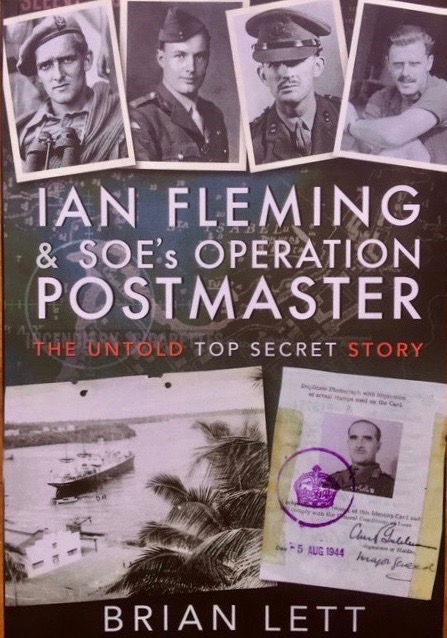
The story they presented was that they were a neutral Swedish crew on a neutral Swedish yacht. In fact, they were a group of SOE agents on an incredibly daring mission, commanded by an actual "M", with whom Ian Fleming worked. This is a book that especially Nordic SOE, SAS & Fleming/Bond buffs can appreciate.

While the Swedish flag was mere camouflage, there were actually Danes aboard, one of whom later would join the SAS and earn a VC, Anders Lassen. Thus it should already be apparent that Ian Fleming & SOE´s Operation Postmaster by Brian Lett is of special interest to Danish military history buffs. Norwegian WWII buffs also have several reasons to pick up this book, because Brigadier Colin Gubbins was "M" and he had a great deal to do with Norway from 1940.

Well, what kind of special operation is Ian Fleming & SOE´s Operation Postmaster about? In 1941 the British started receiving reports that German submarines were using rivers in French parts of Africa for refuelling. At the time, the Special Operations Executive (SOE) was a new outfit with many enemies, not just among the enemy. The SOE had to prove its worth. The cunning plan was to sail a "Swedish" SOE ship, with some great characters, to West Africa and locate German submarine bases. But having arrived in the area the main aim became to steal enemy ships from a neutral Spanish port on the volcanic island of Fernando Po. I will here not give away the wonderful story of what happened but just say that the British Government lied in order to conceal British responsibility for the operation, and basically recommend that you read this book yourself.

Being the author that I am, I do not think that the characterization of Sweden as "pro-German" in Lett´s book is fair. Regardless if one means the Swedish state or the majority of the Swedish people, the largest Swedish sympathies were about Finland, Norway and Denmark. Yes, there were Swedish Nazis and pro-German sympathies, but they never dominated. The thousands of Swedish citizens in Finnish, US and Norwegian service can be compared with the 200 in various German units. For more about Sweden during WWII please turn to e.g. John Gilmour or yours truly.

Nevertheless, Brian Lett´s book is an inspiring and exciting book that should please not just SOE and Fleming/Bond buffs. First published in 2012, the edition I got is from last year. Brian Lett has written other books about special ops and I just recently became aware of his SOE`s Mastermind - Sir Colin Gubbins, a book that I very much look forward to reading.

Thursday, January 30, 2020

Keystone of 22 SAS

Without him there would today probably be no 22nd Special Air Service Regiment.

Quite a few readers of this blog may have read several books about the WWII Special Air Service and also the SAS during recent years. But what about the first postwar decades of the SAS? Here is a book that both covers WWII experiences and some of the more interesting post-1945 SAS episodes until the 1970s. And, of course, there are some Nordic connections.

As some readers may have noticed, I have a special interest in SAS history. This should become more apparent here, as I am planning to blog more about the SAS. Keystone of 22 SAS is, simply put, a fine account both of the life, mostly in the SAS, and times of Lieutenant Colonel John Woodhouse MBE MC. He first experienced combat in a conventional British Army unit in North Africa and there, strangely enough, is the first Nordic connection in the book. For more than twenty years I have been hiking on Arctic WWII battlefields and the type of tin cans that I have most often encountered in German positions are cans that once contained Norwegian fish. Therefore I can recall images from my memory when the book´s author, Alan Hoe (himself an SAS veteran), writes about Woodhouse often eating captured (from the Germans) Norwegian sardines in North Africa.

Keystone of 22 SAS quite often contains Woodhouse´s own words and here are some sentences from his diary in 1944 to give you an idea of his wartime reflections:

"The German soldiers had an unshakable belief in their superiority over all other nations and armies. They had been led to believe that war was glorious and Hitler [...] was invincible. The Wehrmacht was very well led, better equipped and by 1943 more battle experienced than we were. [...] I was often fearful but it always mattered greatly to me that I should be well regarded and respected by the soldiers I commanded. This helped in overcoming fear."

It was in the ruins of the Third Reich that Woodhouse entered a door that eventually led to the SAS. By exaggerating his contacts with Soviet soldiers while he was a PoW, he managed to get a place in a Russian language course. On the successful completion of the course he was posted to Germany where he joined the Control Commission to act as interpreter between Soviet and British military groups. A short time later he was switched to army intelligence. He then exeperienced some memorable encounters both with Soviets, including an early defector, and Germans like Hanna Reitsch, "[...] the only German I met who had the courage still to proclaim loyalty to the Nazis".

In 1950 he reacted positively to an invitation to join the Malayan Scouts and thus fight in the deep jungles of Malaya. He volunteered not least because he was keen to serve under the legendary Mike Calvert, famous for having commanded a Chindit Brigade in Burma. Woodhouse sensed that Calvert was a great source of "original ideas and concepts". Woodhouse became both nervous and "a bit resentful" when Calvert made him Unit Intelligence Officer. But then he meets a very unlikely character in the jungle, "Yorkie" Bjorkman:

"With a good intelligence network the battle is half won. Yes. You can learn a lot from Yorkie. He´s a man with personality, guts and imagination. He´s got thirty Malay police there and he controls the jungle for miles around - controls the jungle."

Bjorkman was awarded both a Distinguished Conduct Medal, the oldest British award for gallantry, and a Military Medal, for bravery. The encounter in the jungle with a man obviously of Nordic extraction is only one of many surprises in Keystone of 22 SAS. The SAS in Cold War Denmark is also part of the book, but one wishes there had been more details in that part.

Woodhouse´s fascinating career did not end at all with his formal retirement in 1964. The year after he was asked by SAS founder David Stirling to lead a team of three men to Yemen and in cooperation with Royalist forces attack an Egyptian airfield. These experiences alone could be made into a good movie.

John Woodhouse passed away in 2008. Now it is time for you to read about his rich life in Keystone of 22 SAS.

Thursday, December 05, 2019

StuG III & IV

A surprisingly good StuG book for both AFV buffs and modellers.

Having a special interest in StuGs it takes a special StuG book to surprise me. Well, Dennis Oliver´s new book StuG III & IV: German Army, Waffen-SS and Luftwaffe, Western Front 1944-1945 contained some news for me - not least about Danish postwar StuG use.

Why are WWII assault guns/tank destroyers of special interest among AFV buffs and modellers? I reckon there are several different answers depending on who you ask, but here in Sweden I think quite a few guys (now rather mature AFV buffs/modellers) once trained to use the Swedish "S-tank" (strv 103), like myself, will be aware of the historical roots between the S-tank and the WWII assault guns. I recall my 1980s exchange of letters with the chief designer of the S-tank, Sven Berge - from which I understood that the design similarities of StuGs and S-tanks were no coincidence.

Now, having read about StuGs since the glorious 1980s it takes quite a lot to impress me. But Dennis Oliver´s book has done so. Almost all WWII photographs in his new book are new to me and then he has produced 23 brilliant colour illustrations, clearly displaying different types of camouflage and markings. Aside from these Oliver provides short but good unit histories with graphics plus all the different StuG scale models ever made and very good photos of assembled and painted kits.

Being a blogger/writer with a Nordic angle on military history I must of course also mention my big surprise when I found Oliver´s photo of a StuG III Ausf. B belonging to Minenkommando Dänemark, a company-sized formation formed by the Allies after WWII to remove the about 1 million mines that the Germans had laid along the Danish coast. I knew of this mine-clearing operation but did not knew it had StuG IIIs and PzKpfw IIIs. Well, Oliver knows a lot about StuGs, and has the ability to transfer his knowledge in this quite short (64 pages) but large size book in the excellent TankCraft series.

Saturday, October 12, 2019

Secret War - Not Just About SOE

An attractive cover for a special operations reference book not just about the SOE.

When you have read about Special Operations Executive (SOE) operations in certain countries you might want to better understand the SOE in general - why it was created in 1940, how it began its existence and what became of it. Secret War by Nigel West answers such questions and has some parts of particular interest to Nordic readers.

Secret War: The Story Of SOE includes the original Cabinet memorandum, drafted by Neville Chamberlain in July 1940, which created SOE. West´s book has many details about the origins of SOE and the serious rivalry it from the start experienced with the Secret Intelligence Service (SIS, also known as MI6). Nigel West even writes that an "undeclared war" existed between the SOE and SIS. West also makes it clear that he has studied not just the successful SOE operations, and that he wants to shed light on how the SOE tipped the resistance balance in favor of Communist groups in several countries, not only in Yugoslavia.

West does not devote many paragraphs to describe Operation Gunnerside, the successful SOE action in the Norwegian mountains to stop the German development of nuclear weapons, through the destruction of heavy water production and stocks. But that operation is well documented in several other books and West instead clarifies how Gunnerside was to the benefit of the status of SOE in general.

Early SOE activities in Sweden and Norway are covered rather extensively. One wishes West had written as much about the last activities, that interest me more. Still, one learns some important facts about the SOE in all of Scandinavia and regarding the Danes I learnt of something I had no idea of - how the US Office of Strategic Services (OSS) had plans for a Danish Operational Group (OG). In fact, several pages of this book are very informative about the OSS.

If you are mainly interested in SOE and OSS activities in France, this book will be even more useful to you.

The edition of Secret War: The Story Of SOE that I have just reviewed is the one that was printed this year (2019). The first edition was published in 1992. I believe it remains a good investment.

Thursday, September 12, 2019

The Normandy Battlefield Encyclopedia

Superb for those of you who have been to Normandy but want to discover more.

Recently I reviewed Visiting the Normandy Invasion Beaches and Battlefields, a terrific book for first-time visitors to Normandy and those planning to lead school groups and similar groups. Now I will review a Normandy guide so comprehensive that it could also be considered a battlefield encyclopedia.

This book, Major & Mrs Holt´s Definitive Battlefield Guide to the D-Day Normandy Landing Beaches (75th Anniversary edition) by Tonie and Valmai Holt, is an impressive mix of good maps, photos and information, the result of decades of Normandy experience and countless meetings with veterans. Aside from many colour maps inside the book you also get a separate map which in itself will probably be very helpful, not least while you are in the area. Simply put, I have never seen a better battlefield tour map before.

Major & Mrs Holt´s new guide can be used not only to plan a trip to battlegrounds or museums of special interest, it is a tool for historians, serving officers, history buffs and wargamers. Even if you have been to Normandy a couple of times I bet you will find several new and highly interesting places thanks to this guide. I did. Also, you will probably find the purely historical information in the book very readable, motivating, and sometimes also very moving.

Nordic readers will be pleased to know that Major & Mrs Holt have not missed the Norwegian and Danish memorials in Normandy and thanks to the maps and photos you will be able to locate them. So far there is no memorial to the Swedes who were also a part of the Normandy landings (mostly at sea but also on the ground and in the air), but there is at least a Bofors anti-aircraft gun in the Bayeux Museum (there is a photo of it in the guide), one of hundreds of Bofors guns used in Normandy.

Major & Mrs Holt´s guide also cover where to stay and eat and special tips for those wishing to tour Normandy by bicycle. The book is 350 pages long but still quite handy (not that large), and filled with good illustrations, mainly in colour.

Tuesday, September 10, 2019

III. Germanic SS Panzer-Korps

277 large size pages about the Waffen-SS and the battle of Narva 1944.

Rather surprisingly, this year two books focused on Nordics in the Waffen-SS have been released. First The Finnish SS-volunteers and Atrocities 1941–1943 by Professor Lars Westerlund, and just recently III. Germanic SS Panzer-Korps by Lennart Westberg, Petter Kjellander & Geir Brenden.

This SS corps was a Waffen-SS armoured corps which saw action mainly on the Eastern Front and is often associated with the Estonian city of Narva due to its fighting there. The corps was formed in April 1943 and first commanded by the former Wiking commander Felix Steiner. III. Germanic SS Panzer-Korps is being released in two volumes by the UK publisher Helion & Company. The first volume, just released, covers the background of the corps, its creation and history until September 1944.

Counting myself as a close friend of Lennart Westberg (we have written two books together) I should not really review his new book, but I see no reason why I can not give an idea of the contents. Naturally, the III. Germanic SS Panzer-Korps is the main focus, but the first 45 pages summarize the latest research about the roots and purposes of the Waffen-SS and especially about its recruits from the Nordic states. The authors describe both the incredible expansion of the Waffen-SS and how the SS "brand" was renewed in 1944. Already in the introduction there are several images that few will have seen before, and not just propaganda photographs.

While photographs, especially previously unpublished ones, are important (not least in this book), the III. Germanic SS Panzer-Korps also contains new insights, e.g. into the serious difficulties to keep Norwegian volunteers within the Waffen-SS. Associate Professor Sigurd Sörlie has contributed a summary of his relevant research to this book.

Many books about the Waffen-SS just mention the often very large component of ethnic Germans/Volksdeutsche (from German minorities outside the Third Reich), but in III. Germanic SS Panzer-Korps they are very much present.

The many large photographs are in some cases of spectacular quality and those from within the city of Narva 1944 should be of interest to a wide group, not least those who plan to visit the city. Military vehicle (tank) buffs will find several images of Panthers and other vehicles, also Italian ones, of great interest.

Finally, the propaganda posters in the book deserve special mention. The SS, for Ersatzkommando Danmark, even produced a poster highlighting the significance of Narva, and the book´s poster captions explain the symbols and messages in this and other relevant Waffen-SS posters.

Friday, September 06, 2019

Valuable Normandy Battlefield Guide

This new battlefield guide by Gareth Hughes will improve most trips to Normandy.

Very pleasantly surprised by this one. Visiting the Normandy Invasion Beaches and Battlefields is both a great guide and a compact WWII reference book.

This book by history teacher and guide Gareth Hughes is mostly intended for those planning and leading groups of young people to the World War Two sites in Normandy. But I do believe it should be read and used also by those with a deep interest in Normandy and WWII in general. It starts with a short but brilliant section entitled “D-Day in Numbers”. Two figures that I found to be of particular interest were: “127 – aircraft lost by the Allies” and “15 – percentage of paratroopers that landed in their planned drop zone”.

The general planning and travel tips are in themselves very valuable. The author then provides a very good WWII timeline followed by one of the best summaries I have come across of both the world wars. Then comes a short but still good glossary of key D-Day terms, such as Bigot, Bocage, PLUTO and SHAEF. A 14-page history of Normandy and D-day follows – a very nice summary.

The WWII location parts of the guide do not include every WWII site in Normandy but instead focus on places suitable for school groups and similar groups. One gets really invaluable advice both how to effectively present these places and their context, why they matter. Now, you might want to instead show around a group of military cadets or aviation/tank buffs. Well, I would still recommend this book as your primary Normandy guide. In my next posts I will present some more “extreme” Normandy guides for those already interested in particular units or vehicles.

As I am always looking for connections to the Nordic countries I was glad to note that the author among the tips for extended tours has included the Utah Danish Memorial, that commemorates the about 800 Danes who were also a part of the D-Day landings. They, like the Swedes, served mainly on board ships, but were nevertheless part of the D-Day machinery.

Friday, July 26, 2019

Nordic Counter-Terrorist Units

Winged dagger patch for Reinforced Regional Task Force of the Swedish Police.

The new edition of my book Elitförband i Norden (Swedish for Nordic Elite Units) will be released in the book stores in a few months. As it does not cover police forces (as stated in the book´s introduction), I am here posting an overview of these units and am at the same time reviewing European Counter-Terrorist Units 1972-2017.

As I promised in my review of Fighting the War on Terror, I shall now review a book focused on the equipment and insignia of Europe´s specialists in striking against various terrorists. The book in question is an Osprey guide first released in 2017, entitled European Counter-Terrorist Units 1972-2017, written by Leigh Neville and illustrated by Adam Hook. While I am no expert in police matters I can still say that I perceive this book as very useful for anyone interested in how these units look and are equipped. It also gives an idea of their training, tactics and techniques.

The book first provides a picture of how terrorism has evolved since the 1972 milestone terrorist attack in Munich. The main change since the 1970s and 80s: ransoms and political demands have been more and more replaced by a simpler desire for mass casualties, often combined with "martyrdom" for the terrorists themselves. A major technology change within the European counter-terrorist (CT) units is the emergence of new CT tools like unmanned aerial vehicles (UAVs) and unmanned ground vehicles (UAGs). Another equipment development is how many more weapons CT units now can choose from, not only from Germany (mainly Heckler & Koch) but also from countries like Russia. An example: French RAID teams use Russian Vepr-12 shotguns (looks basically like a Kalashnikov assault rifle) and Adam Hook has made a superb illustration showing a RAID operator wielding one of these.

While I reckon Leigh Neville has done a great job covering the largest European CT units, he has fewer words and no illustrations for the Nordic states. Still, he does provide sections about Nordic CT units: Denmark´s AKS; Finland´s Karhu (Bear Group) and Norway´s Delta. Sadly, there is no section about Sweden´s NI but the unit is mentioned in the section about the ATLAS network, as NI is a member of ATLAS. Well then, what more is nice to know about Swedish CT capability? NI stands for Nationella insatsstyrkan and simply means National Task Force. It is a unit primarily for CT and within the National Operations Department. However, NI is not the only special ops/SWAT unit of the Swedish Police. There are two more levels, first the Förstärkt regional insatsstyrka (FRI), meaning Reinforced Regional Task Force, and finally "just" regional task forces (i.e. not reinforced).

European Counter-Terrorist Units 1972-2017 is, like most Osprey guides, a very useful and concise guide, but has too little info about Swedish units.

Friday, May 03, 2019

Nordic Combat Uniform News

In a few years no longer standard issue: the Swedish uniform system 90.

The contract for a common uniform system for the Nordic states will be signed next year. Also, Sweden´s current standard camouflage pattern might be replaced. All according to the new issue of the official journal of the Swedish Armed Forces.

Nordic defence cooperation has been going on longer than many realize and seems to rarely spark major interest here in Sweden. However, this may be about to change due to the coming common uniform system of Denmark, Finland, Norway and Sweden. The latest issue of the Swedish defence journal Försvarets Forum contains some interesting news about the coming Nordic Combat Uniform (NCU). First of all the article (on p. 5) makes clear that the NCU prototypes will be tested at six Swedish regiments, and the tests there will start later this year. Next year the contract will be signed and the first regular uniforms are to be delivered to Swedish units in 2023 - for some unknown reason it seems the Danes will get them before the Swedes.

The article states that the new uniforms will both be "lighter and more durable". The camouflage pattern used on the outerwear garments may differ from country to country. But, the article also states that "For Sweden, it might be time to change camouflage pattern". This is confirmed in this more illustrated article, also from an official website. The current standard Swedish camouflage pattern for outerwear is called M90 and yours truly witnessed some of the M90 tests during my basic military training in 1988-89. Agreed, that is a pretty long time ago. But personally speaking I reckon the M90 is rather perfect in Swedish forests. Well, I guess I should not exclude that they will come up with something even better.

Being a history freak I would say that NCU will not be the first Nordic uniform, as due to the Soviet Winter War against Finland in 1939-40, the Swedish Volunteer Corps (SFK) issued one uniform system to both Swedish and Norwegian volunteers for Finland. This system was essentially the Swedish m/39. The main difference was the buttons, that were not Swedish Army issue.

Monday, January 22, 2018

Viking Facts & WW2 Fiction

Replica runestone at Denmark´s perhaps best Viking museum: Kongernes Jelling.

There have been some amazing Viking discoveries in recent times, enabling us to more clearly view those seafarers who "...ventured so fearlessly and so far from their homeland". But, at the same time, the relatively recent events of World War Two are being mixed up with fiction.


Heather Pringle, author of the best book about the SS-mystics of the Ahnenerbe, wrote a wonderful summary of the major new findings about the Vikings, in her well-illustrated 2017 National Geographic article "What You Don’t Know About the Vikings". For example, Pringle pointed out that a very real disaster in 536 AD seems to have given birth to "...one of the darkest of all world myths, the Nordic legend of Ragnarök". She also describes the unique excavation of a Viking raid - a raid that took place "...nearly 50 years before Scandinavian raiders descended on the English monastery of Lindisfarne in 793, long thought to have been the first Viking attack."

Add to that the even more recent discovery of the remains of a female Viking commander.

Well, what is starting to bother me quite seriously is that at the same time as we are getting a better picture of history, from the Vikings to the First Cold War, we are getting movies and TV series so loosely based on actual events that the words "based on" sound worse for every passing year. I can buy the "Viking fiction" trend, because there is not an abundance of sources, but why invent 1940s history? Two examples that IMHO stand out, the TV series "Manhattan" and the more romantic movie "The Exception". While both of them have a great look and some brilliant acting, they are filled with invented plots and even leading characters that never existed. These fake men and women interact with utterly real characters, such as the exiled German Kaiser Wilhelm II in "The Exception". To me, new research is constantly providing more and more drama that actually took place. But for some reason, several movie makers prefer making "WWII" movies based on mostly fictional stories. I find it rather frustrating.

Sunday, April 09, 2017

Freedom Is Not Free

The destroyer "Georg Thiele", part of the task force sent to Narvik - where she still is.

On April 9, 1940 both Denmark and Norway were invaded by Germany. Until last year there were more than a dozen defenders of Norway 1940 still alive, such as Swedish volunteer Jan Danielsen. This year Jan is no longer around and soon this major event in Nordic history will have no living witnesses.

Being with Jan and listening to him was something really special, he was simply a wonderful person that inspired me with his vitality and ideas. He didn´t have to say things like "freedom is not free" - he had lived those words.

All in all some 300 Swedes went over to Norway in 1940, all to join the Norwegian Army and none to fight for Germany. There would have been many more if the Swedish government had not suppressed this volunteer movement. There were hundreds, if not some thousands, in the just disbanded Swedish Volunteer Corps for Finland that Jan had also been in, that were eager to also fight for Norway. But the Swedish government basically stopped this from happening.

Jan with local Narvik reenactor Jon, wearing the type of uniform that Jan wore.

Thanks to veterans like Jan I have come to better understand how rich with possibilities life is, and how very small most of my "problems" actually are.

Me onboard "Georg Thiele". The life vest is because I went there by a small boat.

Sunday, March 12, 2017

The Manhattan Project´s Swedish Connections

Unofficial emblem of the Manhattan Project, circa 1946.

Seldom has a TV series about WWII begun with the same slow pace as "Manhattan". After having seen also the second episode I was not that keen to continue watching it, in spite of the terrific acting, look, atmosphere and the subject itself - the people who made the first atomic bomb. But then something happened.

From lukewarm feelings for the series I developed a real attachment, and after the introduction of the Dane Niels Bohr into the story I keep asking myself how it is possible that both Swedish historians, writers and film directors have been able to pay so little attention to the Swedish connections to the Manhattan Project. I mean, first we have the most crucial trip of Niels Bohr via Sweden, and then we have Arthur Adams, the Sweden-born Soviet spy (and former osnaz soldier) who was focused on the Manhattan project. For more about Adams - see my latest book.

Incidentally, Netflix right now show both "Manhattan" and "The Heavy Water War". So, the same media now has both the Allied and the German atomic bomb stories.

Well, Swedish film directors, read up on Niels Bohr and Arthur Adams...

Wednesday, October 12, 2016

German Eyes On Nordic States

Tore Pryser´s magnificent book about German intelligence in the Nordic region.

Norwegian Professor Tore Pryser´s so far probably most important book is about the German intelligence services in the Nordic states - which is also the title in Norwegian of the book in question (Tyske hemmelige tjenester i Norden). Sadly, it has not yet been translated. But if you can understand Norwegian you really should get it, as it is a goldmine.

This book differs from almost all books about WWII in the Nordic area, as it does NOT start in 1939 and it is NOT limited to one of the Nordic states. Instead, Pryser starts his original study in the early 1930s and looks at how Nazism in the Nordic states, although small, was the foundation for much of the northern activities of the German secret services. Not being limited in scope to Norway, Pryser is also able to tell the full story - as northern German intelligence operations not seldom were cross-border ops.

Another great bonus with this book is that it does not stop in 1945 but rather in 1950. The book also looks at German war aims and war plans, e.g. against Sweden.

So, if you have a serious interest in Nordic WWII history, Tyske hemmelige tjenester i Norden is a real must.

Saturday, June 14, 2014

World's Greatest Cowards: Swedes?

In 1914 we Swedes celebrated 100 years of peace, should we very soon celebrate the 200th anniversary, or ignore it?

Journalists around the world are about to cover the different ceremonies commemorating the outbreak of World War One, starting in Sarajevo on June 28. Rightly so, but as a Swede dealing with war history it is my obligation to also remind about the Swedish–Norwegian War of 1814 and question the feelings about the rare peace that we have since enjoyed.

The Swedish–Norwegian War, known here in Sweden also as the Campaign against Norway, was a war fought between Sweden and Norway that broke out with a Swedish naval attack against Norway on the 26th of July 1814. It ended quickly, on the 14th of August with Norway entering into union with Sweden, but with its own parliament and constitution. That war is today of little consequence for Sweden, as the union was dissolved in 1905. But the peace we have enjoyed since 1814 can still be a hot subject, as was recently demonstrated at a debate in Stockholm when Anders Lindberg, editorial writer of Sweden´s largest newspaper, Aftonbladet, stated "neutrality is the world's most successful policy, it has spared us from wars for 200 years". This praise for neutrality was not quite correct, as Sweden since joining the EU has scrapped the principle of neutrality. However, our non-aligned policy continues, and that is most probably what Mr. Lindberg had in mind. The reaction to these words from Erik Helmerson, editorial writer at Dagens Nyheter, our largest morning paper, was scathingly self-critical: "Sure, if success is that others sacrifice their lives for our sake - then neutrality is a mega-hit".

I would say that both Mr. Lindberg and Mr. Helmerson have missed some key parts of Swedish history. For example, we were not neutral when our neighbour Finland was attacked in 1939. But the help that the Swedish government provided was not flaunted and the full scale of it only became known decades after the war. Also in 1941-44 the Swedish government allowed a volunteer movement for Finland and made it possible for Swedish officers to serve Finland. Perhaps not that many Swedish lives were laid down for Finland 1939-44, 117 lives to be exact. But let´s not forget neither them nor the around thousand Swedish lives lost in Allied supply convoys and military units 1939-45. Most were not in Allied armies but on ships under various flags. However, the Norwegian memorial in Oslo for the around hundred Swedes who died for Norway 1940-45 makes no difference at all between those that died in the Norwegian Merchant Navy and those that died on battlefields in Norway and Normandy. So, there is no reason for us to differentiate, a life is a life.

The number of Swedes who died for Finland or in Allied convoys may largely be described as volunteers and the figures pale when one compares to the war dead of other countries. But one must not forget that the Swedish state facilitated both categories and the number of Swedish sailors who assisted the Allies, 8,000, just cannot be regarded as insignificant.

Let us now look back at August 1914, when Europe was largely at war but we Swedes celebrated our first century of uninterrupted peace by erecting an 18 metre tall monument on the border between Sweden and Norway to celebrate 100 years of peace between our countries. There is a book in English that provides us with a unique view of the ceremony that day, Scandinavia in the First World War edited by Claes Ahlund. I know of no similar book in any language, as it provides insights into several very little known subjects like the intelligence and counter-intelligence war in Scandinavia, the 26,000 (sic!) ethnic Danes in the German military, the 1,100 Scandinavian volunteers in Australian (!) uniform and the immense losses of the Scandinavian merchant ships in 1914 and 1918 - Norway alone lost 829 ships. Yes, that´s right, 829 ships.

Scandinavia in the First World War really is a must if you want to get to know Scandinavia in 1914-18 and also paints vital background for the stance in 1939 - not joining the warring sides had worked in 1914-18, so why change that basic strategy? Just bear in mind that Scandinavia in the First World War is not a regular history book but exactly what the subtitle says: Studies in the War Experience of the Northern Neutrals. A more regular history of Scandinavia in 1914-18 has yet to be written and should preferably include more about Finland and thus be called something like The Nordics and the First World War. A parting tip to those who eventually will write that book, check out Swedes at War.

Finally, should we on the 14th of August celebrate that it will then be - unless the Ukraine War of 2014 turns into something much bigger - 200 years since we were officially at war with another state? Shouldn´t we rather ignore the coming anniversary, considering the many abroad that sacrificed their lives for our sake? Well, aside from that more than a thousand Swedes lost their lives for others, i.e. Finland and the Allies, let me quote the British ambassador to Sweden during WWII, Sir Victor Mallet: "Swedish neutrality was of far greater value to us than a Swedish act of suicide in 1940 would have been."

Tuesday, December 31, 2013

A Few Heartbeats From Sweden

Russian Su-34 aircraft flew close to Sweden for the first time ever during the "Zapad" (West) drills in September.

Looking back at Sweden´s security in 2013 there occured serious events courtesy of the Russian Armed Forces that still, after many months, have not really been explained.

On April 22 the Swedish quality newspaper Svenska Dagbladet reported that two Russian Tu-22M3 nuclear-capable bomber aircraft escorted by four Su-27 fighters had performed night time drills about 35 kilometres from the Swedish border the night of March 29/30. Choosing to stage air drills with nuke bombers 35 kilometres from Sweden may sound serious enough, but several Swedish military sources have since stated that the Russian aircraft had also been simulating attacks on two military targets located inside Sweden, one near Stockholm and one in southern Sweden. The Swedish Air Force did not react. But two Danish F-16 fighters did.

The Polish Centre for Eastern Studies commented i.a.:

"The lack of a reaction from the Swedish Air Force to the Russian exercises proves that this most important branch of the Swedish Armed Forces has structural problems and may be unable to cope with all the tasks it has been entrusted with."

And:

"Russia resumed flights of strategic bombers capable of carrying nuclear warheads in the High North in 2007 and in the Baltic region in 2011 (in international airspace). However, the manoeuvres of 29/30 March were probably the first Russian exercises to simulate a direct attack on Sweden since the end of the Cold War."

In September , during the larger-than-promised "Zapad" (West) drills, Russian Su-34 aircraft flew close to Sweden for the first time ever and the military of Belarus released a clip (see below) showing elite soldiers from Russia and Belarus confronting an unarmed Swedish Gripen (in recce configuration) that was observing the drills.

In October there was a similar event to the one on 29/30 March, but this time the Swedish Air Force reacted (was allowed to react).

However, the Swedish government has still not really explained why, in its view, these most unusual events occured. The Russian Air Force could have chosen a billion other places for air drills with nuke bombers, yet for some reason chose an area a few heartbeats from Sweden.

Nor has our government, as far as I know, seriously commented on any of these events:

* Two Finnish presidents, one minister of defence and a number of Finnish defence experts have openly spoken out against Sweden´s lack of defence.
* Our closest neighbours, the Norwegians, have during 2013 enlarged conscription both in quality and for some units also in length of service.
* In late 2013 the new Norwegian government announced that it has ordered the establishment of a mostly professional rapid-response unit in Setermoen above the Arctic Circle.
* The Finnish Ministry of Defence in late 2013 confirmed that it wishes to purchase 100 Leopard tanks from the Netherlands in a version more modern than what Sweden has. BTW in 2012 Finland purchased missile systems more advanced than anything in the inventory of any other Nordic state.

Now, concerning the coming year, here are some less reported news items/analysis from 2013 that I believe will affect the world in 2014:

"Putin says new post-Soviet union ready for 2015 launch"

"Can a China-Russia Axis Bankrupt the US?"

"French polls show surge in support for far-right National Front"

"Marine Le Pen was recieved by Russian Vice Prime Minister Dmitry Rogozin" (in French, who has seen any news item at all in English about this?)

"US Navy predicts summer ice free Arctic by 2016"

The russian Navy and elite soldiers from Russia and Belarus confronting an unarmed Swedish Gripen (in recce configuration) during the "Zapad" drills in the Baltic.

Tuesday, January 01, 2013

Hitler News of 2013

Wartime newsreel showing Hitler meeting Croatian fascist leader Ante Pavelic. The latter made it to Argentina, hardly the former.

The well-established Israeli newspaper Jerusalem Post on Saturday wrote about a coming Israeli documentary film, "Revealed: Hitler in Argentina". The film will no doubt result in more articles about it during 2013. Here is my take.


"Revealed: Hitler in Argentina" is inspired by the book Hitler’s Escape by Patrick Burnside, but the Israeli filmmakers have added research of their own, all according to the Jerusalem Post article. However, as I have read the book Grey Wolf (2011) by the British authors Simon Dunstan and Gerrard Williams, I am struck by the similarities with that book. From the JP article and the trailer it links to it seems quite clear to me that "Revealed: Hitler in Argentina" and the coming book by Burnside differ not that much from Grey Wolf.

One does get a thousand or so facts from reading the sometimes exciting Grey Wolf but, ultimately, it is a mystery to me why the authors, one of whom (Simon Dunstan) has written a long list of serious books on military history, chose to release this book as a serious book and not semi-fiction. Because aside from facts and some sane conclusions the book contains a long row of unbelievable statements and conspiracy theories. Simply put unconvincing when it comes to the most important parts, the escape via Denmark (remember, there is always a Nordic connection!) and Argentinian aftermath.

What is highly interesting is how and why Argentina and other South American states actually did harbour so many Third Reich mass murderers, not least Josef Mengele, Adolf Eichmann and Croatia's own Hitler, Ante Pavelic. Grey Wolf contains some passages about these as well as the less known SS-general Ludolf von Alvensleben. However, these and some Berlin 1945 parts can't save the book.

As I see no indication of the coming film and book doing a better job than Grey Wolf in presenting basically the same story, I have grave doubts about them.