About Me

My photo
Author, film researcher and member of the Swedish Military History Commission.
Showing posts with label Switzerland. Show all posts

Friday, March 26, 2021

Guarding Hitler

A 22-year-old Swiss student decided to kill Adolf Hitler and got very close to succeeding. The capture of two unusual Waffen-SS soldiers in Normandy resulted in another of the many close calls with death that the Nazi leader had. If you are keen to learn about the close protection around Hitler, his body guards and their vehicles, then this book by Dr. Mark Felton should be of great interest to you.  

Mark Felton has become a familiar name to many WWII buffs thanks to YouTube. By January 2021 his main YouTube channel reached one million subscribers. But with books like Guarding Hitler he has shown that he is much more than a talented YouTuber. In Guarding Hitler he tells the story of the SS forces directly responsible for the personal safety of Hitler and while doing so makes it clear how complicated the SS empire was. The number of similar (competing) branches within the SS is quite baffling and reflects a basic feature of the whole German state under National Socialism. The Sicherheitsdienst (SD), the intelligence agency of the SS and NSDAP (Nazi Party), has become well known, but Guarding Hitler instead acquaints the reader more with the two SS forces responsible for Hitler´s close personal security, the rather confusingly named Reichssicherheitsdienst (RSD) that was not part of the SD, and the Führerbegleitkommando (FBK). To not complicate life too much I here only use the last names that these groups had.


Guarding Hitler is not least about the many attempts to kill Hitler – I found the Swiss student´s to be the most fascinating one. Although this subject has been covered in previous books and documentaries, Felton manages to make also these sections of his book highly readable. He presents own archive finds about the British Special Operations Executive (SOE) assassination plan called Operation Foxley. The plan, focused on sending a sniper team to Obersalzberg, was created due to the capture of two very special Waffen-SS soldiers in Normandy in June 1944 – soldiers that made the SOE realize that the security at Hitler´s Obersalzberg complex was not perfect. The prisoners opened up a window of opportunity for the SOE. In my opinion Guarding Hitler has all the ingredients to form the basis for a really strong documentary about Operation Foxley, that of course could be followed by a WWII “what if” movie.     


Nordic readers may be surprised to learn from Guarding Hitler how RSD body guards protected also the Reichskommissars in Norway and Denmark. The RSD came to protect not only Hitler but many leaders of the Third Reich. 


Aviation buffs will no doubt be most interested in what Felton has written about Hitler´s private air force including the “parachute seat” that was added to the personal Condor aircraft of Hitler. To quote from the relevant chapter: “Air travel was dangerous, particularly during wartime, yet Hitler seemed to prefer the risks rather than using his train for most long-distance journeys.”


Hitler´s train is of course also present, the Führersonderzug and what I found particularly interesting in that part was what happened to it after the war, how it was used by different states and that Hitler´s saloon coach (dining carriage) was taken out of service only in 1990 (!) and is now on display in a Bavarian steam locomotive museum.


Well then, Guarding Hitler should be of interest to both the average WWII buff, WWII researchers and close protection specialists.

Tuesday, October 06, 2020

Essential Study of Foreign Volunteers in the Waffen-SS & Wehrmacht


There are lots of books about foreign volunteers in the Waffen-SS and not as many about the foreigners in the Wehrmacht. What makes A European Anabasis unusual is that it looks at both categories, and contains a lot of credible military analysis.


Last year a paperback version of A European Anabasis: Western European Volunteers in the German Army and SS, 1940-45 by Kenneth W. Estes was published by Helion & Company and it is this version of the book that I shall now review. Unlike many books about foreign volunteers in German formations I would say it treats Wehrmacht and Waffen-SS volunteers with equal attention and the author´s background as a marine, tanker (lieutenant colonel) and professor of history has made possible a convincing evaluation of how the different volunteer groups actually performed. The volunteers from Spain, the Netherlands, Belgium, France, Denmark and Norway (I have placed them in the order of contingent size) are the main focus, and this is a good choice by Estes, in my opinion. Sure, there were also groups from several other Western European states, like Switzerland and Sweden, but as these groups never reached anything even close to the number of Spaniards and Dutchmen etc their significance for the battles of WWII was, basically, microscopic. 


Well then, two-thirds of the West European volunteers in German formations came from Spain and the Netherlands. Kenneth W. Estes does, however, on occasion mention both Swiss and Swedish volunteers and in one case highlights a Swiss national, Dr. Franz Riedweg, as he was a key figure in the Waffen-SS recruitment program aimed at Germanic populations.  


The author in no way hides the fact that Volksdeutsche from Eastern and Southern Europe played the major role in alleviating the mostly unsuccessful recruiting in Western Europe, especially in Scandinavia. Here the author could have inserted a quote from my co-author Lennart Westberg about how dissatisfied Hitler was with the low Swedish turnout, barely 200 men.  


In the Netherlands the recruiting drive had a rather different level of support. Even the former Dutch Army Chief of Staff, General Hendrik Seyffardt, lent his prestige for a Dutch national “legion” under German SS command. However, it should be noted (as Estes does) that Anton Mussert, leader of the Dutch collaborationist NSB, was too optimistic about Dutch willingness to volunteer for German frontline formations.


Speaking of the frontline, the Wehrmacht´s Spanish Division experienced over three thousand (!) casualties in the fighting at Krasny Bor and the Izhora alone. 


Although Estes has concentrated on understanding the fate of contingents and units, he also presents fascinating details about individual volunteers - men that mostly went down with the Third Reich but in some cases also became rather successful, like the first commander of the Spanish Division, General Augustin Munoz Grandes. In fact, Munoz Grandes became the second-ranking man in the postwar Franco regime. 


Of the book´s 50 photos and paintings most are interesting and often depict Spaniards and Belgians (Walloons). In addition there are 15 useful maps. 


A European Anabasis remains an essential study to better understand the complicated German use of foreign volunteers from Western Europe, and their actual military/political value.

Friday, July 19, 2019

Narvik History Hiking Again

Ropes and an old stair (!) to get to the higher Gebirgsjäger Narvik positions.

This year some friends and I decided to look closer at an area that Mikke and I only had started to explore four years ago. Well, the Narvik mountains again delivered some amazing discoveries plus beautiful scenery and weather.

First a warning, to make sure everyone knows the risks. Even if you do find the odd rope or stairs, please understand that these mountains have almost no signs and well marked paths. If there has been some rain recently there will also be plenty of slippery hard surfaces. The military history that is still to be found in the area is not to be removed and if anything looks like ammunition or some other sort of explosive - then it probably is and should not be touched. Remember that people still today are hurt and even killed by explosive remnants from wars that took place a hundred years ago. In other words, hiking in the Narvik area without a special guide requires that you have common sense, good health, some experience of Nordic hiking, good equipment, navigational skills and maps. To be very clear, hiking in the wilderness without a guide can be dangerous and I take no responsibility for others wishing to do something similar.

One of the first German resting positions we found, click on it for larger size.

Almost as soon as we got up on the "upper level" of the mountain we chose to explore, Mats made a great discovery - directly linking us to both the daily life of the German mountain troops and to highest command level. What he found is actually so strange that I will save that episode for a coming book. Moving away from the area where many other hikers had been before us, I almost treaded on the remains of a German stick (hand) grenade. To be precise, a model 1924 Stielhandgranate (M24). As you can see from the below image it is in pieces but still recognizable. Photographed it just like we found it, and left everything. I only take photos.

This German M24 stick hand grenade is being absorbed by nature.

Not far from that grenade we made the next find, a position with a really good view down a slope. It was probably abandoned for some serious reason. Still today it contains plenty of unspent German standard rifle ammo. One does not leave so much ammunition voluntarily, so presumably the owner was wounded, killed or in a hurry away from the position.

German rifle ammo, left in a position with a view to the base of the "path".

Next, I noticed a natural place for storing stuff. I stopped and carefully looked inside. Two more M24 stick hand grenades with some rifle ammo. As these were all unused I did not even step close, but rather took my photos a bit away. You can't be too careful.

Soon 80 years since a German mountain trooper left these M24s behind.

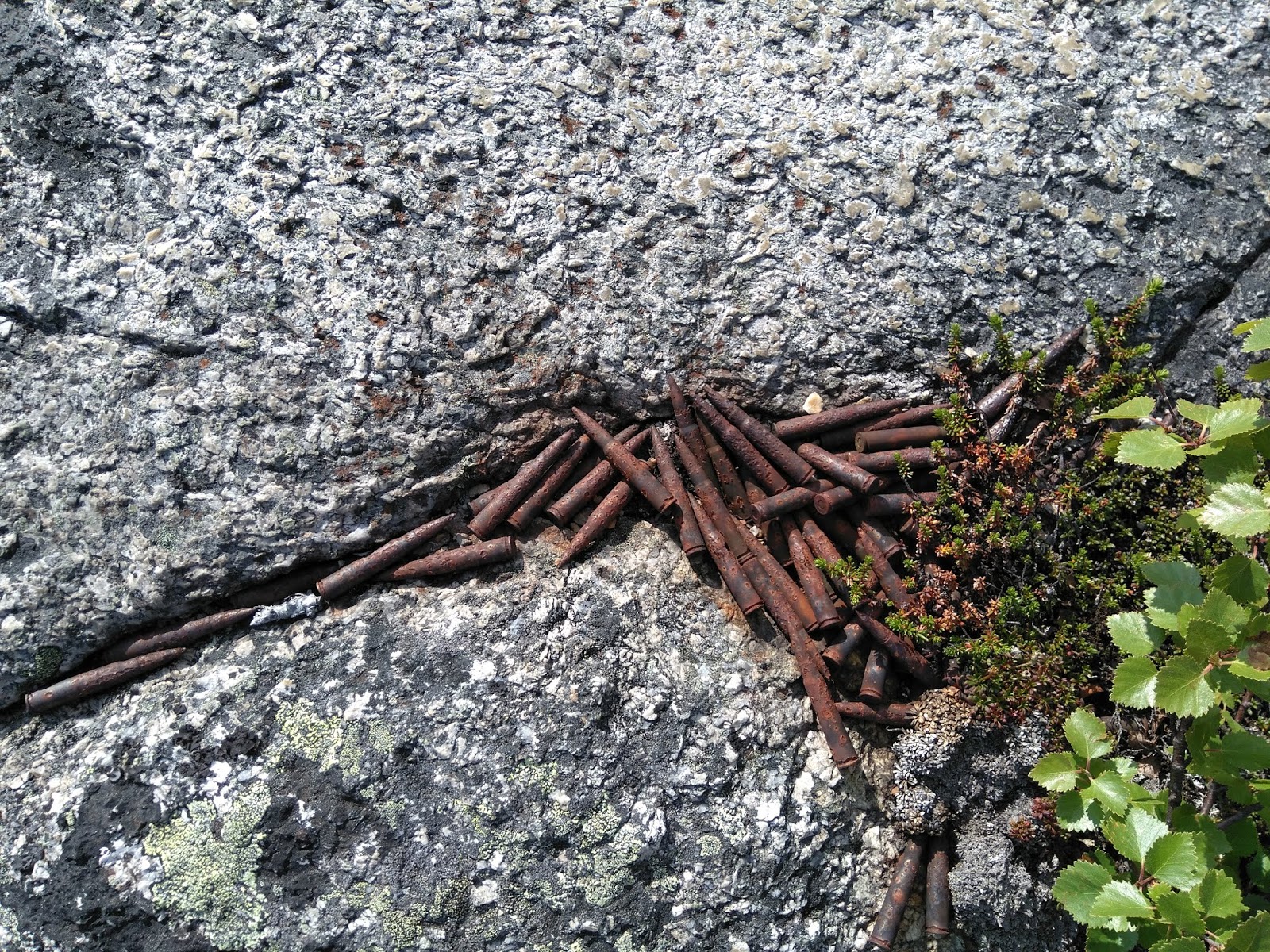
The final day up in the mountains we found mainly empty positions but also two big concentrations of German ammunition, one very obviously was where a MG 34 machine gun had once stood. Notice in the below photograph the rust on the rock surface. Bear in mind that most of the year this and everything else you see up there is mostly covered by snow.

Due to the battle year, the calibre (7.92×57mm) and links one can deduce: MG 34.

Finally, if some of you are wondering about what I am wearing in the first photo (thanks for taking it, Mikke), it is a British 1942 pattern windproof smock. I have an original smock of this type, from a trade I made some thirty years ago. But I no longer wish to use that piece of history on hikes, so this new replica I got from SMB is both a good stand-in and a very practical garment on warm hiking days. What about the thing I am holding on to then? Well, that is a case for my Swiss Army binoculars - a brilliant piece of kit to really examine landscapes.

Thursday, August 31, 2017

Mysterious German Mountain Division Remains Located

The 1st trace. I slightly moved this jerrycan to show the ground below.

Having a special interest in units that were in the area where Finland, Norway and Sweden converge, it was time for me to try to find remains in the field of the mysterious 9th German Mountain Division. I did, with the help of my Finnish friend and colleague Mika Kulju. This is my report about what we found.

In my native language, Swedish, we call the place where the borders of Sweden, Finland and Norway meet Treriksröset. That translates as Three Realms Cairn. What a wonderful ring that has, sounds like some place in a Tolkien book, right? There is also a more "official" name in English for the place, the Three-Country Cairn, but I prefer realms... Anyway, to get to that area by car I drove through the Swedish border town of Karesuando, that in 1944-45 housed several hundred Norwegian "police troops". There is a monument to their memory in front of Karesuando´s former police HQ, known as "The White House", today a local history museum. For more about the "police troops" see my book, Germans & Allies in Sweden.

In Karesuando I also noted that they still have that frontier shop that boasts "WE HAVE EVERYTHING, ALMOST".

I then drove past the enormous German fortified position of the 7th Mountain Division, called the Sturmbock-Stellung and since some years partially restored and including a small but interesting WWII museum mainly about the troops of the German 7th Mountain Division, who held the position between October 1944 and January 1945. Why did I not make a stop there? Well, I have visited it several times before and had some urgent business a bit closer to the Three Realms Cairn. The nature of that business I will not divulge here and now, as it constitutes part of a future article. But I can tell you it will be a surprising article, even for those with a particular interest in the area. I can also say that it was at the place quite close to the cairn that I rendezvoused with my friend Mika Kulju.

After having obtained the information and photos we had set out to get, we drove our cars homewards but made an important stop after about an hour. It was time to see if we during just a few hours might find any traces of the 9th Mountain Division in a place none of us had searched before, its late 1944 position between the border village of Palojoensuu and the town of Enontekiö. The position is known in some sources as the "Palojoensuu Position". Now, several readers may be wondering about the number, the NINTH division? In 1944 the unit was known as Divisional Group Kräutler (in German often just Divisionsgruppe K). On May 6, 1945 (that is what I call late in the war) there was an order re-designating it as the 9th Mountain Division. Well, by using that very late designation I may perhaps have sparked some interest...

What did we see then? First a jerrycan (see above), some parts of a lorry, some yet unidentified metal containers (suggestions about their use are most welcome):


Then, hundreds of dugouts and trenches. Not many directly visible ones (remain) close to Palojoensuu, but once you start getting hills along the road towards Enontekiö you can start looking in tactically logical places, some within sight of the modern road. Here are two photos, click on them to see them in larger size:


Thanks to the slow transformation of the Arctic landscape one can still make out many of the trenches and dugouts. Seeing them makes the WWII history of the area come alive, and the fact that there are no signs to point out anything (and until now no blog with tips about the traces) just makes them more worth seeing, in my opinion.

There is some rusty stuff still in the open, but less than in e.g. the Narvik mountains. Remember to refrain from touching anything that looks like ammunition/explosives, and let things look the way you found them. Take only photos.

Finally, driving back to my home, I was most pleasantly surprised to find a for me new SWISS coffee stop in Muonio, with what might be the best hot chocolate in the world. The place is also worth a stop for the pastries, pies and the amazing Lapland nature photographs. Yes, the place is run by a real Swiss couple. In my opinion the Swiss Cafe in Muonio is definitely worth a large detour.

Wednesday, April 12, 2017

Lenin In Stockholm 1917-2017

Fake history on the cover, Stalin was not part of Lenin´s homecoming via Sweden.

As a student in Soviet Moscow 1991 I daily passed a giant Lenin poster in the entrance of our dormitory. Until one day it had just vanished. Previously, I had seen the spot-turned-into-a-monument in Stockholm where he was photographed in 1917. It is now 100 years since he was standing on that spot, on his way to revolutionary Russia.

The train trip that Vladimir Lenin made from his long exile in Switzerland to the epicenter of Russian politics in Petrograd (the former and later Saint Petersburg) is now on my mind both for historic and current reasons. One is tempted to call what Germany did, making that trip happen, an act of hybrid war against Russia. Going a step further one might say that the modern Kremlin has recently itself come to practice the German idea of helping Lenin. But not just helping one Lenin, but a bunch of "Lenins" in several countries, thus increasing the stress not only on targeted states but also on selected alliances.

Catherine Merridale's recent book Lenin on the Train makes Lenin's 1917 journey to Petrograd's Finland Station come alive, and it has now also appeared in Swedish and I have therefore reviewed it in my native language. Apparently, it has come out in English with two different covers. I must say that the one also used for the Swedish version is superior to the modernistic one. Not least because it contains a "beautiful" example of fake history standing right behind Lenin - Stalin was not on that train.

I have previously blogged in English about Lenin monuments in Sweden, like the one in Stockholm that is all about his physical presence in Stockholm on April 13, 1917. The next day he arrived at a train station not far from where I am writing these words, the one in Boden - that unlike the Stockholm station has retained very much of its outer appearance. From Boden Lenin did not have to travel long to reach Russia, as at the time the border town of Tornio in north Finland was still part of the former Russian Empire, since a few weeks called the Russian republic.

Tuesday, February 11, 2014

The THREE Swedish Lenin Monuments

Also a monument of sorts, the Soviet book in Swedish about Lenin in Sweden.

Today page two of Sweden´s largest morning paper, Dagens Nyheter, is largely about Vladimir Lenin in Stockholm. The online article mentions nothing about the monument in Stockholm to the memory of his visit on April 13, 1917.

However, in the paper edition there is a small item about the Stockholm Lenin monument, located by the main entrance of the Museum of Modern Art, in Swedish Moderna museet. But neither online nor on paper is there any mention of the other two Lenin monuments we have here in Sweden. One of them is well known among locals and is also present on the internet, the 3,7 meter tall Lenin statue in Vittsjö in Hässleholm Municipality in southernmost Sweden. The third one is the least known one, because I have found nothing about it in any books, nor anything online. So, let me hereby present the "unknown" Swedish Lenin memorial plaque, inside the railway station in Haparanda on the border Sweden-Finland.

The text on the Lenin plaque in Haparanda states: "Here Lenin passed through Haparanda on April 15, 1917 on his way from exile in Switzerland to Petrograd in Russia". Click on the photo to view it a bit larger.

Wednesday, January 18, 2012

Swiss Waffen-SS Officer Biography


Among the French volunteers for the Waffen-SS there were a number of Swiss. Here a German 1943 newsreel about new French volunteers.

I today learnt that a fellow volunteer-researcher in Switzerland has released a new book, a biography about the second highest Swiss volunteer in the Waffen-SS, Heinrich Hersche from Appenzell.

In Swedes at War my co-author and I especially compare Swedes and Swiss in the Spanish Civil War and in the Waffen-SS. Our main source of information re. Swiss volunteers was the Swiss author Vincenz Oertle. He has written the most comprehensive book there is on the Swiss in the Waffen-SS: Sollte ich aus Russland nicht zurückkehren: Schweizer Freiwillige an deutscher Seite 1939-1945 (1997). That book is a real must-have source if you have a special interest in the Germanic volunteers (and read German).

Oertle's new book, released in December last year (2011), is entitled Ein Appenzeller in der Waffen-SS and focuses on the life of a battalion commander within the 33rd Waffen-Grenadier-Division "Charlemagne". Hersche was a former major in the Swiss Army cavalry. I have not read the book but judging from the brochure I received today the book is mainly about Hersche's years in the SS - he served right until the end - but also about his prewar personal and political life.

If you can read German here is a Swiss article about the book, and here one can order the book.

Herr Oertle has previously written books about Swiss citizens in the French Foreign Legion, since its inception, and the Swiss Guard of the Vatican. Although the guards may seem like a medieval army, they nowadays also have modern equipment and even a website of their own in English.

BTW, I wrote about the military links between Switzerland and Sweden in this post. I can add that the deal about JAS Gripen has not yet been concluded.

Wednesday, November 30, 2011

Swiss vs. Swedish Military History


A Swedish Saab Gripen in Switzerland during the 2011 Sion airshow.

Today it became known that 22 Swedish Saab Gripen multirole fighters will most likely join the Swiss Luftwaffe. The Swiss Army already operates Swedish combat vehicles. Thus the military of Sweden and Switzerland have come yet a bit closer and there is reason to look back at our somewhat similar military history.

Well, a short but fact-filled summary in English about Swiss military history in comparison to Sweden's is part of the last chapter of Swedes at War by yours truly and Lennart Westberg. As we write there, "There are several good reasons for casual observers to confuse Sweden with Switzerland."

In my opinion, not least because I spent four wonderful years of my youth in Switzerland, we Swedes really have a lot to learn from the Swiss Armed Forces. Thus I hope the new fighter deal will stimulate not only more trade between our countries but also an exchange of ideas about national defence and security policy.

I seem to recall that while I was living in the Swiss capital in 1978-82 there were thoughts about purchasing Saab Viggen. That did not come about then and I believe I even said some words about this on Swedish radio in 1981 or 1982, as a flight-interested Swedish kid living in Switzerland.

Well, congratulations I say, especially to all Swiss and Swedish readers of this blog.