About Me

My photo
Author, film researcher and member of the Swedish Military History Commission.
Showing posts with label WWI. Show all posts

Thursday, April 23, 2020

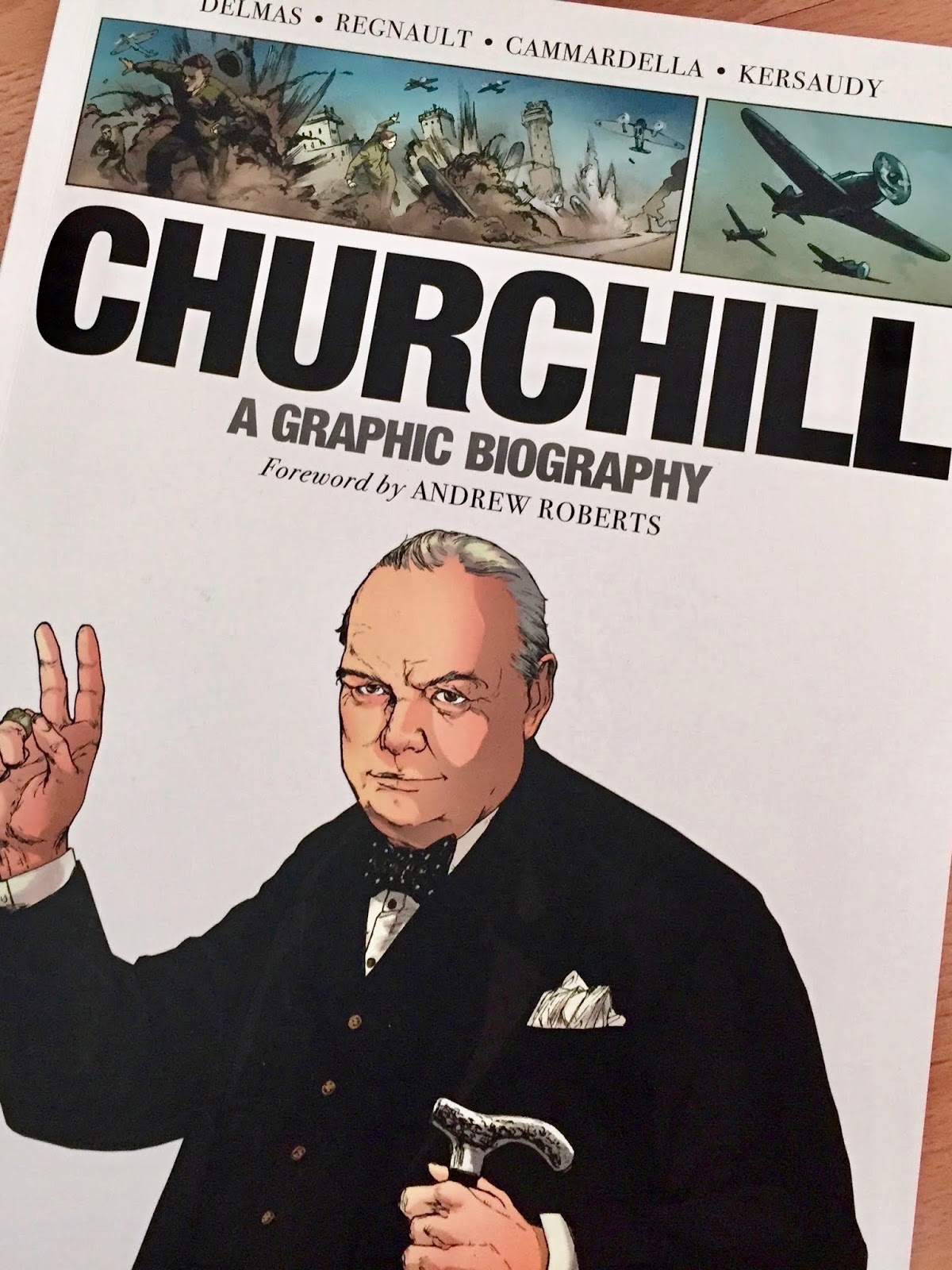
Churchill: A Graphic Biography

Yes, I am reviewing a comic book now! But, trust me - it is seriously good.

Now, Churchill is one fellow that is very hard to summarize. With such a rich and long life in various positions, almost an impossible task. But I´d say that Vincent Delmas has succeeded, both because of the comics and the superb introduction, which is more like an illustrated article.

Of course, lots of important stuff is not part of Churchill: A Graphic Biography, and as a Nordic reader I wanted more about Norway 1940. Still, most of the key moments in his life are here. Speaking about Norway - the heavy water sabotage operation is in the book.

My one real criticism is that the military hardware shown could have been more correct and detailed. But, generally speaking, this is one of the best, if not the best, fact-based comic books that I have read.

One subject that takes up a fairly large part in the final pages of the book is the failure to secure Poland´s independence. Rightly so!

Being a history nerd you have either seen or will probably see the brilliant historical drama web television series "The Crown" created and principally written by Peter Morgan for Netflix. Well, here comes a suggestion for you TV people out there. Check out Churchill: A Graphic Biography by Vincent Delmas etc. Because it is both brilliant and credible. I suspect that this has a lot to do with Francois Kersaudy, the project´s historical consultant. It should be possible to use Churchill: A Graphic Biography as the basis for a Netflix movie, or even a TV series.

Sunday, December 08, 2019

Tolkien At War

Here in the French trenches things happened that greatly influenced J.R.R. Tolkien.

The new Tolkien movie, simply called "Tolkien", takes place in England and France. It is about J.R.R. Tolkien's childhood, youth and time at the front during the First World War. The film seems to have received mostly lukewarm reviews - well, here comes my take.

It seems that few Swedish cinemas (any at all?) have shown "Tolkien". Maybe it was released directly on DVD in Sweden? However, I have now seen it, on DVD, and my opinion is that it is not only well worth seeing, it is simply wonderful. As a film, it is gripping, romantic and beautiful. AND the director is Nordic, Dome Karukoski. What, a director from Finland? Actually, not so strange, considering that the Finnish language was important for Tolkien's saga languages, as was Kalevala - Finland's national epic. The Finnish language is actually mentioned in the film, and rightfully so.

In other words, ignore the reviews and watch the movie yourself. If you then want to know more about Lieutenant Tolkien's war experiences, I highly recommend Tolkien and the Great War by John Garth. A fantastic read if you are really interested in Tolkien and also are a military history buff.

Sunday, April 15, 2018

Soviet Tank Buff Alert

This book is filled with Soviet AFVs, including types most people have never seen.

Once in a while a truly original book on armoured fighting vehicles (AFVs) appears. This is the case with The Red Army On Parade 1917-1945 by the British author James Kinnear.

First, it delivers more than one might expect from the front cover - this book is not only about the parades on Red Square until 1945, it also has amazing photos from other Soviet cities and also from the 7 September Allied Victory Parade in Berlin, where the IS-3 tank made its shock appearance. Looking at the Berlin IS-3 photos it is hard not to feel an urge to immediately build a scale model of it. Well, throughout the book there is plenty of inspiration for all kinds of military vehicle buffs. One also starts to wonder about a lot of things, like where there might be a preserved "Pioneer", a kind of tracked jeep that proved to be a failure but still has some amazing looks. And why have I also never before seen a SU-5-2? Or those magnificent Soviet VJ Day images of Harley-Davidson WLA-42s with PTRD anti-tank rifles. Yes, anti-tank motorcycles!

Not just many (most) photos in the book are previously unseen in the west, The Red Army On Parade 1917-1945 also contains plenty of valuable text about Soviet AFV evolution. There is even a foreword by the current Russian minister of defence, General Sergei Shoigu, including some words from him about Sweden: "The first parade took place in times of Peter the Great, when Moscow was saluting the Russian troops that had defeated the Swedish Army at the Noteburg fortress in 1702." By the way, Noteburg = Nöteborg, meaning "Nut-fortress", was later renamed Shlisselburg.

The Swedish publisher of this book, Canfora, has again managed to surprise tank buffs (as well as truck and motorcycle enthusiasts) with plenty of new and amazing material. But let me also recommend aircraft buffs to visit the Canfora website.

Wednesday, April 12, 2017

Lenin In Stockholm 1917-2017

Fake history on the cover, Stalin was not part of Lenin´s homecoming via Sweden.

As a student in Soviet Moscow 1991 I daily passed a giant Lenin poster in the entrance of our dormitory. Until one day it had just vanished. Previously, I had seen the spot-turned-into-a-monument in Stockholm where he was photographed in 1917. It is now 100 years since he was standing on that spot, on his way to revolutionary Russia.

The train trip that Vladimir Lenin made from his long exile in Switzerland to the epicenter of Russian politics in Petrograd (the former and later Saint Petersburg) is now on my mind both for historic and current reasons. One is tempted to call what Germany did, making that trip happen, an act of hybrid war against Russia. Going a step further one might say that the modern Kremlin has recently itself come to practice the German idea of helping Lenin. But not just helping one Lenin, but a bunch of "Lenins" in several countries, thus increasing the stress not only on targeted states but also on selected alliances.

Catherine Merridale's recent book Lenin on the Train makes Lenin's 1917 journey to Petrograd's Finland Station come alive, and it has now also appeared in Swedish and I have therefore reviewed it in my native language. Apparently, it has come out in English with two different covers. I must say that the one also used for the Swedish version is superior to the modernistic one. Not least because it contains a "beautiful" example of fake history standing right behind Lenin - Stalin was not on that train.

I have previously blogged in English about Lenin monuments in Sweden, like the one in Stockholm that is all about his physical presence in Stockholm on April 13, 1917. The next day he arrived at a train station not far from where I am writing these words, the one in Boden - that unlike the Stockholm station has retained very much of its outer appearance. From Boden Lenin did not have to travel long to reach Russia, as at the time the border town of Tornio in north Finland was still part of the former Russian Empire, since a few weeks called the Russian republic.

Friday, December 09, 2016

The Strangest Winter War Volunteer

Winter War volunteer Otto von Zwehl. Photo from the book cover.

While researching for Swedes at War 1914-1945 I came across some pretty unexpected foreign volunteers for Finland during the Winter War of 1939-40. But I missed one very remarkable German who defied both Hitler and Stalin, only to later return to German service in spite of being considered partly Jewish. The first book about him is now out.

The Winter War had an attraction similar to the Spanish Civil War, it made people volunteer from near and far. Just two examples: the US President’s son Kermit Roosevelt recruited a “Finnish Legion” in London that went to Finland with 230 legionnaires. The elderly French general Clement-Grandcourt signed up as a private, but was made an officer when he arrived at the volunteer center in Helsinki. Well, now Lars Westerlund of the National Archives of Finland, author of several books about 20th century wars, has documented one of the 15 Germans who chose to fight for Finland in spite of the Molotov-Ribbentrop pact. For the Bavarian Otto von Zwehl this was a step that was not as strange as it may sound, as he was among the German officers who had fought for Finland back in 1918. The year after he became a Freikorps volunteer in his native country, the commander of the artillery detachment of the Freikorps Probstmayer.

What made Otto v. Zwehl´s decision to volunteer for Finland in 1939 very special indeed was that he was then both a civil servant of the Third Reich and, according to the same state, a Mischling, meaning mixed-blood, to be precise a Vierteljude ("one-quarter Jew").

As a resident of Finland since 20 years, Otto v. Zwehl felt it was his duty to volunteer for Finland when Stalin attacked on November 30, 1939. In late December 1939 his application was accepted and he was put in charge of a motorized battery of Finland Swedes. The vehicles of the unit got markings consisting of a "Z", for Zwehl, followed by a number. In Germany, the authorities were not happy - when Hitler heard of von Zwehl´s step he "blew his top". Lars Westerlund writes that Hitler then personally made sure that Otto v. Zwehl lost his German citizenship.

In record time, though, von Zwehl was granted Finnish citizenship and refused to follow the advice to emigrate to the United States.

One year later and in spite of how he has been treated by the German state, Otto v. Zwehl became a Finnish volunteer in the German Army in Finland. As a modern reader one finds this decision particularly hard to understand. Here one misses an interview quote from Otto von Zwehl. However, Lars Westerlund has managed to put together an amazing biography even though von Zwehl died in 1960. The book provides very valuable insights into Third Reich policy toward Finland, as well as the German community in Finland. This book also constitutes one of the first Nordic books about Mischlinge in German uniform during WWII, a subject pioneered by the US historian Bryan Mark Rigg.

Otto v. Zwehl is so far only available in German, as an e-book via Amazon or as a book-on-demand in Finland.

Tuesday, November 08, 2016

Great US Presidential Trivia From Sweden

Theodore Roosevelt, Badlands hunter and later president of the USA. Note the Tiffany bowie knife. Photo: George Grantham Baine

By coincidence (or not) I can today blog about a new and partly Swedish book in English about US presidents. It really brings home a lot of both funny, inspiring and important facts about past presidents.

99 Peculiarities of American Presidents
by Dr Fergal Donnelly and Professor Wilhelm Engström (from Uppsala, Sweden) actually is a kind of entertaining mini-history of the United States, including some military history. Among the peculiarities let me mention that one president had actually been a hangman and another one was involved in as many as 100 duels - most of which were fought to defend the honour of his wife.

Of most interest to me were the pages about Dwight "Ike" Eisenhower and Theodore Roosevelt (the Roosevelt who was president 1901-1909). It is a truly amazing story how Roosevelt finally got his Medal of Honor only in 2001, from President Bill Clinton just before he left office. It was for actions against Spanish forces in 1898! I had believed the medal was just a PR stunt by Clinton. Now I understand why it took so long. BTW, Roosevelt's first book was The Naval War of 1812, which had a great impact on the formation of the modern US Navy. I must confess that before I picked up 99 peculiarities of American presidents I was also ignorant of the fact that President Roosevelt´s eldest son, Theodore Roosevelt Jr, was the only general on D-Day to land in Normandy by sea. Some weeks later he died of a heart attack. He was 57 and had kept his heart trouble secret. Like his father would be in 2001, Theodore Roosevelt Jr. was posthumously awarded a Medal of Honor (on 28 September 1944) for his actions on D-Day.

Incidentally, I have previously blogged about the mysterious division in honour of Theodore Roosevelt that was set up by a Swedish volunteer, Ivor Thord-Gray.

Monday, October 17, 2016

Mosul´s Swedish Commander

Uniforms of the Swedish-led Persian gendarmerie were a mix of Sweden and Persia.

The Iraqi city of Mosul is in the global news, but few are aware of the fact that a Swedish volunteer was once in command of the city. His name was Knut Killander and he was from Stockholm. He was part of the Swedish officer contingent serving in Persia between 1911 and 1916, who were split up by the outbreak of World War One.

Captain Knut Killander survived Mosul and other postings during WWI and joined an insurance business, to die peacefully in 1951. His fate is one of many strange and exotic ones in Swedes at War 1914-45, available in both English and Swedish. Some artifacts from the Swedish volunteers in Persia, such as the above headgear, can now be seen in the Army Museum in Stockholm.

Tuesday, July 19, 2016

The Mercenary Behind Alexander Skarsgård: The Real Tarzan Story

The man who found Tarzan, Swedish soldier of fortune Ivor Thord-Gray, and the latest person to portray Tarzan, Swedish actor Alexander Skarsgård. PHOTOS: Umeå University Research Library & Nick Step

All reviewers of the most recent Tarzan movie have so far missed a most ironic (even spooky - compare the faces above) aspect of a Swede portraying the "lord of the jungle": the origin of the Tarzan legend can be traced to a Swedish mercenary in Africa. I have researched his long and stunning career.

Alexander SkarsgÃ¥rd´s face is now on several magazine covers here in Sweden and many other countries too - because of his latest film role, depicting one of the oldest and most iconic action characters ever. I too have now been to the cinema and have seen "The Legend of Tarzan". This latest version of the story mostly takes place after he has spent several years in England, but it also looks back at the crucial childhood moments of John Clayton, the baby boy that after some rather rough ape training turned into the legendary Tarzan. However, nowhere in the movie or on the internet have I found anything to suggest that any film maker, critic or SkarsgÃ¥rd himself is aware of the Swedish origin of the Tarzan story. True, very little has been written in English about this in recent years. But if one can understand Swedish there is a book focused on this aspect, the translated title being The Man Who Found Tarzan (so far only available in Swedish, Mannen som hittade Tarzan) by Joakim Langer.

Well, who found Tarzan, or more correctly, who gave Edgar Rice Burroughs the story that he in 1912 transformed into Tarzan of the Apes? There is much that points at a man from Stockholm, Thord Ivar Hallström. His life might seem just too incredible to be true, especially coming from such a peaceful country as Sweden. But there are many thousand documents, including good photographs, in several official archives in Sweden, Britain and the United States plus private archives in several countries - all proving that Hallström, who after entering British military service in Africa became Ivor Thord-Gray, is Sweden´s most experienced soldier of fortune ever. He served under no less than 13 different flags and fought not only in Europe and Africa but also in Asia and Latin America. In Mexico, 1914, in Pancho Villa’s service, he was in charge of the artillery. During the Russian Civil War (1917-1922) he was highly decorated and rose to the rank of a Russian general in Siberia. In 1935, he was again promoted to the rank of general, this time in the United States. Fighting in hot or freezing places was not his only talent, though. Before he died he managed to conduct enough research to become a respected ethnologist and linguist. You will find more details about Thord-Gray´s military career in Swedes at War 1914-1945 by yours truly and Lennart Westberg.

The above photograph of Thord-Gray is one of several I found in his under-researched archive within the University of UmeÃ¥. It depicts him as a cavalry volunteer on the British side in South Africa. It was during these years that he took part in the capture of a human, a boy, who had been living with some baboons. Joakim Langer has found the first traces of this account in Cape Town. It was in the Mount Nelson Hotel that Thord-Gray in September 1906, thus soon 110 years ago, told a local journalist about a boy raised by apes. That interview was later quoted by American journalists. The similarities between Thord-Gray´s account in 1906 and the 1912 tale of Tarzan by Edgar Rice Burroughs are in themselves telling. But one can also, as Joakim Langer has done, look closer at Tarzan´s noble name. Aside from being born as John Clayton he is also Lord Greystoke. In the early 20th century Thord-Gray spellt his name Thord-Grey. Lord Greystoke and Thord-Grey...

The 1906 interview with Thord-Gray about a boy raised by apes seems not yet to have appeared on the net. However, search engines can locate, in old US newspapers, this article that appeared in print the first time in May 1934:

BOY KIDNAPED [sic] BY BABOONS; TURNS TARZAN
The story of a famous fiction character, who was raised from babyhood by a tribe of apes, is entirely plausible, says Major General Ivor Thord-Gray, soldier of fortune who recently received the most valued decoration of the Swedish Government. Thord-Gray, who has campaigned and explored in a dozen countries and holds numerous decorations, related the story of a sickly eight-year-old white boy, who was seized by baboons while he was serving in the British Army at Pondoland, South Africa. The boy was being wheeled about in a perambulator by a native girl when several score of baboons swooped down upon a nearby field, where corn was ripening. The girl became frightened and fled. Soldiers drove off the animals and found the perambulator empty. The body of a young baboon lay alongside the carriage. "Well, it was not until four years later," he said, "that we got any inkling of his whereabouts." "About a day's march from camp," he said, "a sergeant came running up and told us he had discovered a hairless baboon. We followed him to the base of a. cliff and there before us was the body of a big, husky boy. his skull cracked and bleeding "The scouting party had found him among a family of baboons. The beasts, seeing the approach of the party, tried to scamper up the cliff. Most of them escaped but the boy, not as agile as the beasts, slipped and fell to the bottom. "The boy was more ferocious than the baboons. He jabbered in their language and was as wild as any ape."


Considering Ivor Thord-Gray´s words and that Tarzan now also is portrayed by a countryman of Thord-Gray, one might say that in 2016 Tarzan of the Apes earned a new title: Tarzan of the Swedes.

P.S.
What I thought about the new movie? Beautiful and pretty good entertainment, but the ending is kind of...

Friday, August 01, 2014

Russian Great War Mystery

In this former prison in Karlskrona, Sweden, one of Russia´s first aviators was imprisoned. I met and interviewed him in 1988.

Today it is exactly 100 years since Russia became part of World War One, or as it is still known in some countries, the Great War. But there is almost nothing that reminds about it in today´s Russia, although the Russians generally have a great interest in history and especially wars.

You will find a World War Two monument in just about every Russian town, and in many villages too. In large cities you will find several statues and busts commemorating WWII heroes and a T-34 tank in some public area. Museums and exhibitions about WWII are also very numerous. But the first monument about World War One was unveiled only in 2004 and the first-ever Russian World War I museum has not yet opened (but it will, in St. Petersburg). These and other signs of low interest and scanty knowledge are covered in a highly readable article in today´s English-language The Moscow Times.

Why this low interest? After all, three million Russians lost their lives during WWI. Yes, THREE million lives. The above article tries to explain this mystery and I am not saying it got things wrong but perhaps one could explain even more simply by saying that there was just zero use for WWI. It could not benefit the Soviet state in any way and "stole" attention from the "October Revolution", although one can argue that with no WWI there had also been no revolutions in 1917...

I was thinking a lot about Russia 1914-18 when I recently for the first time visited the former prison in Karlskrona (south Sweden) of Anton Nilson, the Swedish revolutionary who went to Russia during the last stage of WWI and became one of the Red Army´s first aviators. I interviewed him during five intense hours in 1988 and the result is in Swedes at War 1914-45. Part of Nilson´s former prison is now becoming an international school and part of it is a cool restaurant. You should visit it when in Karlskrona. Thanks to the kind staff I got to see several prison cells, some of which looked pretty unchanged since Anton Nilson was in the building.

Saturday, June 14, 2014

World's Greatest Cowards: Swedes?

In 1914 we Swedes celebrated 100 years of peace, should we very soon celebrate the 200th anniversary, or ignore it?

Journalists around the world are about to cover the different ceremonies commemorating the outbreak of World War One, starting in Sarajevo on June 28. Rightly so, but as a Swede dealing with war history it is my obligation to also remind about the Swedish–Norwegian War of 1814 and question the feelings about the rare peace that we have since enjoyed.

The Swedish–Norwegian War, known here in Sweden also as the Campaign against Norway, was a war fought between Sweden and Norway that broke out with a Swedish naval attack against Norway on the 26th of July 1814. It ended quickly, on the 14th of August with Norway entering into union with Sweden, but with its own parliament and constitution. That war is today of little consequence for Sweden, as the union was dissolved in 1905. But the peace we have enjoyed since 1814 can still be a hot subject, as was recently demonstrated at a debate in Stockholm when Anders Lindberg, editorial writer of Sweden´s largest newspaper, Aftonbladet, stated "neutrality is the world's most successful policy, it has spared us from wars for 200 years". This praise for neutrality was not quite correct, as Sweden since joining the EU has scrapped the principle of neutrality. However, our non-aligned policy continues, and that is most probably what Mr. Lindberg had in mind. The reaction to these words from Erik Helmerson, editorial writer at Dagens Nyheter, our largest morning paper, was scathingly self-critical: "Sure, if success is that others sacrifice their lives for our sake - then neutrality is a mega-hit".

I would say that both Mr. Lindberg and Mr. Helmerson have missed some key parts of Swedish history. For example, we were not neutral when our neighbour Finland was attacked in 1939. But the help that the Swedish government provided was not flaunted and the full scale of it only became known decades after the war. Also in 1941-44 the Swedish government allowed a volunteer movement for Finland and made it possible for Swedish officers to serve Finland. Perhaps not that many Swedish lives were laid down for Finland 1939-44, 117 lives to be exact. But let´s not forget neither them nor the around thousand Swedish lives lost in Allied supply convoys and military units 1939-45. Most were not in Allied armies but on ships under various flags. However, the Norwegian memorial in Oslo for the around hundred Swedes who died for Norway 1940-45 makes no difference at all between those that died in the Norwegian Merchant Navy and those that died on battlefields in Norway and Normandy. So, there is no reason for us to differentiate, a life is a life.

The number of Swedes who died for Finland or in Allied convoys may largely be described as volunteers and the figures pale when one compares to the war dead of other countries. But one must not forget that the Swedish state facilitated both categories and the number of Swedish sailors who assisted the Allies, 8,000, just cannot be regarded as insignificant.

Let us now look back at August 1914, when Europe was largely at war but we Swedes celebrated our first century of uninterrupted peace by erecting an 18 metre tall monument on the border between Sweden and Norway to celebrate 100 years of peace between our countries. There is a book in English that provides us with a unique view of the ceremony that day, Scandinavia in the First World War edited by Claes Ahlund. I know of no similar book in any language, as it provides insights into several very little known subjects like the intelligence and counter-intelligence war in Scandinavia, the 26,000 (sic!) ethnic Danes in the German military, the 1,100 Scandinavian volunteers in Australian (!) uniform and the immense losses of the Scandinavian merchant ships in 1914 and 1918 - Norway alone lost 829 ships. Yes, that´s right, 829 ships.

Scandinavia in the First World War really is a must if you want to get to know Scandinavia in 1914-18 and also paints vital background for the stance in 1939 - not joining the warring sides had worked in 1914-18, so why change that basic strategy? Just bear in mind that Scandinavia in the First World War is not a regular history book but exactly what the subtitle says: Studies in the War Experience of the Northern Neutrals. A more regular history of Scandinavia in 1914-18 has yet to be written and should preferably include more about Finland and thus be called something like The Nordics and the First World War. A parting tip to those who eventually will write that book, check out Swedes at War.

Finally, should we on the 14th of August celebrate that it will then be - unless the Ukraine War of 2014 turns into something much bigger - 200 years since we were officially at war with another state? Shouldn´t we rather ignore the coming anniversary, considering the many abroad that sacrificed their lives for our sake? Well, aside from that more than a thousand Swedes lost their lives for others, i.e. Finland and the Allies, let me quote the British ambassador to Sweden during WWII, Sir Victor Mallet: "Swedish neutrality was of far greater value to us than a Swedish act of suicide in 1940 would have been."

Tuesday, June 10, 2014

The Kid That Ignited World War One

Sarajevo, where it all started.

In less than tree weeks it will be exactly 100 years since the assassination in Sarajevo that ignited World War One. Gregor Mayer has helped me better understand this event.

The whole thing started with a kid firing two bullets from a Belgian-made Fabrique Nationale model 1910 pistol. It may seem like the simplest of facts, but the age of the Sarajevo assassins of June 28 1914... the age! For some reason it just did not get to me before I had picked up the new book Conspiracy in Sarajevo by Gregor Mayer. The main assassin, Gavrilo Princip, was 19 when he shot the Austrian Archduke Franz Ferdinand and his wife Sophie, Duchess of Hohenberg. Take away Princip´s moustache and what remains is a kid, even more apparent when you see not just his face. Some of Princip´s helpers were even younger. Perhaps one shouldn´t focus too much on the age of the assassins - as behind the historic action of the young Bosnian Serbs stood older men, members of the secret military society best known as the Black Hand - officers of the Serbian Army. But I still think the age of the assassins says something, like that one has to attract young men (kids) for extreme deeds.

Was the First World War truly a result of the actions of some students? Formally there is little doubt about this but Gregor Mayer also writes that the Austro-Hungarian Empire viewed the assassination as a "welcome reason" for a long contemplated punitive drive against Serbia. In other words, had there been no Gavrilo Princip there would sooner or later nevertheless have been some other action that would have prompted Austria-Hungary to declare war against Serbia, thus setting off the chain reaction that became World War One.

But there did exist a Gavrilo Princip, and thus the story of his short life and motivations should long since be well known. However, while much has been written about the assassination, the actual killer has until now not been the subject of a modern biography such as Gregor Mayer´s. Doctor Martin Pappenheim studied the imprisoned Princip and his notes were published in 1926 - everyone who has read them, raise your hand... Of course, Doctor Pappenheim´s notes are often quoted in Conspiracy in Sarajevo.

What emerges from Gregor Mayer´s book is that Princip was greatly motivated by other assassins who went before him and also by the fact that he had not been allowed to become a soldier. Mayer provides the reader with a strong picture of Princip´s final years as well as the environment in which he grew up. It is also remarkable to read the words from Princip´s trial in October 1914 and about what it is like today in Princip´s home village of Gornij Obljaj.

Right now Sarajevo is preparing for the WWI anniversary, a large photo of Gavrilo Princip can be seen on the site of the assassination, on a banner somewhat strangely proclaiming "The street corner that started the 20th century".

So far, Conspiracy in Sarajevo is only available in German, as Verschwörung in Sarajevo: Triumph und Tod des Attentäters Gavrilo Princip. But aside from hardcover format it is also available as an e-book.

Friday, January 11, 2013

The Most Expensive Cuff Title?

German WWI cuff title kept in a museum in Gibraltar.

While looking for something else I stumbled upon this photo of a German WWI cuff title that I must have photographed in 1987, when I hitch-hiked Stockholm-Gibraltar-Stockholm.

I have always liked cuff titles, i.e. not collecting them as I have never had that kind of money (reproductions don't interest me), but just seeing them and learning about their history. I reckon the above one must be one of the most rare and expensive ones there is. I do not recall the name of the museum I found it in on Gibraltar but I think it was the main museum of the rock.

But why the Swedish colours???

Monday, October 29, 2012

Swedish Afghanistan Type Mission In Iran

Uniform and memorabilia of the Swedish officers and NCOs who volunteered for Persia (Iran). PHOTO: Leif Nilsson/SMHA

Swedes at War begins with the Swedes who volunteered to form a gendarmerie in Persia (Iran). What started in 1911 as an Afghanistan type security assistance mission evolved, for the Persians, into the genesis of the Iranian Army.

Thousands of Persians were trained by the Swedes, partly with Swedish equipment, and led by Swedes in security operations. Not only the largest British and German papers in 1913 and early 1914 praised the Persia Swedes, even in China one could read that the Swedes had been successful. For several of the forty participating Swedes, service in Persian Gendarmerie uniform (see above photo) was a springboard to entering German, British and Finnish service. After the outbreak of WWI some of them entered German service in Persia and on other fronts. Quite a few went on to fight in other wars, a handful even during WWII. For example the Swedish Persia veteran Martin Ekström in 1919 took Narva from the Red Army and during WWII was a battalion commander in the Finnish Army.

Together with some other persons with a special interest in Persia I some years ago suggested that the Swedes who volunteered to create the Persian Gendarmerie should be part of the permanent exhibition of the Swedish Army Museum in Stockholm. Last week this display became reality and you may now there study several original items from the Swedes in Persia.

A complete uniform, orders, medals, maps and photos are now on display in Stockholm. PHOTO: Leif Nilsson/SMHA

Monday, October 15, 2012

Arctic WWI Tank Restored in Russia

Captured British tanks were even on Red Square in Moscow, as this amazing clip from Russian TV shows.

In Swedes at War there is a page about Swedish volunteers in the Russian Civil War working in close cooperation with British tanks. One of those tanks is still around, in Arkhangelsk. It was recently restored and there is now even a book about it.

The tank in question, now even has a very detailed Wikipedia-page. The above clip from Russian TV describes the restoration process and also has some amazing footage from the Russian Civil War era.

As you can see from the Wikipedia page the tank is now inside a protective structure. When I visited tank Mk V No. 9303 some years ago it was out in the open. Still, it was not in a poor state, not at all. So, I was quite surprised by the thorough restoration, which must have been costly.

I was also pleasantly surprised the other day when a friend lent me this book about this particular tank:
It contains a great deal of photographs, so that even if you do not read Russian, I reckon you will find it quite amazing. However, I do not know how you might order this book from outside Russia. Well, there are many good reasons to visit Arkhangelsk. Now there is one more.


Sunday, September 30, 2012

Mountain Warfare Flame Thrower

A flaming hot alpine WWI reenactment produced just some weeks ago.

Being especially interested of war in the Nordic area I have grown interested of mountain warfare in general and therefore I cordially recommend this new video from the alps.

What an extravagant Monte Grappa reenenactment, with flame thrower and all. I have personally found some WWII German flame throwers up here in the Arctic that looked almost the same. I have some photos of my finds somewhere. If memory serves me right I found them on Kola and by Kirkenes. Have also seen some on the Narvik front and in the Lyngen line? Not sure about the latter, I am starting to mix up my trips!

Thanks for the tip, Klemen!

Sunday, July 15, 2012

New Swedish Military Vehicle Museum

A German-designed Swedish m/38 tank with a Czech-designed m/37 in the background. Tempo Vidal grille far right.

A few weeks ago I finally got to visit Arsenalen, the new national Swedish military vehicle museum. It is not as good as Bovington (the British tank museum), but is certainly worth a visit if you are in the Stockholm area.

The museum is focused on armour somehow connected to Sweden, from WWI to the present day, but also has some really interesting "soft skins", such as a German Tempo Vidal G 1200, which for some strange reason was purchased by the Swedish Army.

The influence of German design in early Swedish tanks is apparent, the reason is very simple: the main tank supplier was initially a German plant on Swedish soil, Landsverk. For instance, the above pictured Landsverk m/38 was virtually the same vehicle that in Hungary was known as the Toldi. Interestingly, the only two surviving Toldis are in Russia.

A very rare Landsverk AA-tank, based on the Anti that served Finland and Hungary (as Nimrod) in WWII.

A US-made M8 armoured car, one of four captured by the Swedish Army in Congo.

One of the most exotic vehicles in Arsenalen is the captured M8 Greyhound, once used by the Katanga Province Gendarmerie and then by Swedish UN troops in Congo in the early 1960s.

The museum also features some large dioramas with real vehicles, such as this one with a Hetzer:

I reckon this illustrates the end of the Third Reich quite well. But the Hetzer is rather clean...

In the smaller rooms there are many small dioramas and don't miss the upper floor scale models.

Foreign Legion Viking Record

Henrik Angell from Norway joined the French Foreign Legion and fought against the WWI German Army and early Red Army.

Thanks to Henrik L, a fellow Swedish armoured troops cadet in 1989, I recently became aware of a very special Norwegian colonel who volunteered for France in WWI and served her as a 1st lieutenant (was that also his last French rank?).

His name was Henrik Angell and he survived fighting the WWI German Army but not the combat in the Arctic during the Russian Civil War. The above photo of Angell in a 1918 Swedish weekly paper was found by Henrik and states that Angell is on his way to the Murman-front, i.e. Murmansk.

I reckon Agnell must be the oldest Scandinavian volunteer in the French Foreign legion. He was 63 when he joined!

Friday, March 23, 2012

Foreign Legion Swede Highlighted

Foreign legionnaire Elow Nilson is highlighted in the French edition of Swedish author Peter Englund's "The Beauty and the Sorrow".

Life is good. The author who has inspired me more than any other has sent me his latest book with a dedication as a thank you for some information I provided.

Hardly anyone expected a Swedish book about WWI to get such fine reviews from a global audience. The Beauty and the Sorrow: An Intimate History of the First World War was published first in Peter Englund's own language in 2009 and has since been published in English, German and now also French as La beauté et la douleur des combats.

I have no part in the Swedish edition but played a tiny part in the French edition by providing Peter Englund with some information about the Foreign Legionnaire Elow Nilson, a Swedish volunteer that I wrote about in Swedes at War (first published in 2004) and then Lina Sturfelt wrote more about in her book Eldens återsken ("Reflections of Fire", published in 2008).

Elow Nilson is not part of the Swedish, English and German editions of The Beauty and the Sorrow but only the French edition. Lina Sturfelt's part in restoring Nilson to our collective memory is larger than mine but I am nevertheless proud to have done something for him.

The impact of Peter Englund's book Poltava, available in English as The Battle That Shook Europe: Poltava and the Birth of the Russian Empire is hard to overstate. The book was released the same year I began my military service, 1988, and affected me in many ways. It inspired me to pursue a career not in the army but in military history. But not least it also made me think how odd it is that of the nine Gyllenhaals who were officers under king Charles XII (who lost at Poltava) only one died in battle. How and why did my namesake and direct forefather survive those most extreme years in Sweden's history?

It can be noted that Peter Englund dedicated The Beauty and the Sorrow to the memory of private Carl Englund, who was killed in action outside Amiens on September 13, 1918. He was wearing a uniform of the Australian army, being a member of the 3rd Australian division. He had participated in and survived Passchendaele...

Wednesday, August 10, 2011

The Mysterious Pilot in Älvsbyn

This large-scale model of a "Mystery Ship" is exhibited in the Petrol Museum of Älvsbyn in Swedish Lapland.

One of the most motor nostalgia-filled museums I've ever seen is the Petrol Museum (in Swedish: Bensinmuseum) of Älvsbyn. The museum is small but well worth the visit if you are in northernmost Sweden. Military items are very few but there is a great model of a plane flown by Frank Hawks.

Hawks, famous from the movie serial "The Mysterious Pilot", was a WWI aviator who started breaking air records. In my opinion his "Mystery Ship" aircraft also known as "Texaco 13" is one of the most beautiful aircraft ever built. So, just to be able to see the large-scale (I reckon scale 1:10) model of his plane was a treat in itself.

The Petrol Museum of Älvsbyn has thousands of items related to old gas stations, I reckon most are from the 1930s to 1960s. Aside from these smaller items I also greatly appreciated the car wrecks outside, here are two of them:


Saturday, July 16, 2011

SS Ahnenerbe and Sweden

Herman Wirth, the first leader of the SS organization Ahnenerbe, spoke at this medical society in Stockholm in 1935. I recently wrote the first detailed article about this visit.

In late June I decided to relax with some fiction, but I found it hard to treat the book in question as fiction when I realized how much it was about a dimension of the SS that I have a special interest in, and recently wrote about, the Ahnenerbe.

Since I wrote my blog post SS-Division "Schwarze Sonne" I have written an article about some previously unknown details about a lecture in Stockholm by Ahnenerbe leader Herman Wirth. The visit has not been unknown, already back then in 1935 papers wrote about it, but several details were until this summer unknown. Thanks to a recent Norwegian book, Jakten på Germania (The Hunt for Germania), and some research of my own e.g. in the Royal Library in Stockholm, I was able to write that piece, alas yet only in Swedish.

I reckon I may eventually write a proper article about the Stockholm lecture in English too, but I can immediately divulge that the lecture by Wirth was presented by the Manhem Society, a kind of club for both Swedish ultranationalists and national socialists. However, the locale of the meeting is pretty surprising, the main office of the Swedish Society of Medicine - in the very city centre.

Although Wirth's Stockholm speech is missing in Heather Pringle's Ahnenerbe book The Master Plan there are more Swedish aspects in that book that to my mind by now should have caught the attention of Swedish thriller writers. Thus I was a bit disappointed by the new and very hyped novel Strindberg's Star by Jan Wallentin, a Swedish journalist and now also author.

Jan Wallentin has chosen to make up a drama largely taking place in Sweden. A drama largely connected to the Ahnenerbe, but Wallentin has made very little use of the real Swedish aspects of the Ahnenerbe. This confounds me.

Strindberg's Star has some good qualities, I would say that the diving scenes that the book starts with are simply brilliant thriller writing. I also like the way that Wallentin almost plausibly connects Andrée's Arctic balloon expedition of 1897 with WWI and the "black sun" of the SS.

I think it is no wonder that the book has already been translated into several languages, e.g. German (not yet English AFAIK). Here is a video in German presenting the basic plot of the book:


Sadly, IMHO the author overdid things, mainly by moving away from the realism of the first parts into some kind of new age fantasy of his own. I mean, the novel already had enough esoteric stuff on the pages about the really existing Karl Maria Wiligut and the Ahnenerbe.

Jan Wallentin has a really good point though, about the only known real black sun, the one in the Wewelsburg. Why on earth is so little known about why this symbol was chosen for such a significant spot within the Wewelsburg? Wallentin provides an answer to this riddle but can not be in earnest. His reply is just pure fiction. But why no other black suns before 1946? That is, aside from the one under the Bismarck monument in Hamburg, which is not identical with the Wewelsburg black sun, only similar to it. BTW why the black sun under the Bismarck monument? And who put it there?

Speaking about Nils Strindberg's star I might add that his relative August Strindberg did have a very strong relationship to a symbol, but it was not a star. His tombstone reads "O Crux Ave Spes Unica" (O Cross, Be Greeted, Our Only Hope).

P.S.
There is another modern novel focused on the Black Sun of the SS. The title is simply The Black Sun and it was written some years ago by James Twining. I read it with some satisfaction but must confess that I do not recall much of the plot.