About Me

My photo
Author, film researcher and member of the Swedish Military History Commission.
Showing posts with label Sweden. Show all posts

Wednesday, August 25, 2021

"She was not just difficult with the Gestapo"


Never before have I read such a rich, moving but also critical portrait of a WWII heroine. Lindell´s List delivers more than the title and subtitle promise.

A large part of the book deals with the escape and evasion organization for Allied airmen in France that the very British Mary Lindell founded and led. Looking only at this part there are several strong scenes that should inspire not least filmmakers. Let me immediately say that I am aware of the 1991 movie "One Against the Wind" based on Mary Lindell´s WWII experiences. But even though I have yet to see it I feel certain that modern filmmakers should take a close look at Peter Hore´s book Lindell´s List

Having gone through the First World War in France as a Red Cross nurse, Mary Lindell in 1940 decided to resist the German occupiers in France long before there was any large resistance movement. Her immediate and stubborn will to resist against the odds is, the reader soon understands, a consequence of her strong, controversial, character. Few books I have read have made me sense a person´s character as much as this one. It is clear that she could stand her ground as few others. Perhaps her brother summed her up best: "She was not just difficult with the Gestapo, she was difficult with everyone!"

Lindell´s focus was always on the war task at hand, often a supremely difficult or dangerous task that no one had given her, but that she still saw as something she herself had to solve. Not seldom her own children had to pay a hefty price for her decisions. To quote her son Maurice: "She wasn't´t a mother anymore; she was an officer doing a job which she considered was to be done." 

This tremendous devotion to duty led to Lindell´s death, or so it seemed. When her death certificate was about to be signed she came back from the dead, and more resistance work.  

One might think that in a book like this the Germans are mostly minor, evil types. But several Germans come across as friendly and some truly helpful. The half-English SS-Obersturmführer Percival Treite is very much part of Lindell´s List, and one of the book´s most puzzling figures. 

The women on Lindell´s secret Ravensbrück concentration camp list were taken to freedom and, eventually, health in Sweden by hastily painted Swedish Red Cross buses driven by Swedish Army soldiers. The Swedes part of this book, not least in the "Tuesday Club" (Tisdagsklubben) make it required reading for those with a special interest in Sweden during WWII. But Lindell´s List ought to be appreciated by anyone with an interest in occupied France and resistance work.

Tuesday, July 27, 2021

Bletchley Park's Secret Source

Having read and watched several books/films/TV productions about Bletchley Park (BP) my interest was aroused when I learnt that there was a new book about the little-known network behind the information supplied to Station X (BP). The Swedish Navy is also part of the story.


Let it be said immediately that Bletchley Park´s Secret Source focuses on the very secret Y service that ran a global chain of wireless intercept stations. This new book by Peter Hore, former Head of Defence Studies for the Royal Navy, especially illuminates the Y service Wrens – the operators from the Women´s Royal Naval Service. Thus the subtitle of this book: Churchill´s Wrens and the Y service in World War II. My main reason for reading this book was my interest in the German-speaking Wrens who listened to German radio chatter, but for those of you who are interested in the monitoring of Japanese signals this book is also for you. 


While many Wrens of the Y service had zero military experience there were also some really experienced ladies, such as Violetta Thurstan. Not only had she won the Military Medal for her bravery as a nurse in the First World War, she had been decorated by Russia and Serbia as well, had served in the RAF and the Spanish Civil War and therefore spoke several languages and had a good grasp of many military matters – key Y service skills. 


Several Y service Wrens had been to Germany before the war and some had spent years there and even seen Hitler himself up close. Such a Wren was Elizabeth Agar, who didn´t know much about the Wrens but as soon as she met a smartly dressed one was intrigued and got a “[…] burning desire to join […] even though my only knowledge of the sea was that it made me seasick”.      


In the chaos of 1940 there sometimes was not even time for any training course, not even an issue of uniform! Those times also meant not only listening to the enemy but also observing Luftwaffe aircraft over Britain, sometimes close: “The girls became rather blasé, so they were surprised during a visit by a superintendent from London, when their visitor suddenly jumped into a ditch to take shelter.”


In the book´s chapter “Winning The Big Battles” the Swedish cruiser Gotland´s sighting of the German battleship Bismarck plays a vital role for the British naval attaché in Stockholm, Captain Henry Denham. The part that Denham´s report to London played in sinking the Bismarck is made clear by a personal signal from the First Sea Lord to Denham.   


The author writes that “At the height of the war, the Y stations sent more than 3,000 messages a day to Bletchley Park” and it seems natural to agree that this volume must have been a major contribution to the success of BP. The Y service Wrens in Colombo on Ceylon (now Sri Lanka) even helped prevent a second Pearl Harbor. Bletchley Park´s Secret Source highlights a small group of women, often in miserable working conditions, that indeed had a real effect on the war.

Thursday, July 08, 2021

Sepals Base Investigation


The most secret WWII Allied bases on Swedish territory are now being investigated by proper field research. Last week I had the privilege to take part in the investigation of an until now in modern Sweden basically unknown base under the Special Force HQ (insignia above with the standard British wings worn by many SFHQ operators).


The location of this Sepals base under SFHQ (and perhaps also the Norwegian XU) and most of the artifacts that we found can at this time not be shown, as the place and most artifacts are still under investigation by Swedish archaeologists. What I now can reveal is that a number of issues of the newspaper Stockholms-Tidningen found their way to this remote mountain location. Given the rarity of that paper above the Arctic Circle it is probable that these papers came to this place as part of the flow of weapons, ammunition, food etc between Allied embassies in Stockholm and the resistance groups in the Norwegian county of Nordland. It is known from Norwegian WWII literature that the place we searched was an important point in the secret supply chain to German-occupied Norway.  


Among the newspapers we found there were several articles that really bring home how the reader back then learnt of the major events as they unfolded. The headlines with Stalingrad and 10,000 destroyed Soviet tanks, see below, remind of the scale and connect the base to the larger picture. 


I could not help being rather amused by finding the below article entitled “Invasion In Western Europe Excluded”, that explains how the German fortifications there had become so numerous that successfully invading Western Europe was now impossible.


We were also reminded by the civilian history of the place by several finds. Again, most are waiting to be properly identified, but below is one artifact identified as the foundation for making traditional Sami shoes.


Finally, I wish to thank all those involved in this trip for making it happen, and for good company in a most beautiful area of the mountains shared by Sweden and Norway. For those of you not familiar with the Sepals bases, check out the books by Roger Albrigtsen and myself.   

Saturday, December 19, 2020

Finest Aviation Book I Have Seen


I have previously been impressed by Mikael Forslund´s work, but his latest book, about the American, British, German, Italian and SAAB bombers in the Swedish Air Force 1924-58, is so stunning it is doubtless the finest aviation book I have yet come across. But there is one annoying thing about it.

This superbly illustrated 296 page aircraft book in A4 format has a title that I find a bit misleading: Swedish Bomber Colours 1924-1958. Given the narrow focus of the title and the rather high price of the book I reckon more than a few aviation buffs will wonder if this book is really worth the money. Well, the camouflage and markings of the aircraft in question are certainly covered in the best possible way both by spectacular photographs, several in colour, and many exclusive colour profiles. But the thing is that this book provides so much background and detailed history about the aircraft types and their use that it is more of a bomber aircraft encyclopedia than just a book about paint and markings. In other words the book delivers more than the title promises. Of course, that is better than the other way around, but it may also make some people refrain from getting this book. Now, hopefully some of you who have doubts are reading these words.  

Here are the aircraft types featured in this book, first I list the Swedish Air Force designation and then the international name:

B 1 - FIAT BR
B 2 - FIAT BR 1
B 3 - Junkers Ju 86
B 4 - Hawker Hart
B 5 - Norhrop 8A-1
B 6 - Republic 2-PA Guardsman
B 7 - Fokker G.1 (not delivered but still featured on one page)
B 16A - Caproni Ca 313
B 17 - SAAB 17
B 18 - SAAB 18

Let me add that all variants are featured. Then there are the wonderful sections about Swedish bombers in foreign service, mainly Danish SAAB B 17 bombers in 1945 and the SAAB B 17s in Ethiopia. The Ethiopian photos and interview are incredible and I was very surprised to learn that two former Ethiopian B 17As in 2020 were being restored in Lithuania, of all places.

If you are into building scale models of Swedish bomber aircraft and want to find good photos and colour profiles this book will be like Eldorado for you. But again, this book is much more than a book for scale model enthusiasts, it will delight any Swedish Air Force buff and it also constitutes a great source for researchers and writers. Well done, Mr. Forslund, very well done!

Friday, December 11, 2020

P-51 Mustang

The P-51 Mustang was first flown operationally not by the USAAF but by the Royal Air Force (RAF). This is reflected in this new book that should please both warbird buffs in general and especially modellers - here you will find sharp reviews of P-51 kits in all scales.

This book combines facts about the various Mustangs produced for the RAF and USAAF; text about how they performed (not least against the German Me 262); splendid b/w and color photos from WWII and the Korean War; superb color profiles; some photos of the plane in smaller air forces (including Sweden´s) plus a beautiful section about the plane in model form. 

The chosen photographs are excellent and I have to mention one in particular, of Major James H. Howard - seeing the photo of him and his plane marked for six victories over German aircraft and six victories over Japanese immediately inspired me to build his particular plane. He was awarded the Congressional Medal of Honor for a single-handed battle against over 30 enemy fighters.

Before opening this book I was just vaguely aware of the last Mustang, the Twin Mustang, basically two Mustang fuselages joined together. Weird design - I didn't think it had seen any service. But I was wrong, during the Korean War Twin Mustangs were among the first US aircraft to fight over Korea and they soon, as well as normal Mustangs, showed that they were not obsolete. In my mind the Korean War was a jet fighter war, so the book´s section about Mustangs over Korea held several surprises for me.

Of the book´s 96 large size pages, 37 are devoted to the Mustang in model form, starting with the Academy Mustangs in 1/72 scale and then covering the different 1/48 and 1/32 scale models by various manufacturers. I was surprised at the large number of different kits and appreciate very much how the authors describe the pros and cons of them. It is also in the model section that one finds two photos of Clarence "Bud" Anderson´s "Old Crow". Considering both his Swedish roots and ace status I plan to build  his plane in the near future and while doing so will no doubt have good use of this fine aircraft study produced by Robert Jackson and Lynn Ritger. "Bud" is still alive (!) and I hope he will soon be reading these words.

Thursday, November 12, 2020

Hitler´s V-weapons

The story of the battle against the German V-1 flying bomb and V-2 rocket is more fascinating than I thought. The official history of this battle, recently compiled by John Grehan, reminds of how the unmanned aerial vehicle made its debut long ago and includes Norwegian and Swedish aspects.    

The very secret war against the V-1 and V-2 actually began in Norway already in November 1939, most unexpectedly. This was several months before the country was invaded and became a battleground. What happened was that the British Embassy in Oslo then received two letters from an anonymous German scientist whose name turned out to be Hans Ferdinand Mayer. The embassy staff passed on his letters to the Secret Intelligence Service (SIS/MI6) HQ in London for further analysis. The letters turned out to be a leak from the heart of German high tech weapons research, or as the official history puts it: "the first serious evidence to fall into British hands that the Germans were developing rockets for military purposes". 

It is almost beyond belief how much the Germans poured into the V-1 and V-2 projects and this new book brings home both the scale of the German efforts and how the British analysts and leaders learnt of them and tried to prepare themselves for what was to come, and then acted. What the rocket threat more exactly consisted of became a lot clearer thanks to a V-2 that accidentally flew to Sweden on the 13th of June 1944. It was an incredible moment to stand by this rocket´s crater - it is still well preserved in a dark forest not too far from Kalmar in south Sweden. In fact, this crater is one of the highlights in my latest book.  

Having recently researched the V-2 that ended in Sweden I can say that I know of no previous book that mentions the following aspect of what happened once the Swedish authorities had become aware of the cause of the explosion. Basically all relevant previous books report that debris from the exploded V-2 was collected and brought to Swedish technical experts and then the debris was sent on to the Allies, to British experts in Farnborough. However, Hitler´s V-weapons also states that two British technical intelligence officers were allowed to enter Sweden soon after the explosion, and here immediately made some important discoveries. In other words the first Allied examination  of a V-2 took place not in Farnborough but in Sweden.

There is also an exciting "what if" scenario in Hitler´s V-weapons - the Special Operations Executive (SOE) selected a German technician for capture, a key person for the V-weapons. But the man turned out to be so closely guarded that the SOE deemed it impossible to get him alive. 

Well, this 328 page book with 16 photographs (some quite moving) should please both V-weapon and UAV buffs, as well as civil defense and London historians.

Tuesday, November 10, 2020

The Battle for Norway 1940-1942


If you are researching or wargaming Norway 1940 and/or Operation Claymore 1941, this book will be of great interest to you. Because in The Battle for Norway 1940-1942 you will find the original words of the commanding British officers. Written not with hindsight, but as they saw things at the time.

This 174 page book is mainly a collection of wartime despatches and is very ably introduced by the men who have compiled them, John Grehan and Martin Mace. They correctly point out the crucial factor for the Norwegian campaign of 1940, air superiority. As the Allies never achieved air superiority over Norway their attempts at contesting the German invasion forces were doomed. 

From a Swedish perspective it is of special interest to see how clearly the value of the Swedish port of Luleå is stated. "To interfere with ore supplies to Germany from Luleå" is the second priority of the British forces. After that came preserving "a part of Norway as a seat of Government for the Norwegian King and Government". I incorrectly supposed that Luleå came after that.  

On the other hand, the despatches and reports from Operation Claymore, the March 1941 raid on the Norwegian Lofoten Islands, are full of successful action. It was time for Hitler to taste some of his own medicine - the element of surprise. To attain this the Royal Navy first had to reach an exactness of timing, and so it did. The list of shipping and factories (fish oil plants) destroyed is impressive.

From a Norwegian perspective it is pleasant to read how highly the Norwegian detachment commanded by Captain Martin Linge was praised. In the relevant passage it becomes clear why Martin Linge became the founder of the most celebrated Norwegian WWII unit, the Linge Company of the Special Operations Executive.   

For researchers the index of persons is great. There are not that many illustrations (16) but the book still gets a high score as it constitutes a source of great historical value.

Monday, September 28, 2020

SOE´s Mastermind

A great read about one of the most influential special operations officers of all time.

His codename was actually “M” as Operations and Training Director of the Special Operations Executive (SOE). He was one of the leading British officers on the ground in Arctic Norway 1940. Long before that he had served in Arctic Russia.


Thus I kick myself for not sooner having read this terrific book about Sir Colin Gubbins. SOE´s Mastermind was first published in 2016 and reviews ought not to appear so long afterwards. But, better late than never. Lawyer and SOE expert Brian Lett starts his book perfectly with the escape from Germany in 1914 that was one of the most fundamental learning experiences of young Colin. Then follow years of extreme hardship as a gunner in the First World War and immediately afterwards, in 1919, on the Russian Archangel front. There he had to adapt not only to the Arctic but also to Soviet fighting methods.


On Ireland and in India Colin Gubbins, initially a very conventional warrior, had to learn even more about irregular fighting methods. The Irish Republican Volunteers became his best “teachers” in how to undermine a conventional army, the British Army. The Army realized that Gubbins had learnt a thing or two about irregular warfare and thus he came to write three handbooks for a planned British resistance movement, the first being The Art of Guerilla Warfare, then A Partisan Leader´s Handbook and finally How to Use High Explosives


But Lieutenant Colonel Gubbins was not to become an armchair general - due to various mishaps he had to assume the role of Temporary Brigadier not far from the Arctic Circle in Norway. In spite of very little relevant training and unfavourable geographical conditions he managed to put up a rather good fight against the Germans, until ordered to evacuate his brigade. In spite of being under attack he managed quite well, earning the Distinguished Service Order (DSO). Many of the men he had led in Norway were recruited into the newly formed Commandos. Gubbins himself was needed elsewhere, to form the British guerrilla army called “Auxiliary Units” or “Auxies” that were never employed but would no doubt have made life difficult for the Germans in an occupied United Kingdom.


Well, then follow the years as SOE´s mastermind, from 1943 also formal overall boss at SOE. Author Brian Lett refrained from writing another history of SOE, instead he mainly focused on what leading an organization for sabotage in several countries entailed. This being a Nordic-focused blog I will here only mention some Scandinavian aspects. It turns out that SOE from Stockholm launched a number of non-violent sabotage operations directly against the Germans in Norway. For example, capsules with utterly evil smelling fluid were smuggled into Norway and there were smeared on German greatcoats. The terrible smell made the garments impossible to wear and, like broken German windows, caused serious discomfort during the winter. 


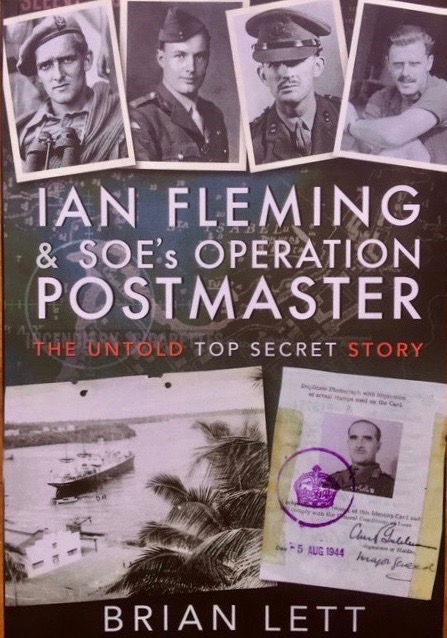
In my blog post "A Deniable Operation Under the Swedish Flag" I wrote about Brian Lett´s wonderful book Ian Fleming & SOE´s Operation Postmaster. Well, in SOE´s Mastermind one learns of what became of the “Swedes”, among them not least the Danish volunteer Anders Lassen, who later was awarded a Victoria Cross.


Operation Gunnerside, the operation against the German atomic project in Norway, has been covered in many books. Still, the Gunnerside chapter in SOE´s Mastermind does not fail to keep me interested and it makes perfectly clear that Gunnerside became an immediate milestone. To quote Lett: “After Operation Gunnerside Colin found it much easier to obtain cooperation of the regular services for SOE´s operations.”


Finally, there is a very personal link between Colin Gubbins and the Swedish-British SOE operator Malcolm Munthe. His own son Michael served in the SOE together with Munthe. What happened next to Michael was a major blow to the Gubbins family but I shall here only say: do not miss this book and specially not if you are curious about what became of the SOE networks after 1945 - to quote the last chapter´s title “Did SOE Refuse to Die?”.

Thursday, August 13, 2020

Axis Armour You Never Knew Existed

Panzer IVs, Panthers and even Tigers served in the WWII Hungarian Army.

Quite many Axis tankers were Hungarians, which is why also several German Armoured Fighting Vehicles (AFVs) were in Hungarian service. A new book looks closer at these, and also the Hungarian vehicles with Swedish roots. 

An amazing number of rare photos and quite a lot of information has been assembled in the new book Hungarian Armoured Fighting Vehicles in the Second World War by Eduardo Manuel Gil Martinez. Being Swedish I was initially mainly interested in the Swedish aspects of his book, but it turned out that the German AFV presence in the Hungarian Army was greater than I thought, and also more interesting than I had imagined. If you are a modeller and you feel like you have run out of Panzer subjects - well, this book will provide you with some extra years of modelling challenges.

Most Swedish armor buffs will know that the Hungarian Toldis and Nimrods were to a large extent Landsverk vehicles, i.e. they were designs from the Landsverk factory in Landskrona in southernmost Sweden. But from this book I learnt something I had no idea of. Not only were the Toldis designed in Sweden, they also contained some components from Sweden, because the Hungarian industry was not able to supply all necessary parts.

Much to my surprise I also learnt from this book that there was even a Toldi converted to a tank destroyer, armed with a German PaK 40. Yes, the book has a photo of it. I can divulge that the result is very similar to a Marder II. Another good reason to release the Toldi also in scale 1/35 - or is there already such a kit and I have just missed it?

Many of the 111 pages of this book are of course devoted to AFVs that were mostly the result of Hungary´s own AFV design efforts. I am talking not least about the Turan tanks and Zrinyi "StuGs". Especially the latter should appeal to modellers. 

Generally speaking this book is a treasure chest for modellers and also provides some insights into the role that Hungary played for the Axis during WWII. The translation at times has some issues but that does not diminish the value of this book. Every tank buff, at least outside Hungary, ought to check out this one.

Tuesday, August 04, 2020

Early Jet Fighters 1944-1954

144 pages of some of the first (and some of the coolest) jet fighters ever. 

If you are looking for good images of the Third Reich´s jet fighters and are intrigued by how these  designs influenced the aviation industries of the Soviet Union, France, Sweden and other nations... well, then this is a book you will appreciate.

As a kid I remember seeing a model (Airfix?) of a Messerschmitt Me 262 and being quite astonished at learning that it was a WWII aircraft. Over the years I have of course learnt of the even more advanced German jet designs, e.g. from the Horten brothers (Reimar and Walter). But it was only through this book that I got the whole picture of German jet fighter development, and just how much it affected Soviet etc aircraft design. Even from a short distance you can mistake a Soviet Sukhoi Su-9/1946 for a Me 262. In fact, some early Soviet jet fighters not only looked rather German, their engines were actually BMW 003s and Jumo 004s - just one of many interesting facts that one learns from Leo Marriott´s book.

There are many astonishing designs in this book that I have seen nowhere else before. But as a Swede I am of course familiar with the planes of the Swedish chapter. Still, even there was a photo that surprised me - of a Lancaster in Swedish service with a jet engine under the belly, the STAL Dovern project. I learnt even more from Marriott´s text and captions about our early jet fighters. I had no idea that when the prototype for the Saab J 29 "Flying Barrel" (largest photo on the book cover) first flew on 1 September 1948 it was flown not by a Swede but by British test pilot Squadron Leader Bob Moore. Swedish pilots then just had no jet experience, of course. 

There is a also a German story behind the development of the J 29. Marriott explains how the plane´s swept wing design originated in the Third Reich and in 1945 reached Sweden via Switzerland. The new wing type was then tested for real with a strange looking Saab Safir trainer aircraft.
   
Leo Marriott has found wonderful images of many beautiful and "less beautiful" early jet fighters, and he rightly lets the photos dominate the book. But he also has provided the photos with some really interesting captions. 

Hm, should I now build a 1:72 scale Heinkel He 162, a Yak-25 or a Caproni-Campini N. I?

Monday, March 09, 2020

A Deniable Operation Under The Swedish Flag

SAS VC holder Anders Lassen (1st from the left) always catches my attention.

The story they presented was that they were a neutral Swedish crew on a neutral Swedish yacht. In fact, they were a group of SOE agents on an incredibly daring mission, commanded by an actual "M", with whom Ian Fleming worked. This is a book that especially Nordic SOE, SAS & Fleming/Bond buffs can appreciate.

While the Swedish flag was mere camouflage, there were actually Danes aboard, one of whom later would join the SAS and earn a VC, Anders Lassen. Thus it should already be apparent that Ian Fleming & SOE´s Operation Postmaster by Brian Lett is of special interest to Danish military history buffs. Norwegian WWII buffs also have several reasons to pick up this book, because Brigadier Colin Gubbins was "M" and he had a great deal to do with Norway from 1940.

Well, what kind of special operation is Ian Fleming & SOE´s Operation Postmaster about? In 1941 the British started receiving reports that German submarines were using rivers in French parts of Africa for refuelling. At the time, the Special Operations Executive (SOE) was a new outfit with many enemies, not just among the enemy. The SOE had to prove its worth. The cunning plan was to sail a "Swedish" SOE ship, with some great characters, to West Africa and locate German submarine bases. But having arrived in the area the main aim became to steal enemy ships from a neutral Spanish port on the volcanic island of Fernando Po. I will here not give away the wonderful story of what happened but just say that the British Government lied in order to conceal British responsibility for the operation, and basically recommend that you read this book yourself.

Being the author that I am, I do not think that the characterization of Sweden as "pro-German" in Lett´s book is fair. Regardless if one means the Swedish state or the majority of the Swedish people, the largest Swedish sympathies were about Finland, Norway and Denmark. Yes, there were Swedish Nazis and pro-German sympathies, but they never dominated. The thousands of Swedish citizens in Finnish, US and Norwegian service can be compared with the 200 in various German units. For more about Sweden during WWII please turn to e.g. John Gilmour or yours truly.

Nevertheless, Brian Lett´s book is an inspiring and exciting book that should please not just SOE and Fleming/Bond buffs. First published in 2012, the edition I got is from last year. Brian Lett has written other books about special ops and I just recently became aware of his SOE`s Mastermind - Sir Colin Gubbins, a book that I very much look forward to reading.

Thursday, February 20, 2020

The Real James Bonds

That strange gun on the cover is a Welrod, a British bolt action suppressed pistol.

Having reviewed Nigel West´s Secret War: The Story Of SOE, I must of course also review his take of the organization that SOE quite often found itself in conflict with, MI6/SIS, i.e. the home of James Bond.

Being an entirely factual book, Nigel West´s MI6: British Secret Intelligence Service Operations 1909-1945, does not waste words on James Bond and only mentions Ian Fleming on one page. Fleming is mentioned not because of his later secret agent novels but due to the fact that he during WWII was an assistant to the Director of Naval Intelligence. However, it is hard not to think of Captain America´s enemy Red Skull when reading about agent SKULL, one of the most important double agents of the war in West´s opinion.

Secret intelligence operations can be hard to explain and summarize. Yet, West often manages to do so. One of the most catastrophic aspects of the the initial stage of the intelligence war 1939-45 is how almost unbelievably unprepared the British were for the eventuality of Germany actually overrunning other countries. In spite of six years of Hitler in command of Germany the SIS had set up no stay-behind networks. Initially there were not even aircraft to fly agents into occupied Europe. Such a unit, 419 Flight (Special Duties), was set up only in July 1940.

Well, what about my favorite aspects of any WWII book, the Nordic aspects? The Norwegian heavy water is of course covered but after the German invasions of 1940 the SIS was itself not that active in Norway and Denmark. In those countries intelligence gathering was mainly performed by the SOE. Stockholm was much more of a stage for the SIS, and West provides a wonderful picture of how absurd it was to be stationed there considering that "[...] personnel from the German, Japanese and British [embassies were] all visiting the seaside together on Sundays during the Swedish summer".

Nigel West is very clear about his view of SIS performance in Stockholm during WWII: "The Stockholm Station was arguably the most successful of the war". West also states that thanks to "unofficial assistance" from Swedish military intelligence, more than fifty Norwegians were detained in Sweden as known infiltration agents from the Sicherheitsdienst in Oslo.

Like West´s SOE book, MI6 is not new but a new edition of a 1983 book. Still, MI6 by Nigel West is a highly readable book and ought to be a useful source for many years yet to come.

Thursday, January 30, 2020

Keystone of 22 SAS

Without him there would today probably be no 22nd Special Air Service Regiment.

Quite a few readers of this blog may have read several books about the WWII Special Air Service and also the SAS during recent years. But what about the first postwar decades of the SAS? Here is a book that both covers WWII experiences and some of the more interesting post-1945 SAS episodes until the 1970s. And, of course, there are some Nordic connections.

As some readers may have noticed, I have a special interest in SAS history. This should become more apparent here, as I am planning to blog more about the SAS. Keystone of 22 SAS is, simply put, a fine account both of the life, mostly in the SAS, and times of Lieutenant Colonel John Woodhouse MBE MC. He first experienced combat in a conventional British Army unit in North Africa and there, strangely enough, is the first Nordic connection in the book. For more than twenty years I have been hiking on Arctic WWII battlefields and the type of tin cans that I have most often encountered in German positions are cans that once contained Norwegian fish. Therefore I can recall images from my memory when the book´s author, Alan Hoe (himself an SAS veteran), writes about Woodhouse often eating captured (from the Germans) Norwegian sardines in North Africa.

Keystone of 22 SAS quite often contains Woodhouse´s own words and here are some sentences from his diary in 1944 to give you an idea of his wartime reflections:

"The German soldiers had an unshakable belief in their superiority over all other nations and armies. They had been led to believe that war was glorious and Hitler [...] was invincible. The Wehrmacht was very well led, better equipped and by 1943 more battle experienced than we were. [...] I was often fearful but it always mattered greatly to me that I should be well regarded and respected by the soldiers I commanded. This helped in overcoming fear."

It was in the ruins of the Third Reich that Woodhouse entered a door that eventually led to the SAS. By exaggerating his contacts with Soviet soldiers while he was a PoW, he managed to get a place in a Russian language course. On the successful completion of the course he was posted to Germany where he joined the Control Commission to act as interpreter between Soviet and British military groups. A short time later he was switched to army intelligence. He then exeperienced some memorable encounters both with Soviets, including an early defector, and Germans like Hanna Reitsch, "[...] the only German I met who had the courage still to proclaim loyalty to the Nazis".

In 1950 he reacted positively to an invitation to join the Malayan Scouts and thus fight in the deep jungles of Malaya. He volunteered not least because he was keen to serve under the legendary Mike Calvert, famous for having commanded a Chindit Brigade in Burma. Woodhouse sensed that Calvert was a great source of "original ideas and concepts". Woodhouse became both nervous and "a bit resentful" when Calvert made him Unit Intelligence Officer. But then he meets a very unlikely character in the jungle, "Yorkie" Bjorkman:

"With a good intelligence network the battle is half won. Yes. You can learn a lot from Yorkie. He´s a man with personality, guts and imagination. He´s got thirty Malay police there and he controls the jungle for miles around - controls the jungle."

Bjorkman was awarded both a Distinguished Conduct Medal, the oldest British award for gallantry, and a Military Medal, for bravery. The encounter in the jungle with a man obviously of Nordic extraction is only one of many surprises in Keystone of 22 SAS. The SAS in Cold War Denmark is also part of the book, but one wishes there had been more details in that part.

Woodhouse´s fascinating career did not end at all with his formal retirement in 1964. The year after he was asked by SAS founder David Stirling to lead a team of three men to Yemen and in cooperation with Royalist forces attack an Egyptian airfield. These experiences alone could be made into a good movie.

John Woodhouse passed away in 2008. Now it is time for you to read about his rich life in Keystone of 22 SAS.

Friday, January 10, 2020

Stunning Scale Models & Dioramas

Here focus on super detailed 1:32 aircraft, e.g. the B-25J Mitchell on the cover.

Few people find the time to spend hundreds of hours on a single scale model. The results can be simply stunning. They certainly are in the books from the Swedish publisher Canfora, and that is why I recently payed them a visit.

Finding little time to myself build scale models, I have come to the conclusion that what I mainly long for is being able to see really good models up close. I mean, REALLY close and in superb photos. Therefore I visited Toni Canfora in Stockholm to discuss his own models and his books - that contain both his finished models and those of many other "model artists" as I would like to call them. On top of the superb photos in all his books Toni Canfora has added really interesting historical facts and model information as well as good captions (IMHO really good books must have really good captions). The main focus of Canfora is scale models and dioramas, but they have other kinds of books too. But first let me show you two more scale model book covers:


What most of all appeals to me with the Canfora scale model books is that some contain dioramas based on actual photographs, like the StuG book above. To me, that sort of diorama is the most amazing to see, the experience can be both like experiencing art and history.

In addition to the now quite many books on scale modeling, Canfora also offer books focused on large & previously mostly unpublished photographs of actual AFVs and aircraft. Mostly taken during WWII. Let me just say how very much I have been surprised by the three AFV Photo Album books about Panther tanks and other AFVs in Czechoslovakia. This is the latest volume, vol 3.


I had never thought that so many previously unpublished amazing Panther photos would appear. Like the scale model books, the AFV books have captions full of information, pointing out lots of details in the photos that one would otherwise miss. Now, do check out all the amazing books from Canfora.

Thursday, December 05, 2019

StuG III & IV

A surprisingly good StuG book for both AFV buffs and modellers.

Having a special interest in StuGs it takes a special StuG book to surprise me. Well, Dennis Oliver´s new book StuG III & IV: German Army, Waffen-SS and Luftwaffe, Western Front 1944-1945 contained some news for me - not least about Danish postwar StuG use.

Why are WWII assault guns/tank destroyers of special interest among AFV buffs and modellers? I reckon there are several different answers depending on who you ask, but here in Sweden I think quite a few guys (now rather mature AFV buffs/modellers) once trained to use the Swedish "S-tank" (strv 103), like myself, will be aware of the historical roots between the S-tank and the WWII assault guns. I recall my 1980s exchange of letters with the chief designer of the S-tank, Sven Berge - from which I understood that the design similarities of StuGs and S-tanks were no coincidence.

Now, having read about StuGs since the glorious 1980s it takes quite a lot to impress me. But Dennis Oliver´s book has done so. Almost all WWII photographs in his new book are new to me and then he has produced 23 brilliant colour illustrations, clearly displaying different types of camouflage and markings. Aside from these Oliver provides short but good unit histories with graphics plus all the different StuG scale models ever made and very good photos of assembled and painted kits.

Being a blogger/writer with a Nordic angle on military history I must of course also mention my big surprise when I found Oliver´s photo of a StuG III Ausf. B belonging to Minenkommando Dänemark, a company-sized formation formed by the Allies after WWII to remove the about 1 million mines that the Germans had laid along the Danish coast. I knew of this mine-clearing operation but did not knew it had StuG IIIs and PzKpfw IIIs. Well, Oliver knows a lot about StuGs, and has the ability to transfer his knowledge in this quite short (64 pages) but large size book in the excellent TankCraft series.

Wednesday, November 20, 2019

No Surrender

German troops march past the Norwegian parliament in 1940. PHOTO: Riksarkivet

In a few months the 80th anniversary of the German invasion of Norway in April 1940 will be highlighted not only here in Scandinavia. There are a number of books in English about the invasion, but the aftermath is not as well documented in English. However, a key source has recently become available: No Surrender.

There is something very inspiring with well-written personal accounts of occupation resistance and imprisonment. No Surrender is one of the strongest, not least because Hans Cappelen wrote it just some months after the war. In Norwegian his WWII memoir was published as Vi ga oss ikke already in 1945. Because of this and his postwar work for the public he became rather well known in Norway, in 1970 he was made a Knight, First Class of the Order of St. Olav.

No surrender contains plenty of exciting scenes due to high stakes and daring. In spite of the grim subject matter and proximity to the events, Hans Cappelen includes humour and portrays his captors in a credible manner. Several conversations that Hans Cappelen had with Germans quite surprised me.

This book is of particular importance not just because it covers the early resistance period, Hans Cappelen was a founding member of the resistance and when he was arrested in 1941 he was tortured and eventually deported to Germany as a "Nacht und Nebel" prisoner, destined to disappear in "Night and Fog" (the meaning of "Nacht und Nebel"). He thus got to know some of Nazi Germany’s most infamous camps, among them Natzweiler, Dachau and Buchenwald. In the spring of 1945 he was rescued by Count Folke Bernadotte’s "White Buses" and transported to Sweden.

RAF veteran and now also translator of No Surrender, J. Basil Cowlishaw, first met Hans Cappelen in the spring of 1949, when Cappelen approved his job application. They became friends and often met each other until Cappelen passed away in 1979. The result of the translator´s excellent understanding of the history and language in question is a wonderful translation - just a pity it has been released only this year. But better late than never.

I usually don´t write where reviewed books are available, but as there are yet very few places that have No Surrender, I will end this review by recommending the Amazon page.

Thursday, November 14, 2019

Red Assault: Soviet Airborne Forces 1939-1941

A truly stunning book, 343 pages of Soviet airborne information and photographs.

For years I have been collecting books about airborne forces and therefore I can guarantee that this book is amazing. Very few readers outside what was once the Soviet Union will have previously seen more than two or three of the book´s photographs. And Red Assault has plenty of photos - that match the surprisingly rich text. And there is a Swedish connection.

Red Assault: Soviet Airborne Forces 1939-1941 by Vladimir Kotelnikov shows, with an amazingly detailed text and lots of different illustrations, that the Soviet airborne were pioneers in more ways than imagined. Because not only does it tell the story of the known airborne equipment and experiments, but also several ideas and tests that have never been documented in any previous book. The early Soviet airborne infatuation with armoured vehicles was not limited to the T-37A amphibious tank. Several other AFVs were tested by the airborne troops. Sketches and fine drawings reveal even more advanced ideas like a "helicopter tank" and then there was the quite adorable "avia-motorcycle" in two variants.

Airborne recoilless guns, an experimental camouflaged jump suit, various parachutes, special gliders, airborne dogs, airdrop sledges - this book has them all and often the quality of both the information and photographs is astounding.

Aircraft buffs will also be baffled, because early Soviet paratroopers were not only dropped from huge TB-3s, Red Assault contains many more types, some very futuristic designs. And now a Swedish connection: "There was a shortage of alloy steel in the country at the time and it had to be imported first and foremost from Sweden."

Not that surprisingly, Mikhail Tukhachevskiy is one of the officers portrayed in this book. But Vladimir Kotelnikov, for credible reasons, writes more about the "fanatic" and "genius" Pavel Grokhovskiy. This airborne pioneer deserves to become better known.

Is there nothing lacking in this book? The parts about the operations in Poland and Finland are short. What about the scope, the book ends in 1941. Well, if it were to cover also 1941-45 with the same degree of detail as 1930-1939 it would be thick as a brick. Better focus on that period in another book. But by the very nature of the events between 1941 and 1945 such a book can not contain as much about airborne development and equipment as Red Assault does. This is because the Soviet airborne forces in 1941-45 found themselves fighting most desperately, largely without aircraft and with no time or resources for airborne development. The Soviet visions of massive airborne operations were not possible to realize until the 1960s.

Sometimes book covers claim that a book is original and contains new insights, photos etc, but the book then actually offers very little that collectors have not seen before. Well, this is just not the case with Red Assault. It delivers. Both airborne and aircraft buffs will be pleasantly surprised by Vladimir Kotelnikov´s book, translated by Kevin Bridge and published by the UK publisher Helion & Company.

Saturday, October 12, 2019

Secret War - Not Just About SOE

An attractive cover for a special operations reference book not just about the SOE.

When you have read about Special Operations Executive (SOE) operations in certain countries you might want to better understand the SOE in general - why it was created in 1940, how it began its existence and what became of it. Secret War by Nigel West answers such questions and has some parts of particular interest to Nordic readers.

Secret War: The Story Of SOE includes the original Cabinet memorandum, drafted by Neville Chamberlain in July 1940, which created SOE. West´s book has many details about the origins of SOE and the serious rivalry it from the start experienced with the Secret Intelligence Service (SIS, also known as MI6). Nigel West even writes that an "undeclared war" existed between the SOE and SIS. West also makes it clear that he has studied not just the successful SOE operations, and that he wants to shed light on how the SOE tipped the resistance balance in favor of Communist groups in several countries, not only in Yugoslavia.

West does not devote many paragraphs to describe Operation Gunnerside, the successful SOE action in the Norwegian mountains to stop the German development of nuclear weapons, through the destruction of heavy water production and stocks. But that operation is well documented in several other books and West instead clarifies how Gunnerside was to the benefit of the status of SOE in general.

Early SOE activities in Sweden and Norway are covered rather extensively. One wishes West had written as much about the last activities, that interest me more. Still, one learns some important facts about the SOE in all of Scandinavia and regarding the Danes I learnt of something I had no idea of - how the US Office of Strategic Services (OSS) had plans for a Danish Operational Group (OG). In fact, several pages of this book are very informative about the OSS.

If you are mainly interested in SOE and OSS activities in France, this book will be even more useful to you.

The edition of Secret War: The Story Of SOE that I have just reviewed is the one that was printed this year (2019). The first edition was published in 1992. I believe it remains a good investment.

Thursday, September 19, 2019

Hitler´s Largest Arctic Project Then & Now

Org. Todt chief Albert Speer (right) with General Eduard Dietl in the Arctic 1943. Attribution: Bundesarchiv, Bild 183-J16636 / CC-BY-SA 3.0

Thanks to a Norwegian friend I was recently invited to a WWII research meeting right beside Hitler´s largest Arctic project, his railway line that was meant to end in Kirkenes by the Finnish (now Russian) border. This blog post is mainly to provide a visual idea of the amazing days we spent up there.

The Organisation Todt (OT) was a German paramilitary engineering organization named after Fritz Todt, an engineer and senior Nazi leader. The OT was one of the Wehrmachtgefolge, German Armed Forces auxiliaries. The organization was responsible for implementing the vision of connecting by rail south Norway with Kirkenes, the northeasternmost town not far from Soviet Murmansk. This meant working in one of the most challenging landscapes on earth due to a staggering amount of mountains and fjords. The Arctic climate and often total lack of roads for supporting motor vehicles did not make things easier. As usual, the OT would rely on forced labour, mostly Soviet and Yugoslav prisoners of war. The section responsible for this most extreme railway project was called OT-Einsatzgruppe "Wiking". The project was pursued right to the very end of the Third Reich, at the cost of thousands of lives.

Our trip last week began with a visit at Klungset, beside the town of Fauske, about 70 kilometres inside the Arctic Circle. Klungset is probably the most intact OT base that there is in 2019, and one of few WWII German military hospitals still around. Last time I visited it, 18 years ago, it was in a deplorable state. Now several parts of it have been restored. In 2015 it became protected by the Directorate for Cultural Heritage in Norway.

The German hospital in Klungset shortly after the German capitulation.

The same place the other day, now in private Norwegian hands.

In connection with the huge Arctic railway project to Kirkenes, this hospital complex was built in 1942-43, mainly for the benefit of German OT staff. Construction was carried out by forced labour, local companies, a southern Norwegian construction company and others. When the base was completed in 1943, it consisted of 12 buildings with a total capacity of 200 beds. Today, four of these buildings are preserved. Although the bulk of the labour force consisted of prisoners of war, this group received limited treatment at the base. This changed radically after the German capitulation, when, in June 1945, the US Army flew Swedish Red Cross personnel, diet foods and medical equipment to treat the most ill Soviet former prisoners of war. Thus American C-47 aircraft flew a Swedish hospital staff from Luleå to Bodö, not far from Klungset. The above 1945 photo from Klungset shows the main building with Swedish medical staff and also some Germans under Norwegian command.

This Phänomen was an ambulance at the base and after 1945 used by a farmer.

Hopefully Klungset will sometime in the future also become a true museum. We saw why that would be a good idea - not only has the main building been restored, another building has been left virtually untouched since 1945 and contains many both unusual and moving artifacts and photographs. Just walking around on the base, especially in the cellars, is a remarkable experience in itself. The two gentlemen who own the premises also have some relevant WWII military vehicles, some virtually untouched since the war, some restored.

US Army Dodge ambulance with a German BMW R75 motorcycle in Klungset.

Thank you so much, Trond Ole Slettvoll, for showing us around on Klungset. Our next big thank you goes to Trond Inge Mathisen of Hamaröy, whose WWII researcher event took place by a mountain lake 90 kilometres north of Klungset, beside the last large German tunnel that was made before the German capitulation. It was never completed and is dangerous to enter, but can be entered with a guide and special equipment - see the last photograph below.

All around our research meeting there were traces of German slave labour camps.

The foundations for a German Arctic railway bridge between two mountains.

The quality of the work is just amazing but also largely covered by vegetation.

German bridge foundations are everywhere but the bridges long gone (sold).

Some of the construction equipment used by the slave workers is still in situ.

The WWII weekend brought together more than 50 Norwegians and 3 Swedes.

Part of the weekend was the unveiling of a new memorial by the last large tunnel.

One of the WWII Soviet (Norwegian) reenactors unveiled the memorial.

The text to the memory of the prisoners of war is in Russian and Norwegian.

Entering the last tunnel should only be done with safety equipment and a guide.

What is inside the last large German Arctic railway tunnel? First, please understand that abandoned WWII tunnels should not be entered, or at least not without safety equipment and a guide, as they are more or less unsafe for various reasons. Well, what about my experiences from the above tunnel? I am saving them and the relevant photos for a manuscript I hope to finish next year which will contain largely unknown and unpublished material. You can support this by reading my books, two are available in English (check Amazon etc). The next one (in October) in Swedish you can see below. It contains chapters i.a. about some very large gifts from Soviet former prisoners of war in Sweden and a previously unknown Allied base on Swedish soil - the Norwegian SOE operators on the cover came from one of these bases. If you are wondering about the submarine on the cover it is U 3503, one of the extremely advanced German submarines of the type XXI class, en route to Norway but scuttled on 8 May 1945 west of Göteborg, Sweden.

Tuesday, September 10, 2019

III. Germanic SS Panzer-Korps

277 large size pages about the Waffen-SS and the battle of Narva 1944.

Rather surprisingly, this year two books focused on Nordics in the Waffen-SS have been released. First The Finnish SS-volunteers and Atrocities 1941–1943 by Professor Lars Westerlund, and just recently III. Germanic SS Panzer-Korps by Lennart Westberg, Petter Kjellander & Geir Brenden.

This SS corps was a Waffen-SS armoured corps which saw action mainly on the Eastern Front and is often associated with the Estonian city of Narva due to its fighting there. The corps was formed in April 1943 and first commanded by the former Wiking commander Felix Steiner. III. Germanic SS Panzer-Korps is being released in two volumes by the UK publisher Helion & Company. The first volume, just released, covers the background of the corps, its creation and history until September 1944.

Counting myself as a close friend of Lennart Westberg (we have written two books together) I should not really review his new book, but I see no reason why I can not give an idea of the contents. Naturally, the III. Germanic SS Panzer-Korps is the main focus, but the first 45 pages summarize the latest research about the roots and purposes of the Waffen-SS and especially about its recruits from the Nordic states. The authors describe both the incredible expansion of the Waffen-SS and how the SS "brand" was renewed in 1944. Already in the introduction there are several images that few will have seen before, and not just propaganda photographs.

While photographs, especially previously unpublished ones, are important (not least in this book), the III. Germanic SS Panzer-Korps also contains new insights, e.g. into the serious difficulties to keep Norwegian volunteers within the Waffen-SS. Associate Professor Sigurd Sörlie has contributed a summary of his relevant research to this book.

Many books about the Waffen-SS just mention the often very large component of ethnic Germans/Volksdeutsche (from German minorities outside the Third Reich), but in III. Germanic SS Panzer-Korps they are very much present.

The many large photographs are in some cases of spectacular quality and those from within the city of Narva 1944 should be of interest to a wide group, not least those who plan to visit the city. Military vehicle (tank) buffs will find several images of Panthers and other vehicles, also Italian ones, of great interest.

Finally, the propaganda posters in the book deserve special mention. The SS, for Ersatzkommando Danmark, even produced a poster highlighting the significance of Narva, and the book´s poster captions explain the symbols and messages in this and other relevant Waffen-SS posters.