Probably the best SOE equipment book in the world. Yes, the authors are Danish.
The best Christmas present I received this year was SOE EQUIPMENT Air Dropped in Europe 1940 - 1945 by Anders Thygesen and Michael Sode. The word unique is quite appropriate, because it contains several photos and facts you will find nowhere else, like the best photos I have ever seen of the elusive SOE jump suit.
Special Operations Executive (SOE) agents that were parachuted into occupied countries were not seldom issued with a set of protective overalls and a jump helmet, sporting a SOE specific camouflage pattern, or simply white (I reckon basically for Norwegian ops). These items were intended to be used only once and were therefore upon landing usually buried or otherwise disposed of. As you have already figured out, they are extremely rare. Once, in Paris, around 1986, I saw a SOE jump suit for sale for about a 1,000 Francs. That was a lot of money in those days, and I could not afford it. Well, nowadays i understand the price is many times that sum. I suppose I will never have one, but now, thanks to my Christmas present (thanks, my love!), I at least can see exactly what they looked like.
BTW, why does not someone make at least a t-shirt with the SOE pattern?
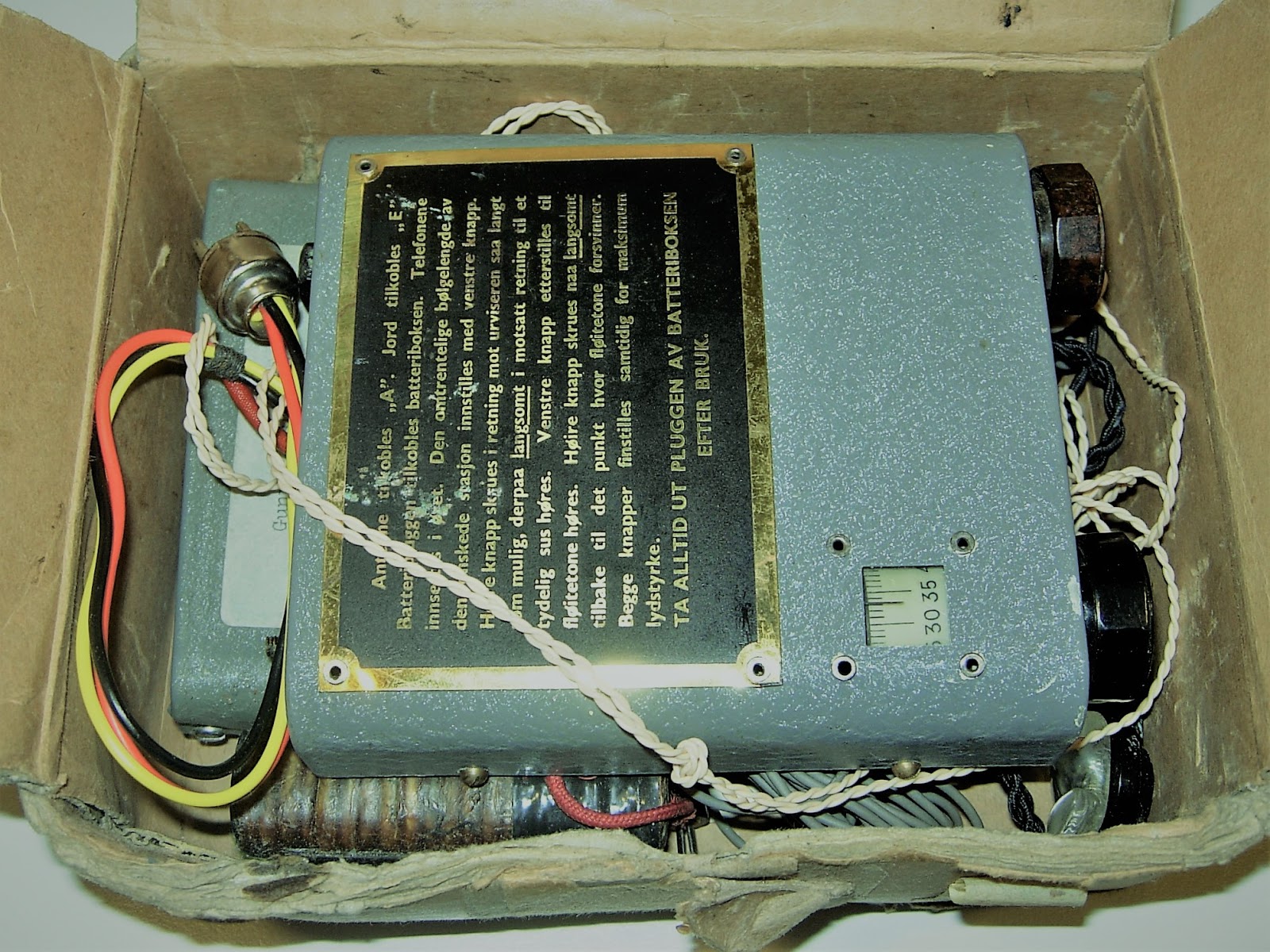
Another great aspect of SOE EQUIPMENT is that I learnt the official designation of the "Sweetheart" radio receiver. Well, according to the instruction sheet pictured in the book they were called Midget Receiver. I recently helped one from the OSS/SOE Sepals operation in Sweden 1944-45 get included into the collections of the Army Museum in Stockholm. Below is a photo of it I took while it was still owned by ex-Sepals helper Gunnar Isberg in Luleå.
Midget Receiver from the Sepals operation, now repaired and again working.
About Me
- Lars Gyllenhaal
- Author, film researcher and member of the Swedish Military History Commission.
Monday, December 25, 2017
Saturday, December 23, 2017
Rhodes WW2 History Holiday
On my first Rhodes trip I found this presumably Italian bunker while jogging.
Three years in a row we have been spending a week or two on Rhodes. The sun, people, beaches, landscape and food of Rhodes are well known. The island also has an amazing amount of remains of ancient Greece and various European knights. However, one thing is absent in the museums and guide books - the World War Two history of Rhodes.
Being an author with a special interest in 20th century wars I naturally could not miss noticing an old bunker while jogging on Rhodes, see the above photo. Then I had the luck to one day stroll into a cafe/hotel in the Old Town, Avalon. There I noticed a young man working on a very old field radio. I asked if it might be from the war, and it was. Thanks to that chance meeting in Avalon with the archeology student Panos Mprokos I have since been able to see many amazing traces from both the Italian and German occupation periods of Rhodes and it is time I show them here to let other Rhodes visitors know that the island has more World War Two history than you have imagined.
The Old Town then and now, the vehicle is a German assault gun, a StuG III.
About an hours drive from Old Town, an abandoned Italian/German barracks.
With Nietzsche´s words "Gelobt sei, was hart macht", i.e. Praised be what hardens.
These German occupants seem to have been from Danzig, today´s Gdansk.
Then we briefly stopped at Hotel Elaphos, a military hospital during the occupation.
The Italian town of Campochiaro became a German HQ and then Greek Eleousa.
Walking around in the former Italian town/military HQ of Campochiaro (now Eleousa) is a special experience, because for some reason the buildings used by the Italian and German occupiers have been abandoned for many decades, making the occupation seem not that distant.
Back in Rhodes City, an Allied WWII memorial for a Greek officer at El Alamein.
Another chance meeting in Rhodes City, a working BMW R 12 motorcycle.
How to see these places? There are plenty of tours to Rhodes Old Town but I believe there are no organized tours to the Italian/German remains outside it. So, you either do your own research and rent a car, or you find Panos Mprokos via the Avalon cafe/hotel, which is beside the upper part of the Avenue of the Knights in Old Town. Avalon is a really great place both to stay and for a snack or meal. The atmosphere is full of history. Try searching with the words avalon hotel rhodes. Below is a photo of Avalon´s main entrance. Just some words of advice if you choose to travel around the island by car/motorcycle: traffic is not like at home, be very careful and rent a safe car model.
Avalon, my favourite cafe/restaurant/hotel on Rhodes.
P.S. I have written about Rhodes during WWII in two issues of the Swedish journal Militär Historia, in issues 8 and 11 during 2017. Sadly, my articles are neither online nor are they in English, but I can recommend one book in English that has information about British raids against the Axis forces on Rhodes, SBS in World War II by Gavin Mortimer, it is also simply a must for all SBS history buffs.
Three years in a row we have been spending a week or two on Rhodes. The sun, people, beaches, landscape and food of Rhodes are well known. The island also has an amazing amount of remains of ancient Greece and various European knights. However, one thing is absent in the museums and guide books - the World War Two history of Rhodes.
Being an author with a special interest in 20th century wars I naturally could not miss noticing an old bunker while jogging on Rhodes, see the above photo. Then I had the luck to one day stroll into a cafe/hotel in the Old Town, Avalon. There I noticed a young man working on a very old field radio. I asked if it might be from the war, and it was. Thanks to that chance meeting in Avalon with the archeology student Panos Mprokos I have since been able to see many amazing traces from both the Italian and German occupation periods of Rhodes and it is time I show them here to let other Rhodes visitors know that the island has more World War Two history than you have imagined.
The Old Town then and now, the vehicle is a German assault gun, a StuG III.
About an hours drive from Old Town, an abandoned Italian/German barracks.
With Nietzsche´s words "Gelobt sei, was hart macht", i.e. Praised be what hardens.
These German occupants seem to have been from Danzig, today´s Gdansk.
Then we briefly stopped at Hotel Elaphos, a military hospital during the occupation.
The Italian town of Campochiaro became a German HQ and then Greek Eleousa.
Walking around in the former Italian town/military HQ of Campochiaro (now Eleousa) is a special experience, because for some reason the buildings used by the Italian and German occupiers have been abandoned for many decades, making the occupation seem not that distant.
Back in Rhodes City, an Allied WWII memorial for a Greek officer at El Alamein.
Another chance meeting in Rhodes City, a working BMW R 12 motorcycle.
How to see these places? There are plenty of tours to Rhodes Old Town but I believe there are no organized tours to the Italian/German remains outside it. So, you either do your own research and rent a car, or you find Panos Mprokos via the Avalon cafe/hotel, which is beside the upper part of the Avenue of the Knights in Old Town. Avalon is a really great place both to stay and for a snack or meal. The atmosphere is full of history. Try searching with the words avalon hotel rhodes. Below is a photo of Avalon´s main entrance. Just some words of advice if you choose to travel around the island by car/motorcycle: traffic is not like at home, be very careful and rent a safe car model.
Avalon, my favourite cafe/restaurant/hotel on Rhodes.
P.S. I have written about Rhodes during WWII in two issues of the Swedish journal Militär Historia, in issues 8 and 11 during 2017. Sadly, my articles are neither online nor are they in English, but I can recommend one book in English that has information about British raids against the Axis forces on Rhodes, SBS in World War II by Gavin Mortimer, it is also simply a must for all SBS history buffs.
Sunday, December 17, 2017
The Last Jedi & Waffen-SS
Skellig Michael, the very real island of the last Jedi. PHOTO: Jerzy Strzelecki
Spoiler alert! Here follow some reflections about the real history (planet Earth history) in the latest episode of Star Wars.
In "The Last Jedi" there is a lot going on, some of it really amazing and fun to watch. Like most scenes on the Irish island of Skellig Michael - what a magnificent filming location - I think it can only be compared to Tunisia or Norway as a Star Wars location.
However, the movie also has some stuff that can disturb fans like me - who basically only really appreciate the original trilogy but cannot abstain from the rest. By disturbing stuff I mean e.g. some of the new characters, several battles and what happens to Princess Leia in space. The joke about General Hux is sort of fun the first time, but then...
Vice Admiral Amilyn Holdo i.e. Laura Dern (remember her in "October Sky"?) is nice, but why was she not allowed to act more officer-like and wear something a bit more officer-like? I could bore you with more questions like that, but instead let me end with two planet Earth things in the new Star Wars episode:
Not General Hux but SS-general Sepp Dietrich, wearing a cuff title on his left arm. PHOTO: Bundesarchiv
1. Several of the bad guys are wearing Waffen-SS style cuff titles, but without German Sütterlin script or Latin letters. Instead, they are adorned with words that I could not read. as they are written in what I suppose is the Aurebesh alphabet, the most common script seen throughout Star Wars. Perhaps someone more into Aurebesh could tell me what they say? Cuff titles could be seen already in the previous episode, on General Hux, but for some reason he has zero letters on his double (!) cuff titles. In "The Last Jedi" you get to see the two types of cuff titles many times and quite up close too.
2. Last but not least, the word ´"Godspeed" is uttered, twice. That word is really old English for "May God cause you to succeed". Pretty weird for a galaxy far, far away a long time ago. "May the Force be with you" would be more natural, like? On the other hand, as a Christian, it was rather nice to hear that unexpected non-Force word. Those of you who have really payed attention will also know that already in 1977, in "A New Hope" (Episode IV), there is a reference to Christianity when "Ben" Kenobi talks to Luke while handing over the light sabre. Kenobi utters "crusade", a word that started with the cross of Jesus. Interestingly, in "The Empire Strikes Back" (Episode V), the word hell is mentioned, when Han Solo says "Then I'll see you in hell". So, besides lots of Japanese and Chinese religious ingredients in the Force, the Star Wars movies do contain some grains of the Abrahamic religions.
Interested in what remains in the Tunisian desert and mountains of Norway from Star Wars? Check out my old blog post Lars Wars.
Spoiler alert! Here follow some reflections about the real history (planet Earth history) in the latest episode of Star Wars.
In "The Last Jedi" there is a lot going on, some of it really amazing and fun to watch. Like most scenes on the Irish island of Skellig Michael - what a magnificent filming location - I think it can only be compared to Tunisia or Norway as a Star Wars location.
However, the movie also has some stuff that can disturb fans like me - who basically only really appreciate the original trilogy but cannot abstain from the rest. By disturbing stuff I mean e.g. some of the new characters, several battles and what happens to Princess Leia in space. The joke about General Hux is sort of fun the first time, but then...
Vice Admiral Amilyn Holdo i.e. Laura Dern (remember her in "October Sky"?) is nice, but why was she not allowed to act more officer-like and wear something a bit more officer-like? I could bore you with more questions like that, but instead let me end with two planet Earth things in the new Star Wars episode:
Not General Hux but SS-general Sepp Dietrich, wearing a cuff title on his left arm. PHOTO: Bundesarchiv
1. Several of the bad guys are wearing Waffen-SS style cuff titles, but without German Sütterlin script or Latin letters. Instead, they are adorned with words that I could not read. as they are written in what I suppose is the Aurebesh alphabet, the most common script seen throughout Star Wars. Perhaps someone more into Aurebesh could tell me what they say? Cuff titles could be seen already in the previous episode, on General Hux, but for some reason he has zero letters on his double (!) cuff titles. In "The Last Jedi" you get to see the two types of cuff titles many times and quite up close too.
2. Last but not least, the word ´"Godspeed" is uttered, twice. That word is really old English for "May God cause you to succeed". Pretty weird for a galaxy far, far away a long time ago. "May the Force be with you" would be more natural, like? On the other hand, as a Christian, it was rather nice to hear that unexpected non-Force word. Those of you who have really payed attention will also know that already in 1977, in "A New Hope" (Episode IV), there is a reference to Christianity when "Ben" Kenobi talks to Luke while handing over the light sabre. Kenobi utters "crusade", a word that started with the cross of Jesus. Interestingly, in "The Empire Strikes Back" (Episode V), the word hell is mentioned, when Han Solo says "Then I'll see you in hell". So, besides lots of Japanese and Chinese religious ingredients in the Force, the Star Wars movies do contain some grains of the Abrahamic religions.
Interested in what remains in the Tunisian desert and mountains of Norway from Star Wars? Check out my old blog post Lars Wars.
Monday, October 09, 2017
The British Norway Campaign
In April 1942 Adolf Hitler stated that only the Battle of Moscow and the Norwegian campaign had been ”absolutely decisive” actions. Why then has, until recently, the Norwegian campaign attracted so few British or American authors? Several reasons can be stated, e.g, that it was a military failure for the Allies, but I so far have found no utterly convincing reply to this question.
What I mainly have gained from the book Churchill and The Norway Campaign (2008) by Graham Rhys-Jones is a more full realization of the Pyrrhic nature of the German victory in Norway. To quote from the book it ”sparked the upheaval which removed Chamberlain´s hesitant and divided ministry and opened the way for an implacable and uncompromising opponent, determined to see the war through to its better end.” That the Norwegian campaign sealed Chamberlain´s fate was certainly not news to me, but it was Churchill and The Norway Campaign that first made me consider the German victory in Norway more of a minus than a plus for the Germans.
The author is not uncritical of Chamberlain´s successor, Churchill. In fact, he writes such things as: ”Behind that benign even homely image, the uplifting rhetoric and the inspiring presence lay a ruthlessness (even sometimes a vindictiveness) worthy of Al Capone.”
The book examines both the strategy behind the tactical actions and many of the more significant events in the fjords and mountains of Norway.
The poor performance of the British Army in Norway seems to have largely been the result of First World War thinking, according to the author. The author confirmed something I have long suspected, that Spaniards formed the largest national group in the Foreign Legion detachment at Narvik. I am impressed with the details regarding the French troops provided by the author.
I also find it commendable that the author describes the almost totally forgotten ”Mowinckel Plan”, an idea not adopted but a great what-if scanario that in a nutshell meant that Swedish forces were to intervene and take over the Narvik area from both the Germans and Allied forces.
The author of Churchill and The Norway Campaign, Graham Rhys-Jones, is also the author of The Loss of the Bismarck (1999) and has a background in the Royal Navy where he commanded a frigate. In more recent years he has taught strategy at the US Naval War College (USNWC) and on leaving the navy he returned to the USNWC as a research fellow.
My main negative remark would be the strong expectation created by the book´s cover. It portrays in colour Winston Churchill flanked by the German generals Eduard Dietl and Nikolaus von Falkenhorst. Considering that the author devotes little space to Dietl and sursprisingly little to Falkenhorst, the overall commander of the invasion of Norway, the cover is rather misleading. That having been said I will not deny that the cover is a very attractive one!
Rhys-Jones has found some excellent photographs for his book, one only wishes he had included some more. The seven maps provide the essential geographical features and names, but not more.
If you are looking for a recent and reliable overview of the battle for Norway in 1940 I would recommend another book: Hitler´s Pre-emptive War by Henrik O. Lunde. If you, however, are mainly interested in the British aspects of this campaign, Churchill and The Norway Campaign is an excellent choice.
What I mainly have gained from the book Churchill and The Norway Campaign (2008) by Graham Rhys-Jones is a more full realization of the Pyrrhic nature of the German victory in Norway. To quote from the book it ”sparked the upheaval which removed Chamberlain´s hesitant and divided ministry and opened the way for an implacable and uncompromising opponent, determined to see the war through to its better end.” That the Norwegian campaign sealed Chamberlain´s fate was certainly not news to me, but it was Churchill and The Norway Campaign that first made me consider the German victory in Norway more of a minus than a plus for the Germans.
The author is not uncritical of Chamberlain´s successor, Churchill. In fact, he writes such things as: ”Behind that benign even homely image, the uplifting rhetoric and the inspiring presence lay a ruthlessness (even sometimes a vindictiveness) worthy of Al Capone.”
The book examines both the strategy behind the tactical actions and many of the more significant events in the fjords and mountains of Norway.
The poor performance of the British Army in Norway seems to have largely been the result of First World War thinking, according to the author. The author confirmed something I have long suspected, that Spaniards formed the largest national group in the Foreign Legion detachment at Narvik. I am impressed with the details regarding the French troops provided by the author.
I also find it commendable that the author describes the almost totally forgotten ”Mowinckel Plan”, an idea not adopted but a great what-if scanario that in a nutshell meant that Swedish forces were to intervene and take over the Narvik area from both the Germans and Allied forces.
The author of Churchill and The Norway Campaign, Graham Rhys-Jones, is also the author of The Loss of the Bismarck (1999) and has a background in the Royal Navy where he commanded a frigate. In more recent years he has taught strategy at the US Naval War College (USNWC) and on leaving the navy he returned to the USNWC as a research fellow.
My main negative remark would be the strong expectation created by the book´s cover. It portrays in colour Winston Churchill flanked by the German generals Eduard Dietl and Nikolaus von Falkenhorst. Considering that the author devotes little space to Dietl and sursprisingly little to Falkenhorst, the overall commander of the invasion of Norway, the cover is rather misleading. That having been said I will not deny that the cover is a very attractive one!
Rhys-Jones has found some excellent photographs for his book, one only wishes he had included some more. The seven maps provide the essential geographical features and names, but not more.
If you are looking for a recent and reliable overview of the battle for Norway in 1940 I would recommend another book: Hitler´s Pre-emptive War by Henrik O. Lunde. If you, however, are mainly interested in the British aspects of this campaign, Churchill and The Norway Campaign is an excellent choice.
Labels:
books,
Foreign Legion,
France,
Germany,
Heer,
Norway,
United Kingdom,
Wehrmacht
Sunday, October 08, 2017
Attention Tank & Airborne Buffs!
The tank that actually got wings now has the stunning book it deserves.
When did I start collecting books about Soviet tanks and airborne troops? Not sure, but sometime in the 1980s. To make clear how much I like this new book, let me immediately say that this is the most amazing and well-presented one about Soviet tanks/airborne I have yet come across.
Although little known, especially in the West, the T-60 small tank (yes, small tank = official designation), was the third most numerous tank-type built in the Soviet Union 1941-45, behind only the classic T-34 and the SU-76 self propelled gun in terms of production.
Aside from the basic T-60 and its more common variants this new 176-page book by James Kinnear and Yuri Pasholok presents the incredible tank-glider variant of the T-60 known as both the KT Flying Tank and A-40. They do so with details I have never seen before and thus make this book a must also for airborne troops history buffs.
Special mention should be made of the sections about the T-60 in combat and the history of both the few preserved T-60s and the full scale T-60-replicas that have been made in Russia in recent years.
This book has set a new standard with lots of new and high quality photos, new facts from primary sources plus fine colour illustrations. I can not recommend you enough to visit the website of the Stockholm publisher, Canfora, to learn more about this book, and their other books. Here is the link you are looking for.
When did I start collecting books about Soviet tanks and airborne troops? Not sure, but sometime in the 1980s. To make clear how much I like this new book, let me immediately say that this is the most amazing and well-presented one about Soviet tanks/airborne I have yet come across.
Although little known, especially in the West, the T-60 small tank (yes, small tank = official designation), was the third most numerous tank-type built in the Soviet Union 1941-45, behind only the classic T-34 and the SU-76 self propelled gun in terms of production.
Aside from the basic T-60 and its more common variants this new 176-page book by James Kinnear and Yuri Pasholok presents the incredible tank-glider variant of the T-60 known as both the KT Flying Tank and A-40. They do so with details I have never seen before and thus make this book a must also for airborne troops history buffs.
Special mention should be made of the sections about the T-60 in combat and the history of both the few preserved T-60s and the full scale T-60-replicas that have been made in Russia in recent years.
This book has set a new standard with lots of new and high quality photos, new facts from primary sources plus fine colour illustrations. I can not recommend you enough to visit the website of the Stockholm publisher, Canfora, to learn more about this book, and their other books. Here is the link you are looking for.
Labels:
books,
Red Army,
Soviet Union,
Sweden,
WWII
Saturday, September 09, 2017
WWII Narvik 2017 Update
It is a bit more than a year since I visited the then new Narvik War Museum. My blog report about that visit was a bit critical. Have things changed since? Yes, and there are both some improvements to report, and a brand new exhibit in the form of the above pictured untouched German Ford V8 towing FLAK.
Artifacts from WWII, especially vehicles, that have "simply" been preserved have a special atmosphere around them. The Hotchkiss tank in the Narvik War Museum is, sadly, not among those vehicles. The tank ought at least to be put into context with the help of some large photographs showing the type in use around Narvik.
However, since my visit last year the museum has added some vehicles from the previous museum and also one that has not been exhibited before, a Ford V8 that really takes you back in time (it is the one in the top photo). The story behind it in brief: it was a Norwegian passenger car (sedan) and then taken over by the Germans and modified so it became a hybrid truck. Two more photos of it.
Another positive change is that the 1:1 diorama is back from the old museum. It is an original German mountain position that has been reconstructed inside the museum. A bonus is that there is now no glass between the visitor and this display. Three photos of it now.
Where is the mountain diorama located? Look for the experimental German rocket launcher. BTW there are only two of these launchers still around... The diorama is right beside it.
The "human torpedo", Morris armoured car and Kettenkrad tracked motorcycle from the old museum are also now back on display.
Gladly, VC Captain Bernard Warburton-Lee´s name has also been rectified.
Now, if one may make a wish or two - how about using the long, winding and mostly empty corridor to the bottom floor - putting up some of the photographs and paintings from the previous museum there? And surely there is room for at least a small display about the paratrooper dimension of the battle of Narvik, a milestone in history, not just WWII history. How about a paratrooper and a parachute container with contents?
Visitors could also get tips for WWII sights around town, e.g. be directed to the 1940 landing sites, slave labour camps and the war cemeteries with their many strong reminders of the ultimate price, with fallen even from New Zealand ("N.Z."). BTW who knows more about Major Bowen´s death, and how Lieutenant Morrison from New Zealand was killed, why so late as May 4, 1945?
Finally, the naval history sight outside Narvik that you have to be rather fit to walk to (skip it in wet conditions, just too dangerous a walk then). In other words, the wreck of the German destroyer Georg Thiele - how is it faring? Well, here are two photos of it I have taken, the first in 2001 and the one below this week.
Thursday, August 31, 2017
Mysterious German Mountain Division Remains Located
The 1st trace. I slightly moved this jerrycan to show the ground below.
Having a special interest in units that were in the area where Finland, Norway and Sweden converge, it was time for me to try to find remains in the field of the mysterious 9th German Mountain Division. I did, with the help of my Finnish friend and colleague Mika Kulju. This is my report about what we found.
In my native language, Swedish, we call the place where the borders of Sweden, Finland and Norway meet Treriksröset. That translates as Three Realms Cairn. What a wonderful ring that has, sounds like some place in a Tolkien book, right? There is also a more "official" name in English for the place, the Three-Country Cairn, but I prefer realms... Anyway, to get to that area by car I drove through the Swedish border town of Karesuando, that in 1944-45 housed several hundred Norwegian "police troops". There is a monument to their memory in front of Karesuando´s former police HQ, known as "The White House", today a local history museum. For more about the "police troops" see my book, Germans & Allies in Sweden.
In Karesuando I also noted that they still have that frontier shop that boasts "WE HAVE EVERYTHING, ALMOST".
I then drove past the enormous German fortified position of the 7th Mountain Division, called the Sturmbock-Stellung and since some years partially restored and including a small but interesting WWII museum mainly about the troops of the German 7th Mountain Division, who held the position between October 1944 and January 1945. Why did I not make a stop there? Well, I have visited it several times before and had some urgent business a bit closer to the Three Realms Cairn. The nature of that business I will not divulge here and now, as it constitutes part of a future article. But I can tell you it will be a surprising article, even for those with a particular interest in the area. I can also say that it was at the place quite close to the cairn that I rendezvoused with my friend Mika Kulju.
After having obtained the information and photos we had set out to get, we drove our cars homewards but made an important stop after about an hour. It was time to see if we during just a few hours might find any traces of the 9th Mountain Division in a place none of us had searched before, its late 1944 position between the border village of Palojoensuu and the town of Enontekiö. The position is known in some sources as the "Palojoensuu Position". Now, several readers may be wondering about the number, the NINTH division? In 1944 the unit was known as Divisional Group Kräutler (in German often just Divisionsgruppe K). On May 6, 1945 (that is what I call late in the war) there was an order re-designating it as the 9th Mountain Division. Well, by using that very late designation I may perhaps have sparked some interest...
What did we see then? First a jerrycan (see above), some parts of a lorry, some yet unidentified metal containers (suggestions about their use are most welcome):
Then, hundreds of dugouts and trenches. Not many directly visible ones (remain) close to Palojoensuu, but once you start getting hills along the road towards Enontekiö you can start looking in tactically logical places, some within sight of the modern road. Here are two photos, click on them to see them in larger size:
Thanks to the slow transformation of the Arctic landscape one can still make out many of the trenches and dugouts. Seeing them makes the WWII history of the area come alive, and the fact that there are no signs to point out anything (and until now no blog with tips about the traces) just makes them more worth seeing, in my opinion.
There is some rusty stuff still in the open, but less than in e.g. the Narvik mountains. Remember to refrain from touching anything that looks like ammunition/explosives, and let things look the way you found them. Take only photos.
Finally, driving back to my home, I was most pleasantly surprised to find a for me new SWISS coffee stop in Muonio, with what might be the best hot chocolate in the world. The place is also worth a stop for the pastries, pies and the amazing Lapland nature photographs. Yes, the place is run by a real Swiss couple. In my opinion the Swiss Cafe in Muonio is definitely worth a large detour.
Having a special interest in units that were in the area where Finland, Norway and Sweden converge, it was time for me to try to find remains in the field of the mysterious 9th German Mountain Division. I did, with the help of my Finnish friend and colleague Mika Kulju. This is my report about what we found.
In my native language, Swedish, we call the place where the borders of Sweden, Finland and Norway meet Treriksröset. That translates as Three Realms Cairn. What a wonderful ring that has, sounds like some place in a Tolkien book, right? There is also a more "official" name in English for the place, the Three-Country Cairn, but I prefer realms... Anyway, to get to that area by car I drove through the Swedish border town of Karesuando, that in 1944-45 housed several hundred Norwegian "police troops". There is a monument to their memory in front of Karesuando´s former police HQ, known as "The White House", today a local history museum. For more about the "police troops" see my book, Germans & Allies in Sweden.
In Karesuando I also noted that they still have that frontier shop that boasts "WE HAVE EVERYTHING, ALMOST".
I then drove past the enormous German fortified position of the 7th Mountain Division, called the Sturmbock-Stellung and since some years partially restored and including a small but interesting WWII museum mainly about the troops of the German 7th Mountain Division, who held the position between October 1944 and January 1945. Why did I not make a stop there? Well, I have visited it several times before and had some urgent business a bit closer to the Three Realms Cairn. The nature of that business I will not divulge here and now, as it constitutes part of a future article. But I can tell you it will be a surprising article, even for those with a particular interest in the area. I can also say that it was at the place quite close to the cairn that I rendezvoused with my friend Mika Kulju.
After having obtained the information and photos we had set out to get, we drove our cars homewards but made an important stop after about an hour. It was time to see if we during just a few hours might find any traces of the 9th Mountain Division in a place none of us had searched before, its late 1944 position between the border village of Palojoensuu and the town of Enontekiö. The position is known in some sources as the "Palojoensuu Position". Now, several readers may be wondering about the number, the NINTH division? In 1944 the unit was known as Divisional Group Kräutler (in German often just Divisionsgruppe K). On May 6, 1945 (that is what I call late in the war) there was an order re-designating it as the 9th Mountain Division. Well, by using that very late designation I may perhaps have sparked some interest...
What did we see then? First a jerrycan (see above), some parts of a lorry, some yet unidentified metal containers (suggestions about their use are most welcome):
Then, hundreds of dugouts and trenches. Not many directly visible ones (remain) close to Palojoensuu, but once you start getting hills along the road towards Enontekiö you can start looking in tactically logical places, some within sight of the modern road. Here are two photos, click on them to see them in larger size:
Thanks to the slow transformation of the Arctic landscape one can still make out many of the trenches and dugouts. Seeing them makes the WWII history of the area come alive, and the fact that there are no signs to point out anything (and until now no blog with tips about the traces) just makes them more worth seeing, in my opinion.
There is some rusty stuff still in the open, but less than in e.g. the Narvik mountains. Remember to refrain from touching anything that looks like ammunition/explosives, and let things look the way you found them. Take only photos.
Finally, driving back to my home, I was most pleasantly surprised to find a for me new SWISS coffee stop in Muonio, with what might be the best hot chocolate in the world. The place is also worth a stop for the pastries, pies and the amazing Lapland nature photographs. Yes, the place is run by a real Swiss couple. In my opinion the Swiss Cafe in Muonio is definitely worth a large detour.
Subscribe to:
Posts (Atom)