About Me

My photo
Author, film researcher and member of the Swedish Military History Commission.

Monday, August 20, 2018

The Lost Tank Battalions

Raiders of the lost tank battalions, this is the book you are looking for.

On 4 December 1942 Adolf Hitler ordered that all Tiger tanks that had been shipped to Italy and were earmarked for fighting Montgomery´s Eighth Army instead be sent to the newly formed 5th Panzer Army in Tunisia. To quote Harry Yeide: "American tankers were [thus] destined to find out that there was a top league of tank design that their own side had not even considered when designing their machines."

That is a quote from the surprising opening chapter of The Infantry´s Armor by military historian Harry Yeide. Yes, I have to admit that I was very surprised by it, because I was totally unaware of the prequel to the first US tank battles in North Africa - that took place on the other side of the world. US tankers were in fact in combat within twenty-four hours of the Japanese bombing of Pearl Harbor. Where? In the Philippines. But perhaps due to the fact that these tankers were not part of any tank division, but instead one of numerous separate tank battalions assigned to infantry formations, their bloody experiences are not that well known.

Well, thanks to The Infantry´s Armor I am now a great deal more aware of the very varied combat that the US Army´s separate tank battalions saw, starting in the Pacific and then in Africa, Italy, France, Belgium and Germany.

Returning to how everything started, here is a small but telling remark from the Bataan Death March orchestrated by the Japanese Army:

"Some 600 Americans and 5,000 to 10,000 Filipinos died during the march. According to a veteran of the 192nd Tank Battalion, tankers removed their Armored Force insignia once they saw that the Japanese were picking tankers out and taking them away, never to be seen again. The tankers had done the Japanese a great deal of damage."

In Africa and Europe it was initially harder for the US Army´s separate tank battalions to make that kind of impact on their enemies. One reason was, I learnt from The Infantry´s Armor, the uncertainty about how to employ tanks in support of infantry. The way that the US Army gradually learnt how to use them is a story told by the often ignored separate tank battalions. It is a story that still today is valuable for serving tankers, especially tank officers. But, make no mistake, this book also tells the rough and bloody stories of individual tankers. You get a sense of the conditions inside the tanks, both in the Pacific jungles and in Europe. The life of the tanker was often chaotic, hot and filled with nauseating gasses from heavy firing.

Normandy buffs get the best account I have ever read about how the countless hedgerows affected the fighting after D-Day, both through words and maps. Speaking of illustrations, this book contains some really great photos of US tanks in action. The number of photographs is not immense, totally 33 photos, but of these I had only come across one or two before. Several of them could be made into dioramas.

The Infantry´s Armor is very valuable for relatives of WWII tankers and other researchers looking for solid and reliable information about the US Army´s separate tank battalions, but it should also be read by currently serving tankers.

Sunday, August 05, 2018

Swedish Armour & Leatherman Adventure

Swedish Landsverks in Dutch service saw action against the 1940 airborne assault.

For years I have been wanting to see the Swedish Landsverk M38 armoured car that is being restored privately in the Netherlands. The Landsverks of the Dutch cavalry took part in the fighting against the invading Germans in 1940. This summer my dream came true - plus we got a major surprise on the same trip, from Tim Leatherman himself.

We went to the Netherlands this summer, not least to later be able to write a story about the WWII Swedish Landsverk armoured cars in service first against German forces and then in captured German service. Thanks to the Bosman brothers my family got to see their wonderful restoration job up close. Their M38 was a few years ago a very sorry looking wreck on Ireland. I will show many more photos of this most impressive project in a coming book. Just let me add here a huge thank you to the talented Bosman brothers.

When planning our Dutch trip we had not heard about the NEMO Science Museum in Amsterdam. Nor did we have an inkling that the inventor of the Leatherman multitool, Tim Leatherman himself, would be there to kick off a world tour. The Leatherman multitool was "born" on a 1975 trip from Amsterdam with a repeatedly malfunctioning little Fiat. A long trip through Europe and all the way to to Iran, that included leaky hotel plumbing and many other situations that so to say demanded a multitool.

Well, while visiting NEMO we became aware of Mr. Leatherman´s presence that day and decided we´d like to see what he looked like and perhaps even hear him speak. In fact, we got to talk to him and he turned out to be amiable, humble and also attentive to our son. I was in the process reminded of my first Leatherman, that I gave away to a Russian gentleman many years ago.

Tim Leatherman and our son Jarl at NEMO in Amsterdam.

Without hoping too much, our son left his name and address on a slip of paper to possibly win a limited edition multitool signed personally by Mr. Leatherman. Well, some hours later I got a call from an unknown number. I had a good feeling, took the call and heard a representative for Mr. Leatherman announce that our son was one of a handful of winners.

The next day we were not going to be in Amsterdam, but the Dutch Leatherman importer Mr. Jerko van den Hazel kindly suggested he would find us where we would be, at the Dutch National Military Museum in Soest, a museum that focuses on the Dutch Armed Forces in the past, present and even in the future. So, at the museum, which turned out to be one of the best museums I have ever visited, Jarl was presented with a limited edition Leatherman that is basically the same design that I once gave away to a Russian who hade been more than helpful for a WWII documentary that I was involved in at the time. Out on the Russian tundra, just before we parted ways, I slipped the multitool into his pocket.

Since those days, some twenty years ago, I have purchased another Leatherman for myself, of a later design. I had not, though, gotten a multitool for our children. So, that Jarl won one was both good timing and amusing, since the type he got was like the one I had once given away.

Jarl using his Leatherman to repair a half-track in the National Military Museum.

Many thanks to Tim Leatherman and Jerko van den Hazel for reminding us, in an unforgettable way, that giving away stuff is a great idea.

Now, just a few examples of what we saw at the museum - that has many hundred other large artifacts and thousands of smaller ones. Let me recommend you to stay there at least one full day. Best is to have two days, to be able to experience the interactive parts. Check out their website for special events (like a big show in the fall, that you should book). Many thanks to Dr. Mathieu Willemsen for your kind help and replies for a future publication.

WWI era FT-17 tank in good shape.

German V-1 meets Spitfire.

A Sherman tank after one or two hits...

This MiG-21 is just one of several Cold War planes that you can see up close.

Sunday, April 15, 2018

Soviet Tank Buff Alert

This book is filled with Soviet AFVs, including types most people have never seen.

Once in a while a truly original book on armoured fighting vehicles (AFVs) appears. This is the case with The Red Army On Parade 1917-1945 by the British author James Kinnear.

First, it delivers more than one might expect from the front cover - this book is not only about the parades on Red Square until 1945, it also has amazing photos from other Soviet cities and also from the 7 September Allied Victory Parade in Berlin, where the IS-3 tank made its shock appearance. Looking at the Berlin IS-3 photos it is hard not to feel an urge to immediately build a scale model of it. Well, throughout the book there is plenty of inspiration for all kinds of military vehicle buffs. One also starts to wonder about a lot of things, like where there might be a preserved "Pioneer", a kind of tracked jeep that proved to be a failure but still has some amazing looks. And why have I also never before seen a SU-5-2? Or those magnificent Soviet VJ Day images of Harley-Davidson WLA-42s with PTRD anti-tank rifles. Yes, anti-tank motorcycles!

Not just many (most) photos in the book are previously unseen in the west, The Red Army On Parade 1917-1945 also contains plenty of valuable text about Soviet AFV evolution. There is even a foreword by the current Russian minister of defence, General Sergei Shoigu, including some words from him about Sweden: "The first parade took place in times of Peter the Great, when Moscow was saluting the Russian troops that had defeated the Swedish Army at the Noteburg fortress in 1702." By the way, Noteburg = Nöteborg, meaning "Nut-fortress", was later renamed Shlisselburg.

The Swedish publisher of this book, Canfora, has again managed to surprise tank buffs (as well as truck and motorcycle enthusiasts) with plenty of new and amazing material. But let me also recommend aircraft buffs to visit the Canfora website.

Friday, February 02, 2018

Science Fiction Movies Taking Place In 2018-2022

"Blade Runner" was set in 2019... Here Ford in 2017. Photo: Gage Skidmore

The most original science fiction/comedy in later years must be the largely Finnish "Iron Sky", that premiered in 2012. Well, now we are all living in 2018, the year when the plot of that movie takes place, and can do some comparing, e.g. between the president in "Iron Sky" and reality.

Now, you might expect me to blog a bit about the sequel, "Iron Sky: The Coming Race", which will be released later this year (not sure which date is correct). However, right now I´d rather like to point out that next year is when the original "Blade Runner" (1982) movie takes place. Amazingly, both Harrison Ford, now 75, and Rutger Hauer, now 74, are still doing films.

And then 2022 is not that distant, the year of the post-apocalyptic science fiction thriller "Soylent Green", made back in 1973. Actually, the first words on the poster for "Soylent Green" were "It´s the year 2022...".

As you have figured out, I have a special interest in when science fiction movies actually meet reality, and I reckon you might be here for the same reason. Well, I am still searching for a word or an expression to describe this interest. Any suggestions?

Monday, January 22, 2018

Viking Facts & WW2 Fiction

Replica runestone at Denmark´s perhaps best Viking museum: Kongernes Jelling.

There have been some amazing Viking discoveries in recent times, enabling us to more clearly view those seafarers who "...ventured so fearlessly and so far from their homeland". But, at the same time, the relatively recent events of World War Two are being mixed up with fiction.


Heather Pringle, author of the best book about the SS-mystics of the Ahnenerbe, wrote a wonderful summary of the major new findings about the Vikings, in her well-illustrated 2017 National Geographic article "What You Don’t Know About the Vikings". For example, Pringle pointed out that a very real disaster in 536 AD seems to have given birth to "...one of the darkest of all world myths, the Nordic legend of Ragnarök". She also describes the unique excavation of a Viking raid - a raid that took place "...nearly 50 years before Scandinavian raiders descended on the English monastery of Lindisfarne in 793, long thought to have been the first Viking attack."

Add to that the even more recent discovery of the remains of a female Viking commander.

Well, what is starting to bother me quite seriously is that at the same time as we are getting a better picture of history, from the Vikings to the First Cold War, we are getting movies and TV series so loosely based on actual events that the words "based on" sound worse for every passing year. I can buy the "Viking fiction" trend, because there is not an abundance of sources, but why invent 1940s history? Two examples that IMHO stand out, the TV series "Manhattan" and the more romantic movie "The Exception". While both of them have a great look and some brilliant acting, they are filled with invented plots and even leading characters that never existed. These fake men and women interact with utterly real characters, such as the exiled German Kaiser Wilhelm II in "The Exception". To me, new research is constantly providing more and more drama that actually took place. But for some reason, several movie makers prefer making "WWII" movies based on mostly fictional stories. I find it rather frustrating.

Friday, January 05, 2018

From Geopolitics To The Ghost Patrol

Eurasianism as depicted on the cover of "The Foundations of Geopolitics".

In 2017 the world´s attention was on several occasions focused on the Korean Peninsula and many feared some kind of war there. But there was no new major violence in 2017. Instead, the ISIS/Daesh terror cult experienced major losses. Will we be so fortunate in 2018? This is my quick review of 2017 - from global to personal - plus some words about 2018.

As I write this blog post there are ominous signals coming from Asia. Sadly, there are more hotspots there than the Korean Peninsula. This does not mean there has to be a new Asian war in 2018, there have been several really bad signs before and no war. Still, the risk for a new war in Asia is IMHO more tangible than, say, five years ago. One might also say that there is an ongoing, slow, war taking place inside North Korea, the persecution of a very large number of North Korean citizens.

In Europe, the year 2017 meant no major change to the Kremlin´s unfinished war against Ukraine - meaning e.g. that, again, more people were killed there by anti-vehicle mines than in any other place, according to this SIPRI report. So far, there is no strong indication where the war is going, but the coming presidential election in Russia, with the first round on 18 March, might provide such an indication. Regarding the presidential candidates aside from Vladimir Putin, Alexei Navalny is not allowed to run and the two major contenders are right now thus Vladimir Zhirinovsky and Pavel Grudinin. Zhirinovsky has threatened the Baltic states and claimed that many in Finland desire that their country again be part of Russia. I heard the latter from the man himself, as I have interviewed him face to face. Nevertheless, Mr. Zhirinovsky, who also happens to be a Russian Army colonel, has been decorated several times by both Presidents Putin and Medvedev.

Finally, in 2017, a book appeared in Swedish about the ideology that since about 1997 has been the rising star among the Moscow security elite, Eurasianism. Like the 2016 English book Black Wind, White Snow by Charles Clover, the new Swedish book, Vi och dom by Bengt Jangfeldt, provides a highly readable history of Eurasianism. It describes, for instance, how one of the 20th century founders of this ideology, Prince Nikolai Trubetzkoy, in the end renounced his Eurasianism. Strangely, this did not stop the resurgence of the Eurasian movement in conjunction with the fall of the Soviet Union, and the first new Eurasian handbook, The Foundations of Geopolitics, has had, to quote Bengt Jangfeldt: "[...] more significance for the ideological development in Russia than any other political publication published after the fall of the Soviet Union".

Considering what is said in The Foundations of Geopolitics (written with the explicit support of a Russian general) about Finland and the Finnish-Swedish border in the section "The Finnish Question", Eurasianism is an ideology that should have been discussed here many years ago. Yet it is only now that this discussion is perhaps emerging.

Now, moving to the personal level, some highlights from my 2017. Aside from several smaller articles I was able to conduct the necessary research in Stockholm for two large articles about the discoveries in 1987 and 1988 of Eastern Bloc explosives and weapons beside one of the largest fuel depots in the country and not far from the main Swedish airport of Arlanda. The articles are based on several different Swedish, German, Austrian, Ukrainian, Russian and British sources, not least documents from the East German Stasi, proving e.g. that the terrorist group that had planted the weapons cache by Arlanda had not only received financing and shelter from the Stasi but also training from its special forces group AGM/S. In the course of my investigation in the field, supported by a good friend, I was able to visit the location of the Arlanda weapons cache and take a series of then-and-now photos and establish the distance between the forest cache and the airport, five kilometres.

Speaking of special forces, I had the pleasure of working together with Finnish military historian Mika Kulju, to also establish on the actual spot, the physical evidence from an Allied base on Swedish soil 1944-45 used for intelligence work against the German forces passing on the other side of the border, in Finnish Lapland. The first physical evidence from this base I was given about a year ago, by Gunnar Isberg, who took part in founding the very first Allied base in Sweden, "Kari", in 1943. It was a pair of US Army snow goggles that since a few weeks are preserved by the Norrbotten Museum in Luleå. These goggles were used by the SOE-trained Norwegian soldiers that lived in the Allied "Sepals" bases on Swedish soil 1944-45.

What Mika Kulju and I found was pretty amazing and forms part of Mika´s latest book, Käsivarren sota - the cover is here below. You will have to wait a year or so until I can write my book relating our findings.


Finally, 2017 was also the year when I finished working on the translation of Spökpatrullen, meaning "The Ghost Patrol", that was published in Swedish in 2012 and written by Karl-Gunnar Norén and yours truly. The book both tells the story of the WWII Long Range Desert Group and what it takes to today find remains of their special vehicles and equipment, still out there in the Egyptian desert. Of course, Karl-Gunnar got to these very remote locations by driving an original 1943 jeep. While nothing can yet be said about its publication I can recommend you to right now open Spotify and type: Long Range Desert Group. It was my greatest pleasure in 2017 to be part of the team behind this song, led by the Swedish musician and artist Tore Berger.

Monday, December 25, 2017

SOE Camo & Midget Receiver

Probably the best SOE equipment book in the world. Yes, the authors are Danish.

The best Christmas present I received this year was SOE EQUIPMENT Air Dropped in Europe 1940 - 1945 by Anders Thygesen and Michael Sode. The word unique is quite appropriate, because it contains several photos and facts you will find nowhere else, like the best photos I have ever seen of the elusive SOE jump suit.

Special Operations Executive (SOE) agents that were parachuted into occupied countries were not seldom issued with a set of protective overalls and a jump helmet, sporting a SOE specific camouflage pattern, or simply white (I reckon basically for Norwegian ops). These items were intended to be used only once and were therefore upon landing usually buried or otherwise disposed of. As you have already figured out, they are extremely rare. Once, in Paris, around 1986, I saw a SOE jump suit for sale for about a 1,000 Francs. That was a lot of money in those days, and I could not afford it. Well, nowadays i understand the price is many times that sum. I suppose I will never have one, but now, thanks to my Christmas present (thanks, my love!), I at least can see exactly what they looked like.

BTW, why does not someone make at least a t-shirt with the SOE pattern?

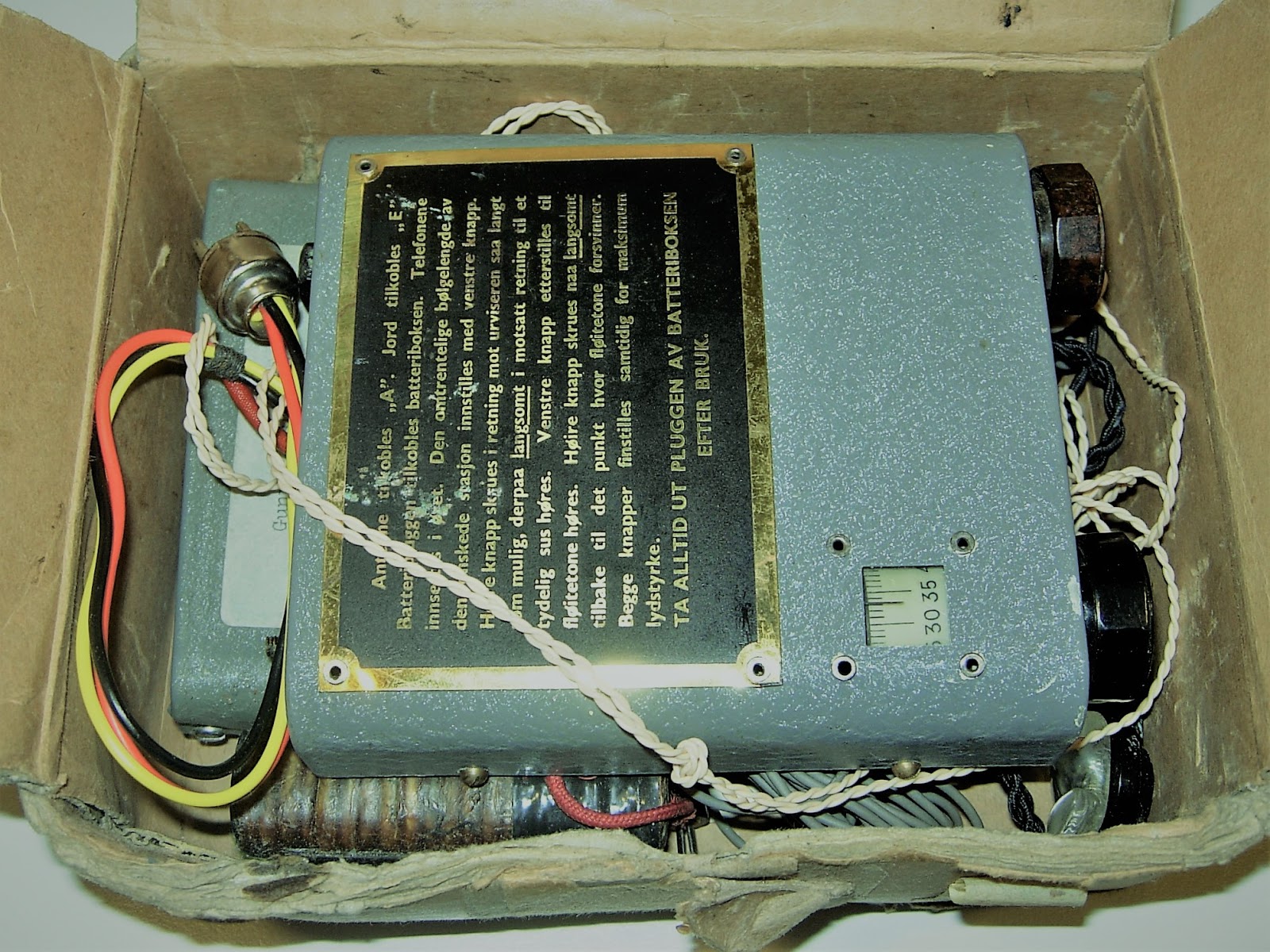
Another great aspect of SOE EQUIPMENT is that I learnt the official designation of the "Sweetheart" radio receiver. Well, according to the instruction sheet pictured in the book they were called Midget Receiver. I recently helped one from the OSS/SOE Sepals operation in Sweden 1944-45 get included into the collections of the Army Museum in Stockholm. Below is a photo of it I took while it was still owned by ex-Sepals helper Gunnar Isberg in Luleå.

Midget Receiver from the Sepals operation, now repaired and again working.