About Me

My photo
Author, film researcher and member of the Swedish Military History Commission.

Saturday, August 31, 2019

LRDG & SAS Traces On Rhodes

Mussolini´s castle in Rhodes is not the only reminder of WWII on the island.

Could there really be traces of the Long Range Desert Group (LRDG) and Special Air Service (SAS) on the island of Rhodes, not far from the old town? Yes there are such traces but you will not learn about them from most Rhodes guides.

The Palace of the Grand Master of the Knights of Rhodes is not just a Gothic castle inside the old town on Rhodes. During the Italian period on Rhodes (1912-1943) the castle was extensively restored and became a holiday residence first for the Italian king and later for Fascist dictator Benito Mussolini, whose name can actually still be seen on a wall by the castle entrance. That wall and the The Rhodes Jewish Museum would to many visitors seem to be the only traces of WWII on the island, but there is actually much, much more to see, especially if you venture outside the old town.

In this old blog post I presented my first tips where to look for traces of the Italian and German occupation periods. Some days ago I returned from our latest Rhodes holiday, during which I found rather intact WWII trenches and the ruins of an Italian WWII workshop, and visited two sites connected to the LRDG and SAS.

This is where a trooper of the LRDG rests, south of the old town on Rhodes.

Hector Mallett came from the NZ cavalry, but was killed while serving in the LRDG.

Why on earth is there a Long Range Desert Group trooper in the Commonwealth war cemetery on Rhodes? Surely there are no deserts on Rhodes? Well, let me first explain that after the North African campaign ended in May 1943 the LRDG became more like the SAS/SBS and was used mainly for raids/sabotage on various Mediterranean islands and in Italy and Yugoslavia. New Zealand LRDG Trooper Hector Mallett died from wounds he sustained during an assault against the Germans on the small island of Levita (now Levitha), more than 100 kilometers from Rhodes. The cemetery is not only for those who lost their lives on Rhodes but also on many other islands in the region, some quite isolated. The Rhodes cemetery is located in the southern outskirts of the city of Rhodes, by the old coastal road to Lindos, opposite the Italian, Jewish and Turkish cemeteries.

After a long jog from our hotel, the joy of finding the Sacred Band/Squadron.

What about traces of the SAS then? Well, first find Mandraki Port. Just north of it stands a war memorial not far from the water, topped with a winged bronze figure representing Victory. It is located in Pl. Antinavarchou Perikli Ioannidi. One of the units specifically named on the memorial and also represented by its insignia is the Sacred Band (or Sacred Squadron). This Greek special forces unit was attached to the SAS from March 1942 and below is a close up of their insignia including the motto "Return Victorious or Dead" (in Greek), said to be the words with which Greek wives once saw their men off to battle.

The Sacred Band insignia in bronze was worn on the right breast of the uniform.

By conducting literally hundreds of island raids together with the SBS, the Sacred Band pinned down thousands of German troops on many islands, thus preventing them from reinforcing the German troops in Italy or France. There are two images of the Sacred Band in action on the war memorial, the better preserved one can be seen below.

Sacred Band soldier scaling some cliffs, depicted on the Rhodes war memorial.

In the modern Greek Army, the Sacred Band's traditions are carried on by the 1st Raider/Paratrooper Brigade, that sports both the band´s sword and the motto of the SAS "Who Dares Wins" in Greek: O Tolmon Nika. If you are a bit of a patch collector you might want to know that the below one was purchased in an army store a short walk from the memorial.

Greek 1st Raider/Paratrooper Brigade patch bought just north of the old town.

What about the WWII trenches and ruins of an Italian workshop that I also found? Well, I need some more input before blogging about them - but don't worry, I will eventually get that and then blog some more about Rhodes.

Tuesday, August 27, 2019

Greatest Normandy Books?

The book that has renewed my interest in the 1944 battle for Normandy.

If you are looking for the greatest books about Normandy 1944 I have some suggestions for you in this and several coming blog posts. Let us start in an unorthodox way with the German view.

There is an abundance of books that focus on the Allied side of this story. In The Germans in Normandy by Richard Hargreaves it is the other way around, and this in itself raises ones interest. Then I was also encouraged to read the book by some words from a fellow author and the Guild of Battlefield Guides (more about Normandy guides in future posts). But, before I venture into actually reviewing The Germans in Normandy I should mention that this 2019 paperback edition is not an entirely new book, as the first edition was published in 2006. Well, that having been said, this book should still rank as one of the best Normandy books.

Richard Hargreaves paints convincing portraits not only of the highest German officers involved. The quotes from them that he presents are both fascinating and in some cases even amusing. One gets the feeling that Hargreaves has correctly identified both the strengths and weaknesses of the German occupiers in northern France. He makes it very clear how much the Germans relied on foreign volunteer troops (many of whom were no true volunteers): “By the spring of 1944, one in six infantry battalions along the Atlantic Coast was composed of Osttruppen and [other] foreign volunteers […]”. In fact, as Hargreaves also points out, in some parts of France the ratio was even higher, so that in certain areas one in five “German” soldiers was not German at all.

The pre-battle conflict between Field Marshal Erwin Rommel and General Leo Geyr von Schweppenburg is amazing to follow and perhaps that row even caused the world famous “longest day” words from Rommel. What about the frontline soldiers then? Well, they are in the book too. Air power enthusiasts also do not have to worry – this book does not just cover the Heer and Waffen-SS but also Luftwaffe aspects.

How were the catastrophic German defeats in Normandy communicated to the German population? Richard Hargreaves shows how the main newspaper of the national socialist party at first rather convincingly “balanced” the defeats with colourful descriptions of the first V1 (flying bomb) strikes against London.

Hargreaves does not end his book with just the final shots in Normandy, but also gives an idea of what the cleaning up there entailed.

You might be tired of Normandy books – but even if you are I reckon you will appreciate The Germans in Normandy. It certainly renewed my interest in that beautiful and once very bloody part of France.

Tuesday, August 13, 2019

Building SAS & LRDG Jeeps

64 large format pages of Jeep history by car designer and restorer Lance Cole.

Many books have been made about the first, now iconic, Second World War Jeeps. So why one more? Well, this is a Jeep book with a difference, being specially focused on modelmakers and military vehicle restorers - and not least those with a special interest for SAS and LRDG Jeeps.

Being a co-author of The Long Range Desert Group: History & Legacy my interest in LRDG & SAS Jeeps is pretty strong. I was therefore pleasantly surprised to see a SAS European Theatre of Operations Jeep as the main illustration on the cover of the new Pen & Sword Land Craft series book The Jeep by car designer, author, journalist, restorer etc Lance Cole. The scale model focus of the series (like in the Tank Craft series) is apparent from the SAS Jeep on the cover, as it is a model. But photographs of actual vehicles and color line drawings are also very much part of the book. I would say that even if you are not at all into models and rather describe yourself as a restorer and/or reenactor, you will find this book to be both helpful and simply a pleasant read and good source.

Basically, this book contains the essential development and design history, describes the lovely details of wartime Jeeps, many variants and, of course, the services they provided on various WWII battlefields. Lance Cole delivers both excellent text and many photographs of actual Jeeps and model Jeeps. Modern military vehicle designers would do well by studying the small, very clever touches of the original Jeeps.

The scale models of SAS Jeeps are well covered, both the Jeeps used in North Africa and in the ETO. The book has only one wartime SAS Jeep photo - the most classic one there is. But the many excellent colour photos of SAS Jeep models made me forgive that. The LRDG part is just one page of line drawings, but on the other hand the four page SAS in North Africa showcase features two wonderful LRDG figures that have replaced the original Tamiya SAS figures. The book informs exactly where these figures are from, and describes and shows just about every 1:24, 1:35, 1:72 and 1:76 scale Jeep kit ever made by various manufacturers around the world. The mostly stunning photos show lots of details, scale model modifications (improvements) and in some cases the models have figures and diorama bases.

Not every aspect of this vast subject is covered in the 64 pages and one hopes that Lance Cole might one day produce a second volume with e.g. Red Army Jeeps, captured Jeeps, unpublished wartime photos of SAS & LRDG Jeeps etc. But, let me be clear, this first Land Craft series book is both a very useful and beautiful guide for Jeep lovers and especially those into scale models of this superb little green machine.

Saturday, July 27, 2019

The Great Escape With Many Nordic Details

Only now, 73 years after the Norwegian release, this book can be read in English.

While The True Story of the Great Escape tells the story of all those that took part in the action that became the hit movie "The Great Escape", this new book is the personal account of Jens Müller, one of the only three men who made it all the way to freedom - in his case freedom was in Gothenburg, Sweden.

Jens Müller had no ordinary Norwegian childhood but a very exotic one, and was thus perhaps destined for an unusual fate during WWII. He was born in Shanghai, China, the son of a Norwegian engineer and a British actress. Müller got a pilot's license while he was still a teenager and was studying in Switzerland when the war broke out. In May 1940 he arrived in England (he should have written more about his motives but with a British mother he had at least one extra motive) and two years later he was an officer in 331 (Norwegian) Squadron at North Weald in England. On 19 June 1942 his Spitfire was shot down by a Focke-Wulf Fw 190. He survived landing in the sea and managed to paddle ashore in Belgium but was soon caught.

Müller´s work for what became known as the "great escape" consisted not least in constructing an air pump for ventilation of the escape tunnel. I do not wish to spoil your reading experience but think I can remark that Jens Müller mostly was treated well by the Germans and initially had no problems escaping. But, just like in many thrillers, he did indeed encounter some tight spots before finding some friendly Swedish sailors. Then two very bad things happen...

The reasons why Jens Müller´s escape was ultimately successful are quite clear from his book. Luck, or whatever it is, always plays a role - but Müller´s home run was perhaps mainly the result of [SPOILER ALERT!] superb intelligence work, amazing planning, some very convincing forged papers and finally some really good nerves.

The Swedish sailors that made the final leg of the escape possible are described rather well, but sadly without their names. They were supposed to get rewards from British authorities, but it is not clear if they got them, nor what their reward was. Does anyone reading this know more about rewards for helpers?

Film buffs will appreciate that this book makes clear how the actual escape differed from the famous movie. This first English language edition of Müller's memoir includes several very good comments by Norwegian historian Asgeir Ueland as well as a preface by Jens Müller's son Jon.

Friday, July 26, 2019

Nordic Counter-Terrorist Units

Winged dagger patch for Reinforced Regional Task Force of the Swedish Police.

The new edition of my book Elitförband i Norden (Swedish for Nordic Elite Units) will be released in the book stores in a few months. As it does not cover police forces (as stated in the book´s introduction), I am here posting an overview of these units and am at the same time reviewing European Counter-Terrorist Units 1972-2017.

As I promised in my review of Fighting the War on Terror, I shall now review a book focused on the equipment and insignia of Europe´s specialists in striking against various terrorists. The book in question is an Osprey guide first released in 2017, entitled European Counter-Terrorist Units 1972-2017, written by Leigh Neville and illustrated by Adam Hook. While I am no expert in police matters I can still say that I perceive this book as very useful for anyone interested in how these units look and are equipped. It also gives an idea of their training, tactics and techniques.

The book first provides a picture of how terrorism has evolved since the 1972 milestone terrorist attack in Munich. The main change since the 1970s and 80s: ransoms and political demands have been more and more replaced by a simpler desire for mass casualties, often combined with "martyrdom" for the terrorists themselves. A major technology change within the European counter-terrorist (CT) units is the emergence of new CT tools like unmanned aerial vehicles (UAVs) and unmanned ground vehicles (UAGs). Another equipment development is how many more weapons CT units now can choose from, not only from Germany (mainly Heckler & Koch) but also from countries like Russia. An example: French RAID teams use Russian Vepr-12 shotguns (looks basically like a Kalashnikov assault rifle) and Adam Hook has made a superb illustration showing a RAID operator wielding one of these.

While I reckon Leigh Neville has done a great job covering the largest European CT units, he has fewer words and no illustrations for the Nordic states. Still, he does provide sections about Nordic CT units: Denmark´s AKS; Finland´s Karhu (Bear Group) and Norway´s Delta. Sadly, there is no section about Sweden´s NI but the unit is mentioned in the section about the ATLAS network, as NI is a member of ATLAS. Well then, what more is nice to know about Swedish CT capability? NI stands for Nationella insatsstyrkan and simply means National Task Force. It is a unit primarily for CT and within the National Operations Department. However, NI is not the only special ops/SWAT unit of the Swedish Police. There are two more levels, first the Förstärkt regional insatsstyrka (FRI), meaning Reinforced Regional Task Force, and finally "just" regional task forces (i.e. not reinforced).

European Counter-Terrorist Units 1972-2017 is, like most Osprey guides, a very useful and concise guide, but has too little info about Swedish units.

Thursday, July 25, 2019

Swedish Intervention In Norway

Not just about Swedish humanitarian efforts during the final year of WWII.

Although the focus of Escape from the Third Reich by Sune Persson is the one indicated by the subtitle, Folke Bernadotte and the White Buses, a rather substantial amount of the book deals with the plans for Swedish military intervention in Norway 1945.

The original Swedish title of this book, Vi åker till Sverige: de vita bussarna 1945, first published in 2002, also did not quite capture how rich this book is. Sune Persson´s book is simply put one of the most important ones for any student of the Nordic states during WWII, along with John Gilmour´s Sweden, the Swastika and Stalin. Why do I say so? Well, aside from providing a convincing account of Count Folke Bernadotte´s "salami-slice strategy" during his negotiations with SS leader Heinrich Himmler, and the resulting transports to Sweden of many thousand prisoners of the SS, this book has a chapter entitled "Operation Rescue Norway!". In it you will find both the so-called "police troops", in effect an Allied infantry division established from 1943 on Swedish soil, and the more than 6,400 Swedes who 1944-45 enlisted in what became the "Swedish Norway battalion". Persson explains how the "police troops" were used, first in Arctic Norway thanks to US transportation aircraft, and why the Swedish volunteers were not allowed by the Norwegian government to participate in Norway´s liberation. This in spite of that, to quote from Person´s book: "...General Eisenhower was of the opinion that the Germans would put up organised resistance in Norway [and] that Norway could be reached effectively only through Sweden...". Persson also writes about the plans to use the regular Swedish Armed Forces in a joint western Allies & Sweden attack on the Germans in Norway. Thus an operation without the Soviets.

This English edition of Sune Persson´s book (translated by Graham Long) has an addition to the Swedish edition, a short but important introduction to English readers, written by Brian Urquhart. The number of photographs is not large, fifteen, but they are well chosen.

Friday, July 19, 2019

Narvik History Hiking Again

Ropes and an old stair (!) to get to the higher Gebirgsjäger Narvik positions.

This year some friends and I decided to look closer at an area that Mikke and I only had started to explore four years ago. Well, the Narvik mountains again delivered some amazing discoveries plus beautiful scenery and weather.

First a warning, to make sure everyone knows the risks. Even if you do find the odd rope or stairs, please understand that these mountains have almost no signs and well marked paths. If there has been some rain recently there will also be plenty of slippery hard surfaces. The military history that is still to be found in the area is not to be removed and if anything looks like ammunition or some other sort of explosive - then it probably is and should not be touched. Remember that people still today are hurt and even killed by explosive remnants from wars that took place a hundred years ago. In other words, hiking in the Narvik area without a special guide requires that you have common sense, good health, some experience of Nordic hiking, good equipment, navigational skills and maps. To be very clear, hiking in the wilderness without a guide can be dangerous and I take no responsibility for others wishing to do something similar.

One of the first German resting positions we found, click on it for larger size.

Almost as soon as we got up on the "upper level" of the mountain we chose to explore, Mats made a great discovery - directly linking us to both the daily life of the German mountain troops and to highest command level. What he found is actually so strange that I will save that episode for a coming book. Moving away from the area where many other hikers had been before us, I almost treaded on the remains of a German stick (hand) grenade. To be precise, a model 1924 Stielhandgranate (M24). As you can see from the below image it is in pieces but still recognizable. Photographed it just like we found it, and left everything. I only take photos.

This German M24 stick hand grenade is being absorbed by nature.

Not far from that grenade we made the next find, a position with a really good view down a slope. It was probably abandoned for some serious reason. Still today it contains plenty of unspent German standard rifle ammo. One does not leave so much ammunition voluntarily, so presumably the owner was wounded, killed or in a hurry away from the position.

German rifle ammo, left in a position with a view to the base of the "path".

Next, I noticed a natural place for storing stuff. I stopped and carefully looked inside. Two more M24 stick hand grenades with some rifle ammo. As these were all unused I did not even step close, but rather took my photos a bit away. You can't be too careful.

Soon 80 years since a German mountain trooper left these M24s behind.

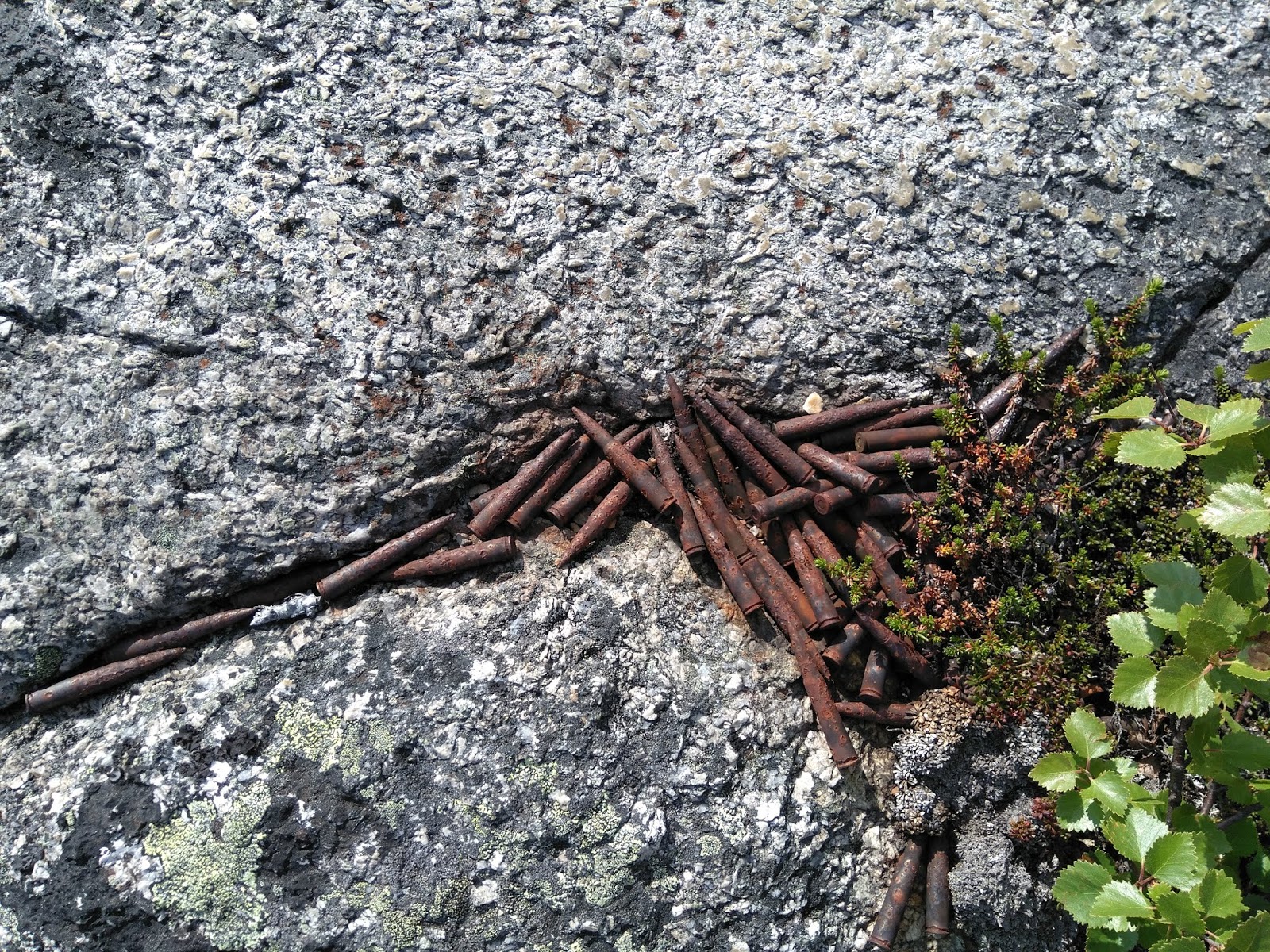
The final day up in the mountains we found mainly empty positions but also two big concentrations of German ammunition, one very obviously was where a MG 34 machine gun had once stood. Notice in the below photograph the rust on the rock surface. Bear in mind that most of the year this and everything else you see up there is mostly covered by snow.

Due to the battle year, the calibre (7.92×57mm) and links one can deduce: MG 34.

Finally, if some of you are wondering about what I am wearing in the first photo (thanks for taking it, Mikke), it is a British 1942 pattern windproof smock. I have an original smock of this type, from a trade I made some thirty years ago. But I no longer wish to use that piece of history on hikes, so this new replica I got from SMB is both a good stand-in and a very practical garment on warm hiking days. What about the thing I am holding on to then? Well, that is a case for my Swiss Army binoculars - a brilliant piece of kit to really examine landscapes.