About Me

- Lars Gyllenhaal
- Author, film researcher and member of the Swedish Military History Commission.
Showing posts with label reenactment. Show all posts
Showing posts with label reenactment. Show all posts
Monday, March 31, 2014
Pre-enacting Pro-Russian Partisan War
This slick video of a future pro-Russian partisan hero in Ukraine has so far had over half a million views.
As has just been pointed out by Ukrainians on Twitter, Russia is now more or less demanding that Ukraine becomes the opposite of what Russia is. Will this lead to something like the scenario in the above clip?
The Russian state is a centralized state with weak minority rights and no secession rights - not even the republics within Russia have the possibility to hold a referendum like the one that was just held in Crimea with a little help from some "polite people in camouflage" or "martians" now known also in Russia as the Russian Armed Forces. However, Russia now wants Ukraine to become the opposite of what Russia is, i.e. Ukraine ought to be a decentralized state with strong minority rights and secession rights.
There are many details in the above partisan clip that merit comment. It was released on Youtube on March 4 and has soon had 600,000 views. It is striking not only for the most professional production but also many military and political details. The music is Cuban (celebrating Fidel Castro) and the setting Cold War Two, but what the story is about is rather a sort of continuation of World War Two in the near future, when there exists a pro-Russian "Donetsk Republic", as indicated by the passport of the die-hard partisan fighter. The title of the neat mini-film in English would be something like "They Came In Vain". "They" of course being Ukrainian fascists.
As far as I know, no western media has so far discussed "They Came In Vain", nor its predecessor, last year´s Youtube-hit about a civil war in Ukraine in 2015, that was actually produced in early 2012!
I would like to see comments re. the many details in "They Came In Vain" and links to relevant articles. I have already found some in Russian (on Fontanka and KP) but would very much like to read more thoughts.

Friday, December 14, 2012
1945 Reenactment in Ukraine
I have never seen reenactment photos like these before, especially the last ones.
Ukrainian and Russian reenactors are obviously not only into reenacting Stalingrad and Kursk. The theme of the above reenactment earlier this year was Graz, Austria, 1945. This enabled not only reenactors in Soviet and German kit to participate but also in US and British uniforms.
I had never thought there would be so many US Airborne and British Army reenactors in Ukraine and Russia. Note that one of the "Wiking" reenactors has a Norwegian arm shield.
Ukrainian and Russian reenactors are obviously not only into reenacting Stalingrad and Kursk. The theme of the above reenactment earlier this year was Graz, Austria, 1945. This enabled not only reenactors in Soviet and German kit to participate but also in US and British uniforms.
I had never thought there would be so many US Airborne and British Army reenactors in Ukraine and Russia. Note that one of the "Wiking" reenactors has a Norwegian arm shield.
Sunday, September 30, 2012
Mountain Warfare Flame Thrower
A flaming hot alpine WWI reenactment produced just some weeks ago.
Being especially interested of war in the Nordic area I have grown interested of mountain warfare in general and therefore I cordially recommend this new video from the alps.
What an extravagant Monte Grappa reenenactment, with flame thrower and all. I have personally found some WWII German flame throwers up here in the Arctic that looked almost the same. I have some photos of my finds somewhere. If memory serves me right I found them on Kola and by Kirkenes. Have also seen some on the Narvik front and in the Lyngen line? Not sure about the latter, I am starting to mix up my trips!
Thanks for the tip, Klemen!
Being especially interested of war in the Nordic area I have grown interested of mountain warfare in general and therefore I cordially recommend this new video from the alps.
What an extravagant Monte Grappa reenenactment, with flame thrower and all. I have personally found some WWII German flame throwers up here in the Arctic that looked almost the same. I have some photos of my finds somewhere. If memory serves me right I found them on Kola and by Kirkenes. Have also seen some on the Narvik front and in the Lyngen line? Not sure about the latter, I am starting to mix up my trips!
Thanks for the tip, Klemen!
Tuesday, September 06, 2011
Back to 1631 and 1991
 Visiting the Breitenfeld battlefield on September 7, 1991, 360 years after Sweden's perhaps most important battle.
 When I walked the Breitenfeld battlefield, tomorrow exactly 20 years ago, it was less than a year since it had been in the state known as East Germany (GDR). This year my thoughts often go back to that trip and my experiences in Moscow also during that year.
I believe it was my paternal grandfather who told me about the role that the first Gyllenhaal, the cavalry Lieutenant Nils Haal, played during the battle of Breitenfeld on September 7, 1631. What he told me astounded me and probably explains some of my interest in wars. Unfortunately I have since not been able to locate written sources that match my memory of what I heard, or think I heard.
We do know though, from 17th century records, that Nils Haal was there, on that field, on that day, and performed well. But exactly what he did I do not yet know for sure.
Many will this week, understandably, be looking back at September 11, 2001. As for me, for some reason I thought more about that day at the start of this year.
I am now more often contemplating what I experienced in 1991, above all the last year of the Soviet Union as a student in Moscow. The most vital part in that was getting to know my future wife Ann-Sofie, another Swedish student there. The no doubt most weird part was finding these two destroyed armoured vehicles on the same street where president Mikhail Gorbachev lived, Kosygin Street.
 A destroyed Soviet BMP and T-54 not far (200 metres?) from president Gorbachev's official residence.
To this day I have found no explanation for the presence of these destroyed military vehicles. Their hatches were open and kids were playing in and around them while we were there, as they were actually standing right beside a school. I reckon they may have been standing just a couple of hundred metres from the Soviet president's residence. If you saw these wrecks in Moscow 1991, or know anything about their story, I'd be very much indebted for your comments.
 To be on the safe side, I made peace with Peter the Great before leaving Moscow. The gentleman dressed up as Peter was (is?) probably Russia's greatest (not tallest) reenactor of the era of Peter the Great.
Thursday, July 14, 2011
"Band of Bruders"?!
In "Band of Brothers," there is a scene where one of the paratroopers is passing a group of German POW's and shouts to them "Where are you from boys?!" And one of the POW's responds in perfect English "I'm from Eugene, Oregon." What the...what's an American doing in the German Army?
Well, guess what, a fan of the famous TV series has made a small but impressive film about one of the Americans in the German Army: Fred Treiber (1922-2008). The name of the production is "Project Edelweiss". May I humbly suggest another name, half in jest: "Band of Bruders" ;-)
Fred Treiber was assigned to the Gebirgsjägers (mountain troops) and ended up fighting in the Caucasus. But the above scenes take place during a Gebirgsjäger training climb in the alps.
I don't understand if there is more coming, I would like to know more about Mr. Treiber, like if he returned to the US after the war and if he during the war perhaps also served in Scandinavia? Here is a longer version of the film and here a slide show of the same hike. Still, I hope a yet longer one with more info about Mr. Treiber will be made. Perhaps the film's director, Patrick Kiser, might read this and could inform some more? Well done, Mr. Kiser, hope to see some more films from your camera.
As I have stated earlier, these kind of films both impress me and make me a bit worried, not least as they are getting so similar to the wartime newsreels that some viewers, especially in the future, may take them for the real thing, clips from the German Wochenschau.
Monday, May 23, 2011
Nord Training In Oulu
The Finnish reenactors behind this new Wochenschau have put a lot of effort into the production.
A previously unknown German news reel from the Arctic? Well, at least a rather good attempt to create one in 2011.
The depicted area is Finnish Oulu, not very far from where I live and where the "Nord" mountain division of the Waffen-SS trained.
The production has a few flaws that give it away as a fake Wochenschau, but quite possibly younger people watching this, especially in the future, may believe it is the real thing. I find this somewhat alarming, but in this case I would say the aim has just been to create a short film Wochenschau-style for historical and human interest in the depicted soldiers, and in filmmaking itself.
I took part in similar reenactments in the 1980s portraying a British tanker. Here I am, to the right, with a "captured" Tiger tank in France:
 "British" tankers with a "captured" Tiger in Vimoutiers, Normandy. Not back in 1944 though, but 1985 or ´86
Part of the key to successful faking is using a period camera with period-type film. If memory serves me right I used a 1940s "box camera" (large format negatives) for the above image.
Today I lack both the time and devotion for reenacting, but find it interesting to once in a while check out the reenactment scene via the internet.
I would say the above Finnish-made video from Youtube would have been perfect had the editing been more drastic and the speech faster and more distinct. Some moments are perfect, impossible to tell from the real thing. Which, again, makes me somewhat concerned about the whole thing. I guess I have mixed feelings nowadays, while 20 years ago I would have been mostly enthusiastic.
Monday, August 16, 2010
Confederates in the Arctic
Reenacting the American Civil War is something that is done not only in the United States but also in distant places like Sweden. However, modern Swedes dressed up as Yankees and Rebels is actually not that strange. In fact, just about normal.
I came to this conclusion while writing the passage in Swedes at War about Swedish volunteers and Swedish Americans who fought for the North or South.

Reenacting at Western Farm in Boden, Sweden. Boden is just below the Arctic Circle. I took the photo some week ago.
For some reason, the Swedish contribution to the American Civil War that is best known in Sweden is probably the USS Monitor, the first US Navy ironclad, designed by the Swedish engineer John Ericsson. But in addition there were several thousand Swedish Americans (many of whom had been born in Sweden) who fought in blue or gray, plus some forty Swedish officers, sergeants, and cadets who left Sweden after the start of the war to join the military forces of the Northern States.
Yes, as far as I know, no Swedish officers joined the Confederates. One of the officers, Ernst von Vegesack, was was even awarded the Medal of Honor (for bravery in the Battle of Gaines´ Mill) and made a US brigadier general.
After having become an American military hero at Antietam and Gettysburg, Ernst von Vegesack returned to Sweden and became chief of a military district. There were, by the way, also some amazing Swedish American Rebel officers.
Three of the Swedish officers who died for the United States are forever honored in Sweden, in the Military Academy Chapel in the Karlberg Castle, where they had completed their officer training.
This summer I got a very personal and moving book about the Civil War from two of my American relatives. I just finished reading it this morning and am really grateful it came into our home. The title is Confederates in the Attic and the contents are perfectly summarized in the Wikipedia-page about the book.
In several ways the book reminded me of one of my absolute non-fiction favourites, The Men Who Stare at Goats. Like the latter, Confederates is a splendid read and great fun, sometimes even hilarious. But quite often also serious, inspiring and never boring.
There are so many things I learnt from the book. One of the least important but most amusing things was the jargon among Civil War reenactors (farbs and hardcores etc) and how the reenacting thing started, with Civil War veterans portraying themselves, i.e. their younger selves, at reunions, then called "encampments". Veterans camped on former battlegrounds, donned their old uniforms and performed mock battles.
The reenacting part of the book brought back many memories as I myself was into this in the 1980s, as a teenager, inspired by British friends. But it was British soldiers we wanted to portray, during WWII. I guess we were hardcore as we almost only had original stuff and did our reenacting mostly where the events that moved us took place, in Normandy.
Of course, nothing is perfect, not even Confederates in the Attic (or my own books!). Judging from this British and this US article and not least this review, it still seems unclear if the sensationally vital Civil War veteran William Jasper Martin was a deserter or not. Please do comment about this as I´d really, really like to know.
BTW, while researching I read the Wikipedia page about Swedish Americans and was glad to see that our most famous American relative is now at the front of Swedish America. And I must confess I had no idea that Uma Thurman and Kim Basinger are Swedish Americans. Thurman is huge in my former homeland Russia, there is even a Russian pop song about her.
I came to this conclusion while writing the passage in Swedes at War about Swedish volunteers and Swedish Americans who fought for the North or South.

Reenacting at Western Farm in Boden, Sweden. Boden is just below the Arctic Circle. I took the photo some week ago.
For some reason, the Swedish contribution to the American Civil War that is best known in Sweden is probably the USS Monitor, the first US Navy ironclad, designed by the Swedish engineer John Ericsson. But in addition there were several thousand Swedish Americans (many of whom had been born in Sweden) who fought in blue or gray, plus some forty Swedish officers, sergeants, and cadets who left Sweden after the start of the war to join the military forces of the Northern States.
Yes, as far as I know, no Swedish officers joined the Confederates. One of the officers, Ernst von Vegesack, was was even awarded the Medal of Honor (for bravery in the Battle of Gaines´ Mill) and made a US brigadier general.
After having become an American military hero at Antietam and Gettysburg, Ernst von Vegesack returned to Sweden and became chief of a military district. There were, by the way, also some amazing Swedish American Rebel officers.
Three of the Swedish officers who died for the United States are forever honored in Sweden, in the Military Academy Chapel in the Karlberg Castle, where they had completed their officer training.
This summer I got a very personal and moving book about the Civil War from two of my American relatives. I just finished reading it this morning and am really grateful it came into our home. The title is Confederates in the Attic and the contents are perfectly summarized in the Wikipedia-page about the book.
In several ways the book reminded me of one of my absolute non-fiction favourites, The Men Who Stare at Goats. Like the latter, Confederates is a splendid read and great fun, sometimes even hilarious. But quite often also serious, inspiring and never boring.
There are so many things I learnt from the book. One of the least important but most amusing things was the jargon among Civil War reenactors (farbs and hardcores etc) and how the reenacting thing started, with Civil War veterans portraying themselves, i.e. their younger selves, at reunions, then called "encampments". Veterans camped on former battlegrounds, donned their old uniforms and performed mock battles.
The reenacting part of the book brought back many memories as I myself was into this in the 1980s, as a teenager, inspired by British friends. But it was British soldiers we wanted to portray, during WWII. I guess we were hardcore as we almost only had original stuff and did our reenacting mostly where the events that moved us took place, in Normandy.
Of course, nothing is perfect, not even Confederates in the Attic (or my own books!). Judging from this British and this US article and not least this review, it still seems unclear if the sensationally vital Civil War veteran William Jasper Martin was a deserter or not. Please do comment about this as I´d really, really like to know.
BTW, while researching I read the Wikipedia page about Swedish Americans and was glad to see that our most famous American relative is now at the front of Swedish America. And I must confess I had no idea that Uma Thurman and Kim Basinger are Swedish Americans. Thurman is huge in my former homeland Russia, there is even a Russian pop song about her.
Tuesday, June 01, 2010
Narvik Veterans - a Tough Breed Indeed
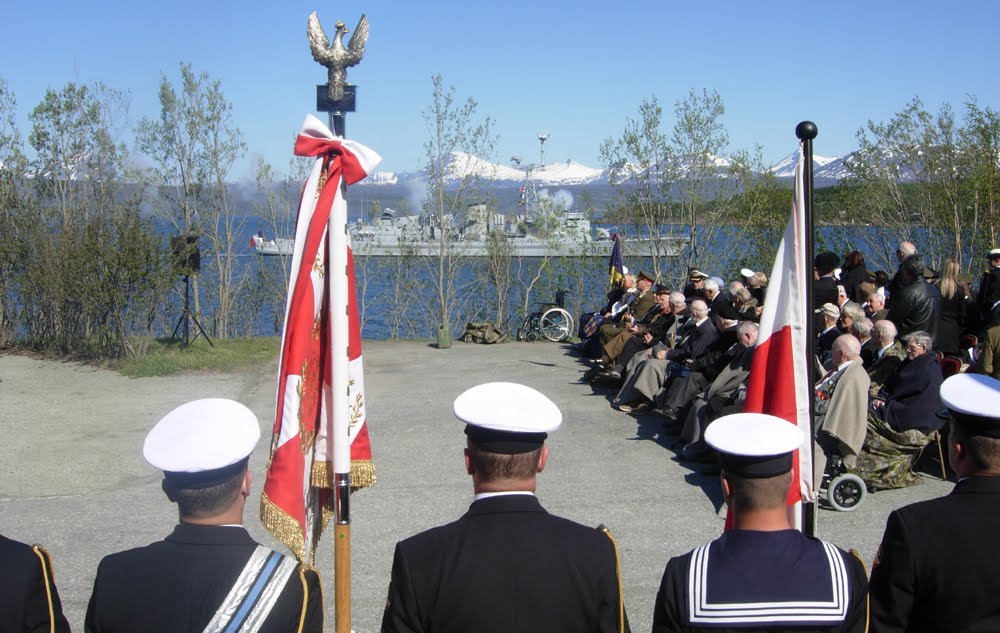
Never before have I met so many impressive and fit 90-year-olds, as I did this weekend in Narvik during the 70th anniversary of the liberation of Narvik (May 28). Narvik was in its best mood and also greeted modern soldiers from five nations including Germany.
In the town of Narvik summer had just arrived. Just a bit up into the mountains it was still late winter.
A Twenty-one gun salute was fired from a French frigate in the morning in honour of the attending veterans and other guests. After this, Norwegian F-16s and British Tornado fighters made some spectacular fly pasts above the crowd. Bands played. ambassadors - including Germany´s - held eloquent speeches and wreaths were layed on monuments and graves.
Most veterans seemed to be from Poland and Norway but there were at least three French alpine ranger veterans attending. Several veterans wore military berets and two Polish veterans wore complete uniforms. Here is one of them (click on the images if you wish to see them in larger size):

No German veterans were sighted but they were remembered too and there were modern German officers attending. The German flag was prominent in the parade that went from the common war cemetery to the main town square.
 Note the third flag from the front, in front of the French flag. A bit surprising, I must say.
Edelweiss insignia was present, but not on German uniforms. It so happens that the Polish mountain infantry have the same symbol on their collars and right arm.
 Greeting the Poles is Norway´s Chief of Defence, General Harald Sunde. And yes, that is a German officer to the right of him.
The main hosts of the ceremonies were General Sunde and Narvik´s town mayor Karen Margrethe Kuvaas, standing side by side in the following photo:

For me, personally, the most amazing veteran attending was Jan Danielsen, the last living Swedish veteran of Narvik. Danielsen was a Swedish cavalry officer when he in late 1939 volunteered for Finland and served in the "Winter War". This could be done with the approval and finally also support of the Swedish government. After Germany on April 9 1940 invaded Norway the Swedish government did not even approve of the formation of a volunteer corps for Norway. Still, Jan Danielsen and some 300 other Swedish citizens crossed the border with Norway to volunteer. Perhaps half of them saw combat. Twelve of the latter at Narvik.
Jan Danielsen was effectively given command of a Norwegian platoon in the high altitude fighting. His closest friend, from the same Swedish cavalry regiment, was killed in action. Still, he led his men onwards. That he and his men did not advance all the way into Bjoernfjell was no fault of Danielsen´s but of the larger strategy.
The following photo shows Jan Danielsen, wearing one of his Norwegian medals and his Finnish Winter War medal, together with local 1940 reenactor Jon K. Johnsen:
 Johnsen is wearing the very same type of uniform that Danielsen wore in 1940.
 There were more reenactors in the main town square, displaying WWII uniforms together with WWII military vehicles such as this British Humber scout car:
 The Bren gunner is the former director of the Troms Defence Museum, Finn Fossum. Behind the Humber a M29C Weasel tracked vehicle can be seen.
Here is another reenactor, showing what the British airborne looked like:
 Behind him a magnificent Dodge ambulance can be seen.
The Troms Defence Museum in Setermoen also displayed some postwar vehicles, like this tank-busting Norwegian Willys Jeep:

I will be writing more about the events of the day and individual Narvik veterans in two coming articles. The above photos are not the best ones I took. Hopefully the articles will later be online and I will then post links to them.
Finally just a photo to show you the view from our dinner table on May 28:

Sitting by the Rombak fjord is my good friend and travelling companion Mikael Norman. After dinner we followed the route of the Allied invasion force up into the mountains. Of course, we found several traces of the events exactly 70 years ago, thanks largely to local WWII historian Öyvind Johnsen, who has just released a very good battlefield guide. More about those traces in the coming articles.
Subscribe to:
Posts (Atom)