About Me

My photo
Author, film researcher and member of the Swedish Military History Commission.
Showing posts with label New Zealand. Show all posts

Wednesday, December 09, 2020

The LRDG In Action 1940-1943


This book is different from most books about the Long Range Desert Group (LRDG) as it contains a great deal of rare or never before published photographs. It includes a lot of details of special interest to military vehicle buffs, special forces insignia collectors and scale modelers.


The New Zealander and LRDG buff Brendan O´Carroll has made this book in the series “Images of War” truly stand out. To start with, most books in this series are thinner. This one is 215 pages long and largely photographs but also some really good text. Sure, it does contain some photos I have seen before – but as Mr. O´Carroll is a true expert who knows how to write informative captions he has added new value to those photos. 


The many images in The Long Range Desert Group In Action 1940-1943 were taken both by official photographers and the LRDG men themselves, many come from private photo albums, drawers etc. The quality of the photos from personal cameras is not seldom poor (some have been enhanced), but this can both be forgiven, as they can still reveal a lot, and be explained – the films were often developed in Cairo photo shops with unclean water. The resulting images thus could show not only specks of dust but also hairs and parts of insects. Still, there are also plenty of photos in Brendan O´Carroll´s new book that are clear and sharp. Being Swedish I was particularly happy to find a new and crisp photo of a Bofors (made in Sweden) mounted on an LRDG Ford.


Uniforms and insignia of patrolmen are featured in some superb photographs I have never seen before. LRDG members could certainly look very strange and exotic! 


Several images ought to constitute strong inspiration for dioramas, and some of these also feature non-LRDG vehicles and I here have to make special mention of an Afrika Korps Panzerfunkwagen and a Marmon Herrington armoured car of the King´s Dragoon Guards. Simply stunning photos.


Those of you who have read the LRDG book I wrote with Karl-Gunnar Norén may recall the story of Nick Wilder, the LRDG captain who performed a miracle for Montgomery nor far from Tataouine, the town that later became Tatooine in the Star Wars films. Well, sadly we could not locate any good enough photos of Captain Wilder. But Brendan O´Carroll has succeeded in finding some photos of Wilder in preparation for the attack on the Barce airfield. It is just incredible to see these photos.    


You might think that the book ends with the LRDG operations in Tunisia – but this it does not! Instead, it follows the desert veterans to their next assignment as part of the Raiding Forces, Middle East, made up of around 200 LRDG patrolmen and 150 men of the Special Boat Squadron (SBS) and No. 30 Commando. In other words the book ends with some photos from Greek Islands. As soon as I saw them I started thinking about visiting these islands in a year or two. The vaccinations have started folks, so let us start planning to visit LRDG sites again – yet another reason to purchase The Long Range Desert Group In Action 1940-1943.

Tuesday, July 21, 2020

Bren Gun Carrier

Contains 64 pages crammed with first class information and photographs.

Let me immediately confess that I have been wrong about the Bren Gun and Universal Carriers. For some reason I until recently thought it was a simple, dull type of vehicle. I have been VERY wrong.

Last year I reviewed a previous Land Craft series book about a more universally (forgive the pun) appreciated vehicle, the Jeep in SAS & LRDG service. Now it is time for Robert Jackson´s book about something of an armoured equivalent of the Jeep. Bren Gun and Universal Carriers did not only serve in every theatre of WWII, they were also produced in several countries. I had been aware of the Canadian Universal Carriers but have now, thanks to Jackson´s new book, learnt also of the US, Canadian and New Zealand Universals.

Carriers not only had machine guns, there were some with artillery and anti-tank weapons mounted on top - both in Allied and German service. Yes, the Germans used captured Universal Carriers, and that is how I came to develop an interest in them. The thing is that I last year discovered that German trains transported i.a. a Carrier from a Swedish railway station (Haparanda) to an unknown destination in Norway or Germany. The vehicle in question may have been captured at Dunkirk and then sent to serve with a German unit somewhere in Lapland. There definitely exist photos of Universal Carriers in German Arctic service, in Kari Kuusela´s book Panzers in Finland. Why at least one Carrier (there is only one in the photos) was transported by the Germans via Sweden is not known. While Robert Jackson´s new book has not solved this mystery it does have some photos and colour drawings of Universal Carriers in German service.

Especially scale modellers and MV buffs will appreciate Bren Gun Carrier - Britain´s Universal War Machine, because it contains the best photos I have ever seen of many different scale models of the type. Several of the scale models also carry all kinds of equipment and some are part of magnificent dioramas.

The combat performance of the Universal Carrier is not the main focus of this book - but it does provide examples of the type´s strengths and weaknesses. There are some surprising examples of actions with Carriers. While the section about Carriers in conflicts after 1945 is not long, it is certainly interesting. BTW I hope to rather soon visit a Carrier abandoned in an Arctic forest.

Tuesday, June 16, 2020

New LRDG Field Research Expedition

The issue includes two LRDG buff expeditions and some remarkable barn finds.

The times are strange and more trouble seems to be brewing. Still, there is some good news for fans of the early Long Range Desert Group (LRDG) and Special Air Service (SAS) - in the June 2020 issue of Classic Military Vehicle.

CMV has put together a very special LRDG 80th anniversary issue. It starts with a terrific and very visual summary by Toby Savage about the Egyptian LRDG field research trip featured in-depth in Karl-Gunnar Noréns and my book The Long Range Desert Group: History & Legacy, which is also shown in the article.

Very happy too see our book and the LRDG Preservation Society in CMV.

Toby brought along a kite on the trip and took aerial photographs with it and his article starts with a stunning example. The same CMV issue contains a complete surprise for me, an article by James Davis and Martin Spriggs about their Tunisia expedition in late 2019 to find LRDG patrol vehicles. While no complete vehicles were found, LRDG buffs will still find the article of interest and the finds they did make prove that there is more out there to be found. Good to learn about this and that the search in the area will continue.

I was chuffed to bits that CMV editor Andrew Stone was also able to do an interview with LRDG veteran Jack Mann, who was present at our book launch in London last year. Just before Stone was to meet the amazing Mann the pandemic changed everything. But IMHO the interview, mainly by telephone, turned out nicely and above all transmits some of Jack Mann´s remarkable attitude. No wonder he later served with the SAS.

Another morale-boosting section of this CMV issue is the "Military Vehicle Market" that includes some really inspiring barn finds. If you too have a soft spot for the Daimler Dingo - well, then you will just love the issue´s Dingo story. Now, don´t tell me that you also appreciate the odd Panzer? Well, the June issue also has a great Jagdpanzer 38 article that of course also has a Swedish connection. If you have trouble finding CMV for sale where you live, you might consider getting a (digital) CMV subscription.

Wednesday, April 29, 2020

When The SAS Stormed An Embassy

The SAS operation "Nimrod" took place here in 1980. My photo from 2019.

30 April 2020 it is 40 years since the start of one of the most famous anti-terrorist operations ever. In the end, Special Air Service (SAS) operators saved all but one of the remaining hostages. Do watch the movie about the event, but bear in mind that it says very little about one lesson from the event - a lesson that we ought to be more aware of.

As a kid in the early 1980s I was favourably impressed by the abseiling SAS soldiers that hit the global news. But their appearance at the Iranian embassy in London was also a bit terrifying. Dressed largely in black, with their faces inside black respirators and wielding black submachine guns (Heckler & Koch MP5s), they looked rather sinister (Darth Vader-ish). Naturally, as soon as "6 Days" was released I was keen to see how a detailed reenactment of the event would look like. Well, it is not just about the 17 minute SAS assault, but about the whole Iranian embassy siege of 30 April to 5 May 1980. The siege situation is presented from three perspectives and it is quite moving to follow the negotiator Max Vernon (Mark Strong). But, being fond of books about the SAS, I was more interested in the SAS perspective, i.e. Rusty Firmin (Jamie Bell). "6 Days" made me wonder about some of his decisions and therefore I wanted to know more from the actual Rusty Firmin. Here is the book by him that I then got:

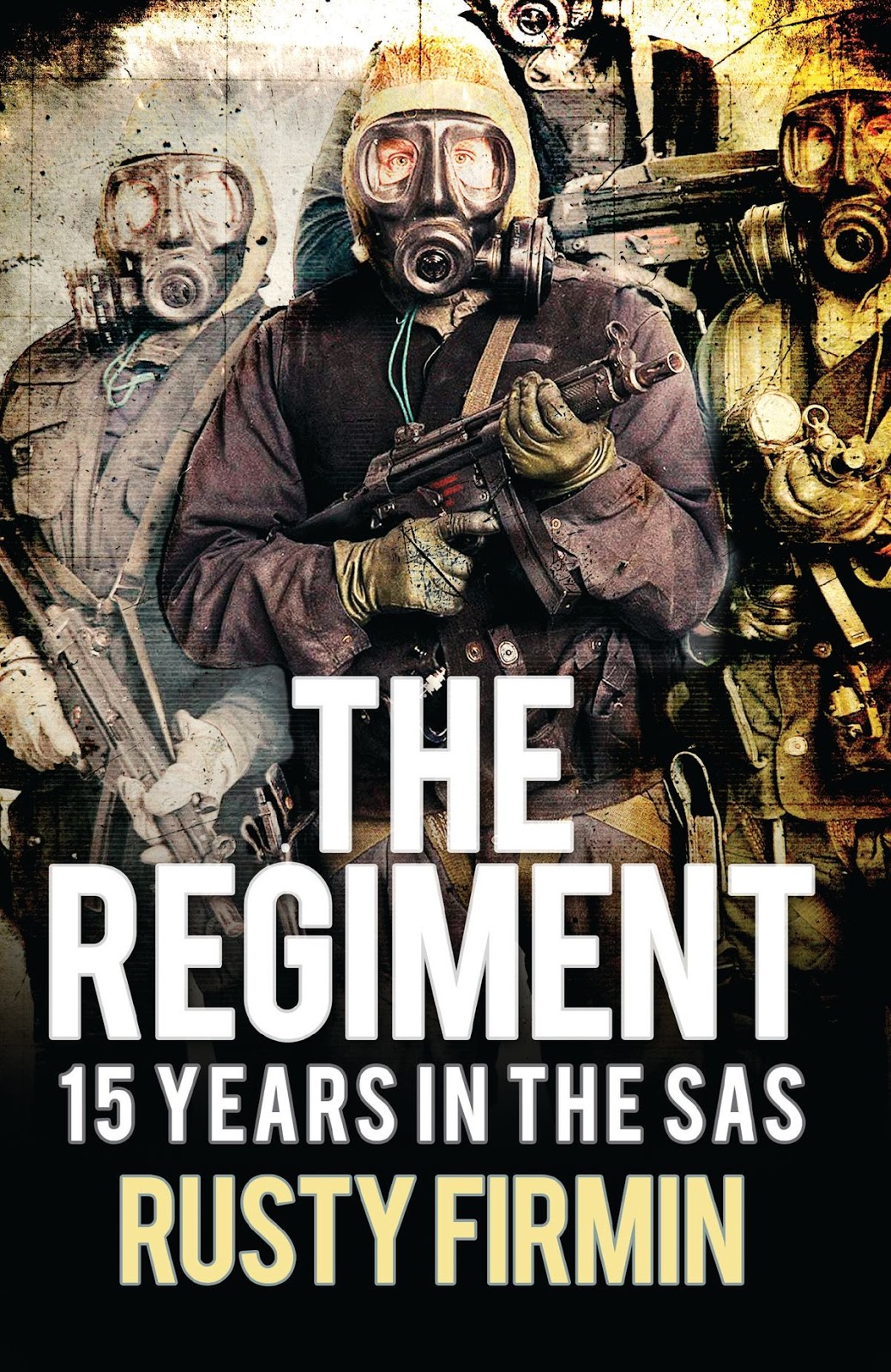
The book Rusty Firmin wrote about his career in the SAS. Some surprising insights.

Rusty Firmin´s The Regiment (2015) explains a key moment in the embassy that the movie "6 Days" portrays rather poorly, it seems to me. There is also the book focusing on the siege that Firmin wrote together with Will Pearson, entitled Go! Go! Go! (2011), and then there is e.g. Who Dares Wins (2009) by Gregory Fremont-Barnes. But hey, no book will probably affect the general public´s knowledge about the event as much as the movie "6 Days", which is why I decided to write this blog post. In spite of everything that I appreciate in "6 Days", there is one big thing the film makers could have done better. Who was behind the whole thing? Of course, the movie informs a bit about the terrorist group that took over the embassy, the Democratic Revolutionary Front for the Liberation of Arabistan. However, there was a state behind the group: Iraq. The Iraqi state under Saddam Hussein not only prepared, financed and supplied the terrorists (e.g. with Soviet RGD-5 hand grenades and Czechoslovak Skorpions). One of their Iraqi intelligence handlers had even taken them to London. In "6 Days" this is summarized too much, the relevant scene is so short that some may miss it.

So, what on the surface looked like the act of a terrorist group of Arabian separatists from Iran was more like an Iraqi strike against Iran. Byt why is this small proxy war in London forty years ago relevant for us in 2020? Well, there were several terrorist actions during the 1980s, in different countries, that still today are sometimes not portrayed as what they mostly were, war by proxy. That is a form of warfare that has made a comeback in recent years, and therefore we need to be able to identify and understand it. Iraq under Saddam was not the main culprit, usually it was one or more security/intelligence agencies from the Soviet bloc. But these quite often used terrorists, not least Arab terrorists. This modus operandi even affected my native Sweden, and it took many years for Swedes to start realizing this.

Seeing the Iranian embassy in London today is just like seeing it on 30 April 1980. It was seriously damaged at the end of the siege but has been nicely restored. It is easy to see the embassy yourself as it is in the heart of London. There are some other places connected to SAS history not far from the embassy and I will be writing about these in a London guide that I intend to release here in a month or so.