About Me

My photo
Author, film researcher and member of the Swedish Military History Commission.
Showing posts with label Cold War. Show all posts

Saturday, December 19, 2020

Finest Aviation Book I Have Seen


I have previously been impressed by Mikael Forslund´s work, but his latest book, about the American, British, German, Italian and SAAB bombers in the Swedish Air Force 1924-58, is so stunning it is doubtless the finest aviation book I have yet come across. But there is one annoying thing about it.

This superbly illustrated 296 page aircraft book in A4 format has a title that I find a bit misleading: Swedish Bomber Colours 1924-1958. Given the narrow focus of the title and the rather high price of the book I reckon more than a few aviation buffs will wonder if this book is really worth the money. Well, the camouflage and markings of the aircraft in question are certainly covered in the best possible way both by spectacular photographs, several in colour, and many exclusive colour profiles. But the thing is that this book provides so much background and detailed history about the aircraft types and their use that it is more of a bomber aircraft encyclopedia than just a book about paint and markings. In other words the book delivers more than the title promises. Of course, that is better than the other way around, but it may also make some people refrain from getting this book. Now, hopefully some of you who have doubts are reading these words.  

Here are the aircraft types featured in this book, first I list the Swedish Air Force designation and then the international name:

B 1 - FIAT BR
B 2 - FIAT BR 1
B 3 - Junkers Ju 86
B 4 - Hawker Hart
B 5 - Norhrop 8A-1
B 6 - Republic 2-PA Guardsman
B 7 - Fokker G.1 (not delivered but still featured on one page)
B 16A - Caproni Ca 313
B 17 - SAAB 17
B 18 - SAAB 18

Let me add that all variants are featured. Then there are the wonderful sections about Swedish bombers in foreign service, mainly Danish SAAB B 17 bombers in 1945 and the SAAB B 17s in Ethiopia. The Ethiopian photos and interview are incredible and I was very surprised to learn that two former Ethiopian B 17As in 2020 were being restored in Lithuania, of all places.

If you are into building scale models of Swedish bomber aircraft and want to find good photos and colour profiles this book will be like Eldorado for you. But again, this book is much more than a book for scale model enthusiasts, it will delight any Swedish Air Force buff and it also constitutes a great source for researchers and writers. Well done, Mr. Forslund, very well done!

Friday, October 30, 2020

The Most Amazing Tank Destroyer Ever


Which tank destroyer can be called the most effective? We could probably debate that forever. However, I find one tank destroyer a bit more fascinating than the rest. Not least because after 76 years it is still in service. There is now a brilliant book in English about it.


Both the Third Reich and the Soviet Union produced some larger and deadlier tank destroyers than the Soviet SU-100. But in the Red Army the SU-100 was the most powerful medium tank destroyer. At medium ranges it could take out both Panthers and Tigers, even King Tigers. So, why has not that much been written about the SU-100 in English? Well one reason is that it entered service only in the fall of 1944. Another being that you basically have to be Russian and work in Russia many years to produce a book like this. Well, half of the pair behind SU-100 Self-Propelled Gun is Nikolai Polikarpov, chief editor of M-Hobby, a Russian modelling magazine which has been in publication since 1993. I read several of the first issues and still have them. Mr. Polikarpov´s research is one reason this new book is a dream come true for Soviet era AFV modellers. But it is also rich in details for military vehicle buffs. There is no detail of the SU-100 that is not featured, also in splendid colour photographs. The other author of the book, James Kinnear, has brought with him long experience of writing on military subjects, e.g. for IHS Jane´s defence yearbooks and Osprey Vanguard. In addition, the Swedish publisher, Canfora, has done a splendid job presenting the work of the authors. 


The combat debut of the SU-100 took place in Hungary in the first days of 1945. Here one of the few problems with the vehicle instantly became obvious, it lacked secondary armament, i.e. machine guns. This of course meant that to defend the vehicle against German infantry the crew would largely have to rely on personal small arms (SMGs) and hand grenades. The passage about the German documents about SU-100 employment in Hungary is sobering, evidently both combatants misidentified each others AFVs. 


The pages about SU-100s in post-1945 service are amazing if one is also a Cold War history buff. In Soviet service the type was formally taken out of service in 1968. But that was not the end, as it then entered “strategic reserve storage” and was at least returned to some active service during the 1980s. The Soviet forces in Afghanistan used SU-100s to knock out resistance fortifications. 


There are amazing sections about the SU-100 in Czechoslovak and Cuban service. In 1961 both SU-100s and T-34-85s were in combat against the American sponsored landings on Cuba. The photos from Cuba should also inspire any Cold War modeler, a great deal.


Then there is the story of the SD-100 (Czech-made SU-100) on display in the UKs fabulous Tank Museum at Bovington. I had no idea that it is one of several SD-100s knocked out by British paras in Egypt during the 1956 Suez Crisis. In general, the info and photos about preserved SU-100s and SD-100s is one of my favourite parts of the book.


The most remarkable thing, in my view, is the fact that several SU-100 again entered combat in 2014, when several companies of SU-100s were employed in the Yemeni Civil War. Accordingly, the last of the excellent colour profiles in the book shows a SU-100 in 2017, captured by Houthi rebels from government forces. During the Yemeni Civil War a number of SU-100s have of course been destroyed, but in 2020 at least one SU-100 remained in operation.  


The photographs in the book showing the SU-100 in operational WWII service are not that many, but on the other hand they are mostly of very high quality. I am especially fascinated by the image from Berlin April 1945 with two officers in British or Polish uniforms – the perfect subject for a small diorama. 


This book is so new it even contains photographs from the 75thanniversary Victory Parade in Moscow 2020, when no less than seven working SU-100s paraded across Red Square. SU-100 Self-Propelled Gun is the second in the series “Red Machines” from Canfora. The first was T-60 Small Tank & Variants


To sum things up, this is the way.

Saturday, July 25, 2020

Sirius, A Watchful Eye In The North

I simply can not imagine a more beautiful book about special forces than this one.

If you have read my book about elite forces in the Nordic states (so far only available in Swedish: Elitförband i Norden) you may have noticed that I have a special interest in the Danish Sirius rangers. Patrolling with dog sleds over huge and uninhabited areas on Greenland is their everyday work.

Sadly, I only recently got hold of Sirius A Watchful Eye In The North by Peter Bondo Christensen, biologist at Aarhus University, with photos taken by Sweden's probably most Arctic photographer ever, Magnus Elander. All the Arctic travel behind their book is in itself worth a lot of respect. The thing is that they have also achieved something brilliant. I simply can not imagine a better, more beautiful book about special forces, dogs and Greenland than this one.

Sirius A Watchful Eye In The North not only provides the reader with an understanding of the unit's history and tasks, I think Peter Bondo Christensen and Magnus Elander have managed to convey some of the feeling of "flow" that the Sirius rangers get when they have learned the "craft" and solve tasks in harmony with both dogs, snow, ice and extreme temperatures.

Magnus Elander's photographs are so beautiful that words fail me - it is such a joy to see them that I can only compare to going to the best art galleries I have visited. No wonder his pictures can be found in magazines such as National Geographic Magazine and he has been named "Wildlife Photographer of the Year".

Serving for a period with the Sirius Patrol means, in a way, being away from the "real" world for two years. You might think that two years is just too much - talk about social distancing! But Sirius A Watchful Eye In The North lets the reader understand that the time on Greenland creates extremely strong friendships, with both humans and animals. The book allows the reader to perceive another world, both more difficult, easier and more beautiful than the "normal world".

The only sad thing about Sirius A Watchful Eye In The North, released in 2018, is that the book is very difficult to get hold of. It is a little easier to find the Danish version, published in 2009 and 2018. Those editions are also completely sold out, but several copies are available in Danish libraries.

The book is 206 pages and the format is slightly larger than A4. Should you manage to find a copy for sale, be prepared to pay a lot. But whatever it costs, you will find that it was worth it - because this is one of the finest books ever created.

Wednesday, April 29, 2020

When The SAS Stormed An Embassy

The SAS operation "Nimrod" took place here in 1980. My photo from 2019.

30 April 2020 it is 40 years since the start of one of the most famous anti-terrorist operations ever. In the end, Special Air Service (SAS) operators saved all but one of the remaining hostages. Do watch the movie about the event, but bear in mind that it says very little about one lesson from the event - a lesson that we ought to be more aware of.

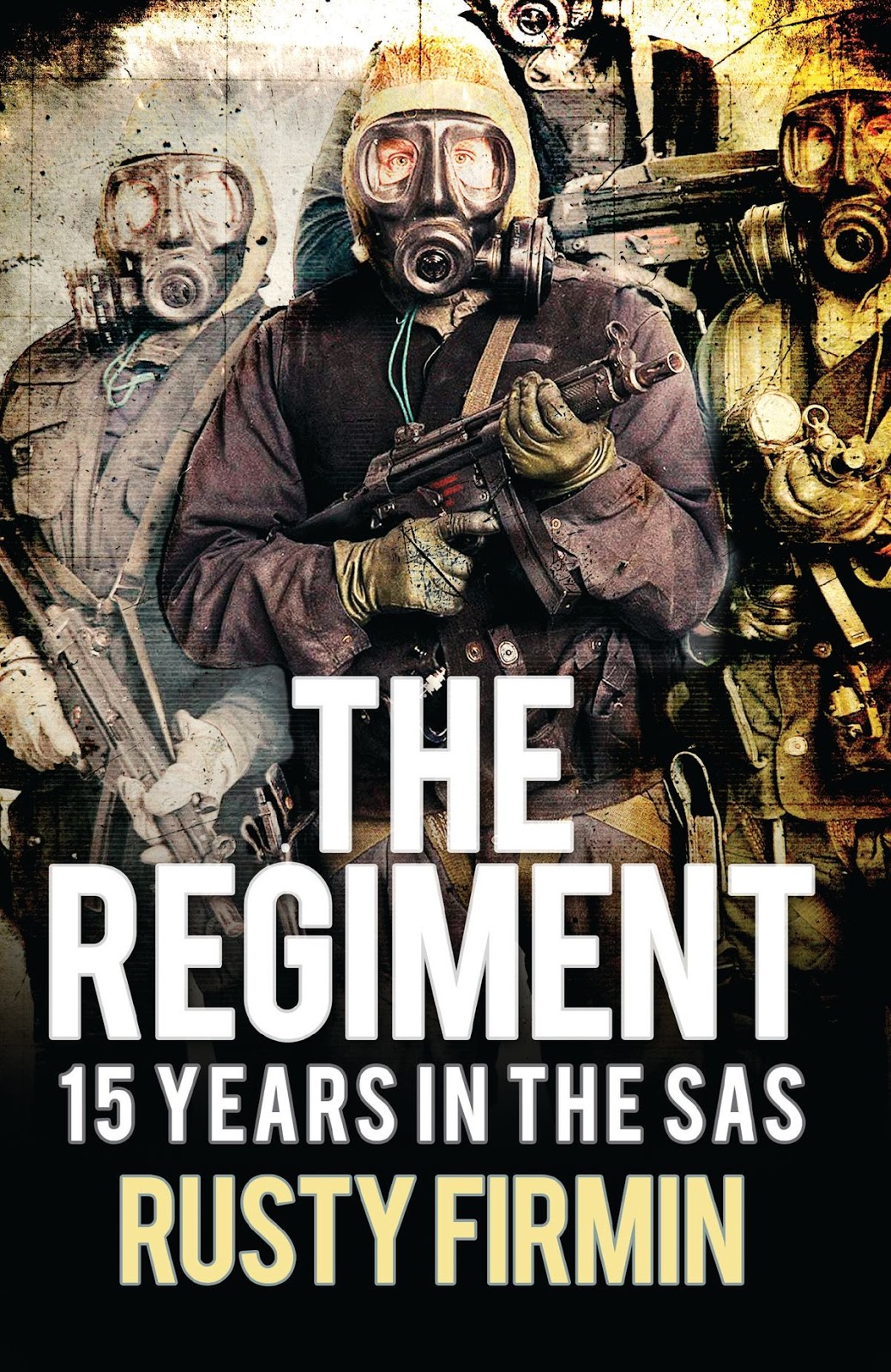
As a kid in the early 1980s I was favourably impressed by the abseiling SAS soldiers that hit the global news. But their appearance at the Iranian embassy in London was also a bit terrifying. Dressed largely in black, with their faces inside black respirators and wielding black submachine guns (Heckler & Koch MP5s), they looked rather sinister (Darth Vader-ish). Naturally, as soon as "6 Days" was released I was keen to see how a detailed reenactment of the event would look like. Well, it is not just about the 17 minute SAS assault, but about the whole Iranian embassy siege of 30 April to 5 May 1980. The siege situation is presented from three perspectives and it is quite moving to follow the negotiator Max Vernon (Mark Strong). But, being fond of books about the SAS, I was more interested in the SAS perspective, i.e. Rusty Firmin (Jamie Bell). "6 Days" made me wonder about some of his decisions and therefore I wanted to know more from the actual Rusty Firmin. Here is the book by him that I then got:

The book Rusty Firmin wrote about his career in the SAS. Some surprising insights.

Rusty Firmin´s The Regiment (2015) explains a key moment in the embassy that the movie "6 Days" portrays rather poorly, it seems to me. There is also the book focusing on the siege that Firmin wrote together with Will Pearson, entitled Go! Go! Go! (2011), and then there is e.g. Who Dares Wins (2009) by Gregory Fremont-Barnes. But hey, no book will probably affect the general public´s knowledge about the event as much as the movie "6 Days", which is why I decided to write this blog post. In spite of everything that I appreciate in "6 Days", there is one big thing the film makers could have done better. Who was behind the whole thing? Of course, the movie informs a bit about the terrorist group that took over the embassy, the Democratic Revolutionary Front for the Liberation of Arabistan. However, there was a state behind the group: Iraq. The Iraqi state under Saddam Hussein not only prepared, financed and supplied the terrorists (e.g. with Soviet RGD-5 hand grenades and Czechoslovak Skorpions). One of their Iraqi intelligence handlers had even taken them to London. In "6 Days" this is summarized too much, the relevant scene is so short that some may miss it.

So, what on the surface looked like the act of a terrorist group of Arabian separatists from Iran was more like an Iraqi strike against Iran. Byt why is this small proxy war in London forty years ago relevant for us in 2020? Well, there were several terrorist actions during the 1980s, in different countries, that still today are sometimes not portrayed as what they mostly were, war by proxy. That is a form of warfare that has made a comeback in recent years, and therefore we need to be able to identify and understand it. Iraq under Saddam was not the main culprit, usually it was one or more security/intelligence agencies from the Soviet bloc. But these quite often used terrorists, not least Arab terrorists. This modus operandi even affected my native Sweden, and it took many years for Swedes to start realizing this.

Seeing the Iranian embassy in London today is just like seeing it on 30 April 1980. It was seriously damaged at the end of the siege but has been nicely restored. It is easy to see the embassy yourself as it is in the heart of London. There are some other places connected to SAS history not far from the embassy and I will be writing about these in a London guide that I intend to release here in a month or so.

Sunday, August 05, 2018

Swedish Armour & Leatherman Adventure

Swedish Landsverks in Dutch service saw action against the 1940 airborne assault.

For years I have been wanting to see the Swedish Landsverk M38 armoured car that is being restored privately in the Netherlands. The Landsverks of the Dutch cavalry took part in the fighting against the invading Germans in 1940. This summer my dream came true - plus we got a major surprise on the same trip, from Tim Leatherman himself.

We went to the Netherlands this summer, not least to later be able to write a story about the WWII Swedish Landsverk armoured cars in service first against German forces and then in captured German service. Thanks to the Bosman brothers my family got to see their wonderful restoration job up close. Their M38 was a few years ago a very sorry looking wreck on Ireland. I will show many more photos of this most impressive project in a coming book. Just let me add here a huge thank you to the talented Bosman brothers.

When planning our Dutch trip we had not heard about the NEMO Science Museum in Amsterdam. Nor did we have an inkling that the inventor of the Leatherman multitool, Tim Leatherman himself, would be there to kick off a world tour. The Leatherman multitool was "born" on a 1975 trip from Amsterdam with a repeatedly malfunctioning little Fiat. A long trip through Europe and all the way to to Iran, that included leaky hotel plumbing and many other situations that so to say demanded a multitool.

Well, while visiting NEMO we became aware of Mr. Leatherman´s presence that day and decided we´d like to see what he looked like and perhaps even hear him speak. In fact, we got to talk to him and he turned out to be amiable, humble and also attentive to our son. I was in the process reminded of my first Leatherman, that I gave away to a Russian gentleman many years ago.

Tim Leatherman and our son Jarl at NEMO in Amsterdam.

Without hoping too much, our son left his name and address on a slip of paper to possibly win a limited edition multitool signed personally by Mr. Leatherman. Well, some hours later I got a call from an unknown number. I had a good feeling, took the call and heard a representative for Mr. Leatherman announce that our son was one of a handful of winners.

The next day we were not going to be in Amsterdam, but the Dutch Leatherman importer Mr. Jerko van den Hazel kindly suggested he would find us where we would be, at the Dutch National Military Museum in Soest, a museum that focuses on the Dutch Armed Forces in the past, present and even in the future. So, at the museum, which turned out to be one of the best museums I have ever visited, Jarl was presented with a limited edition Leatherman that is basically the same design that I once gave away to a Russian who hade been more than helpful for a WWII documentary that I was involved in at the time. Out on the Russian tundra, just before we parted ways, I slipped the multitool into his pocket.

Since those days, some twenty years ago, I have purchased another Leatherman for myself, of a later design. I had not, though, gotten a multitool for our children. So, that Jarl won one was both good timing and amusing, since the type he got was like the one I had once given away.

Jarl using his Leatherman to repair a half-track in the National Military Museum.

Many thanks to Tim Leatherman and Jerko van den Hazel for reminding us, in an unforgettable way, that giving away stuff is a great idea.

Now, just a few examples of what we saw at the museum - that has many hundred other large artifacts and thousands of smaller ones. Let me recommend you to stay there at least one full day. Best is to have two days, to be able to experience the interactive parts. Check out their website for special events (like a big show in the fall, that you should book). Many thanks to Dr. Mathieu Willemsen for your kind help and replies for a future publication.

WWI era FT-17 tank in good shape.

German V-1 meets Spitfire.

A Sherman tank after one or two hits...

This MiG-21 is just one of several Cold War planes that you can see up close.

Tuesday, June 13, 2017

KGB Sleeper Agents: "The Americans" vs. Reality

KGB (Cheka) agent number 1, Felix Dzerzhinsky, in Moscow, USSR 1991.

OK, you have watched the TV series ”The Americans” and are curious about the reality behind the story. Well, I have a suggestion – read the book that shows, again, that fact beats fiction.

My view of ”The Americans” in a nutshell: an entertaining drama series with some really good actors, but also rather far from the very real Soviet agents masquerading as non-Soviet citizens in the West under assumed or created identities, also known as ”illegals”. While the basic idea of the TV series, of two Soviet KGB officers posing as an American married couple living in the suburbs with their children, is factual enough, most of the action in the series is pure fiction. The KGB did not plant agents in other countries to have them shoot people just about every working week. Sure, KGB agents did kill folks abroad, but only rarely, and only very rarely by using their very expensive illegals. So, like the TV series ”Manhattan”, too many important scenes in ”The Americans” simply did not happen in real life.

Also, ”The Americans” has some flaws in the way things look. Sure, the people who have procured the 1970´s and 80´s clothes, music and cars for the series have – I think – done a good job. I reckon that few recent TV series have gotten the look of the eighties as right as ”The Americans”. However, the 1980´s Soviet Embassy in Washington hardly was decorated with those really old Soviet propaganda posters. Then there are the KGB uniform mistakes in the episode ”Covert War” (season 1 episode 11). And the name Zhukov. OK, not an uncommon Soviet (Russian) name. But considering Georgy Zhukov, the Red Army´s WWII top military commander, couldn´t they have come up with another name?

Now, if you are keen to get to know the reality behind ”The Americans” I can recommend the real story of Jack Barsky, ”Deep Undercover”. Barsky was born in the GDR, better known as East Germany, in 1949 as Albrecht Dittrich. While his life and autobiography does not have the action of ”The Americans” it is still an exciting read. It is also a deeply personal and amazing story, that really should please not just espionage buffs.

”Deep Undercover” provides testimony about the preparations and purpose of the Soviet illegals after Stalin´s death. To summarize Barsky´s purpose: to become succesful and enter into the highest American circles and be ”…a rich undercover revolutionary in the United States” (quote from the book). Why all this effort then? Well, to ultimately influence US policy and promote revolutionary change in the West. But aside from this long range aim Barsky also gets to do some more immediate, practical tasks in the US.

The main objective of subversion explains Barsky´s interest in e.g. secessionist initiatives in Canada and a search for radical political leaning in the West. Left or right – equally interesting. Main thing to fan those flames, hasten revolution.

As I mentioned, Albrecht Dittrich/Jack Barsky was originally not a Soviet citizen but an East German one. Being Swedish, I think this makes him a bit extra interesting, as the KGB "outsourced" part of its work with Swedes to East Germans. For example, the more than twenty Swedish volunteers in Soviet special operation forces (spetsnaz and the ”Bernhard” sabotage group) were led by two Germans who both became top leaders within the KGB´s East German version, the Stasi (I have written about these Swedes and Germans in two books). Now, Barsky had no KGB tasks in Sweden, he only used Stockholm as an east-west transportation hub, but his relationship to the KGB provides insights into the larger KGB-GDR system.

A key term in Barsky´s book is value system. When the very expensively trained subversion agent´s own value system changes, everything changes. In this lies a huge lesson for the future. Actually, this makes the book a story of so much more than one KGB spy.

Thursday, December 31, 2015

More Swedish Citizens Have Died For Jihad Than For Hitler

Our new book "Swedes at War 1945-2015" is the first history of the post-WWII volunteers from Sweden in foreign units.

At the end of 2015 I am pondering the fact that since our book Swedes at War 1945-2015 was published this fall yet more Swedish citizens have died for jihad and the latest statistics from Sweden´s security agency Säkerhetspolisen mean that more Swedish citizens have now died for jihad than for Hitler.

As Lennart Westberg and I wrote in our previous and also translated book, 28 Swedes died in the service of Hitler´s Waffen-SS and Wehrmacht (26 in the W-SS + 2 in the Wehrmacht). In late 2015 it became known that about 40 Swedish citizens have died in various groups fighting for jihad in either Syria or Iraq. However, if one looks back at the very first Swedes who died for jihad in different states (not just in Syria and Iraq), as we do in our new book, the total figure today is no doubt above 40. Because already in 1993 Mikael Glinka from Stockholm died for the sake of jihad in Bosnia. In the 1990s there were also Swedish citizens who died in combat in e.g. Chechnya.

So, as 2015 moves fully into history, I wonder why my state and society has been so slow to pick up the implications of jihad. Well, not only jihad, but challenges to our security in general. How was it possible that we scrapped most of our security thinking and military and civil defence capability? To end this last blog post of the year with something positive I could of course add that the current Swedish government in late 2015 decided to bring back Swedish "total defence" planning in some way. But the very late hour and lack of extra funding also weigh heavily.

P.S.
If you are wondering how many Swedish citizens died against Hitler - well, there is no exact figure but it is clear that many more died against than for. In the various Allied convoys (to Liverpool, Murmansk etc) some 900 Swedish seamen died. In addition there were Swedish citizens in US, British, French, Norwegian etc army, navy & air units and approx a hundred were killed in action. For more about the Swedes on the Allied side I again refer to our previous book Swedes at War 1914-1945, also available in English.

Monday, March 31, 2014

Pre-enacting Pro-Russian Partisan War


This slick video of a future pro-Russian partisan hero in Ukraine has so far had over half a million views.

As has just been pointed out by Ukrainians on Twitter, Russia is now more or less demanding that Ukraine becomes the opposite of what Russia is. Will this lead to something like the scenario in the above clip?

The Russian state is a centralized state with weak minority rights and no secession rights - not even the republics within Russia have the possibility to hold a referendum like the one that was just held in Crimea with a little help from some "polite people in camouflage" or "martians" now known also in Russia as the Russian Armed Forces. However, Russia now wants Ukraine to become the opposite of what Russia is, i.e. Ukraine ought to be a decentralized state with strong minority rights and secession rights.

There are many details in the above partisan clip that merit comment. It was released on Youtube on March 4 and has soon had 600,000 views. It is striking not only for the most professional production but also many military and political details. The music is Cuban (celebrating Fidel Castro) and the setting Cold War Two, but what the story is about is rather a sort of continuation of World War Two in the near future, when there exists a pro-Russian "Donetsk Republic", as indicated by the passport of the die-hard partisan fighter. The title of the neat mini-film in English would be something like "They Came In Vain". "They" of course being Ukrainian fascists.

As far as I know, no western media has so far discussed "They Came In Vain", nor its predecessor, last year´s Youtube-hit about a civil war in Ukraine in 2015, that was actually produced in early 2012!

I would like to see comments re. the many details in "They Came In Vain" and links to relevant articles. I have already found some in Russian (on Fontanka and KP) but would very much like to read more thoughts.

Monday, January 06, 2014

The Rise of the Eurasian Union

Popular clip warning Ukrainians of civil war, NATO intervention (above you see German troops) and stressing the necessity of the Eurasian Union.

Imagine it was less than a year before the launch of the European Union but almost no journalists reported about it. Does that sound impossible? Well, I would argue that we in the EU member states and the United States are now living in that kind of media situation.

The 2013 mass protests in Ukraine resulted in thousands of news reports in English and hundreds in my native Swedish. A fair number of them mentioned the background of the EU’s Eastern Partnership versus the Russian-led Customs Union. Not that many mentioned the underlying vision of the Eurasian Union and, here is my point, only very few western media reports have explained what the Eurasian Union vision is, where it comes from and how close it is to being launched, i.e. January 1, 2015. The launch was again verified by Vladimir Putin himself, as a little Christmas present.

One of the few English-language journals to have realized the importance of the rise of the Eurasian Union is European Business Review (EBR). Shortly before Christmas EBR interviewed British Liberal MEP Sir Graham Watson, who frankly told EBR:

"One of the main problems with ENP [European Neighbourhood Policy] is Russia, and how we deal with the rise of the Eurasian Union, which has become the elephant in the room. We need to be cannier in how we respond to Russia's overtures to our Eastern neigbours which are likely to be in full gear from the Sochi Olympics up to the launch of Eurasian Union in January 2015."

Former German Foreign Minister and Vice Chancellor Joschka Fischer on December 31 commented under the headline "Europe’s Ukrainian Blunder" in a most undiplomatic manner, seeing threats to "post-Soviet order in Europe" and "a lot of violence".

EU security "does not capture the reality of today’s world” said Spain´s former Foreign Minister Ana Palacio.

That is what I call being frank.

Still, no big debate in "normal" media about the conflicting visions and projects of the EU and the Russian-led Eurasian Union.

Well, today at least a leading political risk consultancy, the Eurasia Group, published some sound conclusions about Russia in its "Top Risks 2014" guide. I especially agree with "The implications of an all-powerful leader with a shrinking support base and a flair for the unpredictable are worrisome". The following I do not agree with: "Policy has already become more erratic and lacking in strategic vision". But that doesn´t at all change how valid I find this later recommendation: "Look for brash geopolitical behavior from Russia in 2014".

BTW, if you haven´t yet read the article "Can a China-Russia Axis Bankrupt the US?", just do it...

Finally, two of the most important Youtube clips from 2013 regarding the Eurasian Union, the first one (promoting the union as the only viable solution) both in Russian and with a voice-over in English (the clips are the same although the first images differ). The last clip, "Euromaidan Anthem", has subtitles in English and features some of the strongest images from Ukraine last year:


Tuesday, December 31, 2013

A Few Heartbeats From Sweden

Russian Su-34 aircraft flew close to Sweden for the first time ever during the "Zapad" (West) drills in September.

Looking back at Sweden´s security in 2013 there occured serious events courtesy of the Russian Armed Forces that still, after many months, have not really been explained.

On April 22 the Swedish quality newspaper Svenska Dagbladet reported that two Russian Tu-22M3 nuclear-capable bomber aircraft escorted by four Su-27 fighters had performed night time drills about 35 kilometres from the Swedish border the night of March 29/30. Choosing to stage air drills with nuke bombers 35 kilometres from Sweden may sound serious enough, but several Swedish military sources have since stated that the Russian aircraft had also been simulating attacks on two military targets located inside Sweden, one near Stockholm and one in southern Sweden. The Swedish Air Force did not react. But two Danish F-16 fighters did.

The Polish Centre for Eastern Studies commented i.a.:

"The lack of a reaction from the Swedish Air Force to the Russian exercises proves that this most important branch of the Swedish Armed Forces has structural problems and may be unable to cope with all the tasks it has been entrusted with."

And:

"Russia resumed flights of strategic bombers capable of carrying nuclear warheads in the High North in 2007 and in the Baltic region in 2011 (in international airspace). However, the manoeuvres of 29/30 March were probably the first Russian exercises to simulate a direct attack on Sweden since the end of the Cold War."

In September , during the larger-than-promised "Zapad" (West) drills, Russian Su-34 aircraft flew close to Sweden for the first time ever and the military of Belarus released a clip (see below) showing elite soldiers from Russia and Belarus confronting an unarmed Swedish Gripen (in recce configuration) that was observing the drills.

In October there was a similar event to the one on 29/30 March, but this time the Swedish Air Force reacted (was allowed to react).

However, the Swedish government has still not really explained why, in its view, these most unusual events occured. The Russian Air Force could have chosen a billion other places for air drills with nuke bombers, yet for some reason chose an area a few heartbeats from Sweden.

Nor has our government, as far as I know, seriously commented on any of these events:

* Two Finnish presidents, one minister of defence and a number of Finnish defence experts have openly spoken out against Sweden´s lack of defence.
* Our closest neighbours, the Norwegians, have during 2013 enlarged conscription both in quality and for some units also in length of service.
* In late 2013 the new Norwegian government announced that it has ordered the establishment of a mostly professional rapid-response unit in Setermoen above the Arctic Circle.
* The Finnish Ministry of Defence in late 2013 confirmed that it wishes to purchase 100 Leopard tanks from the Netherlands in a version more modern than what Sweden has. BTW in 2012 Finland purchased missile systems more advanced than anything in the inventory of any other Nordic state.

Now, concerning the coming year, here are some less reported news items/analysis from 2013 that I believe will affect the world in 2014:

"Putin says new post-Soviet union ready for 2015 launch"

"Can a China-Russia Axis Bankrupt the US?"

"French polls show surge in support for far-right National Front"

"Marine Le Pen was recieved by Russian Vice Prime Minister Dmitry Rogozin" (in French, who has seen any news item at all in English about this?)

"US Navy predicts summer ice free Arctic by 2016"

The russian Navy and elite soldiers from Russia and Belarus confronting an unarmed Swedish Gripen (in recce configuration) during the "Zapad" drills in the Baltic.

Wednesday, July 24, 2013

Hard Power, At Any Cost?


71 seconds from last week´s record snap drills in Russia.

Last week´s enormous snap drills in Russia and the news about greater US-Russian involvement in the war in Syria have yet to be reacted upon by the Swedish government, at least openly. While we are waiting for reactions we might consider what Sergei Witte, prime minister of the Russian Empire, said a hundred years ago about the importance of hard power:

In truth, what is it that has essentially upheld Russian statehood? Not only primarily, but exclusively the army. Who created the Russian Empire, transforming the semi-Asiatic Muscovite tsardom into the most influential, most dominant, grandest European power? Only the power of the army's bayonet. The world bowed not to our culture, not to our bureaucratized church, not to our wealth and prosperity. It bowed to our might.

In other words, soft power could never substitute for traditional hard power. The big question now is if anyone in today´s Russian political elite has any other opinion than Sergei Witte?

Second big question: are the costs for obtaining greater hard power in today´s world truly irrelevant? Kazimierz Waliszewski wrote on the essence of Russia: "the readiness and power to ignore the cost in obtaining a desired result". Does this apply just as much today?

Friday, November 23, 2012

Norwegian Ninja Takeover

Teaser for "Norwegian Ninja", my all-time favourite action comedy

The recent BBC report that Japanese Ninjas are soon only history need not cause alarm. Norwegian Ninjas lead the way!

"Norwegian Ninja" is a Norwegian action comedy about the classic Cold War.

Time to face the music, move over Japan!

Sunday, July 15, 2012

New Swedish Military Vehicle Museum

A German-designed Swedish m/38 tank with a Czech-designed m/37 in the background. Tempo Vidal grille far right.

A few weeks ago I finally got to visit Arsenalen, the new national Swedish military vehicle museum. It is not as good as Bovington (the British tank museum), but is certainly worth a visit if you are in the Stockholm area.

The museum is focused on armour somehow connected to Sweden, from WWI to the present day, but also has some really interesting "soft skins", such as a German Tempo Vidal G 1200, which for some strange reason was purchased by the Swedish Army.

The influence of German design in early Swedish tanks is apparent, the reason is very simple: the main tank supplier was initially a German plant on Swedish soil, Landsverk. For instance, the above pictured Landsverk m/38 was virtually the same vehicle that in Hungary was known as the Toldi. Interestingly, the only two surviving Toldis are in Russia.

A very rare Landsverk AA-tank, based on the Anti that served Finland and Hungary (as Nimrod) in WWII.

A US-made M8 armoured car, one of four captured by the Swedish Army in Congo.

One of the most exotic vehicles in Arsenalen is the captured M8 Greyhound, once used by the Katanga Province Gendarmerie and then by Swedish UN troops in Congo in the early 1960s.

The museum also features some large dioramas with real vehicles, such as this one with a Hetzer:

I reckon this illustrates the end of the Third Reich quite well. But the Hetzer is rather clean...

In the smaller rooms there are many small dioramas and don't miss the upper floor scale models.

Wednesday, July 04, 2012

Third Reich Comics in Swedish Book

A page about a Afrika Korps soldier's survival ordeal in the desert from the Third Reich comic book "Bilderbogen vom Kriege".

I had no idea there were comics in the Third Reich until I found Swedish comics historian Fredrik Strömberg's book Comic Art Propaganda. Nor did I know that the SS in its journal Das Schwarze Korps attacked Superman in 1940.

In Comic Art Propaganda you will find some fantastic images from the Third Reich comic book Bilderbogen vom Kriege (Picture Stories from the War) and the Superman article in Das Schwarze Korps (The Black Corps) and many, many examples of comic art used as propaganda until the present day. The author Fredrik Strömberg has put together an impressive collection, albeit not only related to war and sometimes he uses the term propaganda a bit too generously in my opinion.

Strömberg provides several gems of information about American comics in WWII and during the classic Cold War period. Sadly, there is little in his book about Soviet and Russian comic art. Thus the general impression of the Cold War era that one gets is rather one-sided (very common, but I do not think that is a good excuse). I have in my collection even a quite recent Russian election poster using comic art.

There is a German website with some other samples from Bilderbogen vom Kriege.


Friday, October 21, 2011

The Legend of Larry Thorne


Jussi Syren & The Groundbreakers 2008 performing "The Legend of Larry Thorne" in a Helsinki place called Texas.

Just found this song about a certain green beret from Finland that I wrote about some time ago. I welcome more info about the band.

Tuesday, September 06, 2011

Back to 1631 and 1991

Visiting the Breitenfeld battlefield on September 7, 1991, 360 years after Sweden's perhaps most important battle.

When I walked the Breitenfeld battlefield, tomorrow exactly 20 years ago, it was less than a year since it had been in the state known as East Germany (GDR). This year my thoughts often go back to that trip and my experiences in Moscow also during that year.

I believe it was my paternal grandfather who told me about the role that the first Gyllenhaal, the cavalry Lieutenant Nils Haal, played during the battle of Breitenfeld on September 7, 1631. What he told me astounded me and probably explains some of my interest in wars. Unfortunately I have since not been able to locate written sources that match my memory of what I heard, or think I heard.

We do know though, from 17th century records, that Nils Haal was there, on that field, on that day, and performed well. But exactly what he did I do not yet know for sure.

Many will this week, understandably, be looking back at September 11, 2001. As for me, for some reason I thought more about that day at the start of this year.

I am now more often contemplating what I experienced in 1991, above all the last year of the Soviet Union as a student in Moscow. The most vital part in that was getting to know my future wife Ann-Sofie, another Swedish student there. The no doubt most weird part was finding these two destroyed armoured vehicles on the same street where president Mikhail Gorbachev lived, Kosygin Street.

A destroyed Soviet BMP and T-54 not far (200 metres?) from president Gorbachev's official residence.

To this day I have found no explanation for the presence of these destroyed military vehicles. Their hatches were open and kids were playing in and around them while we were there, as they were actually standing right beside a school. I reckon they may have been standing just a couple of hundred metres from the Soviet president's residence. If you saw these wrecks in Moscow 1991, or know anything about their story, I'd be very much indebted for your comments.

To be on the safe side, I made peace with Peter the Great before leaving Moscow. The gentleman dressed up as Peter was (is?) probably Russia's greatest (not tallest) reenactor of the era of Peter the Great.

Swedish Heavy Metal

The all-metal 1:6 scale S-tank being constructed by Peter in Boden, Sweden. PHOTO: PE

Tigers and T-34s in scale 1:6 and even 1:4 have been around for some years now. But what about Swedish heavy metal and more specifically the tank yours truly once commanded, the much hyped/hated S-tank?

Well, there are no giant S-models for sale but I have met Peter E., a gentleman in Boden who is making his own all-metal S-tank in 1:6. Thanks to Peter I could attach the above photo of his amazing work so far.

Peter told me he saw Armorteks Tigers in 1:6 about ten years ago and then felt he should try doing something himself in that scale. Why an all-metal S-tank in 1:6? Well, Peter lives not far from the P 5 museum in Boden that has a 1:1 S-tank and thus he thought he would have some edge.

To make a project like this come true Peter has involved something like ten different firms and spent perhaps 500 hours on the project.

Interestingly, Peter's ultimate goal is not a total scale copy but a metal model with functioning suspension and gun elevation. The problem-solving process interests him more than the construction itself.

You can follow the evolution of this project in this thread which is part of a Swedish forum for large-scale model armour projects.

Wednesday, August 17, 2011

Unknown Arctic Airfield Discovered

By the just discovered airstrip. The petrol barrel is marked Shell. In the background the magnificent "Lapponian Gate". PHOTO: Björn Lundquist

Could this discovery be linked to the WWII Allied "Kari" or "Sepals" bases in northern Sweden? Or is it something to do with the early Cold War? Well, what seems pretty clear is that Björn Lundquist has photographed a previously undocumented airfield in a strategic area.

After a tip, Björn Lundquist of Kiruna, former commander of both northern Swedish ranger regiments, decided to check out an area between Abisko and Stordalen, places that are not that far from Norwegian Narvik.

What Björn Lundquist has just photographed resembles a simpler WWII or 1950s airfield. According to Lundquist's measurements it is 300 x 40 metres. He also found what seem to be field side markings and a field stop and the remains of a building.

No known Swedish military records have any indication of an airfield where the discovery was made.

Suggestions and other comments are very welcome.

Thank you, Björn, for letting me be first to publish this discovery and I hope some readers here can provide some clues or even unravel the facts behind these remains.

The remains of a building by the airfield. PHOTO: Björn Lundquist

Wednesday, May 04, 2011

Operation Neptune´s Spear and Swedish SEALs


To find an active US Navy SEAL willing to talk about operation Neptune´s Spear is no easy thing, but an American relative managed to find Mike Smith, a former SEAL. I like his last comments.

US Navy SEALs have been of particular interest to Swedes long before the bin Laden raid. This is because Sweden´s most famous elite officer, Carl Hamilton, is a fully qualified SEAL.

Carl Hamilton, however, is a James Bondesque character in novels by Swedish author Jan Guillou, and movies based on these books. But there has been a Rolf Hamilton and a Jan T. Sundlöf, two Swedish naval officers/attack divers that I have written about in my previous Swedish book, Elitförband i Norden ("Nordic Elite Units") and a long article. These officers received UDT/SEAL training in the 1950s to 1970s. Hopefully I will have time to translate and adapt that book into English next year.

Nice SEAL-interview, Randy!

Thursday, April 21, 2011

Party Soldiers Then & Now

The title translates as "Europe´s Shame". The men on the cover of this brand new Swedish book belong to the Hungarian Guard, one of several new uniformed political movements to appear in Europe in recent years.

The most political soldiers in Swedes at War are those who joined the International Brigades in Spain and those who joined the Waffen-SS during WWII. The majority of these Swedes were members of two political parties. Well, party soldiers are back in Europe.

Of the 540 Swedes on the side of the Spanish Republic 1936-39 about 340 belonged to SKP, the Swedish Communist Party which was the Swedish branch of the Comintern, the Communist International.

Of the 200 Swedes in German WWII service (approx. 180 in the Waffen-SS, 20 in the Wehrmacht) between 120 and 130 were members of SSS, the main Swedish National Socialist party.

In other words, Sweden definately had some party soldiers during the 20th century. In addition, on Swedish territory, there were Red Front fighters, SA-men and Sveaborg-men, affiliated to the same two parties. Although these were not openly armed units they too can certainly be said to have been political soldiers.

Since the 1940´s there have been some attempts by Swedish national socialists and similar groups to create new party soldiers, but all these attempts have been very small-scale, limited and unsuccessful.

Now, if you have not been in Europe for a while you might want to check out this clip from Hungary:


The depicted Hungarian Guard, now known as the Hungarian National Guard, is only one of several uniformed political movements to appear in Central/Eastern Europe in recent years. In contrast to attempts in Western Europe, like the Wehrsportgruppen in West Germany in the 1970s and 1980s, these new groups are more well-organized and vital. The most notable groups are in Hungary, Russia, Serbia, Bulgaria and the Czech Republic.

Why the more successful revival of the party soldier phenomenon in these countries? My thinking goes something as follows, as I told researcher Lisa Bjurwald, author of the new book Europas skam ("Europe´s Shame"):

1. Apart from serious social problems in these countries they all have a common past of various pioneer movements and state-sponsored military "games" and youth training between 1945 and 1989.

2. In the case of Hungary the military has been radically down-sized, creating a vaccuum.

3. These groups offer cameraderie and a sense of "doing something" for society, protecting/preserving traditions/identity and not least increasing "security".

Here are some photos to illustrate my point about the military culture that was actively promoted in Eastern Europe, in comparison with national socialist youth culture:

Hitlerjugend as depicted in an issue of "Tyska Röster" (German Voices), the largest Swedish-language German magazine in Sweden during WWII. To be precise the boys are Deutsches Jungvolk (DJ), the junior branch of the HJ.

Pioneers in Eastern Europe 1945-1989 basically looked like these ones. The depicted pioneers are 1960s East German.

Rifle training for Hitlerjugend with army instructors. PHOTO: Deutsches Bundesarchiv

Rifle training for East German youth in 1967. The uniforms and Zeltbahns (tent parts) are from the Nationale Volksarmee (National Peolple´s Army). PHOTO: Deutsches Bundesarchiv (Ulrich Kohls)

Although the book Europas skam is far from only about party soldiers like the Hungarian National Guard, I still think it will be of great interest to many with an interest in radical political groups, nationalism, racism and the near future of Europe. So, if you read Swedish - check it out.

Finally a book tip if you are interested to learn more about the party soldiering of the SS. More than often SS-books focus on the field operations of the Waffen-SS. One book that is very different is The SS: A History 1919-1945 by Robert Lewis Koehl.