About Me

My photo
Author, film researcher and member of the Swedish Military History Commission.
Showing posts with label France. Show all posts

Wednesday, August 25, 2021

"She was not just difficult with the Gestapo"


Never before have I read such a rich, moving but also critical portrait of a WWII heroine. Lindell´s List delivers more than the title and subtitle promise.

A large part of the book deals with the escape and evasion organization for Allied airmen in France that the very British Mary Lindell founded and led. Looking only at this part there are several strong scenes that should inspire not least filmmakers. Let me immediately say that I am aware of the 1991 movie "One Against the Wind" based on Mary Lindell´s WWII experiences. But even though I have yet to see it I feel certain that modern filmmakers should take a close look at Peter Hore´s book Lindell´s List

Having gone through the First World War in France as a Red Cross nurse, Mary Lindell in 1940 decided to resist the German occupiers in France long before there was any large resistance movement. Her immediate and stubborn will to resist against the odds is, the reader soon understands, a consequence of her strong, controversial, character. Few books I have read have made me sense a person´s character as much as this one. It is clear that she could stand her ground as few others. Perhaps her brother summed her up best: "She was not just difficult with the Gestapo, she was difficult with everyone!"

Lindell´s focus was always on the war task at hand, often a supremely difficult or dangerous task that no one had given her, but that she still saw as something she herself had to solve. Not seldom her own children had to pay a hefty price for her decisions. To quote her son Maurice: "She wasn't´t a mother anymore; she was an officer doing a job which she considered was to be done." 

This tremendous devotion to duty led to Lindell´s death, or so it seemed. When her death certificate was about to be signed she came back from the dead, and more resistance work.  

One might think that in a book like this the Germans are mostly minor, evil types. But several Germans come across as friendly and some truly helpful. The half-English SS-Obersturmführer Percival Treite is very much part of Lindell´s List, and one of the book´s most puzzling figures. 

The women on Lindell´s secret Ravensbrück concentration camp list were taken to freedom and, eventually, health in Sweden by hastily painted Swedish Red Cross buses driven by Swedish Army soldiers. The Swedes part of this book, not least in the "Tuesday Club" (Tisdagsklubben) make it required reading for those with a special interest in Sweden during WWII. But Lindell´s List ought to be appreciated by anyone with an interest in occupied France and resistance work.

Friday, March 26, 2021

Guarding Hitler

A 22-year-old Swiss student decided to kill Adolf Hitler and got very close to succeeding. The capture of two unusual Waffen-SS soldiers in Normandy resulted in another of the many close calls with death that the Nazi leader had. If you are keen to learn about the close protection around Hitler, his body guards and their vehicles, then this book by Dr. Mark Felton should be of great interest to you.  

Mark Felton has become a familiar name to many WWII buffs thanks to YouTube. By January 2021 his main YouTube channel reached one million subscribers. But with books like Guarding Hitler he has shown that he is much more than a talented YouTuber. In Guarding Hitler he tells the story of the SS forces directly responsible for the personal safety of Hitler and while doing so makes it clear how complicated the SS empire was. The number of similar (competing) branches within the SS is quite baffling and reflects a basic feature of the whole German state under National Socialism. The Sicherheitsdienst (SD), the intelligence agency of the SS and NSDAP (Nazi Party), has become well known, but Guarding Hitler instead acquaints the reader more with the two SS forces responsible for Hitler´s close personal security, the rather confusingly named Reichssicherheitsdienst (RSD) that was not part of the SD, and the Führerbegleitkommando (FBK). To not complicate life too much I here only use the last names that these groups had.


Guarding Hitler is not least about the many attempts to kill Hitler – I found the Swiss student´s to be the most fascinating one. Although this subject has been covered in previous books and documentaries, Felton manages to make also these sections of his book highly readable. He presents own archive finds about the British Special Operations Executive (SOE) assassination plan called Operation Foxley. The plan, focused on sending a sniper team to Obersalzberg, was created due to the capture of two very special Waffen-SS soldiers in Normandy in June 1944 – soldiers that made the SOE realize that the security at Hitler´s Obersalzberg complex was not perfect. The prisoners opened up a window of opportunity for the SOE. In my opinion Guarding Hitler has all the ingredients to form the basis for a really strong documentary about Operation Foxley, that of course could be followed by a WWII “what if” movie.     


Nordic readers may be surprised to learn from Guarding Hitler how RSD body guards protected also the Reichskommissars in Norway and Denmark. The RSD came to protect not only Hitler but many leaders of the Third Reich. 


Aviation buffs will no doubt be most interested in what Felton has written about Hitler´s private air force including the “parachute seat” that was added to the personal Condor aircraft of Hitler. To quote from the relevant chapter: “Air travel was dangerous, particularly during wartime, yet Hitler seemed to prefer the risks rather than using his train for most long-distance journeys.”


Hitler´s train is of course also present, the Führersonderzug and what I found particularly interesting in that part was what happened to it after the war, how it was used by different states and that Hitler´s saloon coach (dining carriage) was taken out of service only in 1990 (!) and is now on display in a Bavarian steam locomotive museum.


Well then, Guarding Hitler should be of interest to both the average WWII buff, WWII researchers and close protection specialists.

Saturday, November 21, 2020

SAS Jeep Operations in Germany and Norway


It´s not every day that you find a new book about the SAS in Norway and discover one more Nordic in the ranks of the SAS. Well, With the SAS Across the Rhine is mainly about final operations on German soil. Still, it is well worth getting and now for some details.


Unlike some SAS books this one by the late (he died in 2002) Colonel Ian Wellsted OBE, MA, is very personal, it has plenty of details about his love life. This may put off some readers, but should not – because Wellsted´s memoir highlights something probably quite common – how a turbulent emotional conflict at home can follow a soldier to the battlefield and affect his behaviour a lot.    


In January 1945 Ian Wellsted is trained in the French alps for operations in Norway together with a Danish SAS member I had never heard of before. No, I am not talking about Anders Lassen VC. Every Nordic reader into SAS history knows about Lassen. Wellsted writes about Paul Jensen, a former Spanish Civil War volunteer who after the German invasion of his homeland had become active in a Danish resistance organization until he had to flee to the UK, where he joined the SAS. No year for this is given but Wellsted writes about the man on several pages and Danish history buffs should thus be able to track him down. Would love to find out more about Paul Jensen, or perhaps that was not his actual name? Let me know, dear Danish readers.


To get into the right shape for Norway the SAS men are helped by French alpine rangers, chasseurs alpins, and the part about them was for me extra enjoyable as I have had the pleasure of observing them on an exercise. To be precise I was skiing with the 27thAlpine Ranger Battalion. I thus relate to Ian Wellsted´s warm feelings for his cool French hosts. 


After about a month in the alps the SAS skiers were told Norway was no longer a top priority (but Norway will come back on the agenda) and they were instead sent to Germany to there constitute an advance party with armoured jeeps. So, all you SAS jeep fans, here is a book you will definitely want to read. Wellsted´s jeep battle accounts are supported by 16 photos, not always top quality but none of which I have seen before, and some tactical maps. 


In Germany the author confronts not only German snipers but also a most tense situation with one of his own that obviously is suffering from extreme battle fatigue. 


Once Germany has fallen Norway returns on the SAS agenda. Of course, we now all know that this also broke the German will to fight on in Norway. But at the time things were not so evident, and Wellsted paints a vivid picture of what Norway was like just after the general German surrender. One only wishes this part had been a bit longer and that there had been more photos from it. But the one photo that there is, is of particular interest, with many nice jeep details.


With the SAS Across the Rhine (155 pages) ends with a very modern take on what the WWII SAS was all about and lessons to be learnt from them. This part has been written by one of New Zealand´s greatest SAS history buffs, Terence Gardiner, a retired air commodore, and is in itself worth your time. 

Thursday, November 12, 2020

Hitler´s V-weapons

The story of the battle against the German V-1 flying bomb and V-2 rocket is more fascinating than I thought. The official history of this battle, recently compiled by John Grehan, reminds of how the unmanned aerial vehicle made its debut long ago and includes Norwegian and Swedish aspects.    

The very secret war against the V-1 and V-2 actually began in Norway already in November 1939, most unexpectedly. This was several months before the country was invaded and became a battleground. What happened was that the British Embassy in Oslo then received two letters from an anonymous German scientist whose name turned out to be Hans Ferdinand Mayer. The embassy staff passed on his letters to the Secret Intelligence Service (SIS/MI6) HQ in London for further analysis. The letters turned out to be a leak from the heart of German high tech weapons research, or as the official history puts it: "the first serious evidence to fall into British hands that the Germans were developing rockets for military purposes". 

It is almost beyond belief how much the Germans poured into the V-1 and V-2 projects and this new book brings home both the scale of the German efforts and how the British analysts and leaders learnt of them and tried to prepare themselves for what was to come, and then acted. What the rocket threat more exactly consisted of became a lot clearer thanks to a V-2 that accidentally flew to Sweden on the 13th of June 1944. It was an incredible moment to stand by this rocket´s crater - it is still well preserved in a dark forest not too far from Kalmar in south Sweden. In fact, this crater is one of the highlights in my latest book.  

Having recently researched the V-2 that ended in Sweden I can say that I know of no previous book that mentions the following aspect of what happened once the Swedish authorities had become aware of the cause of the explosion. Basically all relevant previous books report that debris from the exploded V-2 was collected and brought to Swedish technical experts and then the debris was sent on to the Allies, to British experts in Farnborough. However, Hitler´s V-weapons also states that two British technical intelligence officers were allowed to enter Sweden soon after the explosion, and here immediately made some important discoveries. In other words the first Allied examination  of a V-2 took place not in Farnborough but in Sweden.

There is also an exciting "what if" scenario in Hitler´s V-weapons - the Special Operations Executive (SOE) selected a German technician for capture, a key person for the V-weapons. But the man turned out to be so closely guarded that the SOE deemed it impossible to get him alive. 

Well, this 328 page book with 16 photographs (some quite moving) should please both V-weapon and UAV buffs, as well as civil defense and London historians.

Tuesday, October 06, 2020

Essential Study of Foreign Volunteers in the Waffen-SS & Wehrmacht


There are lots of books about foreign volunteers in the Waffen-SS and not as many about the foreigners in the Wehrmacht. What makes A European Anabasis unusual is that it looks at both categories, and contains a lot of credible military analysis.


Last year a paperback version of A European Anabasis: Western European Volunteers in the German Army and SS, 1940-45 by Kenneth W. Estes was published by Helion & Company and it is this version of the book that I shall now review. Unlike many books about foreign volunteers in German formations I would say it treats Wehrmacht and Waffen-SS volunteers with equal attention and the author´s background as a marine, tanker (lieutenant colonel) and professor of history has made possible a convincing evaluation of how the different volunteer groups actually performed. The volunteers from Spain, the Netherlands, Belgium, France, Denmark and Norway (I have placed them in the order of contingent size) are the main focus, and this is a good choice by Estes, in my opinion. Sure, there were also groups from several other Western European states, like Switzerland and Sweden, but as these groups never reached anything even close to the number of Spaniards and Dutchmen etc their significance for the battles of WWII was, basically, microscopic. 


Well then, two-thirds of the West European volunteers in German formations came from Spain and the Netherlands. Kenneth W. Estes does, however, on occasion mention both Swiss and Swedish volunteers and in one case highlights a Swiss national, Dr. Franz Riedweg, as he was a key figure in the Waffen-SS recruitment program aimed at Germanic populations.  


The author in no way hides the fact that Volksdeutsche from Eastern and Southern Europe played the major role in alleviating the mostly unsuccessful recruiting in Western Europe, especially in Scandinavia. Here the author could have inserted a quote from my co-author Lennart Westberg about how dissatisfied Hitler was with the low Swedish turnout, barely 200 men.  


In the Netherlands the recruiting drive had a rather different level of support. Even the former Dutch Army Chief of Staff, General Hendrik Seyffardt, lent his prestige for a Dutch national “legion” under German SS command. However, it should be noted (as Estes does) that Anton Mussert, leader of the Dutch collaborationist NSB, was too optimistic about Dutch willingness to volunteer for German frontline formations.


Speaking of the frontline, the Wehrmacht´s Spanish Division experienced over three thousand (!) casualties in the fighting at Krasny Bor and the Izhora alone. 


Although Estes has concentrated on understanding the fate of contingents and units, he also presents fascinating details about individual volunteers - men that mostly went down with the Third Reich but in some cases also became rather successful, like the first commander of the Spanish Division, General Augustin Munoz Grandes. In fact, Munoz Grandes became the second-ranking man in the postwar Franco regime. 


Of the book´s 50 photos and paintings most are interesting and often depict Spaniards and Belgians (Walloons). In addition there are 15 useful maps. 


A European Anabasis remains an essential study to better understand the complicated German use of foreign volunteers from Western Europe, and their actual military/political value.

Wednesday, September 30, 2020

Hitler´s Hangmen: The Secret German Plot to Kill Churchill

German prisoners of war in the UK had ambitious plans for December 1944.

Years of research by retired Queen´s Counsel Brian Lett has led him to present spectacular conclusions about German plans for the UK connected to the German 1944 Ardennes campaign. This book is of special interest both to those into late German plans and fans of exploring WWII places. 

Recently I have reviewed two other books by Brian Lett that have expanded my knowledge of WWII special operations, see my blog posts "A Deniable Operation Under the Swedish Flag" and "SOE:s Mastermind". Here I will review Hitler´s Hangmen: The Secret German Plot to Kill Churchill, a 2019 book by Lett about British fascists, Axis POWs in the UK and how these, possibly even working together, might have affected world history during the German 1944 Ardennes offensive.

Having practiced law for almost half a century it is no wonder that Brian Lett begins his book with a thorough explanation of the Vehmic court, a German punishment court with medieval origins. This vigilante court system was revived among German POWs, also in Britain. Vehmic "justice" seems to have made many German POWs feel that the Third Reich was present also in very small and rural British locations. Lett has visited and photographed a number of these German POW places, and the book will surely inspire several readers to themselves visit them. Few camps are as unchanged as Camp 21 in Scottish Comrie ("British Colditz"), but I must say that even the rather small traces that remain of Camp 17 in Lodge Moor, Sheffield, hold a strange attraction (I confess to being a bit fascinated by WWII-related sites, my latest book is about visiting 200 WWII sites in Sweden).

Now, most readers will be aware of the British Union of Fascists (BUF) under Oswald Mosley - and the BUF certainly is part of this book - but Brian Lett shows that Mosley at the time was only one of several influential fascists in British society. Lett paints portraits also of British fascists like Arnold Leese and his Imperial Fascist League, and MP Jock Ramsay and his Right Club. The latter seems to have had special opportunities to cause serious damage. 

Considering the information that Brian Lett has provided about British fascists I would say that most (or even all?) authors outside Britain have underestimated the original British fascist groups and are largely ignorant of the Right Club.

Another reason to read Brian Lett´s latest book is that he writes eloquently about characters like the head of Churchill´s personal security, Detective Inspector Walter Thompson, and the officer of the German Army who became the head of the London Interrogation Centre (London Cage), Colonel Alexander Scotland.    

Well, what evidence does the author present to justify the sensational subtitle of this book, The Secret German Plot to Kill Churchill? Quite a lot hangs on the plans developed in the Devizes Camp in Wiltshire and I would like to know more about the interrogation team from the US XVIII Airborne Corps that discovered the Devizes plan. To begin with I will read the whole book one more time, not least for the sheer pleasure, but then I hope to some day get more details both about the interrogators and the interrogated.

Tuesday, August 04, 2020

Early Jet Fighters 1944-1954

144 pages of some of the first (and some of the coolest) jet fighters ever. 

If you are looking for good images of the Third Reich´s jet fighters and are intrigued by how these  designs influenced the aviation industries of the Soviet Union, France, Sweden and other nations... well, then this is a book you will appreciate.

As a kid I remember seeing a model (Airfix?) of a Messerschmitt Me 262 and being quite astonished at learning that it was a WWII aircraft. Over the years I have of course learnt of the even more advanced German jet designs, e.g. from the Horten brothers (Reimar and Walter). But it was only through this book that I got the whole picture of German jet fighter development, and just how much it affected Soviet etc aircraft design. Even from a short distance you can mistake a Soviet Sukhoi Su-9/1946 for a Me 262. In fact, some early Soviet jet fighters not only looked rather German, their engines were actually BMW 003s and Jumo 004s - just one of many interesting facts that one learns from Leo Marriott´s book.

There are many astonishing designs in this book that I have seen nowhere else before. But as a Swede I am of course familiar with the planes of the Swedish chapter. Still, even there was a photo that surprised me - of a Lancaster in Swedish service with a jet engine under the belly, the STAL Dovern project. I learnt even more from Marriott´s text and captions about our early jet fighters. I had no idea that when the prototype for the Saab J 29 "Flying Barrel" (largest photo on the book cover) first flew on 1 September 1948 it was flown not by a Swede but by British test pilot Squadron Leader Bob Moore. Swedish pilots then just had no jet experience, of course. 

There is a also a German story behind the development of the J 29. Marriott explains how the plane´s swept wing design originated in the Third Reich and in 1945 reached Sweden via Switzerland. The new wing type was then tested for real with a strange looking Saab Safir trainer aircraft.
   
Leo Marriott has found wonderful images of many beautiful and "less beautiful" early jet fighters, and he rightly lets the photos dominate the book. But he also has provided the photos with some really interesting captions. 

Hm, should I now build a 1:72 scale Heinkel He 162, a Yak-25 or a Caproni-Campini N. I?

Monday, August 03, 2020

Astonishing Normandy Discoveries

Two books that have changed my understanding of the great invasion. 

In recent years there have hardly been any finds in Normandy more astonishing than those of UK author Gary Sterne. It all began when he found a map in a pocket of a US Army veteran´s uniform - a map that led him to the forgotten German Maisy Battery battlefield. 

As the Maisy Battery could be forgotten and buried for so long one must wonder what else there is that we Normandy buffs have missed? Well, each year since the discovery in 2006 more and more of the Maisy trenches and bunkers are being restored. At the time of writing this (August 2020) the Maisy Battery is also again open for visitors. Recently I have been reading Gary Sterne´s two-volume work about the US Army ranger history that is so very much part of Maisy (on maps also known as Grandcamp-Maisy). Maisy for decades has been virtually unknown, in the shadow of the Pointe du Hoc battle. 

To summarize the two books by Gary Sterne is no easy task, given their almost incredible amount of facts, maps, photos and previously top secret documents. These books differ a lot from most WWII books in that the author, Mr. Sterne, has chosen to not just quote documents he has found but also to reproduce very many of them in the end product. He has really discovered a lot of ranger history previously unknown to the public, and it is therefore understandable that he was eager to include a lot of documents. Still, especially volume one suffers from simply too many documents. Well, if you are doing serious ranger research or are a relative of one of the most relevant men, the rangers of the 2nd and 5th US Army Ranger Infantry Battalions, you will probably benefit from this abundance of documents – because there is a high probability that the persons you are most interested in are mentioned on one or several of the 492 pages of volume one and/or 668 pages of volume two. 

The value of owning volume one is that you can see where each company was preparing for D-Day on any given day, plus that you get some good and sometimes amusing insights into the evolution of the relationship between the rangers and their British hosts, both commandos and civilians. The rangers were to a large extent the US equivalent of the commandos. A favourite paragraph of mine in volume one is: “The British don’t know how to make a good cup of coffee. You don´t know how to make a good cup of tea. It´s an even swap." This is a quote from the instruction Interaction with the British

The period document written by Maurice Prince of the 2nd Rangers is quoted a lot by Sterne, and rightly so, because it is a rather charming unit history. An example from 5 December 1943 about getting to know wartime Britain: “We learned what rationing really was, the darkness of a total black-out, the shortage of petrol, and the absence of motor vehicles.” The average WWII buff, however, may not be that interested in the many months of preparations for Normandy – which is the focus of volume one – and thus can go straight to volume two. Here one finds not only the most interesting invasion documents of the rangers and lots of Normandy photographs I have seen nowhere else, but also Gary Sterne´s groundbreaking conclusions. 

Learning more about Pointe du Hoc and Maisy it is probably impossible to not long for another trip to Normandy. I have previously reviewed this Normandy travel guide that should both be studied before trips and also be brought along. 

Being especially interested in Swedish-American Captain Ralph Goranson of the 2nd Rangers, as I have written about him in two of my books, I was pleased to find the most relevant after action report about him in D-Day Cover Up At Pointe Du Hoc. Goranson again appears in the chapter “Medals and Battle Honours”, where one gets all the information about every relevant Distinguished Service Cross and Silver Star. Relatives and researchers of 2nd and 5th rangers will indeed find a great deal of important documents in these books, the most interesting ones in volume two.

Friday, June 19, 2020

An Eagle´s Odyssey

Ju 52 and Bf 110 are highlighted but in the end the author commanded Bf 109s.

Luftwaffe pilot memoirs are not rare but An Eagle´s Odyssey by Johannes Kaufman deserves special attention. Kaufmann was an extremely experienced pilot when the war ended and tells his story with precision.

Johannes Kaufmann´s first training flights took place in 1935. Ten years later, in April 1945, he escorted colleagues on Kamikaze type missions. What you get from reading An Eagle´s Odyssey is a real insider´s account of what life in the Third Reich´s Luftwaffe was like, from the incredibly fast rise to the ferocious end.

Professor Richard Overy provides a fitting foreword to this piece of air power history and I find it hard to not agree with him both about the great value of the book and also what it is lacking. It is a book that is very, very focused on the Luftwaffe pilot´s training, tools and combat experience. It is almost as if the war beyond the view from the cockpit did not exist. But the author explains this somewhat in passage about when news reached him of Hitler´s order to unleash war upon the West in 1940:

“All hopes of an early end to the war appeared to be dashed. Every radio bulletin was followed with keen interest. There was a definite feeling of apprehension, not to say concern [but] nobody expressed their misgivings out loud. We had already reached the stage where most of us were beginning to think it prudent to keep our views on current events to ourselves.”

Well, if you are aware of the book´s focus on aircraft and flying and are trying to understand e.g. the German side of some event in the air war, then you will be rewarded. To begin with, Johannes Kaufmann will take you along to the Luftwaffe´s early version of basic flying training. Then he flies Ju 52s during the war against Poland, becomes a flight instructor and is put in charge of collecting captured aircraft from all over France. All the time Kaufmann vividly describes his flights.

Messerschmitt´s twin-engined long-range Zerstörer (destroyer), i.e. heavy fighter, the Bf 110, then comes alive. This is thanks to Kaufmann´s posting to the Zerstörerschule (destroyer school) Schleissheim. Then follows a pilot´s view of the Eastern Front and here is a quote from the book to illustrate the early missions over the Soviet Union: “First we dive-bombed the hangars and technical sites, and then went in low to strafe the few aircraft dispersed about the field.”

Of great interest to UK readers should be Kaufmann´s words about how the RAF performed, and how he viewed the Spitfire. The real gem, though, in my opinion, is his time in Jagdgeschwader 4 and especially what he writes about the German Kamikaze equivalents, in German called SO pilots, SO meaning Selbstopfer = self-sacrifice.

This book was first published in German in 1989 but only last year appeared also in English. I have a strong feeling that the translation has captured both the meaning and style of the original text. It has also been somewhat updated, I understand. There are only four photos, on the back cover, but the text is the richest I have so far come across about a Luftwaffe pilot´s flight experiences.

Monday, March 09, 2020

A Deniable Operation Under The Swedish Flag

SAS VC holder Anders Lassen (1st from the left) always catches my attention.

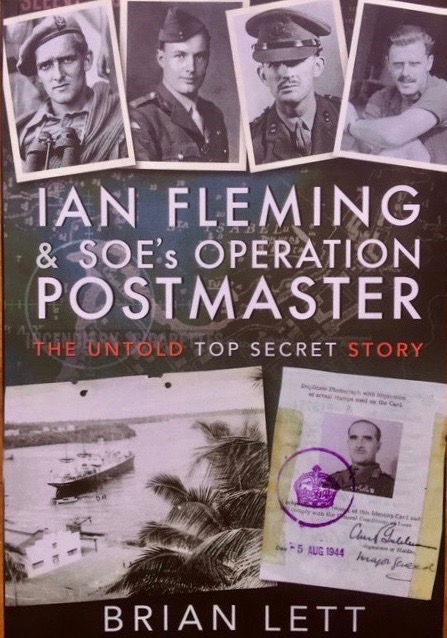
The story they presented was that they were a neutral Swedish crew on a neutral Swedish yacht. In fact, they were a group of SOE agents on an incredibly daring mission, commanded by an actual "M", with whom Ian Fleming worked. This is a book that especially Nordic SOE, SAS & Fleming/Bond buffs can appreciate.

While the Swedish flag was mere camouflage, there were actually Danes aboard, one of whom later would join the SAS and earn a VC, Anders Lassen. Thus it should already be apparent that Ian Fleming & SOE´s Operation Postmaster by Brian Lett is of special interest to Danish military history buffs. Norwegian WWII buffs also have several reasons to pick up this book, because Brigadier Colin Gubbins was "M" and he had a great deal to do with Norway from 1940.

Well, what kind of special operation is Ian Fleming & SOE´s Operation Postmaster about? In 1941 the British started receiving reports that German submarines were using rivers in French parts of Africa for refuelling. At the time, the Special Operations Executive (SOE) was a new outfit with many enemies, not just among the enemy. The SOE had to prove its worth. The cunning plan was to sail a "Swedish" SOE ship, with some great characters, to West Africa and locate German submarine bases. But having arrived in the area the main aim became to steal enemy ships from a neutral Spanish port on the volcanic island of Fernando Po. I will here not give away the wonderful story of what happened but just say that the British Government lied in order to conceal British responsibility for the operation, and basically recommend that you read this book yourself.

Being the author that I am, I do not think that the characterization of Sweden as "pro-German" in Lett´s book is fair. Regardless if one means the Swedish state or the majority of the Swedish people, the largest Swedish sympathies were about Finland, Norway and Denmark. Yes, there were Swedish Nazis and pro-German sympathies, but they never dominated. The thousands of Swedish citizens in Finnish, US and Norwegian service can be compared with the 200 in various German units. For more about Sweden during WWII please turn to e.g. John Gilmour or yours truly.

Nevertheless, Brian Lett´s book is an inspiring and exciting book that should please not just SOE and Fleming/Bond buffs. First published in 2012, the edition I got is from last year. Brian Lett has written other books about special ops and I just recently became aware of his SOE`s Mastermind - Sir Colin Gubbins, a book that I very much look forward to reading.

Thursday, January 16, 2020

Lofoten Commando´s Incredible Odyssey

He fought in France, Norway, Tunisia, Italy and then from France to Germany.

Not that many of the first British commandos managed to fight all the way to Germany. Fewer still managed to experience danger in so many different places as did Leslie Young. His son, Sir Nicholas Young, has researched his wartime odyssey not least by going to Norway´s Lofoten Islands.

Having survived Dunkirk, Leslie Young was among the first to volunteer for a new special force, the Commandos. He managed to become one of the "specially trained troops of the hunter class" and the author lets us know what early wartime commando training was like. Being a Nordic in love with the awe-inspiring Lofoten Islands I then was amazed to read details of the famous Lofoten raid that I was unaware of. There is also some comic relief: a telephone exchange was captured and one of the British officers could not resist the temptation to send a telegram "To A. Hitler, Berlin". But I will not spoil your reading by here revealing the text of the telegram.

The Lofoten Islands of today are also in the book, as the author did research there in 2011, i.a. visiting one of the best military history museums in Norway, the Lofoten War Museum in Svolvaer. Back in 1941 it was the telegraph station and post office, and was the first building to be taken over by the Commandos, who landed just a few metres away. I can only agree with Sir Young: "The museum houses an extraordinary collection of uniforms, photos, flags, pieces of old weaponry [...]".

Having checked off Norway on his bucket list (I am just kidding about the list), Leslie Young then served on the battlefields of Tunisia - and of course, his son (the book´s author) went there too and could locate the very spot where his father made some fateful observations.

The book also has many amazing glimpses of Leslie Young´s life on the run in Italy (with villages in shocking conditions) and while fighting in Normandy against i.a. the 12th SS Panzer Division "Hitlerjugend". Strangely enough he then reaches the same area where he fought back in 1940. This last stage of the war in North West Europe is grim, but once in a while the advancing British units also get superb treatment from grateful locals. Reading about this and the author´s research travels inspires me and makes me recall similar feelings, how such travels forge deeper relationships.

What about the skull insignia on the cover? It is the badge of the unit that Major Leslie Young belonged to during the Lofoten raid, No. 4 Commando.

Finally some words about the book´s author - he began as a lawyer, then discovered his vocation as a charity worker and was knighted in 2000 for services to cancer care and in retirement remains a charity trustee and is chair of the Monte San Martino Trust, set up by former PoWs in Italy. This trust will receive proceeds from the sale of Escaping with his Life.

Monday, December 30, 2019

My Father Joachim von Ribbentrop

The author´s Waffen-SS years are also in the book, but not in the title & subtitle.

This year (2019) was the final year in the life of Rudolf von Ribbentrop, son of the Third Reich´s foreign minister Joachim von Ribbentrop - the German half of the most common name for the Hitler-Stalin Pact (Molotov-Ribbentrop Pact) that in August 1939 stunned the world. Speaking about 2019, one of the final meetings of President Vladimir Putin this year was largely about this pact.

President Putin has lately talked a great deal about the Molotov-Ribbentrop Pact. There have been reactions to this, not least from the first victim of the pact, Poland. In other words, this first English language edition of Rudolf von Ribbentrop´s book about his father has been released with rather good timing. Most of its 476 pages are indeed about Joachim von Ribbentrop and several passages about him, as well as quotes from him and others, are of great interest. But aside from the direct quotes My Father Joachim von Ribbentrop is a mixed bag. The idea to let the book also be about the author´s own past is understandable. Rudolf von Ribbentrop not only witnessed the rise of the Third Reich from a rather unique position, he joined the SS Infantry Regiment "Deutschland" and took part in the invasion of France 1940. Afterwards he led a platoon of what later became "Nord", in Finland; was assigned to the Leibstandarte "Adolf Hitler"; participated as a tank commander in the Third Battle of Kharkov/Kharkiv and was shot by a sniper while rescuing wounded.

After recovering, the young von Ribbentrop became a Panzer company commander and led his company during the recapture of Kharkov/Kharkiv, after which he received the Knight’s Cross. He was transferred to the SS Division "Hitlerjugend" and was again wounded when a Spitfire attacked his car. Ribbentrop was awarded the German Cross in Gold during the defense of Normandy in 1944. He also took part in the Battle of the Bulge and met Hitler in his bunker in February 1945. All this he describes himself and his words are often fascinating to read. The problem is how these personal experiences are spread out over the book, and that there are passages that indicated to me that the author´s age introduced errors of memory into the text - he was 87 when he finished writing the original (German) manuscript.

Rudolf von Ribbentrop´s take on the origin and conduct of the Second World War is thought-provoking but at times simply not convincing. He did realize that he had served a murderous dictator but he nevertheless believed that Hitler had above all been tricked into attacking Poland - indirectly tricked by conspiring German generals. Where is Alfred Naujocks, Gleiwitz and other German-orchestrated incidents along the Polish-German border? Was I just too tired or did the author attempt to explain away the Lebensraum motive? The pages about his father´s enthusiasm for the pact with Stalin are more interesting, and also credible. My Father Joachim von Ribbentrop does contribute to the picture of Hitler´s foreign minister, but one should read it bearing in mind who wrote it, when he wrote it and only after having read other books about the Molotov–Ribbentrop Pact.

Sunday, December 08, 2019

Tolkien At War

Here in the French trenches things happened that greatly influenced J.R.R. Tolkien.

The new Tolkien movie, simply called "Tolkien", takes place in England and France. It is about J.R.R. Tolkien's childhood, youth and time at the front during the First World War. The film seems to have received mostly lukewarm reviews - well, here comes my take.

It seems that few Swedish cinemas (any at all?) have shown "Tolkien". Maybe it was released directly on DVD in Sweden? However, I have now seen it, on DVD, and my opinion is that it is not only well worth seeing, it is simply wonderful. As a film, it is gripping, romantic and beautiful. AND the director is Nordic, Dome Karukoski. What, a director from Finland? Actually, not so strange, considering that the Finnish language was important for Tolkien's saga languages, as was Kalevala - Finland's national epic. The Finnish language is actually mentioned in the film, and rightfully so.

In other words, ignore the reviews and watch the movie yourself. If you then want to know more about Lieutenant Tolkien's war experiences, I highly recommend Tolkien and the Great War by John Garth. A fantastic read if you are really interested in Tolkien and also are a military history buff.

Thursday, December 05, 2019

StuG III & IV

A surprisingly good StuG book for both AFV buffs and modellers.

Having a special interest in StuGs it takes a special StuG book to surprise me. Well, Dennis Oliver´s new book StuG III & IV: German Army, Waffen-SS and Luftwaffe, Western Front 1944-1945 contained some news for me - not least about Danish postwar StuG use.

Why are WWII assault guns/tank destroyers of special interest among AFV buffs and modellers? I reckon there are several different answers depending on who you ask, but here in Sweden I think quite a few guys (now rather mature AFV buffs/modellers) once trained to use the Swedish "S-tank" (strv 103), like myself, will be aware of the historical roots between the S-tank and the WWII assault guns. I recall my 1980s exchange of letters with the chief designer of the S-tank, Sven Berge - from which I understood that the design similarities of StuGs and S-tanks were no coincidence.

Now, having read about StuGs since the glorious 1980s it takes quite a lot to impress me. But Dennis Oliver´s book has done so. Almost all WWII photographs in his new book are new to me and then he has produced 23 brilliant colour illustrations, clearly displaying different types of camouflage and markings. Aside from these Oliver provides short but good unit histories with graphics plus all the different StuG scale models ever made and very good photos of assembled and painted kits.

Being a blogger/writer with a Nordic angle on military history I must of course also mention my big surprise when I found Oliver´s photo of a StuG III Ausf. B belonging to Minenkommando Dänemark, a company-sized formation formed by the Allies after WWII to remove the about 1 million mines that the Germans had laid along the Danish coast. I knew of this mine-clearing operation but did not knew it had StuG IIIs and PzKpfw IIIs. Well, Oliver knows a lot about StuGs, and has the ability to transfer his knowledge in this quite short (64 pages) but large size book in the excellent TankCraft series.

Thursday, November 28, 2019

Hitler´s Paratroopers In Normandy

If you wish to know how the German paras fought in Normandy, this book is for you.

Retired US Army Colonel Gilberto Villahermosa has produced 303 pages of top-notch German paratrooper history. He has chosen to focus on the German II Parachute Corps and its commander Eugen Meindl in Normandy.

Some German paratroopers were actually wargaming an airborne landing by the Allies just hours before the Allied airborne operation was launched. It so happened that German paras then found themselves fighting great numbers of their equivalents in the US Army. it is interesting to read how they viewed each other and compared equipment. The aspect the Germans were really impressed with seems to have been the (amount of) American medical equipment, not least the individual soldier´s medical items. The US rations also caused some German envy.

What about the US view of Fallschirmjäger equipment? An example comes from Major Salve Matheson, partly Norwegian and Swedish and at the time a staff officer in the US 506th PIR. Matheson is quoted by the author regarding the capture of a German 75 mm recoilless rifle for paratroopers: "This was the first and only weapon of this kind encountered by the regiment though its value was not realised".

The fighting between the German and US paras became bitter indeed around Vierville, where an entire Fallschirmjäger battalion fought an understrength battalion of US paras. It became known as the Battle of Hell´s Corner. The pages about this battle are among the most interesting in the book.

The combat experience and quality of the German paras in Normandy varied greatly - far from all had any jump training at this stage of the war, and Hitler´s Paratroopers In Normandy helps make that clear.

This book contains a document from General Meindl marked "Destroy After Reading" that sums up the first lessons learnt the hard way by the Fallschirmjägers in Normandy. In general, this book´s conclusions are of great value.

Hitler´s Paratroopers In Normandy has all that one expects from a good unit history including maps, photographs and useful appendixes. It contains 44 photos - not a huge number, but some of them are amazing.

Saturday, October 12, 2019

Secret War - Not Just About SOE

An attractive cover for a special operations reference book not just about the SOE.

When you have read about Special Operations Executive (SOE) operations in certain countries you might want to better understand the SOE in general - why it was created in 1940, how it began its existence and what became of it. Secret War by Nigel West answers such questions and has some parts of particular interest to Nordic readers.

Secret War: The Story Of SOE includes the original Cabinet memorandum, drafted by Neville Chamberlain in July 1940, which created SOE. West´s book has many details about the origins of SOE and the serious rivalry it from the start experienced with the Secret Intelligence Service (SIS, also known as MI6). Nigel West even writes that an "undeclared war" existed between the SOE and SIS. West also makes it clear that he has studied not just the successful SOE operations, and that he wants to shed light on how the SOE tipped the resistance balance in favor of Communist groups in several countries, not only in Yugoslavia.

West does not devote many paragraphs to describe Operation Gunnerside, the successful SOE action in the Norwegian mountains to stop the German development of nuclear weapons, through the destruction of heavy water production and stocks. But that operation is well documented in several other books and West instead clarifies how Gunnerside was to the benefit of the status of SOE in general.

Early SOE activities in Sweden and Norway are covered rather extensively. One wishes West had written as much about the last activities, that interest me more. Still, one learns some important facts about the SOE in all of Scandinavia and regarding the Danes I learnt of something I had no idea of - how the US Office of Strategic Services (OSS) had plans for a Danish Operational Group (OG). In fact, several pages of this book are very informative about the OSS.

If you are mainly interested in SOE and OSS activities in France, this book will be even more useful to you.

The edition of Secret War: The Story Of SOE that I have just reviewed is the one that was printed this year (2019). The first edition was published in 1992. I believe it remains a good investment.

Thursday, October 10, 2019

Operation Totalize & Michael Wittmann

Great to better understand Operation Totalize and Michael Wittmann´s last battle.

Having previously blogged about two guides about all of Normandy it is time to look at a new book focusing on an area of particular interest to armour buffs, the area covered by Operation Totalize, during which German tank ace Michael Wittmann was killed.

The new book Operation Totalize by Tim Saunders is filled with both the information, photos and maps that you need to get a good idea of this offensive launched by Allied troops to break through the German defences south of Caen. If you are mostly interested in US forces this book is not for you, because Totalize is the story of Canadian, British and Polish troops fighting against Wehrmacht and Waffen-SS units.

Tim Saunders is of the opinion that it was most likely Sherman Trooper Joe Ekins who took out Michael Wittmann´s Tiger. Ekins belonged to the British 1st Northamptonshire Yeomanry. Saunders presents a plausible scenario but does not exclude another Sherman due to the nature of armoured warfare. Well, thanks to the relevant text, air photograph and map in Operation Totalize one has the tools necessary to visit the battleground in question and oneself judge what is more likely, Joe Ekins or a tank from the Canadian Sherbrooke Fusilier Regiment.

Speaking of tanks, during Totalize the Germans used also some radio-controlled tanks of the type Borgward B IV, operated by the Funklenk-Abteilung 301. This part of the book was a surprise for me, and Saunders has also found a Borgward photo I had not seen before.

If you are an AFV buff, wargamer or intend to do a battlefield tour of the Operation Totalize battlegrounds, you will find this book very helpful and you will want to bring it with you to Normandy.

Let me finally say that the author, Tim Saunders, has found many great photos I had never seen before and I also like how he uses maps and unit insignia.

Thursday, September 12, 2019

The Normandy Battlefield Encyclopedia

Superb for those of you who have been to Normandy but want to discover more.

Recently I reviewed Visiting the Normandy Invasion Beaches and Battlefields, a terrific book for first-time visitors to Normandy and those planning to lead school groups and similar groups. Now I will review a Normandy guide so comprehensive that it could also be considered a battlefield encyclopedia.

This book, Major & Mrs Holt´s Definitive Battlefield Guide to the D-Day Normandy Landing Beaches (75th Anniversary edition) by Tonie and Valmai Holt, is an impressive mix of good maps, photos and information, the result of decades of Normandy experience and countless meetings with veterans. Aside from many colour maps inside the book you also get a separate map which in itself will probably be very helpful, not least while you are in the area. Simply put, I have never seen a better battlefield tour map before.

Major & Mrs Holt´s new guide can be used not only to plan a trip to battlegrounds or museums of special interest, it is a tool for historians, serving officers, history buffs and wargamers. Even if you have been to Normandy a couple of times I bet you will find several new and highly interesting places thanks to this guide. I did. Also, you will probably find the purely historical information in the book very readable, motivating, and sometimes also very moving.

Nordic readers will be pleased to know that Major & Mrs Holt have not missed the Norwegian and Danish memorials in Normandy and thanks to the maps and photos you will be able to locate them. So far there is no memorial to the Swedes who were also a part of the Normandy landings (mostly at sea but also on the ground and in the air), but there is at least a Bofors anti-aircraft gun in the Bayeux Museum (there is a photo of it in the guide), one of hundreds of Bofors guns used in Normandy.

Major & Mrs Holt´s guide also cover where to stay and eat and special tips for those wishing to tour Normandy by bicycle. The book is 350 pages long but still quite handy (not that large), and filled with good illustrations, mainly in colour.

Friday, September 06, 2019

Valuable Normandy Battlefield Guide

This new battlefield guide by Gareth Hughes will improve most trips to Normandy.

Very pleasantly surprised by this one. Visiting the Normandy Invasion Beaches and Battlefields is both a great guide and a compact WWII reference book.

This book by history teacher and guide Gareth Hughes is mostly intended for those planning and leading groups of young people to the World War Two sites in Normandy. But I do believe it should be read and used also by those with a deep interest in Normandy and WWII in general. It starts with a short but brilliant section entitled “D-Day in Numbers”. Two figures that I found to be of particular interest were: “127 – aircraft lost by the Allies” and “15 – percentage of paratroopers that landed in their planned drop zone”.

The general planning and travel tips are in themselves very valuable. The author then provides a very good WWII timeline followed by one of the best summaries I have come across of both the world wars. Then comes a short but still good glossary of key D-Day terms, such as Bigot, Bocage, PLUTO and SHAEF. A 14-page history of Normandy and D-day follows – a very nice summary.

The WWII location parts of the guide do not include every WWII site in Normandy but instead focus on places suitable for school groups and similar groups. One gets really invaluable advice both how to effectively present these places and their context, why they matter. Now, you might want to instead show around a group of military cadets or aviation/tank buffs. Well, I would still recommend this book as your primary Normandy guide. In my next posts I will present some more “extreme” Normandy guides for those already interested in particular units or vehicles.

As I am always looking for connections to the Nordic countries I was glad to note that the author among the tips for extended tours has included the Utah Danish Memorial, that commemorates the about 800 Danes who were also a part of the D-Day landings. They, like the Swedes, served mainly on board ships, but were nevertheless part of the D-Day machinery.

Tuesday, August 27, 2019

Greatest Normandy Books?

The book that has renewed my interest in the 1944 battle for Normandy.

If you are looking for the greatest books about Normandy 1944 I have some suggestions for you in this and several coming blog posts. Let us start in an unorthodox way with the German view.

There is an abundance of books that focus on the Allied side of this story. In The Germans in Normandy by Richard Hargreaves it is the other way around, and this in itself raises ones interest. Then I was also encouraged to read the book by some words from a fellow author and the Guild of Battlefield Guides (more about Normandy guides in future posts). But, before I venture into actually reviewing The Germans in Normandy I should mention that this 2019 paperback edition is not an entirely new book, as the first edition was published in 2006. Well, that having been said, this book should still rank as one of the best Normandy books.

Richard Hargreaves paints convincing portraits not only of the highest German officers involved. The quotes from them that he presents are both fascinating and in some cases even amusing. One gets the feeling that Hargreaves has correctly identified both the strengths and weaknesses of the German occupiers in northern France. He makes it very clear how much the Germans relied on foreign volunteer troops (many of whom were no true volunteers): “By the spring of 1944, one in six infantry battalions along the Atlantic Coast was composed of Osttruppen and [other] foreign volunteers […]”. In fact, as Hargreaves also points out, in some parts of France the ratio was even higher, so that in certain areas one in five “German” soldiers was not German at all.

The pre-battle conflict between Field Marshal Erwin Rommel and General Leo Geyr von Schweppenburg is amazing to follow and perhaps that row even caused the world famous “longest day” words from Rommel. What about the frontline soldiers then? Well, they are in the book too. Air power enthusiasts also do not have to worry – this book does not just cover the Heer and Waffen-SS but also Luftwaffe aspects.

How were the catastrophic German defeats in Normandy communicated to the German population? Richard Hargreaves shows how the main newspaper of the national socialist party at first rather convincingly “balanced” the defeats with colourful descriptions of the first V1 (flying bomb) strikes against London.

Hargreaves does not end his book with just the final shots in Normandy, but also gives an idea of what the cleaning up there entailed.

You might be tired of Normandy books – but even if you are I reckon you will appreciate The Germans in Normandy. It certainly renewed my interest in that beautiful and once very bloody part of France.