About Me

My photo
Author, film researcher and member of the Swedish Military History Commission.
Showing posts with label Australia. Show all posts

Tuesday, July 21, 2020

Bren Gun Carrier

Contains 64 pages crammed with first class information and photographs.

Let me immediately confess that I have been wrong about the Bren Gun and Universal Carriers. For some reason I until recently thought it was a simple, dull type of vehicle. I have been VERY wrong.

Last year I reviewed a previous Land Craft series book about a more universally (forgive the pun) appreciated vehicle, the Jeep in SAS & LRDG service. Now it is time for Robert Jackson´s book about something of an armoured equivalent of the Jeep. Bren Gun and Universal Carriers did not only serve in every theatre of WWII, they were also produced in several countries. I had been aware of the Canadian Universal Carriers but have now, thanks to Jackson´s new book, learnt also of the US, Canadian and New Zealand Universals.

Carriers not only had machine guns, there were some with artillery and anti-tank weapons mounted on top - both in Allied and German service. Yes, the Germans used captured Universal Carriers, and that is how I came to develop an interest in them. The thing is that I last year discovered that German trains transported i.a. a Carrier from a Swedish railway station (Haparanda) to an unknown destination in Norway or Germany. The vehicle in question may have been captured at Dunkirk and then sent to serve with a German unit somewhere in Lapland. There definitely exist photos of Universal Carriers in German Arctic service, in Kari Kuusela´s book Panzers in Finland. Why at least one Carrier (there is only one in the photos) was transported by the Germans via Sweden is not known. While Robert Jackson´s new book has not solved this mystery it does have some photos and colour drawings of Universal Carriers in German service.

Especially scale modellers and MV buffs will appreciate Bren Gun Carrier - Britain´s Universal War Machine, because it contains the best photos I have ever seen of many different scale models of the type. Several of the scale models also carry all kinds of equipment and some are part of magnificent dioramas.

The combat performance of the Universal Carrier is not the main focus of this book - but it does provide examples of the type´s strengths and weaknesses. There are some surprising examples of actions with Carriers. While the section about Carriers in conflicts after 1945 is not long, it is certainly interesting. BTW I hope to rather soon visit a Carrier abandoned in an Arctic forest.

Sunday, September 11, 2016

How Sweden Became A Space & Drone Nation

Sweden´s space pioneer hanging in the ceiling of the Vidsel museum.

Some of the most amazing museums are those that are generally not open. Such is the status of the museum of the Vidsel Test Range in Swedish Lapland. This test range is a Swedish strategic national test and evaluation asset. The museum tells the little known stories of how Sweden became a space and drone nation.

Thanks to Mr. X I recently got the opportunity to visit a museum few outside of the aerospace industry get to visit, the Vidsel Test Range Museum. It is probably the only place in the world reminding about the first Swedish rocket launch into space. The rocket in question was a US-made Arcas rocket launched from a place called Nausta, in 1961 - i.e. 55 years ago. Not that much has been written about the launch since then and the nickname it got at the time is just about forgotten now: "Plutnik". Aside from the similarity with Sputnik the name indicates something small and cute.

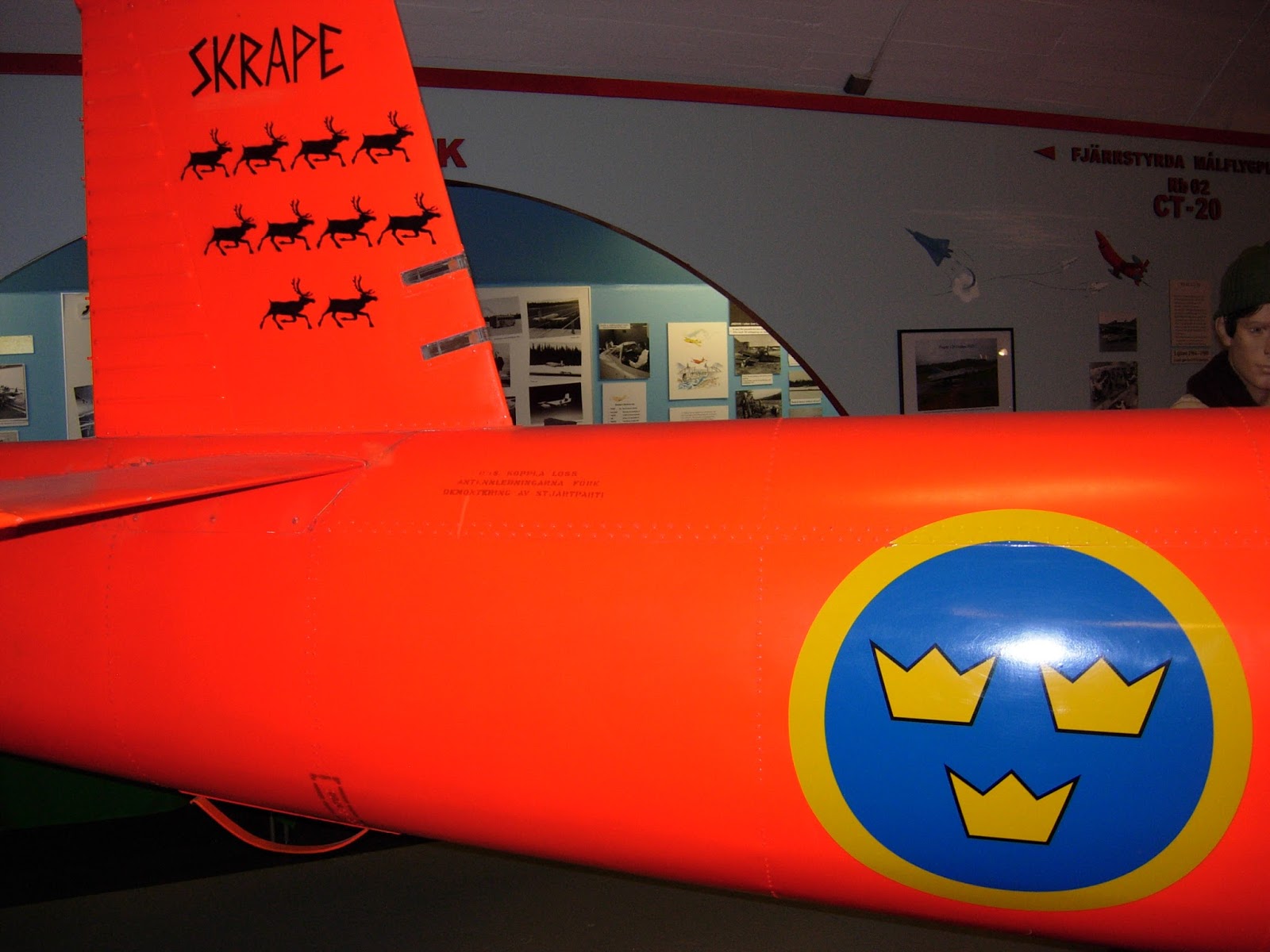
The Vidsel Test Range Museum preserves many unique machines but sadly I was in a hurry and therefore can only present one more - but it is a milestone: Sweden´s first drone, the target drone RB01 Jindivik. I think the year of its first Swedish flight may surprise you, 1959. Also, few will guess the manufacturer: the Australian Government Aircraft Factories (GAF).

Sweden´s first drone and yours truly.

Yes, those are reindeer and I am not sure what they signify.

Thank you, folks, for letting me in, and the photo permit. For more photos from the museum, visit this Vidsel website (in Swedish).

Want some more little-known Swedish history? Then how about how many German aircraft the Swedish Armed Forces shot down just in 1940, or how more Swedish citizens have died for jihad than for Hitler.

Saturday, June 14, 2014

World's Greatest Cowards: Swedes?

In 1914 we Swedes celebrated 100 years of peace, should we very soon celebrate the 200th anniversary, or ignore it?

Journalists around the world are about to cover the different ceremonies commemorating the outbreak of World War One, starting in Sarajevo on June 28. Rightly so, but as a Swede dealing with war history it is my obligation to also remind about the Swedish–Norwegian War of 1814 and question the feelings about the rare peace that we have since enjoyed.

The Swedish–Norwegian War, known here in Sweden also as the Campaign against Norway, was a war fought between Sweden and Norway that broke out with a Swedish naval attack against Norway on the 26th of July 1814. It ended quickly, on the 14th of August with Norway entering into union with Sweden, but with its own parliament and constitution. That war is today of little consequence for Sweden, as the union was dissolved in 1905. But the peace we have enjoyed since 1814 can still be a hot subject, as was recently demonstrated at a debate in Stockholm when Anders Lindberg, editorial writer of Sweden´s largest newspaper, Aftonbladet, stated "neutrality is the world's most successful policy, it has spared us from wars for 200 years". This praise for neutrality was not quite correct, as Sweden since joining the EU has scrapped the principle of neutrality. However, our non-aligned policy continues, and that is most probably what Mr. Lindberg had in mind. The reaction to these words from Erik Helmerson, editorial writer at Dagens Nyheter, our largest morning paper, was scathingly self-critical: "Sure, if success is that others sacrifice their lives for our sake - then neutrality is a mega-hit".

I would say that both Mr. Lindberg and Mr. Helmerson have missed some key parts of Swedish history. For example, we were not neutral when our neighbour Finland was attacked in 1939. But the help that the Swedish government provided was not flaunted and the full scale of it only became known decades after the war. Also in 1941-44 the Swedish government allowed a volunteer movement for Finland and made it possible for Swedish officers to serve Finland. Perhaps not that many Swedish lives were laid down for Finland 1939-44, 117 lives to be exact. But let´s not forget neither them nor the around thousand Swedish lives lost in Allied supply convoys and military units 1939-45. Most were not in Allied armies but on ships under various flags. However, the Norwegian memorial in Oslo for the around hundred Swedes who died for Norway 1940-45 makes no difference at all between those that died in the Norwegian Merchant Navy and those that died on battlefields in Norway and Normandy. So, there is no reason for us to differentiate, a life is a life.

The number of Swedes who died for Finland or in Allied convoys may largely be described as volunteers and the figures pale when one compares to the war dead of other countries. But one must not forget that the Swedish state facilitated both categories and the number of Swedish sailors who assisted the Allies, 8,000, just cannot be regarded as insignificant.

Let us now look back at August 1914, when Europe was largely at war but we Swedes celebrated our first century of uninterrupted peace by erecting an 18 metre tall monument on the border between Sweden and Norway to celebrate 100 years of peace between our countries. There is a book in English that provides us with a unique view of the ceremony that day, Scandinavia in the First World War edited by Claes Ahlund. I know of no similar book in any language, as it provides insights into several very little known subjects like the intelligence and counter-intelligence war in Scandinavia, the 26,000 (sic!) ethnic Danes in the German military, the 1,100 Scandinavian volunteers in Australian (!) uniform and the immense losses of the Scandinavian merchant ships in 1914 and 1918 - Norway alone lost 829 ships. Yes, that´s right, 829 ships.

Scandinavia in the First World War really is a must if you want to get to know Scandinavia in 1914-18 and also paints vital background for the stance in 1939 - not joining the warring sides had worked in 1914-18, so why change that basic strategy? Just bear in mind that Scandinavia in the First World War is not a regular history book but exactly what the subtitle says: Studies in the War Experience of the Northern Neutrals. A more regular history of Scandinavia in 1914-18 has yet to be written and should preferably include more about Finland and thus be called something like The Nordics and the First World War. A parting tip to those who eventually will write that book, check out Swedes at War.

Finally, should we on the 14th of August celebrate that it will then be - unless the Ukraine War of 2014 turns into something much bigger - 200 years since we were officially at war with another state? Shouldn´t we rather ignore the coming anniversary, considering the many abroad that sacrificed their lives for our sake? Well, aside from that more than a thousand Swedes lost their lives for others, i.e. Finland and the Allies, let me quote the British ambassador to Sweden during WWII, Sir Victor Mallet: "Swedish neutrality was of far greater value to us than a Swedish act of suicide in 1940 would have been."

Friday, March 23, 2012

Foreign Legion Swede Highlighted

Foreign legionnaire Elow Nilson is highlighted in the French edition of Swedish author Peter Englund's "The Beauty and the Sorrow".

Life is good. The author who has inspired me more than any other has sent me his latest book with a dedication as a thank you for some information I provided.

Hardly anyone expected a Swedish book about WWI to get such fine reviews from a global audience. The Beauty and the Sorrow: An Intimate History of the First World War was published first in Peter Englund's own language in 2009 and has since been published in English, German and now also French as La beauté et la douleur des combats.

I have no part in the Swedish edition but played a tiny part in the French edition by providing Peter Englund with some information about the Foreign Legionnaire Elow Nilson, a Swedish volunteer that I wrote about in Swedes at War (first published in 2004) and then Lina Sturfelt wrote more about in her book Eldens återsken ("Reflections of Fire", published in 2008).

Elow Nilson is not part of the Swedish, English and German editions of The Beauty and the Sorrow but only the French edition. Lina Sturfelt's part in restoring Nilson to our collective memory is larger than mine but I am nevertheless proud to have done something for him.

The impact of Peter Englund's book Poltava, available in English as The Battle That Shook Europe: Poltava and the Birth of the Russian Empire is hard to overstate. The book was released the same year I began my military service, 1988, and affected me in many ways. It inspired me to pursue a career not in the army but in military history. But not least it also made me think how odd it is that of the nine Gyllenhaals who were officers under king Charles XII (who lost at Poltava) only one died in battle. How and why did my namesake and direct forefather survive those most extreme years in Sweden's history?

It can be noted that Peter Englund dedicated The Beauty and the Sorrow to the memory of private Carl Englund, who was killed in action outside Amiens on September 13, 1918. He was wearing a uniform of the Australian army, being a member of the 3rd Australian division. He had participated in and survived Passchendaele...

Saturday, January 01, 2011

Two Wars and Blade Runner

It is the first day of 2011. Many will ponder the fact that this year it will be exactly ten years since the September 11 attacks. Many remember exactly what they were doing on that 9-11. I remember too, although I am Swedish and was not in the United States at the time. However, in 2011 there are also good reasons to remember events of 70 years ago and to watch a prediction from 1981.

This photograph taken in Afghanistan in 2010 would not have been taken had it not been for what happened ten years ago. The soldier is from the Australian Special Operations Task Group and the photo was taken during the Shah Wali Kot offensive. PHOTO: Corporal Raymond Vance

The Japanese attack on Pearl Harbor, 70 years ago on the coming December 7, deserves to be widely remembered this year, and not just by Americans - the attack brought the United States not only directly into war against Japan but also against Hitler, through his declaration of war on the United States on December 11, 1941.

The Japanese attack was big news also in German-oocupied Eastern Europe, where a Russian boy was eagerly following world events. The boy, Roman Kravchenko-Berezhnoy, wrote in his secret diary on December 9, 1941, about Japan´s dim chance of success: "The navies of England, America, Australia and Holland are on one side, while Japan is on the other. Furthermore, hostile naval bases surround Japan. Besides, it is deeply involved in its war in China."

The secret wartime diary of Roman Kravchenko-Berezhnoy forms a major part of a book written by him some years ago: Victims, Victors: From Nazi Occupation to the Conquest of Germany as Seen by a Red Army Soldier. I am not neutral in relation to that book as I was one of its editors. Still, I believe it can be said quite objectively that Victims, Victors is a valuable book in any quest to understand the Russian WWII experience. Here is the book´s cover:

The sitting Red Army soldier on the cover is the author, who began the war as a news-hungry schoolboy, the son of a Tsarist officer, and who ended it as a submachinegunner and military interpreter.

How can I write "objectively"? Well, for example Walter Dunn wrote in Journal of Military History about it: "A remarkable document, casting light on events little understood. . . . Required reading for students of World War II and modern Russian history."

The monumental German-Soviet clash of 1941-45 - that on 22 June started exactly 70 years ago - is just a lot of places and dates for most people in the west. In the former Soviet Union, on the other hand, it is the defining moment of the previous century. Virtually everyone in what once was the Soviet Union has a personal relationship to WWII through the staggering Soviet losses, something like 27 million lives (both civilians and military).

Yes, the current estimate is about 27 million dead, which is exactly three times the total current population of my country, Sweden.

To somewhat understand Russia (or other states on former Soviet territory), studying WWII is simply essential. I also believe that especially the Red Army has long been a mystery to westerners for the lack of i.a. translated auto-biographies by Russian soldiers. Therefore I warmly recommend to those who have not read Victims, Victors to check out some more reviews.

Personally, one of the most fascinating things with Roman´s book I found to be how he tried to predict the future, and often succeeded. I guess this might have to do with my interest in movies about our near future. As you might already have guessed, "Terminator" is one of my favourites (the first and second, not the two latest). However, my number one is "Blade Runner". The year that has just begun happens to also be a special year for fans of that movie. On March 9 this year (2011) it will be 30 years since the principal photography of "Blade Runner" started. It ended four months later but was released only the following year (1982). In other words, watching "Blade Runner" this spring is watching a thirty year old vision of 2019.

I will not here compare what the movie is about with what we now almost know about the world in seven years. I just want to encourage you to see the movie (again). I especially recommend the 2007 version of the film, Ridley Scott's "final cut" version. Not least because of the documentaries on the DVD. It was while recently watching this DVD that I realized that there is a German Stahlhelm (steel helmet) also in "Blade Runner", in the home of J.F. Sebastian. It is worn by a small robot. I reckon it is a WWII helmet, made to look like it is from WWI. If you are into Stahlhelms in movies you might want to read my previous posts about this phenomenon.

P.S.
One of the most read posts I wrote during 2010 was this one about the Franciscan Waffen-SS soldier Gereon Goldmann. If you are wondering why I have since not written about that man and his story, you can be sure I will return to him in 2011. I read his book in German about a month ago and was so moved I decided to read it in English and Swedish too. Just the other day I got these books and I will soon start to read them and then do some research of my own. So, I reckon I will write about Goldmann again in March.