About Me

My photo
Author, film researcher and member of the Swedish Military History Commission.
Showing posts with label Soviet Union. Show all posts

Thursday, July 08, 2021

Sepals Base Investigation


The most secret WWII Allied bases on Swedish territory are now being investigated by proper field research. Last week I had the privilege to take part in the investigation of an until now in modern Sweden basically unknown base under the Special Force HQ (insignia above with the standard British wings worn by many SFHQ operators).


The location of this Sepals base under SFHQ (and perhaps also the Norwegian XU) and most of the artifacts that we found can at this time not be shown, as the place and most artifacts are still under investigation by Swedish archaeologists. What I now can reveal is that a number of issues of the newspaper Stockholms-Tidningen found their way to this remote mountain location. Given the rarity of that paper above the Arctic Circle it is probable that these papers came to this place as part of the flow of weapons, ammunition, food etc between Allied embassies in Stockholm and the resistance groups in the Norwegian county of Nordland. It is known from Norwegian WWII literature that the place we searched was an important point in the secret supply chain to German-occupied Norway.  


Among the newspapers we found there were several articles that really bring home how the reader back then learnt of the major events as they unfolded. The headlines with Stalingrad and 10,000 destroyed Soviet tanks, see below, remind of the scale and connect the base to the larger picture. 


I could not help being rather amused by finding the below article entitled “Invasion In Western Europe Excluded”, that explains how the German fortifications there had become so numerous that successfully invading Western Europe was now impossible.


We were also reminded by the civilian history of the place by several finds. Again, most are waiting to be properly identified, but below is one artifact identified as the foundation for making traditional Sami shoes.


Finally, I wish to thank all those involved in this trip for making it happen, and for good company in a most beautiful area of the mountains shared by Sweden and Norway. For those of you not familiar with the Sepals bases, check out the books by Roger Albrigtsen and myself.   

Friday, February 05, 2021

Marching From Defeat


A lot of people have seen “As Far As My Feet Will Carry Me”, a 2001 WWII movie based on a book by Josef Martin Bauer. Both can be summed up as an exciting escape story: a German soldier, Clemens Forell, is sent to a very remote Soviet camp and walks to freedom against all odds. However, it has turned out that very little in that film/book can have come from the actual life of the real Forell, Cornelius Rost. Well, is the new book Marching From Defeat by Claus Neuber better than Bauer´s book?

Marching From Defeat is a book from 2020 in English but was published in German seven years ago, as Marsch aus dem Untergang. Simply put it is an autobiographical escape account by Claus Neuber, who was a German Army artillery lieutenant on the 1944 Eastern Front, serving in the 18th Panzergrenadier Division. Like thousands of other German soldiers he finds himself caught up in Operation Bagration, the huge Red Army offensive in the summer of 1944. He is then on the run behind Soviet lines for more than two months and during that time he is captured by the Soviets but manages to escape from his first camp.

Neuber recorded his experiences of escaping from Soviet captivity in a report soon afterwards, and later expanded his account. But it was not published in Germany until 2014. To tell you what I think of his book I will start with the credibility and then what it was like reading it.

Basically I wish Claus Neuber had met a more objective and professional German publisher/editor. Because his account has many signs of being authentic and therefore it should have been “left alone”, i.e. not been mixed with a lot of postwar thoughts. Of course the book could still have included postwar insights and comments. Actually, it could well have had some more postwar comments – from different historians of the Eastern Front. But the postwar insights and comments should have been in chapters separate from the wartime experiences. So, I object to how Neuber´s 1944 memories have been “developed”, because that process has not improved the book.

Still, especially once you get to the start of the long trek towards the new German lines, Marching From Defeat is often an amazing read. One gets the feeling that these are indeed the thoughts, experiences and conversations of German soldiers on the run. Surprisingly often they are helped by locals and some of the most moving scenes in the book are the encounters between the author´s group and villagers that often had no reason to help Germans - but still did so because they recognized the human beings behind the remains of German uniform.

I do not wish to spoil your reading experience but think the following quote from the author gives an idea of the challenges he encountered, without revealing too much: “Had I known about the ordeal that lay ahead of me, I would have given up all hope, but luckily I didn´t know and none of us knew because it was unimaginable.”

Neuber encountered countless setbacks of all kinds but also learnt repeatedly how a setback can turn out to be for the best. Sometimes it is almost beyond belief how he could carry on walking.

So, if you are into WWII escape & survival stories and/or have been intrigued by As Far As My Feet Will Carry Me, then Marching From Defeat should interest you. Hopefully some future book will examine Claus Neuber´s account in more detail, comparing it with wartime documents and also with similar fates.

Tuesday, December 29, 2020

German Special Operations Book Of The Year

Prewar missions over the UK and Poland; German airfields behind Soviet lines and a "Tatzelwurm" mission against Stalin himself - there is so much amazing stuff in this book, and not just about the Luftwaffe´s most secret missions. Some spectacular photos are also in the book.

The two Russian authors Dmitry Degtev and Dmitry Zubov shed light on several German top secret missions with the help of both Russian archives and previous books only available in Russian. I reckon very few people in the West have seen most of the info and photos presented in this book. It starts with naming Luftwaffe officers involved in prewar reconnaissance missions over Poland, the Soviet Union and the UK. These missions were done mainly by using Deutsche Lufthansa aircraft and the first mission over the UK seems to have taken place in 1937. There are several exact officer and aircraft details in the text but here, like in other places in the book, one would have liked to have seen original documents and/or archival details - because the information is of such great interest. However, later on in the book some original wartime documents are shown, regarding other missions.

The invasion of Norway was of course preceded by secret Luftwaffe reconnaissance flights but nowhere before have I read about the exact aircraft used, and other details. There is also a Swedish connection as the reconnaissance aircraft mostly then used were Fw 200 Condors and part of the trip to and from Norway was a route over Sweden already frequented by civilian Fw 200s from Deutsche Lufthansa.

Most of the book is of course devoted to the Eastern Front and from these pages I believe almost every reader will learn new things about German spies, their equipment, the aircraft used and several secret German airfields behind the Soviet lines. The latter can be explained by very few radar stations, no Soviet night fighters as such and vast uninhabited areas. The many spy missions launched by the Germans over the Soviets, and much increased in numbers after the first German defeats, caused the Soviets to form two new formations: destroyer (anti-sabotage) battalions and a new type of security police, SMERSH, an abbreviation for "Death to spies". But, as the authors also note, quite often the Soviet security organs arrested people who had nothing to do with the Luftwaffe, Abwehr (German military intelligence) or SD (the SS intelligence service). These three German organs came to work together on the Eastern Front to such a degree that the title of the book might as well have contained the words "German special operations". 

Having an interest in the Arctic I was especially keen to read the sections about German insertions in the Arkhangelsk and Komi regions. Even though I have read some about these missions in Finnish books I found lots of new details in The Luftwaffe´s Secret WWII Missions. There are also some to me new details about German operations in Iraq and Iran, even illustrated with a Luftwaffe aerial photograph of an airfield near Teheran. But even more spectacular are the often illustrated pages of the special ops with the rare and futuristic Ar 232 "Tatzelwurm". It had a distinct advantage for special ops: "When taking off and landing on rough ground, eleven additional pairs of small wheels under the lower fuselage came into play, to which special rubber caterpillar tracks could be fitted if necessary."

The highlight of the book is in my opinion the description of Peter Tavrin´s failed but still most amazing Kremlin mission, that includes both German and Soviet photographs and Soviet documents that highlight the role of a "Tatzelwurm" in this desperate 007-type mission to assassinate Stalin. These pages could quite easily be transformed into a blockbuster or a TV series (isn't there already a Russian movie?).

The book ends with psychological portraits of Hitler and the Abwehr´s Wilhelm Canaris, which might seem a bit odd given the Luftwaffe title. But after having read these portraits I think I see the point of the authors. With men like Hitler and Canaris at the top, no secret mission could have altered the final outcome.

Friday, October 30, 2020

The Most Amazing Tank Destroyer Ever


Which tank destroyer can be called the most effective? We could probably debate that forever. However, I find one tank destroyer a bit more fascinating than the rest. Not least because after 76 years it is still in service. There is now a brilliant book in English about it.


Both the Third Reich and the Soviet Union produced some larger and deadlier tank destroyers than the Soviet SU-100. But in the Red Army the SU-100 was the most powerful medium tank destroyer. At medium ranges it could take out both Panthers and Tigers, even King Tigers. So, why has not that much been written about the SU-100 in English? Well one reason is that it entered service only in the fall of 1944. Another being that you basically have to be Russian and work in Russia many years to produce a book like this. Well, half of the pair behind SU-100 Self-Propelled Gun is Nikolai Polikarpov, chief editor of M-Hobby, a Russian modelling magazine which has been in publication since 1993. I read several of the first issues and still have them. Mr. Polikarpov´s research is one reason this new book is a dream come true for Soviet era AFV modellers. But it is also rich in details for military vehicle buffs. There is no detail of the SU-100 that is not featured, also in splendid colour photographs. The other author of the book, James Kinnear, has brought with him long experience of writing on military subjects, e.g. for IHS Jane´s defence yearbooks and Osprey Vanguard. In addition, the Swedish publisher, Canfora, has done a splendid job presenting the work of the authors. 


The combat debut of the SU-100 took place in Hungary in the first days of 1945. Here one of the few problems with the vehicle instantly became obvious, it lacked secondary armament, i.e. machine guns. This of course meant that to defend the vehicle against German infantry the crew would largely have to rely on personal small arms (SMGs) and hand grenades. The passage about the German documents about SU-100 employment in Hungary is sobering, evidently both combatants misidentified each others AFVs. 


The pages about SU-100s in post-1945 service are amazing if one is also a Cold War history buff. In Soviet service the type was formally taken out of service in 1968. But that was not the end, as it then entered “strategic reserve storage” and was at least returned to some active service during the 1980s. The Soviet forces in Afghanistan used SU-100s to knock out resistance fortifications. 


There are amazing sections about the SU-100 in Czechoslovak and Cuban service. In 1961 both SU-100s and T-34-85s were in combat against the American sponsored landings on Cuba. The photos from Cuba should also inspire any Cold War modeler, a great deal.


Then there is the story of the SD-100 (Czech-made SU-100) on display in the UKs fabulous Tank Museum at Bovington. I had no idea that it is one of several SD-100s knocked out by British paras in Egypt during the 1956 Suez Crisis. In general, the info and photos about preserved SU-100s and SD-100s is one of my favourite parts of the book.


The most remarkable thing, in my view, is the fact that several SU-100 again entered combat in 2014, when several companies of SU-100s were employed in the Yemeni Civil War. Accordingly, the last of the excellent colour profiles in the book shows a SU-100 in 2017, captured by Houthi rebels from government forces. During the Yemeni Civil War a number of SU-100s have of course been destroyed, but in 2020 at least one SU-100 remained in operation.  


The photographs in the book showing the SU-100 in operational WWII service are not that many, but on the other hand they are mostly of very high quality. I am especially fascinated by the image from Berlin April 1945 with two officers in British or Polish uniforms – the perfect subject for a small diorama. 


This book is so new it even contains photographs from the 75thanniversary Victory Parade in Moscow 2020, when no less than seven working SU-100s paraded across Red Square. SU-100 Self-Propelled Gun is the second in the series “Red Machines” from Canfora. The first was T-60 Small Tank & Variants


To sum things up, this is the way.

Monday, October 26, 2020

Surprisingly Good German Special Forces Memoir


The special forces of German WWII military intelligence, the Brandenburgers, are not as well known as the British SAS, but just as interesting. However, I have to confess that the title of this book made me think that it would not be as well-written and credible as it turned out to be. 

To me the title Blood and Soil somehow signalled propaganda. Still, I was very curious to read this book as the sources about the Brandenburgers are not that many, especially the good books are few. There are many misunderstandings about the Brandenburgers. Indeed, as Lawrence Paterson writes in his introduction: "What wartime records remain are often fragmentary or cloaked in cover names, leading to frequent misdirection and confusion. Many operations attributed to the Brandenburgers were either non-existent, or in fact carried out by other units of the Abwehr [German military intelligence service] or SS."

The name of the author of Blood and Soil, Sepp de Giampietro, sounds Italian and this is because he came from the German ethnic group in South Tyrol, Italy. One learns a great deal from this book how this group viewed both Fascist Italy and Nazi Germany. The punitive measures that Italy directed against the ethnic Germans proved to be very counterproductive.

Initially the author thinks he has joined the German mountain infantry/rangers, the Gebirgsjägers, and is satisfied with that. But after a while his unit is attached to German military intelligence and quite a few South Tyroleans thus became Brandenburgers. The first period of the author´s military training is described with some nostalgia, in spite of what followed. 

The key element of the special forces period of Brandenburger history (their status changed) was the wearing of foreign uniforms and use of captured vehicles, to enable complete surprise at bridges and other crucial objectives. The author very seriously discusses how he and others felt at the time about wearing different foreign uniforms. He also explains how the most important fighting unit was not the company but the commando, an unusually large and autonomous platoon.

The details are rich and fascinating about the German campaign in Greece 1941, the author was among the very first to reach the flagpole of the Acropolis. Then one gets to follow the author in the Soviet Union, up to the Caucasus mountains. The author writes well and not without humour. He is able to give a vivid idea of how things then appeared, how he viewed events at the time. But also shows in several passages how he came to change his views, not least regarding the policies of the Third Reich.  

There are 30 photographs in the book and most of them are of great interest although not all are sharp. I would have liked more pages about 1943-45 but that does not really affect my verdict - this memoir is of great interest to all with an interest in special forces and especially in the history of the Brandenburgers.

Wednesday, October 21, 2020

The Last 1945 Battle in Northwest Europe

The general public might think mostly of Nordics when hearing “foreign troops in German uniform”, while in fact the typical foreigner from Western Europe was from Spain and if one looks also eastwards the typical foreigner was from one of the Soviet republics. Thus Night of the Bayonets, is mainly about a very underreported group of soldiers. 

This new book by historian and journalist Eric Lee should be on your WWII reading list not only for focusing on Eastern European soldiers in German service. It is above all a surprising and well-written account of the last fighting to take place in 20thcentury Northwest Europe. Then there is a deeper reason for learning more about the homeland of the main characters, Georgia. By any measure a man from that part of the world was one of the most influential men of the 20thcentury, Joseph Stalin (born Dzhugashvili). Georgia has played and will play a large role in the fate of both Caucasia and Russia. 


It was in Oslo in the 1980s that I first heard about a strange and bloody battle in which Georgian troops in German uniform fought against much better armed German troops. This battle took place on Texel, a Dutch island, and ended only several days after the formal end of WWII in Europe. Ever since I have been keen to learn more about the fighting on Texel, what initiated it and what the underlying motives were. Sure, there have been some books and articles mentioning the battle for Texel. But until I read Night of the Bayonets I had only a rough idea of what happened. 


Eric Lee wisely begins his book by showing how the Georgian Legion in German WWII service was a revival – there had been such a legion during the First World War. Of course, that first legion had no National Socialist profile, and it gained a good reputation in Georgia, from which the second legion could benefit. Georgian history in this respect is similar to Finland´s – during WWII the phenomenon of Finnish volunteers in German uniform was to a great extent a consequence of the battalion of Finnish Jaegers in German service between 1915 and 1918.


Just like the Finnish Jaeger Battalion veterans, men who had served in the first Georgian Legion played an important role in the formation of a new national army. The Soviet authorities did their best to erase the memory of that army and most parts of Georgia´s independent period 1918 to 1921. But Eric Lee summarizes those years well and lets the reader glimpse into an amazing alternative to what happened in Lenin´s Russia. German troops arrived in the Georgian capital of Tbilisi just two weeks after Georgia had proclaimed independence in 1918. Knowing that is fundamental to understanding the relationship between Germany and Georgia. 


Likewise it is fundamental to Georgian history that there was a nationwide rebellion after the Soviet conquest. It took place in August 1924 and led to both thousands of deaths and a great career boost to a local Soviet secret police officer, Lavrenty Beria – later second only to Stalin and actually described as “our Himmler” by Stalin during the Yalta summit in 1945.  


During his invasion of the Soviet Union, Hitler´s forces never made it far beyond the Georgian frontier, although they somehow found the energy and time to climb Mount Elbrus, the highest peak in the Caucasus. 


While German WWII troops never were able to hold any sizeable Georgian town they did manage to take a number of Georgian prisoners, who were joined by Georgian deserters and Georgians in German and French exile. At first, while Germany was basically on the offensive, there could be no new Georgian Legion, due to Nazi optimism and racism. But long before the new legion was formed, German military intelligence set up a largely Georgian unit within the Brandenburg Regiment (Wehrmacht special forces). This unit was the Sonderverband Bergmann and by the spring of 1943 it was itself of regimental size. But, rather tellingly, all the officers in it were German. The Germans, especially Hitler, just didn´t really trust former Red Army soldiers. This somewhat changed, initially, with the advent of the Georgian Legion.


The low trust was quite rational, as very many Georgians (and other nationalities) had “volunteered” to serve in German uniform mainly to avoid starvation. Especially during the first year of the great invasion the conditions for Soviet prisoners of war were incredibly grim. The Germans realized that it would be much harder for their Georgian troops to desert on another front than the Eastern one. So, Georgians were sent to Northwest Europe, even to the Channel Islands (Guernsey etc). Still, even in France some managed to desert also in groups, and Eric Lee´s account of what happened in Hirson is remarkable – a Georgian group there managed to join the French resistance. There is also an amazing passage about a similar mutiny by Ukrainian troops in France.


Until April 1945 one of the most peaceful places to end up in as a Georgian was the Dutch island of Texel. Although it did have a large amount of bunkers, some 500, it was also a haven for children from the Dutch mainland. Why the Georgians rebelled there in April 1945 and not just waited calmly for the war to end has puzzled me ever since that day I learnt about the very bloody Texel mutiny. Well, to avoid spoilers I will here just say that Mr. Lee provides credible motives for this seemingly irrational course of action. 


The Germans, of course, counter-attacked, not least with an impressive amount of artillery rounds. Texel, the peaceful oasis, was shot to pieces while the war in Europe was largely winding down. The reader learns about these events both through accounts of Georgians, Germans, Dutchmen and Canadians. Mr. Lee has found some fantastic quotes. 


Night of the Bayonets also deals with the many misunderstandings and remains of Soviet era propaganda that still surround “the Russian War”, as the uprising on Texel is to this day called among the Dutch. More than 3,000 people died in the battle, mostly Germans. No Russians, but the name has stuck.


The photographs are not that many (20) but they are very interesting and some of the WWII photos of the Germans on Texel are even in colour.


So, Night of the Bayonets is a great book, a real must if you are into the last WWII fighting in Europe or Soviet/Georgian history.     

Tuesday, August 04, 2020

Early Jet Fighters 1944-1954

144 pages of some of the first (and some of the coolest) jet fighters ever. 

If you are looking for good images of the Third Reich´s jet fighters and are intrigued by how these  designs influenced the aviation industries of the Soviet Union, France, Sweden and other nations... well, then this is a book you will appreciate.

As a kid I remember seeing a model (Airfix?) of a Messerschmitt Me 262 and being quite astonished at learning that it was a WWII aircraft. Over the years I have of course learnt of the even more advanced German jet designs, e.g. from the Horten brothers (Reimar and Walter). But it was only through this book that I got the whole picture of German jet fighter development, and just how much it affected Soviet etc aircraft design. Even from a short distance you can mistake a Soviet Sukhoi Su-9/1946 for a Me 262. In fact, some early Soviet jet fighters not only looked rather German, their engines were actually BMW 003s and Jumo 004s - just one of many interesting facts that one learns from Leo Marriott´s book.

There are many astonishing designs in this book that I have seen nowhere else before. But as a Swede I am of course familiar with the planes of the Swedish chapter. Still, even there was a photo that surprised me - of a Lancaster in Swedish service with a jet engine under the belly, the STAL Dovern project. I learnt even more from Marriott´s text and captions about our early jet fighters. I had no idea that when the prototype for the Saab J 29 "Flying Barrel" (largest photo on the book cover) first flew on 1 September 1948 it was flown not by a Swede but by British test pilot Squadron Leader Bob Moore. Swedish pilots then just had no jet experience, of course. 

There is a also a German story behind the development of the J 29. Marriott explains how the plane´s swept wing design originated in the Third Reich and in 1945 reached Sweden via Switzerland. The new wing type was then tested for real with a strange looking Saab Safir trainer aircraft.
   
Leo Marriott has found wonderful images of many beautiful and "less beautiful" early jet fighters, and he rightly lets the photos dominate the book. But he also has provided the photos with some really interesting captions. 

Hm, should I now build a 1:72 scale Heinkel He 162, a Yak-25 or a Caproni-Campini N. I?

Friday, July 24, 2020

Fallschirmjäger!

307 pages of German paratrooper biographies and personal photographs.

From Norway to Crete, German WWII Fallschirmjägers i.e. paratroopers made a strong impression on the battlefield. The new book Fallschirmjäger! by Greg Way has a personal focus, it lets the reader get to know 18 German paras - mainly their frontline memories but also what they experienced in captivity.

Royal Navy veteran Greg Way started corresponding and then meeting with German paratrooper veterans more than twenty years ago, and his book is the result of these years of contact. While Mr. Way has chosen to concentrate on the history of the individual rather than the unit, he does begin his book with a good summary of the Luftwaffe paratrooper operations and campaigns, and a useful glossary of relevant terminology and abbreviations.

Having lived in the Netherlands and last year written a chapter about how German paras met some rather stiff resistance from Dutch cavalrymen in Landsverk armoured cars (from Sweden), it was of special interest to me to read about the invasion of the Netherlands from the perspective of Kurt Schulz. His recollections are the most gripping I have so far read about that operation. I only wish there had been some more paragraphs about his later service with the 14. Luftwaffen-Feld-Division by the Arctic Circle in Norway. Although this part is not even a page long it contains some highly interesting details and a photo from Norwegian Nesna that make me want to find out more about this little-described division.

The memories of captivity i.e. POW camps are surprising. For example German paratrooper veteran Wilhelm Schulte reported that German POWs in Arkansas were treated well and when one of them died the man was given a proper burial outside the camp that included full military honors from American soldiers.

Combat on Crete is covered i.a. in the chapters about Josef Jendryschik and Bernd Bosshammer. Russia, Monte Cassino and other actions in Italy are covered in several chapters. The book contains an unusually high amount of private photographs, some modern photos of equipment and battle sites plus other types of illustrations like drawings and documents.

To sum things up, Fallschirmjäger! gives the reader good insights into the wartime service and captivity of a cross-section of German paras, and should be of special interest to those researching Crete and Monte Cassino.

Friday, June 19, 2020

An Eagle´s Odyssey

Ju 52 and Bf 110 are highlighted but in the end the author commanded Bf 109s.

Luftwaffe pilot memoirs are not rare but An Eagle´s Odyssey by Johannes Kaufman deserves special attention. Kaufmann was an extremely experienced pilot when the war ended and tells his story with precision.

Johannes Kaufmann´s first training flights took place in 1935. Ten years later, in April 1945, he escorted colleagues on Kamikaze type missions. What you get from reading An Eagle´s Odyssey is a real insider´s account of what life in the Third Reich´s Luftwaffe was like, from the incredibly fast rise to the ferocious end.

Professor Richard Overy provides a fitting foreword to this piece of air power history and I find it hard to not agree with him both about the great value of the book and also what it is lacking. It is a book that is very, very focused on the Luftwaffe pilot´s training, tools and combat experience. It is almost as if the war beyond the view from the cockpit did not exist. But the author explains this somewhat in passage about when news reached him of Hitler´s order to unleash war upon the West in 1940:

“All hopes of an early end to the war appeared to be dashed. Every radio bulletin was followed with keen interest. There was a definite feeling of apprehension, not to say concern [but] nobody expressed their misgivings out loud. We had already reached the stage where most of us were beginning to think it prudent to keep our views on current events to ourselves.”

Well, if you are aware of the book´s focus on aircraft and flying and are trying to understand e.g. the German side of some event in the air war, then you will be rewarded. To begin with, Johannes Kaufmann will take you along to the Luftwaffe´s early version of basic flying training. Then he flies Ju 52s during the war against Poland, becomes a flight instructor and is put in charge of collecting captured aircraft from all over France. All the time Kaufmann vividly describes his flights.

Messerschmitt´s twin-engined long-range Zerstörer (destroyer), i.e. heavy fighter, the Bf 110, then comes alive. This is thanks to Kaufmann´s posting to the Zerstörerschule (destroyer school) Schleissheim. Then follows a pilot´s view of the Eastern Front and here is a quote from the book to illustrate the early missions over the Soviet Union: “First we dive-bombed the hangars and technical sites, and then went in low to strafe the few aircraft dispersed about the field.”

Of great interest to UK readers should be Kaufmann´s words about how the RAF performed, and how he viewed the Spitfire. The real gem, though, in my opinion, is his time in Jagdgeschwader 4 and especially what he writes about the German Kamikaze equivalents, in German called SO pilots, SO meaning Selbstopfer = self-sacrifice.

This book was first published in German in 1989 but only last year appeared also in English. I have a strong feeling that the translation has captured both the meaning and style of the original text. It has also been somewhat updated, I understand. There are only four photos, on the back cover, but the text is the richest I have so far come across about a Luftwaffe pilot´s flight experiences.

Wednesday, June 03, 2020

Hitler´s Spanish Division

This book covers more units than the "Blue Division" of Spanish volunteers.

One of the baffling things about foreigners in the Wehrmacht and Waffen-SS is how the really large categories are often ignored, like the Spaniards. This is not least true if we look at articles and books produced here in Scandinavia. Hitler´s Spanish Division provides a surprisingly rich visual overview of the different units with Spanish volunteers.

To give an idea of just how popular it initially was in Spain to volunteer for service in German units on the Eastern Front we can start by just looking at the number of Spanish volunteers in the Luftwaffe, 659 men. That in itself is many more than the number of Swedes in all types of German formations 1939-1945 - there were about 200 Swedes all in all. However, the vast majority of Spaniards of course served in German Army (Heer) units, more than 46,000. Well, if one adds up these with Spains Luftwaffe volunteers and the Spaniards in the Kriegsmarine, Waffen-SS and various Wehrmachtsgefolge (Wehrmacht auxiliaries) like Organisation Todt, then the total figure is around 48,000 Spanish men and women.

Hitler´s Spanish Division by Pablo Sagarra, Óscar González and Lucas Molina make clear just how large the Spanish contribution to Operation Barbarossa was. This they do in an unexpected way - not by focusing on the actions of the German 250th Infantry Division more commonly known as the Blue Division (blue = colour of Spain´s Falangist/Fascist Party) and other German units with Spaniards, but by looking at a select number of individual volunteers. The first chapter is about the three Spanish generals on the Eastern Front, the next about three of the sixteen Spanish colonels in German uniform. I bet you can guess what the third chapter is about. After the two chapters about NCOs and men follows a short but fascinating chapter about the Blue Legion, the successor of the Blue Division (the legion was more like a regiment). The remainder of the book briefly covers Spaniards in the Waffen-SS, Luftwaffe, Kriegsmarine etc.

The strength of the book lies in the many Eastern Front photos, studio portraits and Osprey-style colour illustrations by Ramiro Bueiro. A large number of original artifacts from volunteers are also shown in colour, mainly decorations and documents. The uniforms demonstrate that the look of the Spaniards could differ quite a lot from German regulations.

In other words, this is a book above all for readers who are into militaria and scale models. But readers more interested in studying volunteer movements, especially Falangist/Fascist volunteers, are at the same time provided with an overview of the Spanish presence on the Eastern Front, plus a rather good glimpse into how much Eastern Front veterans affected the postwar Spanish Armed Forces.

Monday, April 27, 2020

T-14 Armata MBT

The first book to focus on the most radical new MBT since the Swedish S-tank.

The Russian T-14 Armata tank differs so much from previous main battle tanks that one could say it is the most radical "production" tank since the turretless Swedish "S-tank" (strv 103). The first book in English about this vehicle, written by James Kinnear, is more interesting than the parade photo on the cover indicates.

Of course, some who read this blog post will not consider the S-tank to have been a tank. Some will say it was actually a tank destroyer or an assault gun. Well, let us not here argue about that vehicle´s capabilities. I could argue quite a lot, because I was trained to use it during 15 months. But whatever your opinion is, it is a fact that in the Swedish Army the strv 103 was officially classified as a tank. "Strv" is short for stridsvagn which is Swedish for a tank (MBT). Let us move on to what is new. Well, at least fairly new. This May 9 it will be exactly 5 years since the T-14 was officially presented during the Victory Day parade in Moscow. But the T-14 still can be considered "the new kid on the block" and there still are good reasons to read the first book in English to focus on the T-14, written by the armour expert James Kinnear and first published in 2018.

At first glance the T-14 might not look so revolutionary. But first of all its resemblance to previous Russian and Soviet tanks is almost zero. It thus constitutes a break with tradition. Then, inside, there is a huge difference. The tank turret has no tankers, it is remotely controlled by the three-man crew, located safely within the hull. The latter two features were two of the main features of the S-tank.

Looking closer at the exterior lots of interesting features become clear. And this book will certainly delight both tankers and scale modellers because it has many really nice photos of the exterior. But, to me, the real gem is the surprisingly detailed chapter about the development of the vehicle. However, before I describe it I must say something about the current status of the T-14. There are huge doubts about the T-14, mainly if it will become a mass produced tank. Media sources have gone from stating that there would be over two thousand T-14s by now (are there more than twenty now?), to playing down the need for the T-14. There seem to be endless amounts of Soviet tanks that can be modernized to a remarkable degree.

So, there is much that is unclear about the future of the T-14, something which was evident already when James Kinnear wrote his book. Kinnear also made the question marks clear already on the rear cover.

Well, no matter what the future holds, the history of the T-14 is amazing and not something you will find on Wikipedia. Kinnear´s book describes several design bureau projects with details and some photos that I have never come across before. Scale modellers into making "what if" tanks ought to get some inspiration from this chapter.

T-14 Armata by James Kinnear has no doubt expanded my understanding of the T-14s history, but at the same time it has made me wonder if not the Soviet tank design bureaus in Kharkov (Kharkiv) and Leningrad (Saint Petersburg) had been studying developments in Sweden during the 1980s quite a lot. I am thinking of the various Swedish UDES vehicles, especially the UDES 19 and UDES XX20. While I did not have the privilege of seeing a UDES 19 IRL (check it out via the link to the UDES page I just provided) I did get to see the UDES XX20. Below is a photo from my one and only encounter with it.

Seeing an UDES XX20 up close. Not sure about the year but I reckon 1985/86.

Finally, I must say I am very impressed with the quality of all Canfora books, T-14 Armata is just one of several terrific books from Swedish Canfora. Do visit the Canfora website and look around.

Thursday, April 23, 2020

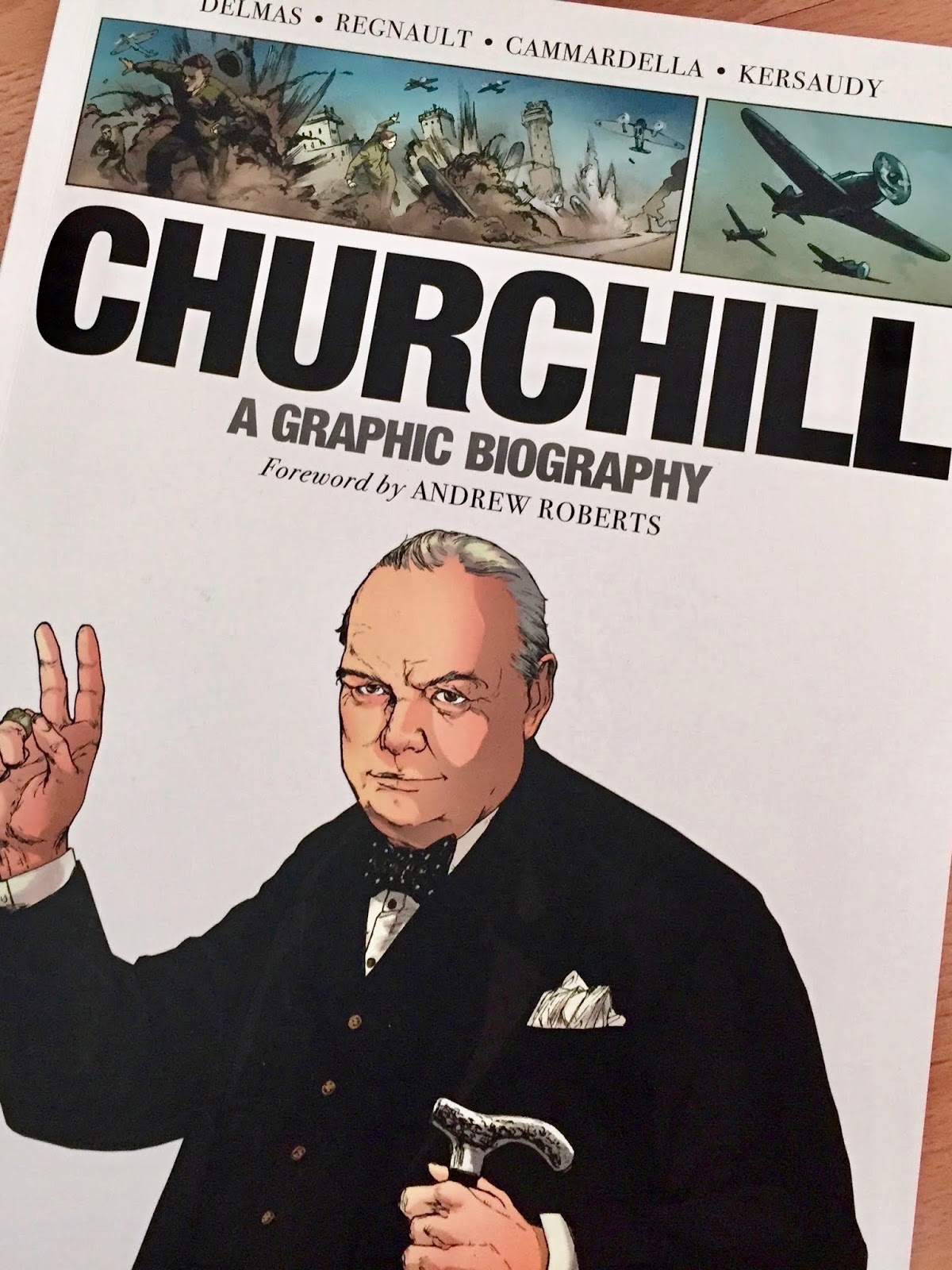
Churchill: A Graphic Biography

Yes, I am reviewing a comic book now! But, trust me - it is seriously good.

Now, Churchill is one fellow that is very hard to summarize. With such a rich and long life in various positions, almost an impossible task. But I´d say that Vincent Delmas has succeeded, both because of the comics and the superb introduction, which is more like an illustrated article.

Of course, lots of important stuff is not part of Churchill: A Graphic Biography, and as a Nordic reader I wanted more about Norway 1940. Still, most of the key moments in his life are here. Speaking about Norway - the heavy water sabotage operation is in the book.

My one real criticism is that the military hardware shown could have been more correct and detailed. But, generally speaking, this is one of the best, if not the best, fact-based comic books that I have read.

One subject that takes up a fairly large part in the final pages of the book is the failure to secure Poland´s independence. Rightly so!

Being a history nerd you have either seen or will probably see the brilliant historical drama web television series "The Crown" created and principally written by Peter Morgan for Netflix. Well, here comes a suggestion for you TV people out there. Check out Churchill: A Graphic Biography by Vincent Delmas etc. Because it is both brilliant and credible. I suspect that this has a lot to do with Francois Kersaudy, the project´s historical consultant. It should be possible to use Churchill: A Graphic Biography as the basis for a Netflix movie, or even a TV series.

Thursday, February 20, 2020

The Real James Bonds

That strange gun on the cover is a Welrod, a British bolt action suppressed pistol.

Having reviewed Nigel West´s Secret War: The Story Of SOE, I must of course also review his take of the organization that SOE quite often found itself in conflict with, MI6/SIS, i.e. the home of James Bond.

Being an entirely factual book, Nigel West´s MI6: British Secret Intelligence Service Operations 1909-1945, does not waste words on James Bond and only mentions Ian Fleming on one page. Fleming is mentioned not because of his later secret agent novels but due to the fact that he during WWII was an assistant to the Director of Naval Intelligence. However, it is hard not to think of Captain America´s enemy Red Skull when reading about agent SKULL, one of the most important double agents of the war in West´s opinion.

Secret intelligence operations can be hard to explain and summarize. Yet, West often manages to do so. One of the most catastrophic aspects of the the initial stage of the intelligence war 1939-45 is how almost unbelievably unprepared the British were for the eventuality of Germany actually overrunning other countries. In spite of six years of Hitler in command of Germany the SIS had set up no stay-behind networks. Initially there were not even aircraft to fly agents into occupied Europe. Such a unit, 419 Flight (Special Duties), was set up only in July 1940.

Well, what about my favorite aspects of any WWII book, the Nordic aspects? The Norwegian heavy water is of course covered but after the German invasions of 1940 the SIS was itself not that active in Norway and Denmark. In those countries intelligence gathering was mainly performed by the SOE. Stockholm was much more of a stage for the SIS, and West provides a wonderful picture of how absurd it was to be stationed there considering that "[...] personnel from the German, Japanese and British [embassies were] all visiting the seaside together on Sundays during the Swedish summer".

Nigel West is very clear about his view of SIS performance in Stockholm during WWII: "The Stockholm Station was arguably the most successful of the war". West also states that thanks to "unofficial assistance" from Swedish military intelligence, more than fifty Norwegians were detained in Sweden as known infiltration agents from the Sicherheitsdienst in Oslo.

Like West´s SOE book, MI6 is not new but a new edition of a 1983 book. Still, MI6 by Nigel West is a highly readable book and ought to be a useful source for many years yet to come.

Thursday, January 30, 2020

Keystone of 22 SAS

Without him there would today probably be no 22nd Special Air Service Regiment.

Quite a few readers of this blog may have read several books about the WWII Special Air Service and also the SAS during recent years. But what about the first postwar decades of the SAS? Here is a book that both covers WWII experiences and some of the more interesting post-1945 SAS episodes until the 1970s. And, of course, there are some Nordic connections.

As some readers may have noticed, I have a special interest in SAS history. This should become more apparent here, as I am planning to blog more about the SAS. Keystone of 22 SAS is, simply put, a fine account both of the life, mostly in the SAS, and times of Lieutenant Colonel John Woodhouse MBE MC. He first experienced combat in a conventional British Army unit in North Africa and there, strangely enough, is the first Nordic connection in the book. For more than twenty years I have been hiking on Arctic WWII battlefields and the type of tin cans that I have most often encountered in German positions are cans that once contained Norwegian fish. Therefore I can recall images from my memory when the book´s author, Alan Hoe (himself an SAS veteran), writes about Woodhouse often eating captured (from the Germans) Norwegian sardines in North Africa.

Keystone of 22 SAS quite often contains Woodhouse´s own words and here are some sentences from his diary in 1944 to give you an idea of his wartime reflections:

"The German soldiers had an unshakable belief in their superiority over all other nations and armies. They had been led to believe that war was glorious and Hitler [...] was invincible. The Wehrmacht was very well led, better equipped and by 1943 more battle experienced than we were. [...] I was often fearful but it always mattered greatly to me that I should be well regarded and respected by the soldiers I commanded. This helped in overcoming fear."

It was in the ruins of the Third Reich that Woodhouse entered a door that eventually led to the SAS. By exaggerating his contacts with Soviet soldiers while he was a PoW, he managed to get a place in a Russian language course. On the successful completion of the course he was posted to Germany where he joined the Control Commission to act as interpreter between Soviet and British military groups. A short time later he was switched to army intelligence. He then exeperienced some memorable encounters both with Soviets, including an early defector, and Germans like Hanna Reitsch, "[...] the only German I met who had the courage still to proclaim loyalty to the Nazis".

In 1950 he reacted positively to an invitation to join the Malayan Scouts and thus fight in the deep jungles of Malaya. He volunteered not least because he was keen to serve under the legendary Mike Calvert, famous for having commanded a Chindit Brigade in Burma. Woodhouse sensed that Calvert was a great source of "original ideas and concepts". Woodhouse became both nervous and "a bit resentful" when Calvert made him Unit Intelligence Officer. But then he meets a very unlikely character in the jungle, "Yorkie" Bjorkman:

"With a good intelligence network the battle is half won. Yes. You can learn a lot from Yorkie. He´s a man with personality, guts and imagination. He´s got thirty Malay police there and he controls the jungle for miles around - controls the jungle."

Bjorkman was awarded both a Distinguished Conduct Medal, the oldest British award for gallantry, and a Military Medal, for bravery. The encounter in the jungle with a man obviously of Nordic extraction is only one of many surprises in Keystone of 22 SAS. The SAS in Cold War Denmark is also part of the book, but one wishes there had been more details in that part.

Woodhouse´s fascinating career did not end at all with his formal retirement in 1964. The year after he was asked by SAS founder David Stirling to lead a team of three men to Yemen and in cooperation with Royalist forces attack an Egyptian airfield. These experiences alone could be made into a good movie.

John Woodhouse passed away in 2008. Now it is time for you to read about his rich life in Keystone of 22 SAS.

Friday, January 10, 2020

Stunning Scale Models & Dioramas

Here focus on super detailed 1:32 aircraft, e.g. the B-25J Mitchell on the cover.

Few people find the time to spend hundreds of hours on a single scale model. The results can be simply stunning. They certainly are in the books from the Swedish publisher Canfora, and that is why I recently payed them a visit.

Finding little time to myself build scale models, I have come to the conclusion that what I mainly long for is being able to see really good models up close. I mean, REALLY close and in superb photos. Therefore I visited Toni Canfora in Stockholm to discuss his own models and his books - that contain both his finished models and those of many other "model artists" as I would like to call them. On top of the superb photos in all his books Toni Canfora has added really interesting historical facts and model information as well as good captions (IMHO really good books must have really good captions). The main focus of Canfora is scale models and dioramas, but they have other kinds of books too. But first let me show you two more scale model book covers:


What most of all appeals to me with the Canfora scale model books is that some contain dioramas based on actual photographs, like the StuG book above. To me, that sort of diorama is the most amazing to see, the experience can be both like experiencing art and history.

In addition to the now quite many books on scale modeling, Canfora also offer books focused on large & previously mostly unpublished photographs of actual AFVs and aircraft. Mostly taken during WWII. Let me just say how very much I have been surprised by the three AFV Photo Album books about Panther tanks and other AFVs in Czechoslovakia. This is the latest volume, vol 3.


I had never thought that so many previously unpublished amazing Panther photos would appear. Like the scale model books, the AFV books have captions full of information, pointing out lots of details in the photos that one would otherwise miss. Now, do check out all the amazing books from Canfora.

Tuesday, January 07, 2020

The Year´s Best Military History

Seeing Field Marshal Montgomery´s "Giant Killer" was one highlight during 2019.

Several personal highlights in 2019 were connected to my first book release in London. But it was not in that city I found last year´s most impressive military history book.

Karl-Gunnar Norén and yours truly had a splendid time releasing The Long Range Desert Group: History & Legacy at the Swedish Embassy in London. Few experiences can beat meeting a cheerful LRDG & SAS veteran and the editor-in-chief of After the Battle. However, the day after was almost equally brilliant, as we then were given a surprise we had never even dreamt of: we were shown the ultimate collection of original Special Air Service (SAS) artifacts. We have still not fully recovered from this and I will return to our surprise visit in a special blog post. The above photograph is not from the SAS museum but from the desert section of the Imperial War Museum - that we visited later that day. The fly swatter actually bears the name "Giant Killer" and was used by Monty himself, in the desert - where also the Rommel portrait once was. More precisely, the portrait adorned Field Marshal Erwin Rommel´s own HQ until it was captured by the British Eighth Army.

Since those London days in May 2019 we have had the pleasure of reading about our LRDG book in After the Battle No. 186 and Classic Military Vehicle No. 219. By the way, my two English language articles about WWII in the Arctic are still in print, in After the Battle issues 99 and 136.

Summer in 2019 again meant history hiking with good friends in Narvik, and in October I had the privilege to break the news of the first film footage of a Junkers Ju 52 in pretty good shape at a depth of 75 metres, in a lake north of Narvik. Then three friends and yours truly located another Junkers aircraft, but this time a rather rare bomber, a Ju 86/B 3, and one not seen by anyone since it went down in 1943. This time the location was not in Norway but in Sweden and this is a discovery that is still not complete as we have yet to photograph and film the cockpit and tail section. So far we have basically recorded only the wings and brought up an aircraft tire and Junkers factory data plate, to clearly prove the aircraft identity. The bomber broke into sections upon crash landing on the lake ice, and the parts are very hard indeed to locate due to the nature of the lake. More info about the Ju 86/B 3 discovery will sooner or later appear on this blog.

Finally, in November, I came across the military history book that for me was the most original and important one last year, Red Assault: Soviet Airborne Forces 1939-1941 by Vladimir Kotelnikov. May the year 2020 provide less events that will go down in military history and more books as amazing as his.

Many thanks to all friends around the globe who made my three 2019 books possible.

Monday, December 30, 2019

My Father Joachim von Ribbentrop

The author´s Waffen-SS years are also in the book, but not in the title & subtitle.

This year (2019) was the final year in the life of Rudolf von Ribbentrop, son of the Third Reich´s foreign minister Joachim von Ribbentrop - the German half of the most common name for the Hitler-Stalin Pact (Molotov-Ribbentrop Pact) that in August 1939 stunned the world. Speaking about 2019, one of the final meetings of President Vladimir Putin this year was largely about this pact.

President Putin has lately talked a great deal about the Molotov-Ribbentrop Pact. There have been reactions to this, not least from the first victim of the pact, Poland. In other words, this first English language edition of Rudolf von Ribbentrop´s book about his father has been released with rather good timing. Most of its 476 pages are indeed about Joachim von Ribbentrop and several passages about him, as well as quotes from him and others, are of great interest. But aside from the direct quotes My Father Joachim von Ribbentrop is a mixed bag. The idea to let the book also be about the author´s own past is understandable. Rudolf von Ribbentrop not only witnessed the rise of the Third Reich from a rather unique position, he joined the SS Infantry Regiment "Deutschland" and took part in the invasion of France 1940. Afterwards he led a platoon of what later became "Nord", in Finland; was assigned to the Leibstandarte "Adolf Hitler"; participated as a tank commander in the Third Battle of Kharkov/Kharkiv and was shot by a sniper while rescuing wounded.

After recovering, the young von Ribbentrop became a Panzer company commander and led his company during the recapture of Kharkov/Kharkiv, after which he received the Knight’s Cross. He was transferred to the SS Division "Hitlerjugend" and was again wounded when a Spitfire attacked his car. Ribbentrop was awarded the German Cross in Gold during the defense of Normandy in 1944. He also took part in the Battle of the Bulge and met Hitler in his bunker in February 1945. All this he describes himself and his words are often fascinating to read. The problem is how these personal experiences are spread out over the book, and that there are passages that indicated to me that the author´s age introduced errors of memory into the text - he was 87 when he finished writing the original (German) manuscript.

Rudolf von Ribbentrop´s take on the origin and conduct of the Second World War is thought-provoking but at times simply not convincing. He did realize that he had served a murderous dictator but he nevertheless believed that Hitler had above all been tricked into attacking Poland - indirectly tricked by conspiring German generals. Where is Alfred Naujocks, Gleiwitz and other German-orchestrated incidents along the Polish-German border? Was I just too tired or did the author attempt to explain away the Lebensraum motive? The pages about his father´s enthusiasm for the pact with Stalin are more interesting, and also credible. My Father Joachim von Ribbentrop does contribute to the picture of Hitler´s foreign minister, but one should read it bearing in mind who wrote it, when he wrote it and only after having read other books about the Molotov–Ribbentrop Pact.

Saturday, November 23, 2019

The Soviet Army On Parade 1946-1991

Now, which Soviet AFV in Sweden have I placed my review copy on?

Last year I blogged about British author James Kinnear´s original work of reference The Red Army On Parade 1917-1945. Does his new book, about the Soviet Army 1946-1991, deserve as much attention?

Already in the introduction for The Soviet Army On Parade 1946-1991 James Kinnear makes clear that we have entered a new era - he relates the history of the Soviet R-1 rocket, that began with the construction of no less than 29 V-2 rockets from components captured in Germany. Thus the post-1945 Soviet military parades, and this new book by Kinnear, encompass not only the history of Soviet AFVs, support & transport vehicles, it also constitutes a photographic encyclopedia of Soviet rockets and missiles from WWII to 1991. Due to the fact of the pioneering mechanization of the Soviet airborne forces it is also a book of great interest to airborne history buffs.

The first chapter kicks off with a grand image of a T-44 with markings that ought to inspire several modellers. Some more highlights are the images of the 2A3 "Kondensator" self-propelled nuclear gun; the (A)SU-85 airborne self-propelled gun and the ZiS-110B parade limousine. Rather surprisingly, there is even a 1947 image of amphibious Soviet DUKWs on parade in front of the Winter Palace in Leningrad. However, some Soviet military vehicles were just never paraded, such as the enigmatic tank destroyer SU-122-54. Only 77 of these beasts were built. They served in secrecy but some decommissioned examples were converted to armoured recovery vehicles and used on standby at Red Square parades in the 1980s. It was only this appearance that confirmed the existence of the tank destroyer. Mr. Kinnear provides images of both vehicles.

One of the best parts of the book is the final photo guide and glossary, the "heart" of the reference aspect of the book. But before that there is an amazing chapter on the many AFVs on "parade" during the attempted coup d´etat of August 1991.

Not only has the author located an impressive amount of great photographs, the captions show that the author really knows his stuff - he points out fine details, making the images even more interesting.

In general, this book, like Kinnear´s previous one, describes in amazing detail the vehicles and heavy weapons of an era. At the same time Kinnear provides a history of the main world events of the decades in question. This is largely a very good idea, that put the weapons and vehicles in context. I wrote "largely" because the pages about the author´s views regarding history after 1991 can be questioned both due to the years in the book´s title and the book type. Nevertheless, The Soviet Army On Parade 1946-1991 is a treasure trove for students of military history and especially for military vehicle buffs.

Thus The Soviet Army On Parade 1946-1991 is as valuable as The Red Army On Parade 1917-1945, and together the two volumes tell both the story of the world´s heaviest military parades and much about several of the most influential weapons and vehicles of the 20th century.

Thursday, November 14, 2019

Red Assault: Soviet Airborne Forces 1939-1941

A truly stunning book, 343 pages of Soviet airborne information and photographs.

For years I have been collecting books about airborne forces and therefore I can guarantee that this book is amazing. Very few readers outside what was once the Soviet Union will have previously seen more than two or three of the book´s photographs. And Red Assault has plenty of photos - that match the surprisingly rich text. And there is a Swedish connection.

Red Assault: Soviet Airborne Forces 1939-1941 by Vladimir Kotelnikov shows, with an amazingly detailed text and lots of different illustrations, that the Soviet airborne were pioneers in more ways than imagined. Because not only does it tell the story of the known airborne equipment and experiments, but also several ideas and tests that have never been documented in any previous book. The early Soviet airborne infatuation with armoured vehicles was not limited to the T-37A amphibious tank. Several other AFVs were tested by the airborne troops. Sketches and fine drawings reveal even more advanced ideas like a "helicopter tank" and then there was the quite adorable "avia-motorcycle" in two variants.

Airborne recoilless guns, an experimental camouflaged jump suit, various parachutes, special gliders, airborne dogs, airdrop sledges - this book has them all and often the quality of both the information and photographs is astounding.

Aircraft buffs will also be baffled, because early Soviet paratroopers were not only dropped from huge TB-3s, Red Assault contains many more types, some very futuristic designs. And now a Swedish connection: "There was a shortage of alloy steel in the country at the time and it had to be imported first and foremost from Sweden."

Not that surprisingly, Mikhail Tukhachevskiy is one of the officers portrayed in this book. But Vladimir Kotelnikov, for credible reasons, writes more about the "fanatic" and "genius" Pavel Grokhovskiy. This airborne pioneer deserves to become better known.

Is there nothing lacking in this book? The parts about the operations in Poland and Finland are short. What about the scope, the book ends in 1941. Well, if it were to cover also 1941-45 with the same degree of detail as 1930-1939 it would be thick as a brick. Better focus on that period in another book. But by the very nature of the events between 1941 and 1945 such a book can not contain as much about airborne development and equipment as Red Assault does. This is because the Soviet airborne forces in 1941-45 found themselves fighting most desperately, largely without aircraft and with no time or resources for airborne development. The Soviet visions of massive airborne operations were not possible to realize until the 1960s.

Sometimes book covers claim that a book is original and contains new insights, photos etc, but the book then actually offers very little that collectors have not seen before. Well, this is just not the case with Red Assault. It delivers. Both airborne and aircraft buffs will be pleasantly surprised by Vladimir Kotelnikov´s book, translated by Kevin Bridge and published by the UK publisher Helion & Company.

Thursday, September 19, 2019

Hitler´s Largest Arctic Project Then & Now

Org. Todt chief Albert Speer (right) with General Eduard Dietl in the Arctic 1943. Attribution: Bundesarchiv, Bild 183-J16636 / CC-BY-SA 3.0

Thanks to a Norwegian friend I was recently invited to a WWII research meeting right beside Hitler´s largest Arctic project, his railway line that was meant to end in Kirkenes by the Finnish (now Russian) border. This blog post is mainly to provide a visual idea of the amazing days we spent up there.

The Organisation Todt (OT) was a German paramilitary engineering organization named after Fritz Todt, an engineer and senior Nazi leader. The OT was one of the Wehrmachtgefolge, German Armed Forces auxiliaries. The organization was responsible for implementing the vision of connecting by rail south Norway with Kirkenes, the northeasternmost town not far from Soviet Murmansk. This meant working in one of the most challenging landscapes on earth due to a staggering amount of mountains and fjords. The Arctic climate and often total lack of roads for supporting motor vehicles did not make things easier. As usual, the OT would rely on forced labour, mostly Soviet and Yugoslav prisoners of war. The section responsible for this most extreme railway project was called OT-Einsatzgruppe "Wiking". The project was pursued right to the very end of the Third Reich, at the cost of thousands of lives.

Our trip last week began with a visit at Klungset, beside the town of Fauske, about 70 kilometres inside the Arctic Circle. Klungset is probably the most intact OT base that there is in 2019, and one of few WWII German military hospitals still around. Last time I visited it, 18 years ago, it was in a deplorable state. Now several parts of it have been restored. In 2015 it became protected by the Directorate for Cultural Heritage in Norway.

The German hospital in Klungset shortly after the German capitulation.

The same place the other day, now in private Norwegian hands.

In connection with the huge Arctic railway project to Kirkenes, this hospital complex was built in 1942-43, mainly for the benefit of German OT staff. Construction was carried out by forced labour, local companies, a southern Norwegian construction company and others. When the base was completed in 1943, it consisted of 12 buildings with a total capacity of 200 beds. Today, four of these buildings are preserved. Although the bulk of the labour force consisted of prisoners of war, this group received limited treatment at the base. This changed radically after the German capitulation, when, in June 1945, the US Army flew Swedish Red Cross personnel, diet foods and medical equipment to treat the most ill Soviet former prisoners of war. Thus American C-47 aircraft flew a Swedish hospital staff from Luleå to Bodö, not far from Klungset. The above 1945 photo from Klungset shows the main building with Swedish medical staff and also some Germans under Norwegian command.

This Phänomen was an ambulance at the base and after 1945 used by a farmer.

Hopefully Klungset will sometime in the future also become a true museum. We saw why that would be a good idea - not only has the main building been restored, another building has been left virtually untouched since 1945 and contains many both unusual and moving artifacts and photographs. Just walking around on the base, especially in the cellars, is a remarkable experience in itself. The two gentlemen who own the premises also have some relevant WWII military vehicles, some virtually untouched since the war, some restored.

US Army Dodge ambulance with a German BMW R75 motorcycle in Klungset.

Thank you so much, Trond Ole Slettvoll, for showing us around on Klungset. Our next big thank you goes to Trond Inge Mathisen of Hamaröy, whose WWII researcher event took place by a mountain lake 90 kilometres north of Klungset, beside the last large German tunnel that was made before the German capitulation. It was never completed and is dangerous to enter, but can be entered with a guide and special equipment - see the last photograph below.

All around our research meeting there were traces of German slave labour camps.

The foundations for a German Arctic railway bridge between two mountains.

The quality of the work is just amazing but also largely covered by vegetation.

German bridge foundations are everywhere but the bridges long gone (sold).

Some of the construction equipment used by the slave workers is still in situ.

The WWII weekend brought together more than 50 Norwegians and 3 Swedes.

Part of the weekend was the unveiling of a new memorial by the last large tunnel.

One of the WWII Soviet (Norwegian) reenactors unveiled the memorial.

The text to the memory of the prisoners of war is in Russian and Norwegian.

Entering the last tunnel should only be done with safety equipment and a guide.

What is inside the last large German Arctic railway tunnel? First, please understand that abandoned WWII tunnels should not be entered, or at least not without safety equipment and a guide, as they are more or less unsafe for various reasons. Well, what about my experiences from the above tunnel? I am saving them and the relevant photos for a manuscript I hope to finish next year which will contain largely unknown and unpublished material. You can support this by reading my books, two are available in English (check Amazon etc). The next one (in October) in Swedish you can see below. It contains chapters i.a. about some very large gifts from Soviet former prisoners of war in Sweden and a previously unknown Allied base on Swedish soil - the Norwegian SOE operators on the cover came from one of these bases. If you are wondering about the submarine on the cover it is U 3503, one of the extremely advanced German submarines of the type XXI class, en route to Norway but scuttled on 8 May 1945 west of Göteborg, Sweden.